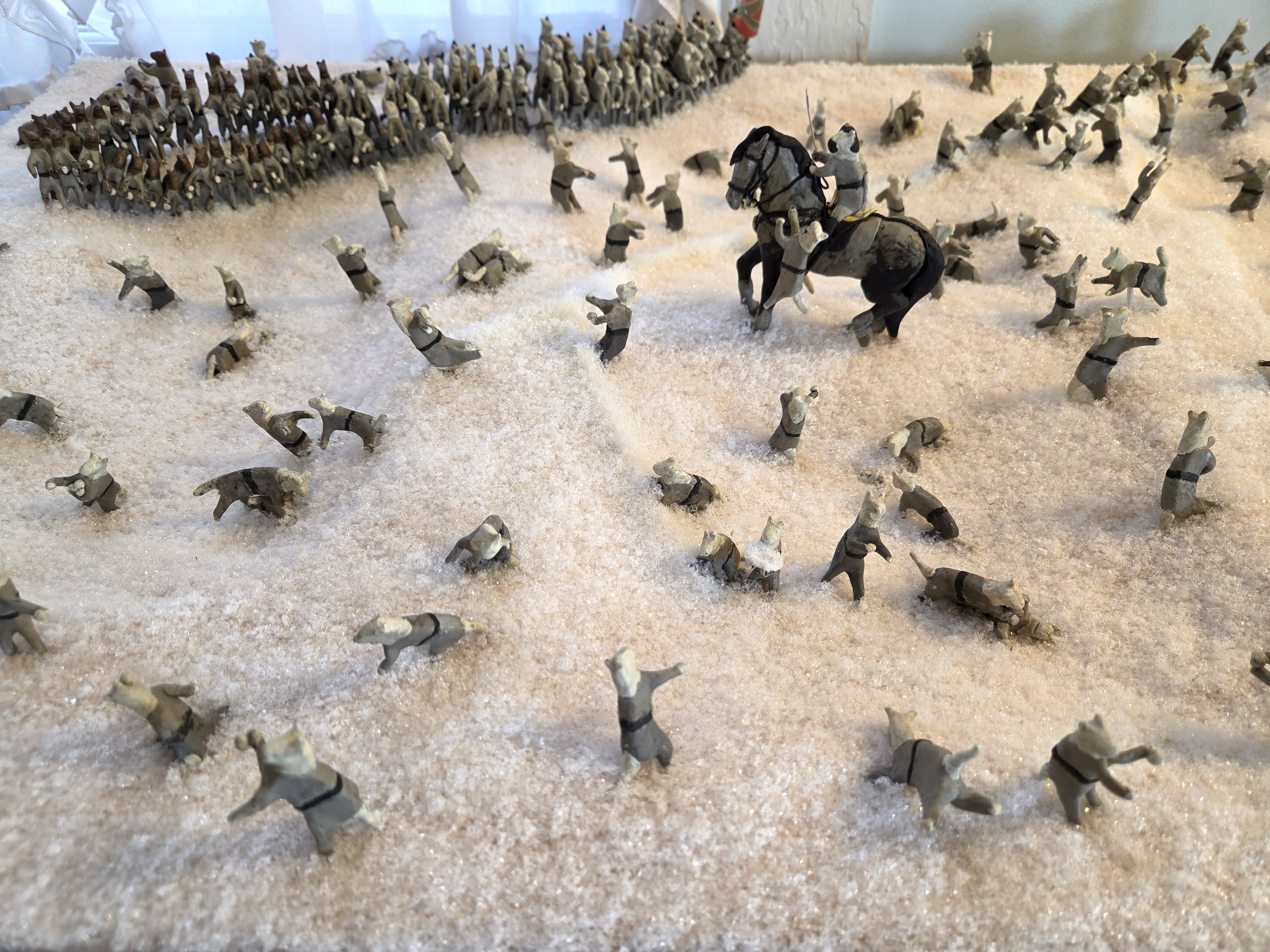
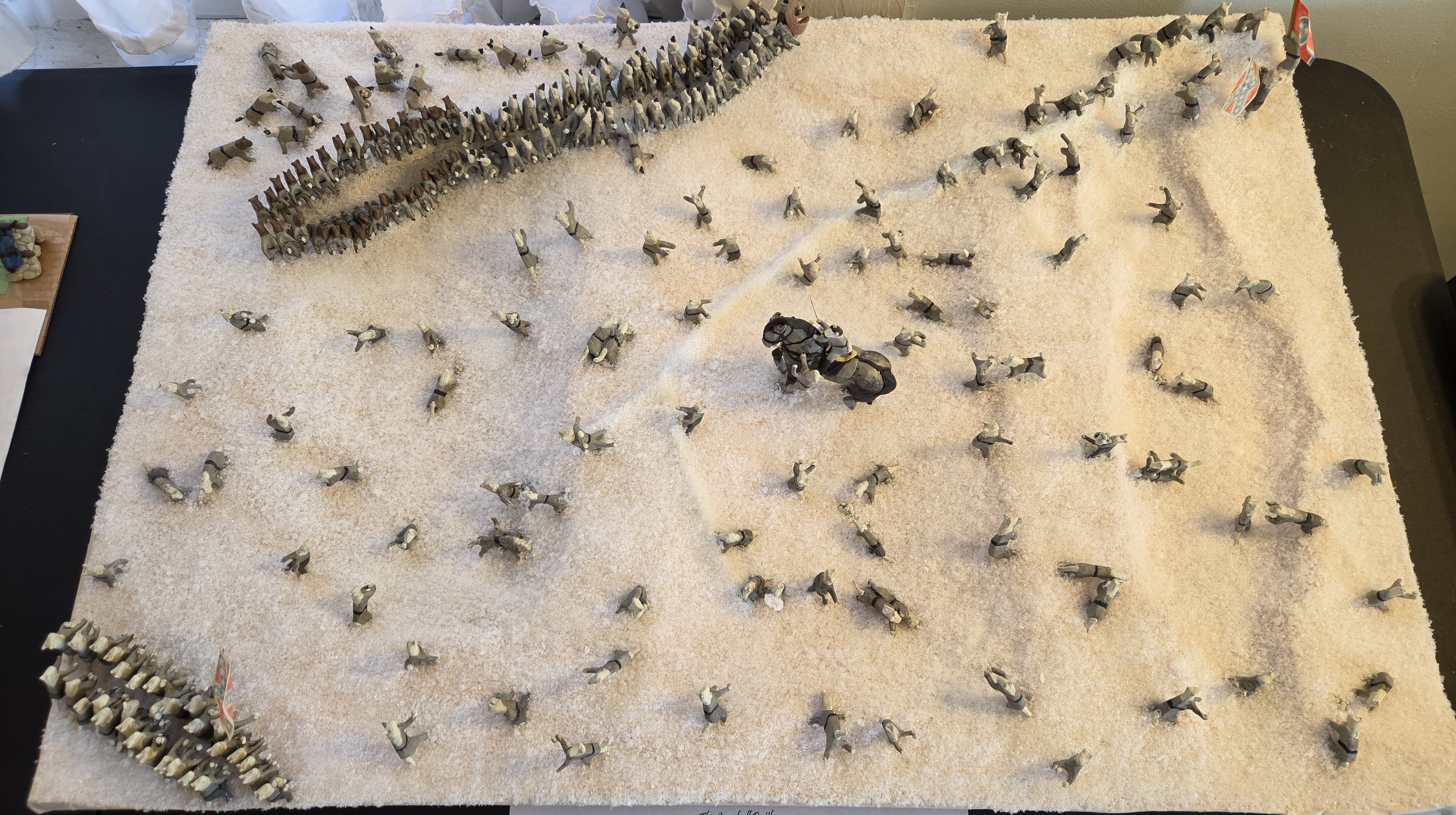
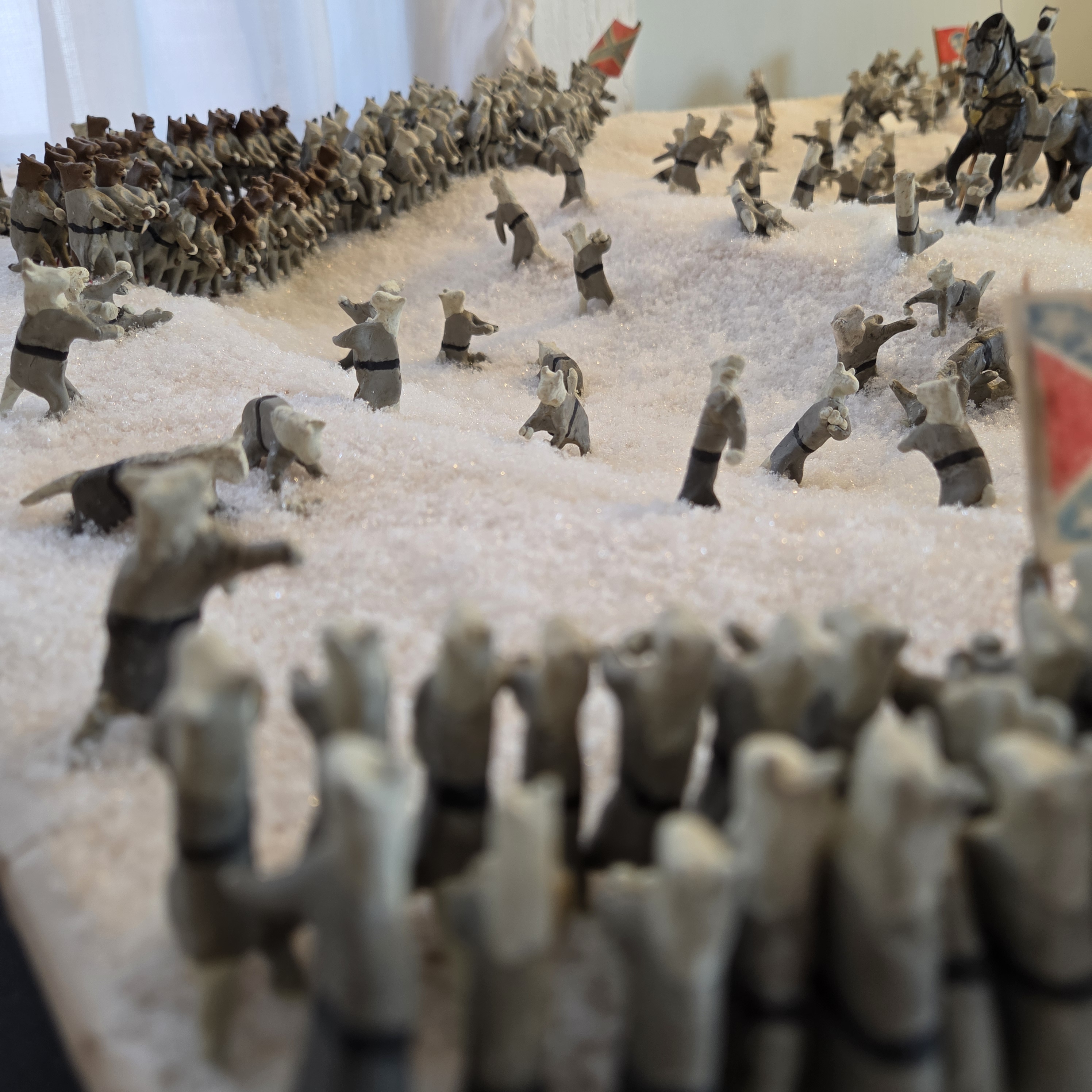
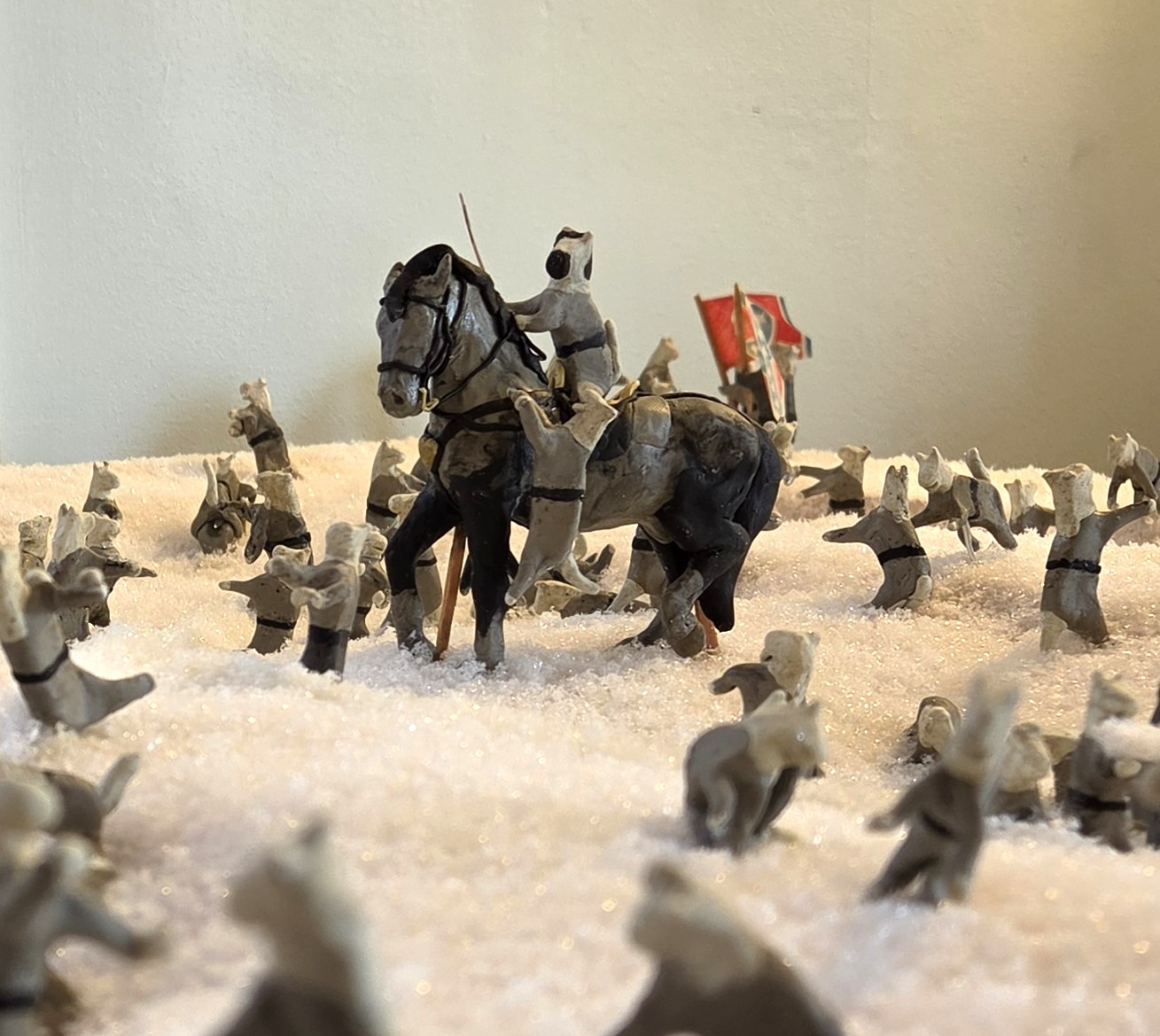
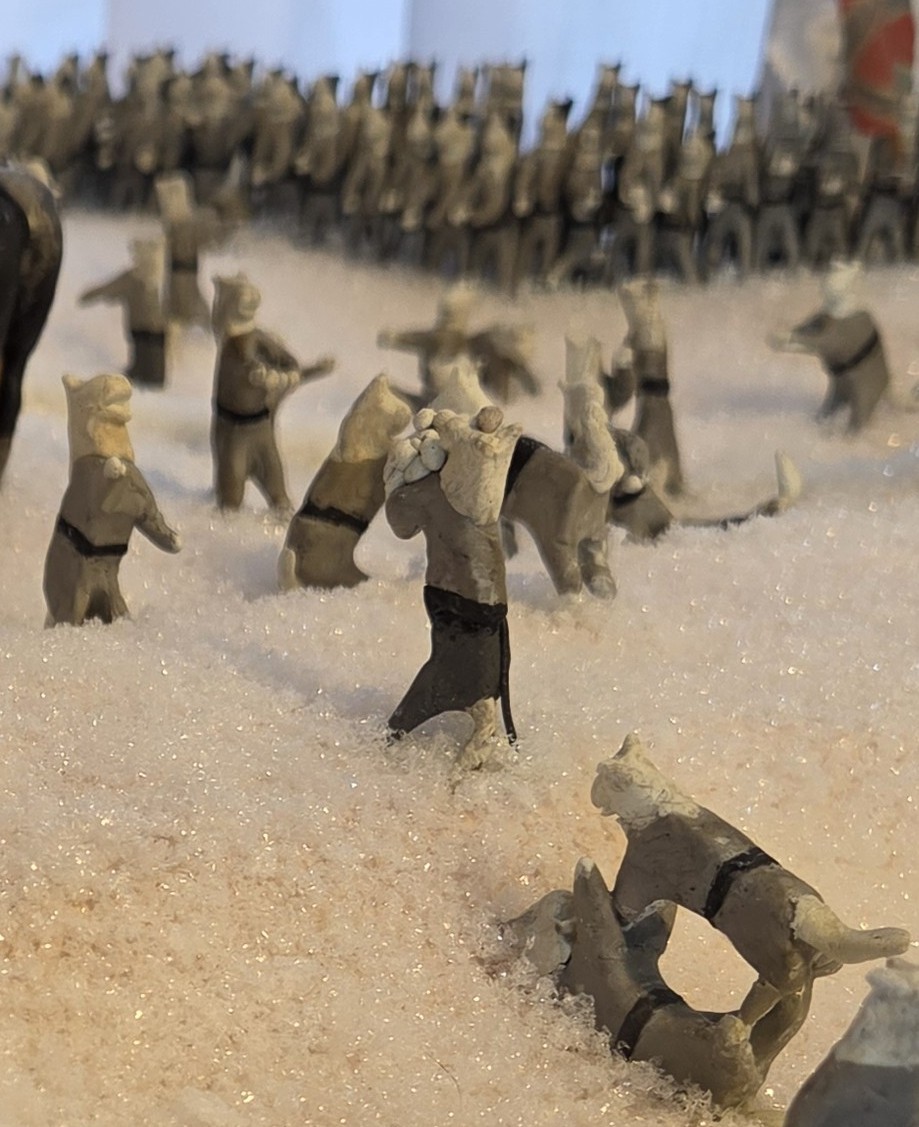
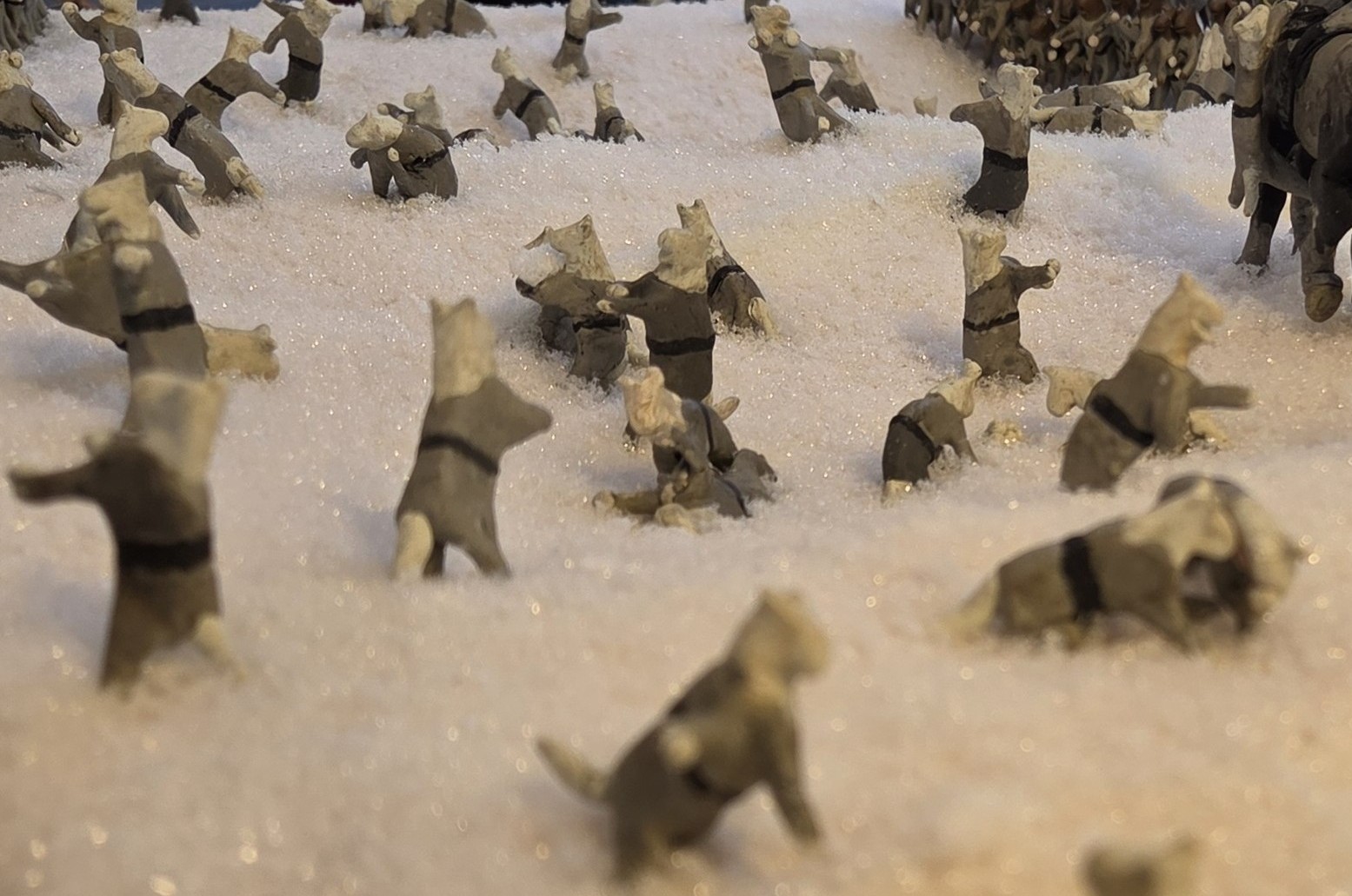
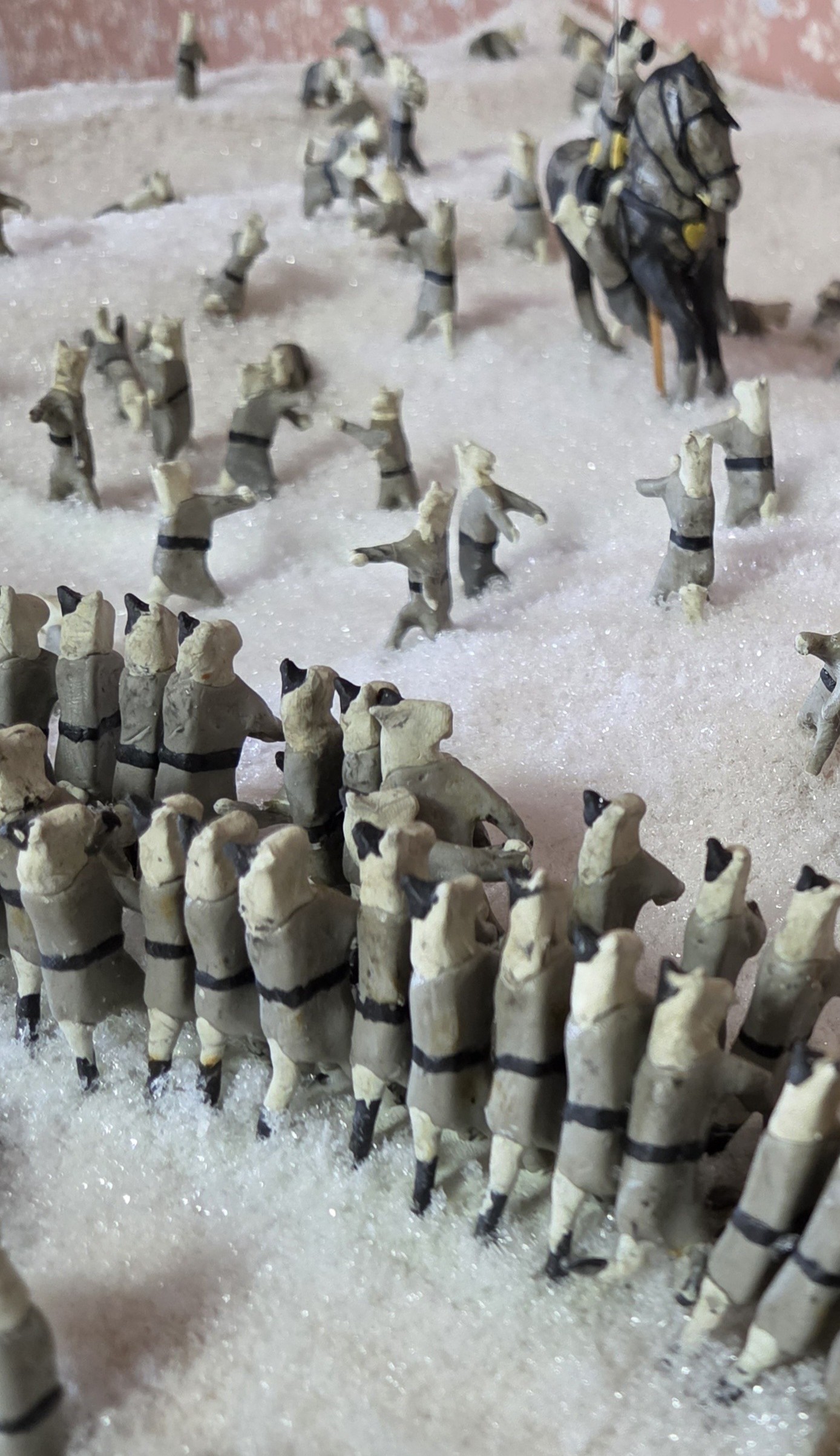
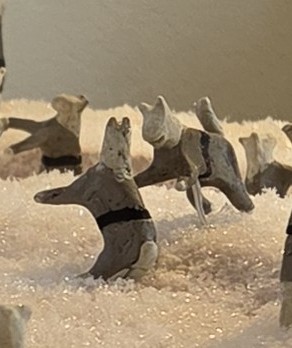
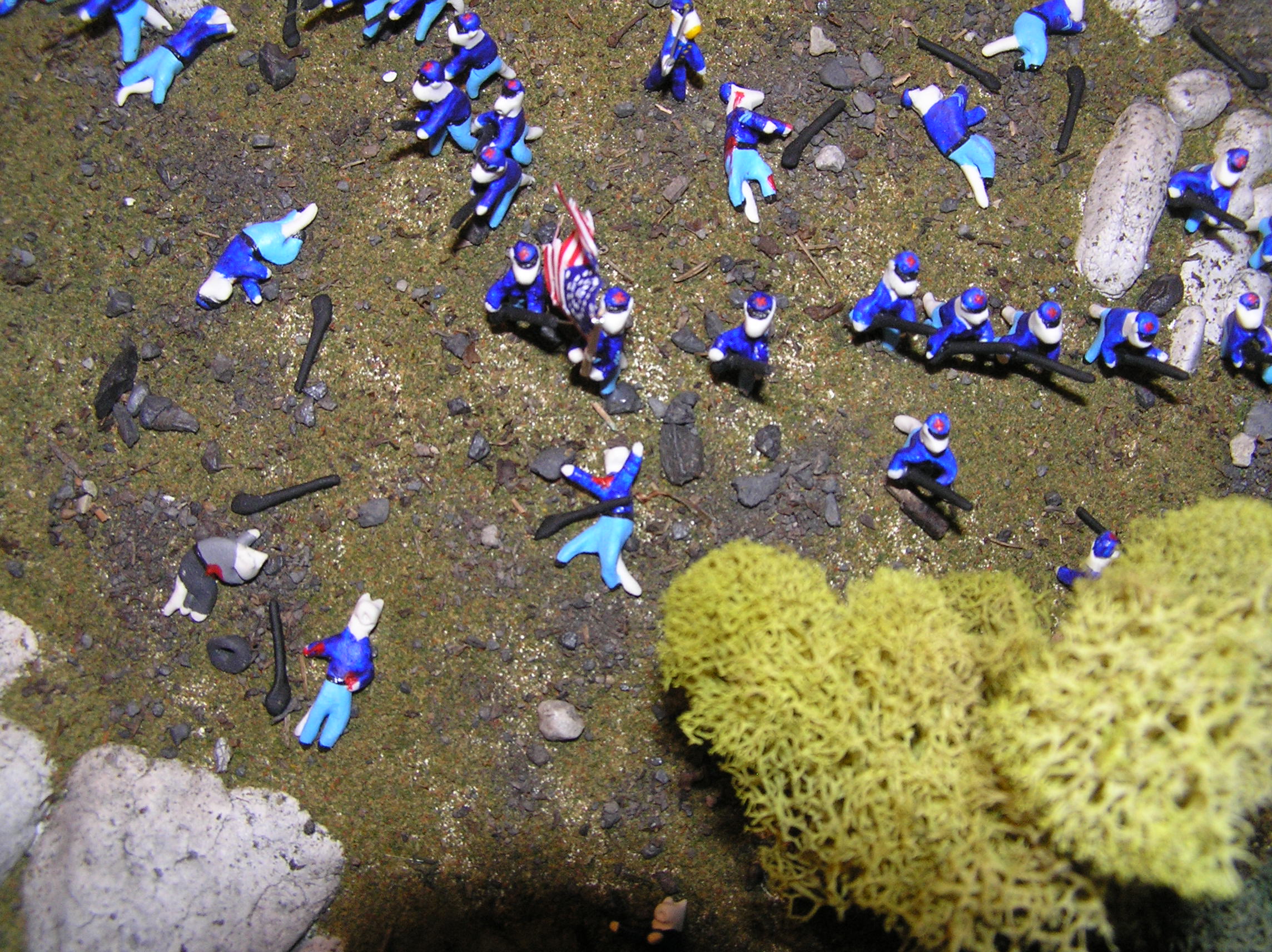
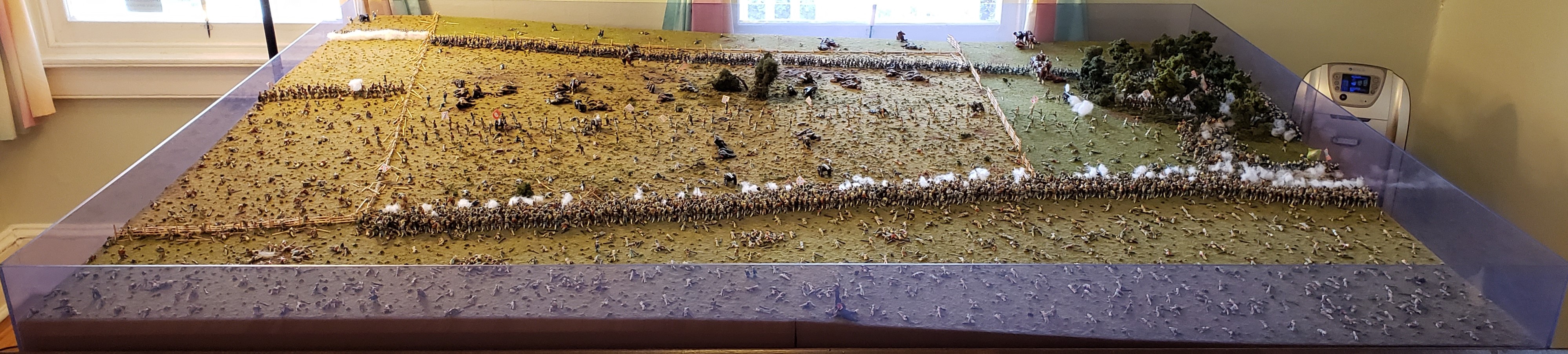
A “new old” diorama is at Civil War Tails! The Snowball Battle came on display on March 16, but its story reaches back to the very early days of our clay Civil War cats.
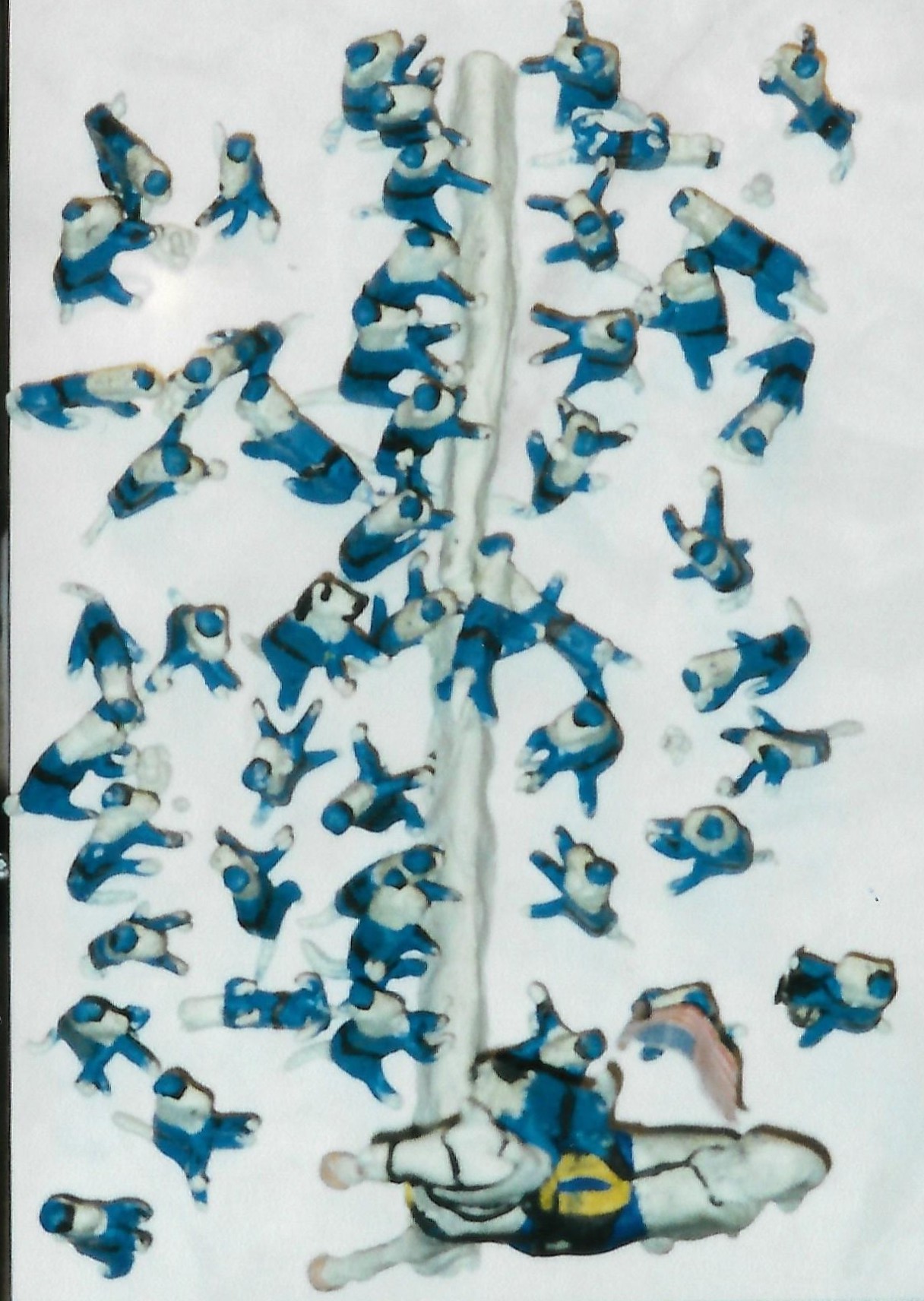
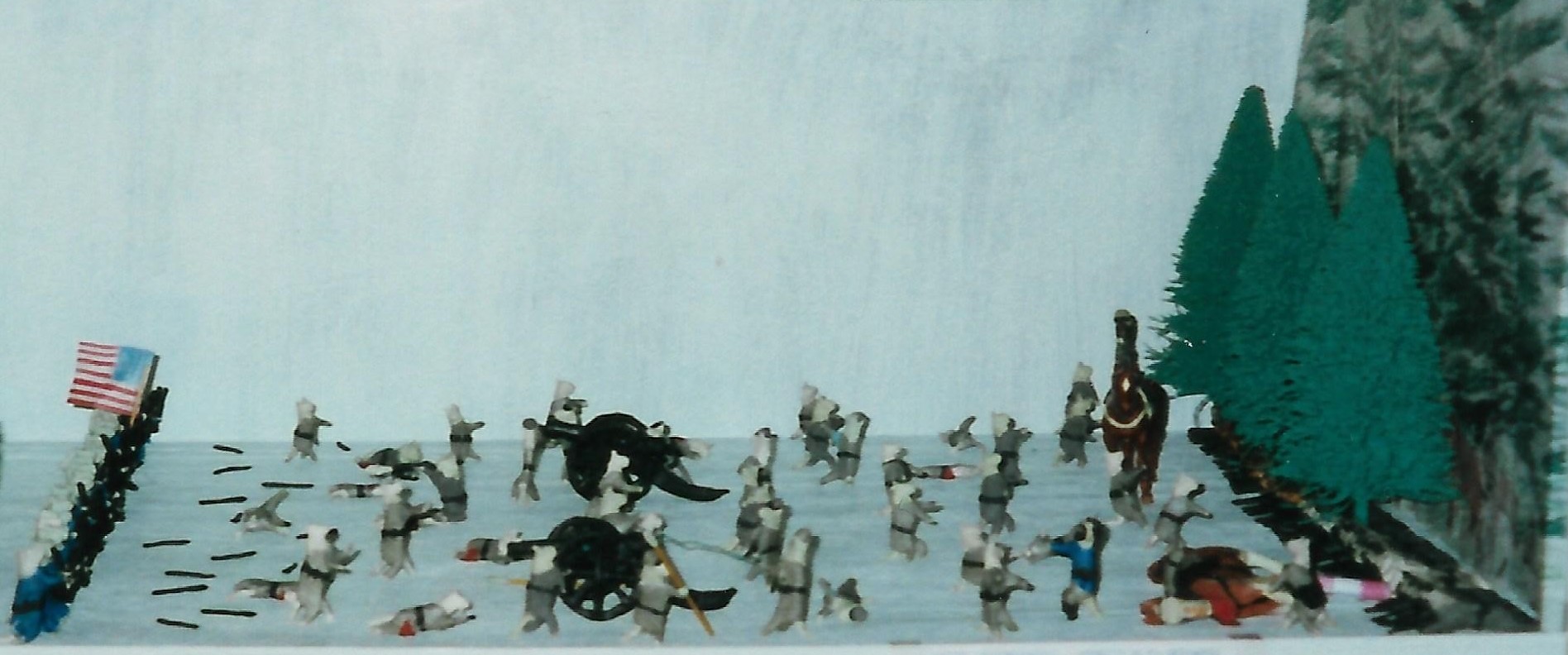
Our very first snowball battle diorama was actually of Union cats fighting. It first appears in a photo from early 1999, making it one of our very early dioramas (we began dioramas in 1998). We ended up selling it at a garage sale, but the idea of such a diorama did not fade away. There are just too many stories of the fun that soldiers had in the snow! (For a few, check out our other mewsings here and here.)
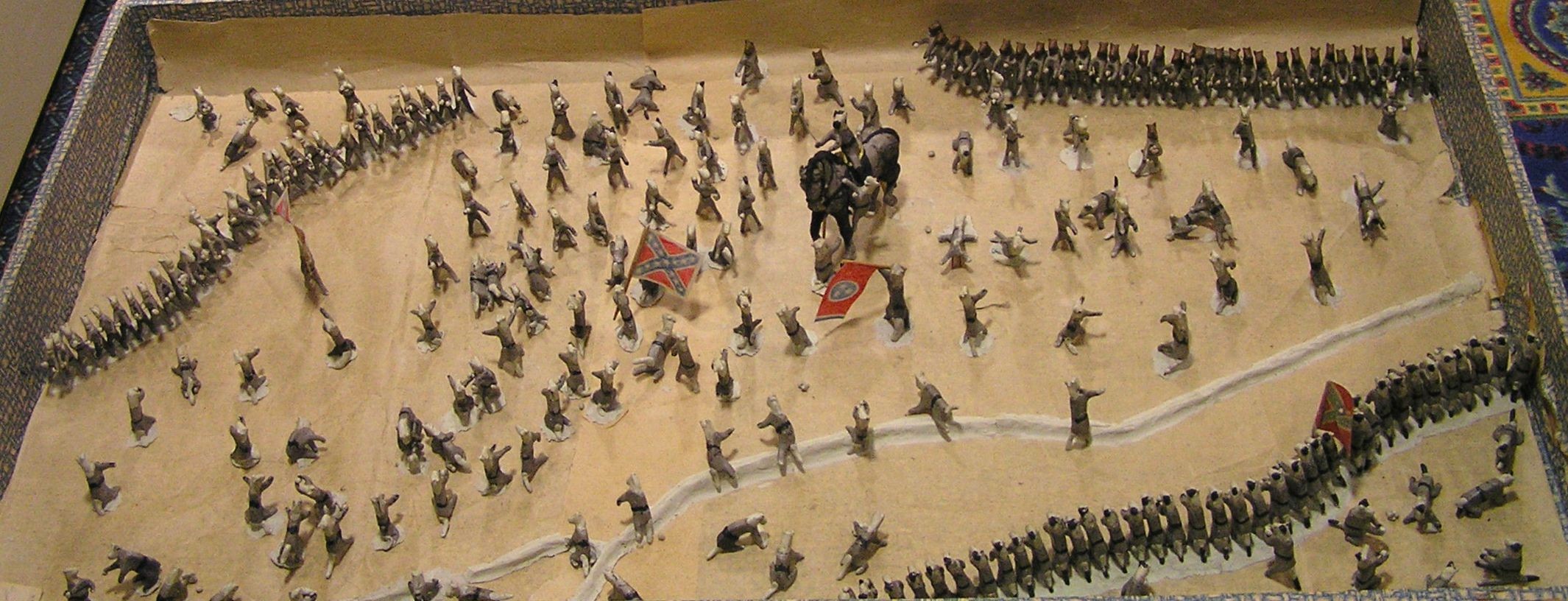
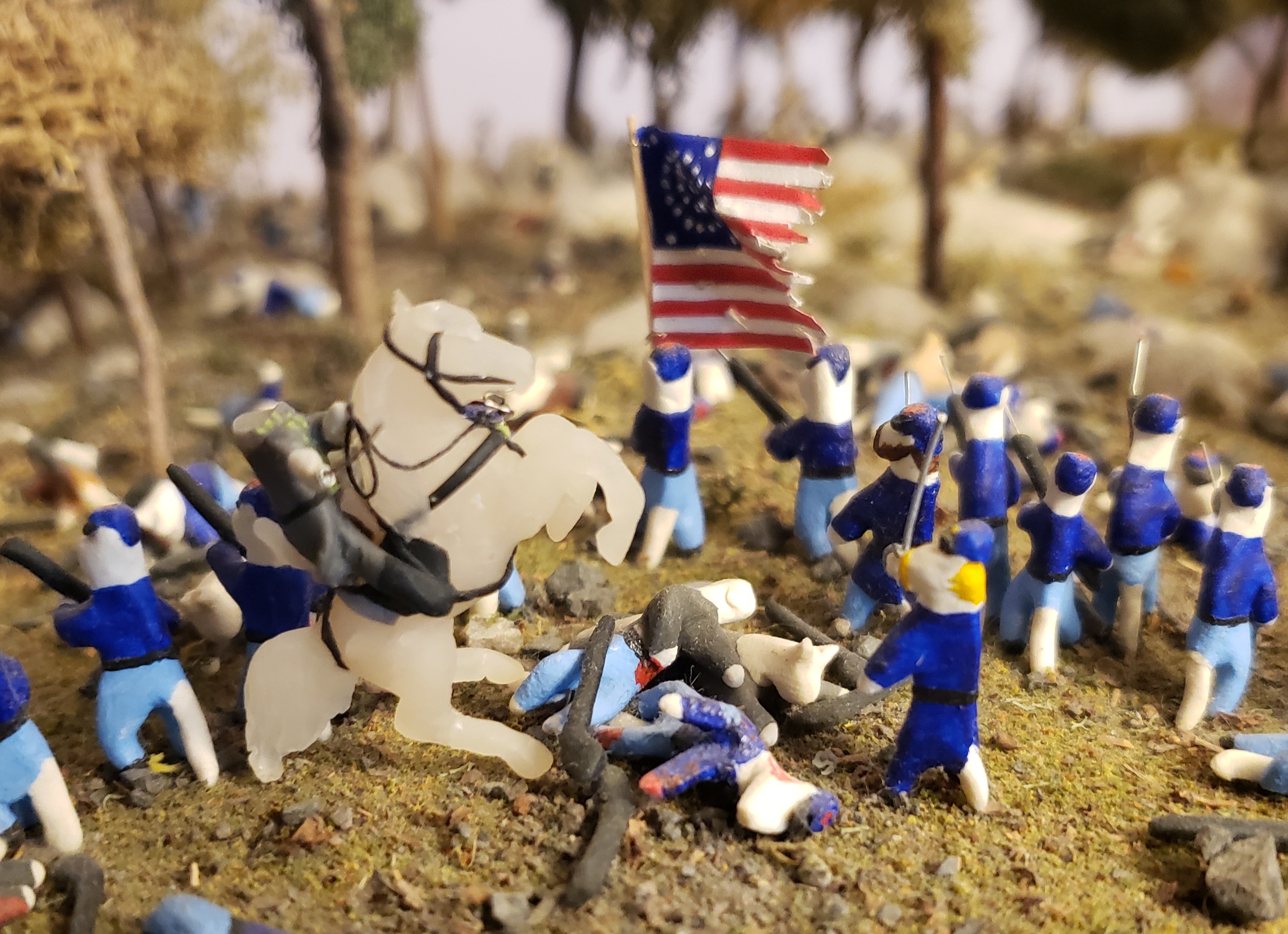
The story of Gen. Patrick Cleburne joining in a snowball fight is one that just begs for a diorama. How can you pass up a story where soldiers have to discuss whether or not to throw their general into a creek? On July 29, 2000, we began making our current version with 2-inch tall Confederate cats under Gen. Cleburne. By July 2003, the diorama was set up in a large wooden tray. The snow was white paper, and each cat had a white clay base.
Since opening Civil War Tails in 2015, the idea of bringing out the Snowball Battle has been on the wishlist, but we knew it would need a major overhaul. Finally, in January of 2026, when Gettysburg sat under eight inches of snow and we were all sick and tired of cold and shoveling, the inspiration struck. Now was the time to revamp the Snowball Battle!
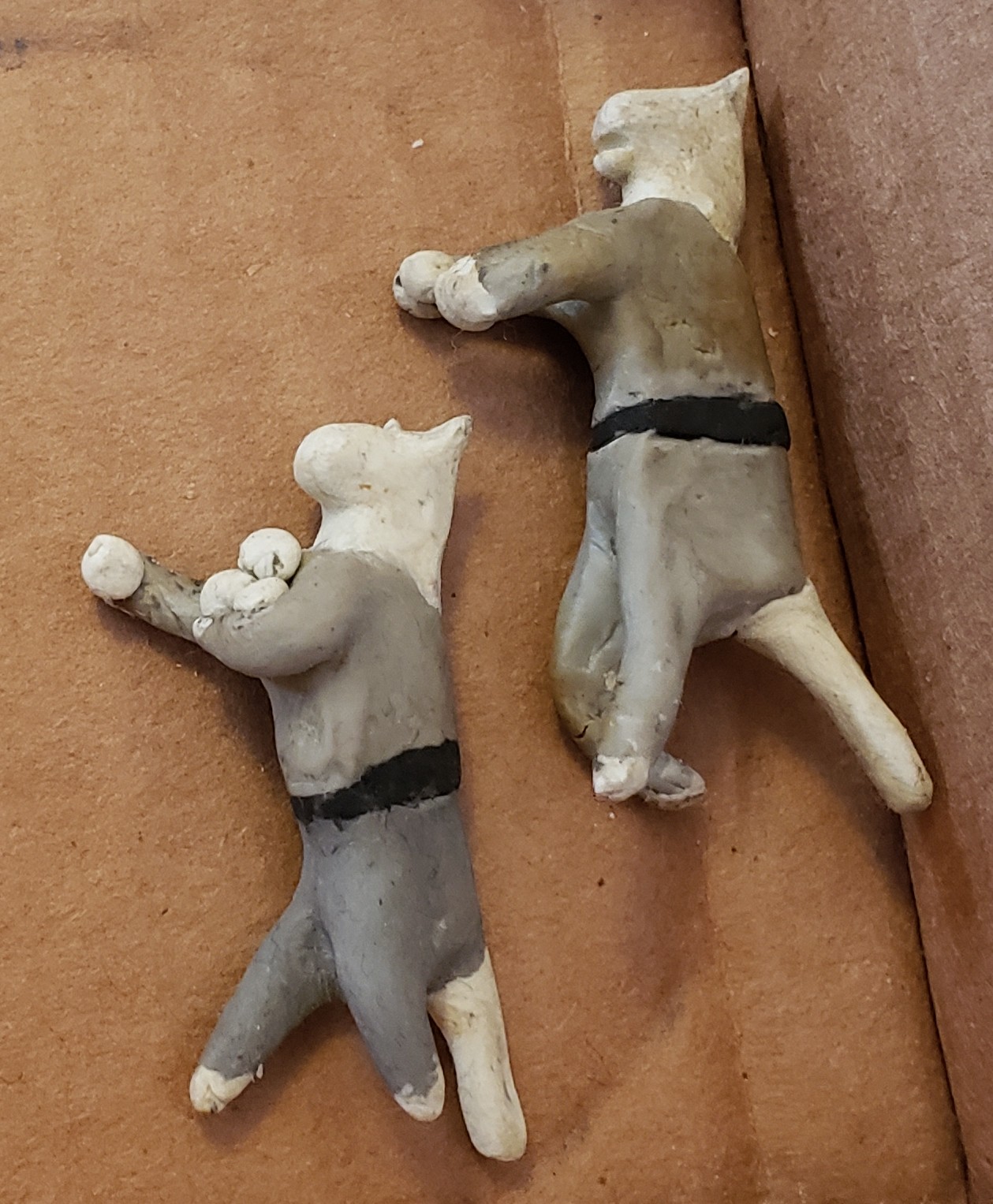
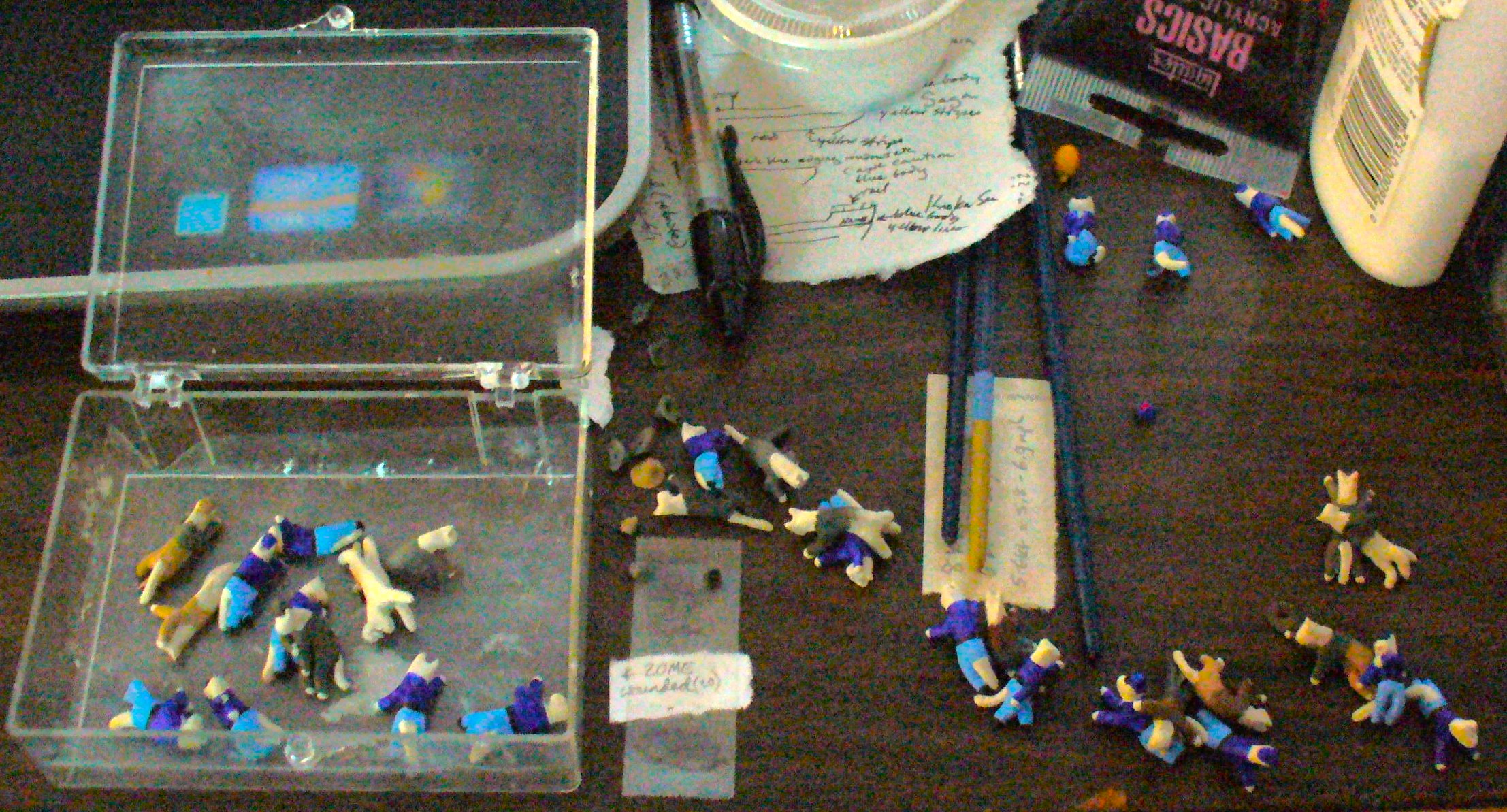
As with “Come On, You Wolverines”, revamping old clay cats involved cleaning decades of grime off of their faces and uniforms. With them being old, stiff, non-hardening modeling clay, lots of arms, legs, tails, and even heads fell off, so we did quite a bit of gluing.
The main change, however, was creating a new base and installing new “snow.” We took the opportunity to add a little topography, too. Rebecca began gluing the cats onto the base, keeping the basic layout of the original diorama. And then, Ruth realized the charging cats were in a single rank! Civil War soldiers fought snowball battles with the same formations and tactics as a real battle, so they would be in the double ranks that Napoleonic tactics dictated. So, we had to take up the glued ranks and combine them. That would have been a big mistake to overlook! It just goes to show that even if an old diorama is loosely based off of a story—as opposed to detailed accounts and maps—we still need to pay attention to the details and check if they need to be updated for general accuracy.
On March 16, the Snowball Battle was finished and brought out on display! (Rebecca made a last push specifically in order to bring it out exactly six weeks after the groundhogs and Charlie the Groundcat [#CharlieTheGroundcat on Instagram] predicted six more weeks of winter.)
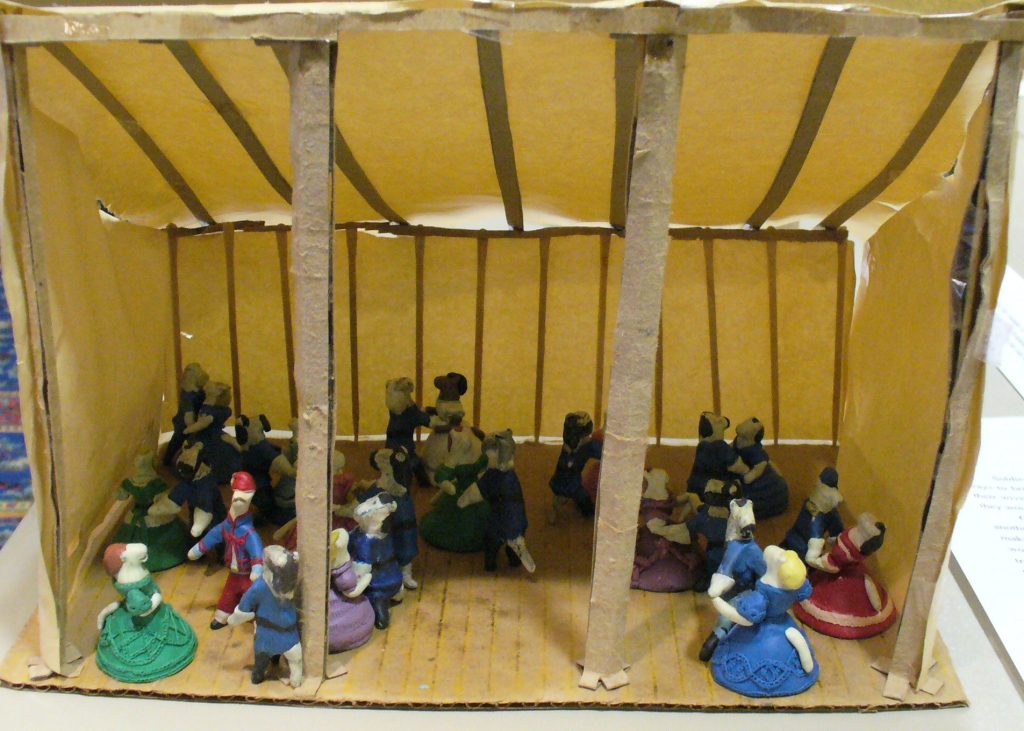
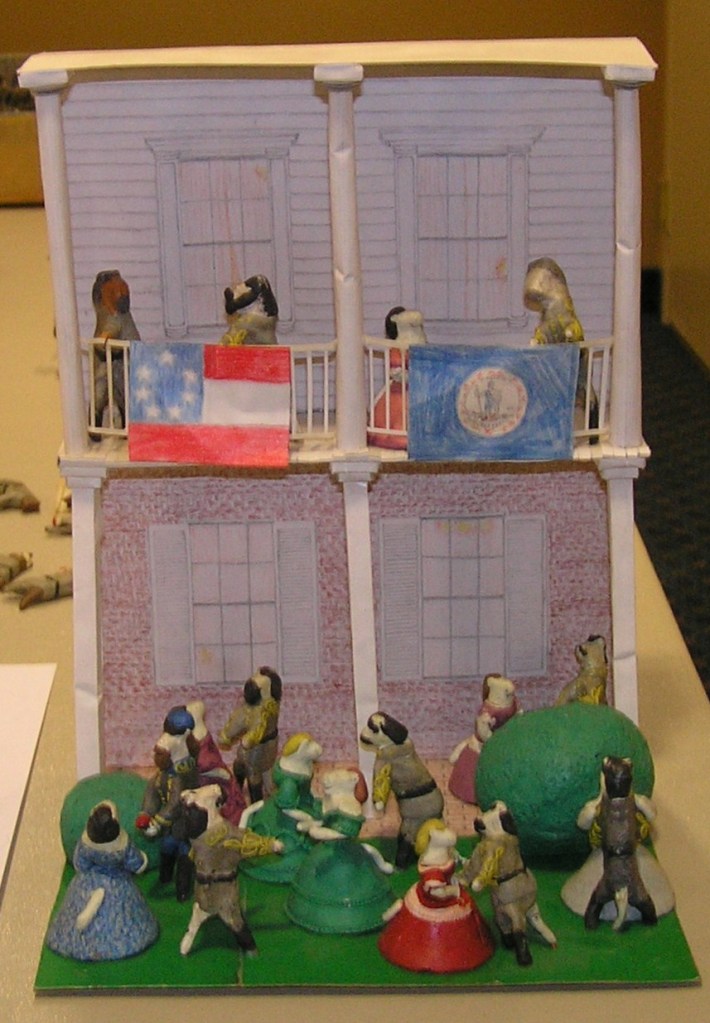
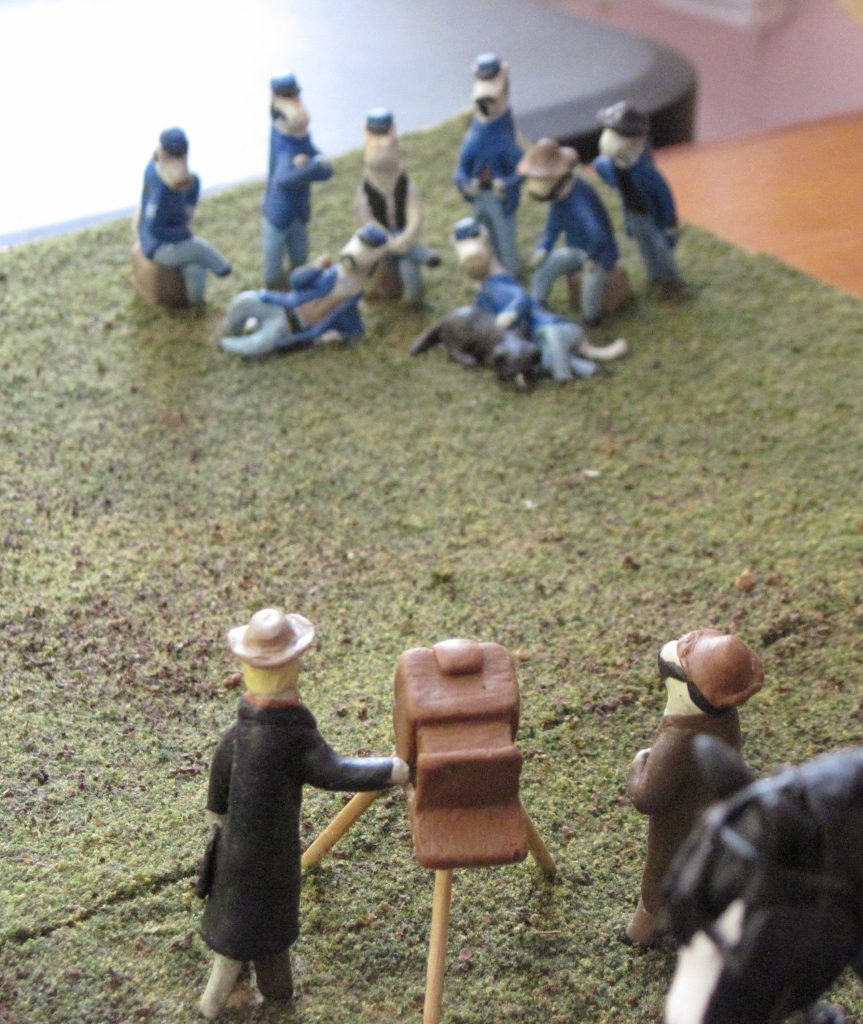
We are excited to have one more diorama showing the lighter side of the Civil War. Because the human interest stories of the war are what has always caught our interest, we enjoy sharing the fact that even though “war is hell,” the individuals involved were men and women just like we are, and they enjoyed fun, humor, and laughter just as we do. So, stop by and check out our Snowball Battle (if you’re tired of snow, feel free to come in July or August when you’ll be glad to think of snow days!), and while you are here, make sure to find our other non-fighting scenes: the Union Ball, Confederate Ball, and photographer.
As we celebrate 10 years of Civil War Tails, we thought it would be fun to recap our Christmas posts. Have you read all of them? Have you missed some? Do you have a favorite?
Sometimes, we have serious or history-related Christmas mewsings. Our first one, “Christmas Angels” in 2016, focused on Sgt. Richard Kirkland. We also looked at some “Christmas Traditions” in 2018 (Kitty the Museum Cat makes a cameo – and learns that popcorn for stringing doesn’t come with butter!!).
The most fun to write are our whimsical ones.
In 2021, Kelly the Museum Dog learns what Christmas is all about, and why it means so much for her hoomans — and all hoomans!
In 2023, Joanie writes to Santa, but feels she has already received her gifts that year as she got a new home!
In 2022, the Civil War cats had to scurryfunge when the hoomans were sighted returning home a day early! Will the cats clean up the partying and return the museum to normal in time? Or will the hoomans learn that the “Night at the Museum” movies had it right??
And then we have the “Saving Christmas” Series! It all began in 2017, when the Civil War Cats saved the Nutcrackers from the Mouse King and his minions.
In 2020, the cats were back at it, saving Santa from COVID. (Ever since then, if you follow the Adventures of the Headless Horsecat, I’m sure you’ve noticed that Covid has become rather tame and a friend to the Headless Horsecat.)
Last year, Santa found himself in trouble again, and the cats had to rely on Joanie and her nose for cookies to save the day! We would like to report that Santa has not forgotten Joanie’s help, and as a reward for her services, a few days ago he made her an Honorary Reindeer!!
Today we take a moment for our annual reflection on some of what we are grateful for, here at Civil War Tails.
2025 marks ten years of Civil War Tails Diorama Museum. It may not seem long, but most small businesses do not survive the first two years. For those who do, it often takes about five years to turn a profit. This Thanksgiving, we are grateful for all of you who have helped our museum not only survive but thrive!
As we look back over our journey, we are grateful to God for how He worked all the pieces to fall into place:
guiding us to see the listing for this building, in the location we thought would be ideal (Baltimore Street)
giving us parents who supported our crazy idea and who have helped us every step of the way to make the museum possible
bringing the Washington Post and NPR to our museum in Spring 2016, after we opened on Labor Day weekend 2015 (talk about getting the word out quickly!)
continuing to bring interviewers for articles, podcasts, and websites, and
continuing to bring us you! Word-of-mouth is a wonderful resource, and we are deeply grateful to each of you who has told (or cajoled) a family member or friend to visit us. The best parts of our work here are to see the joy it brings you, the way that our dioramas help you to piece together the history you have just learned on battlefield tours, and the way children (and adults) are inspired to create their own dioramas or to study history.
Thank you for ten great years (yes, including 2020), and here’s to many more together!
In honor of 30 years of Civil War cats, the Headless Horsecat decided to have his photo taken with each K-Cat!
Since we don’t know Cats 1000 and 2000, he first visited the Original Civil War Cats, Generals Lee and Grant. They were very obliging when he asked for a photograph with them.
Next, he went to Cat 3000, who mistook him for one of the Confederates from Battery Wagner. An honest mistake, but he hurried away from there!
However, it seems that the little snafu got his fighting blood up, because when he reached the Angle, he joined in Pickett’s Charge and galloped past Cat 4000 to the stone wall.
There, he (almost literally) ran into Cat 8000’s spongestaff!
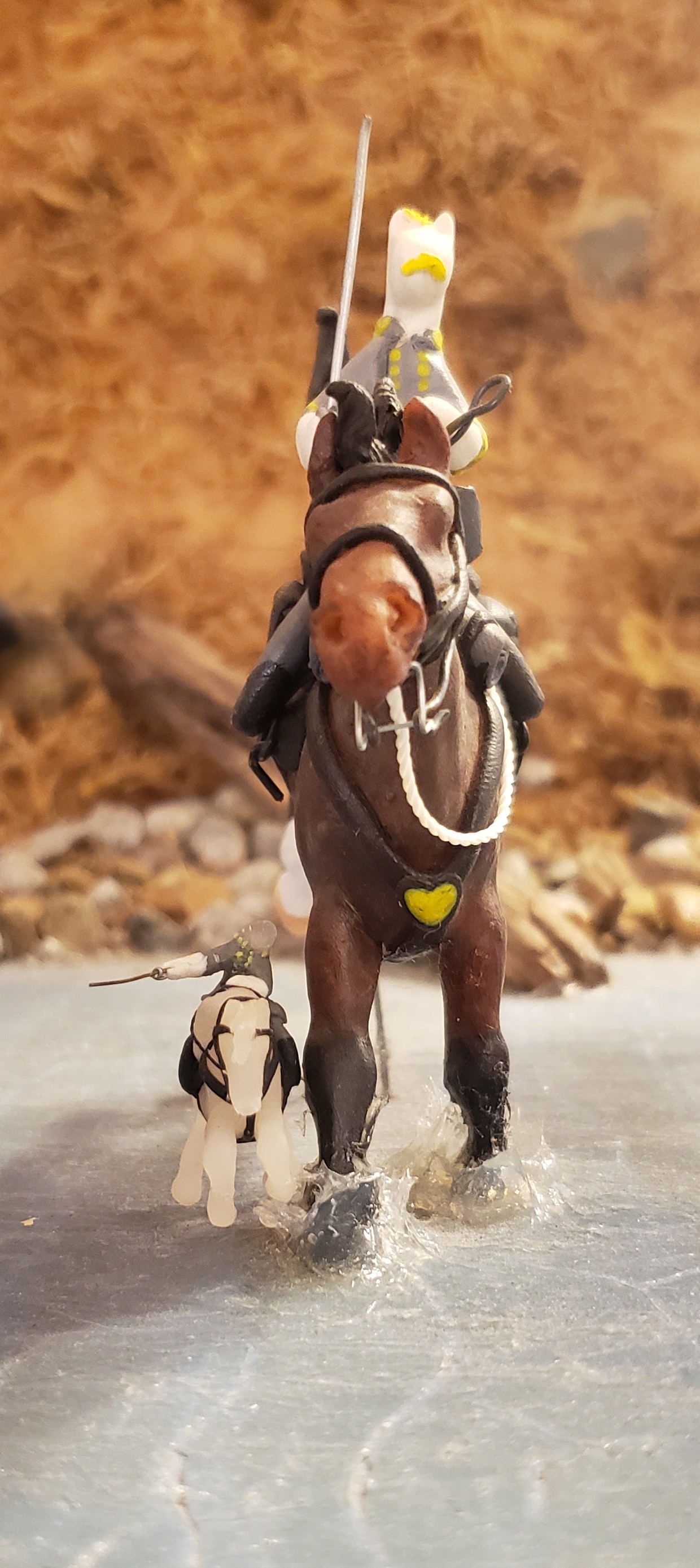
Deciding to take a break, he joined Cat 5000 for a swim in the Duck River.
Then, off to Little Round Top, where he pitched in with the 15th Alabama, facing Cat 6000 and the 20th Maine.
—Only to be run over by Cat 7000 in the bayonet charge!
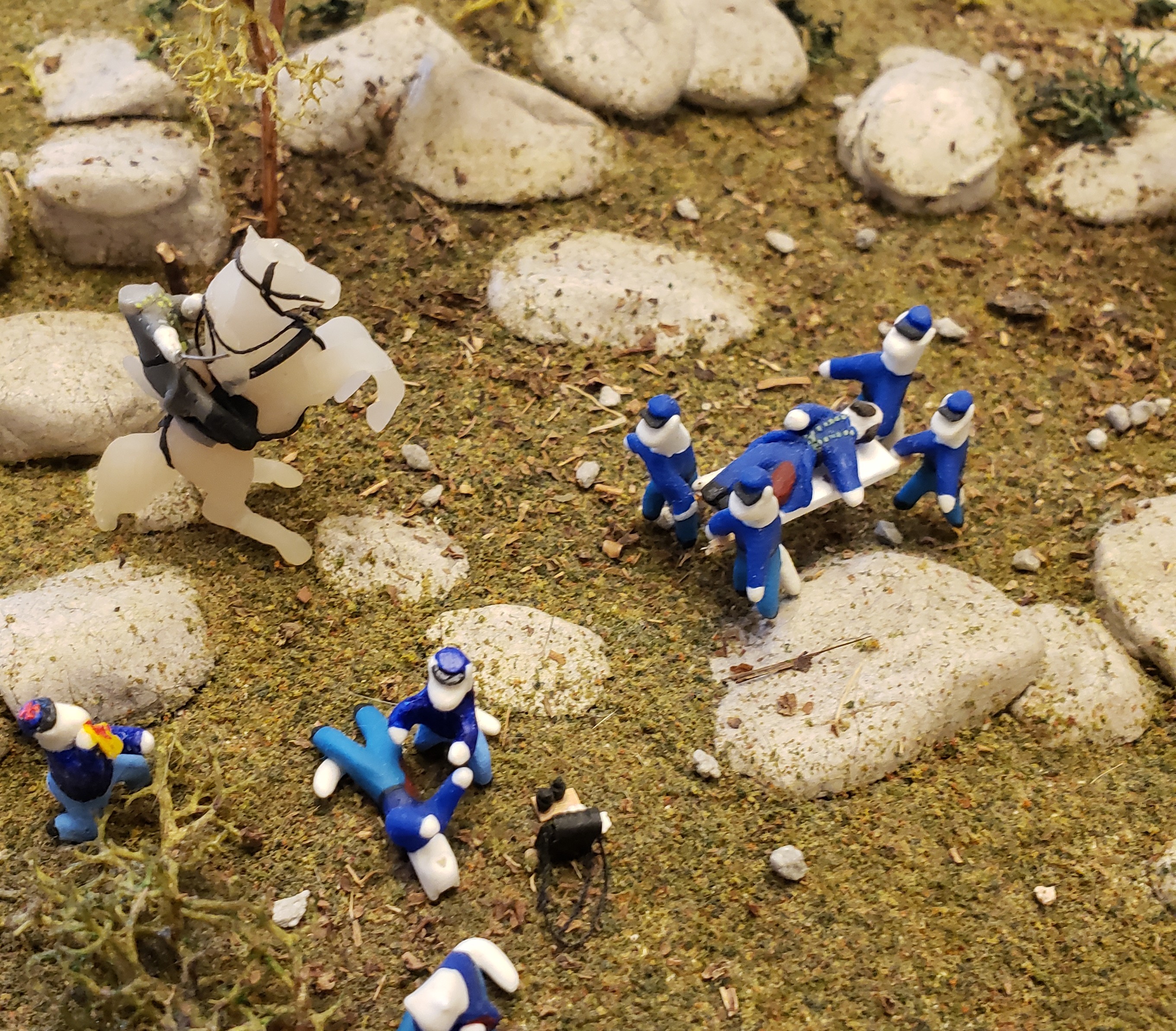
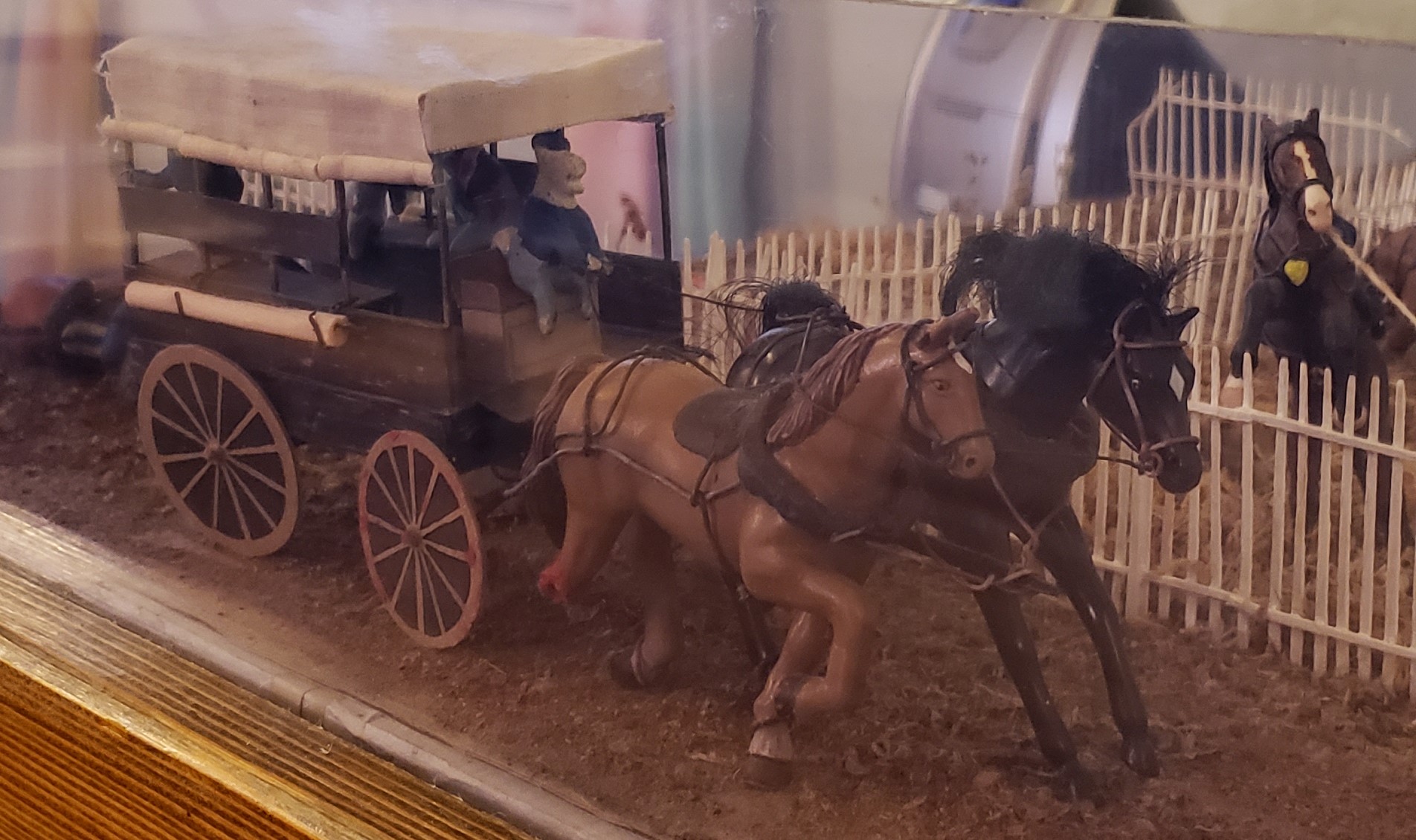
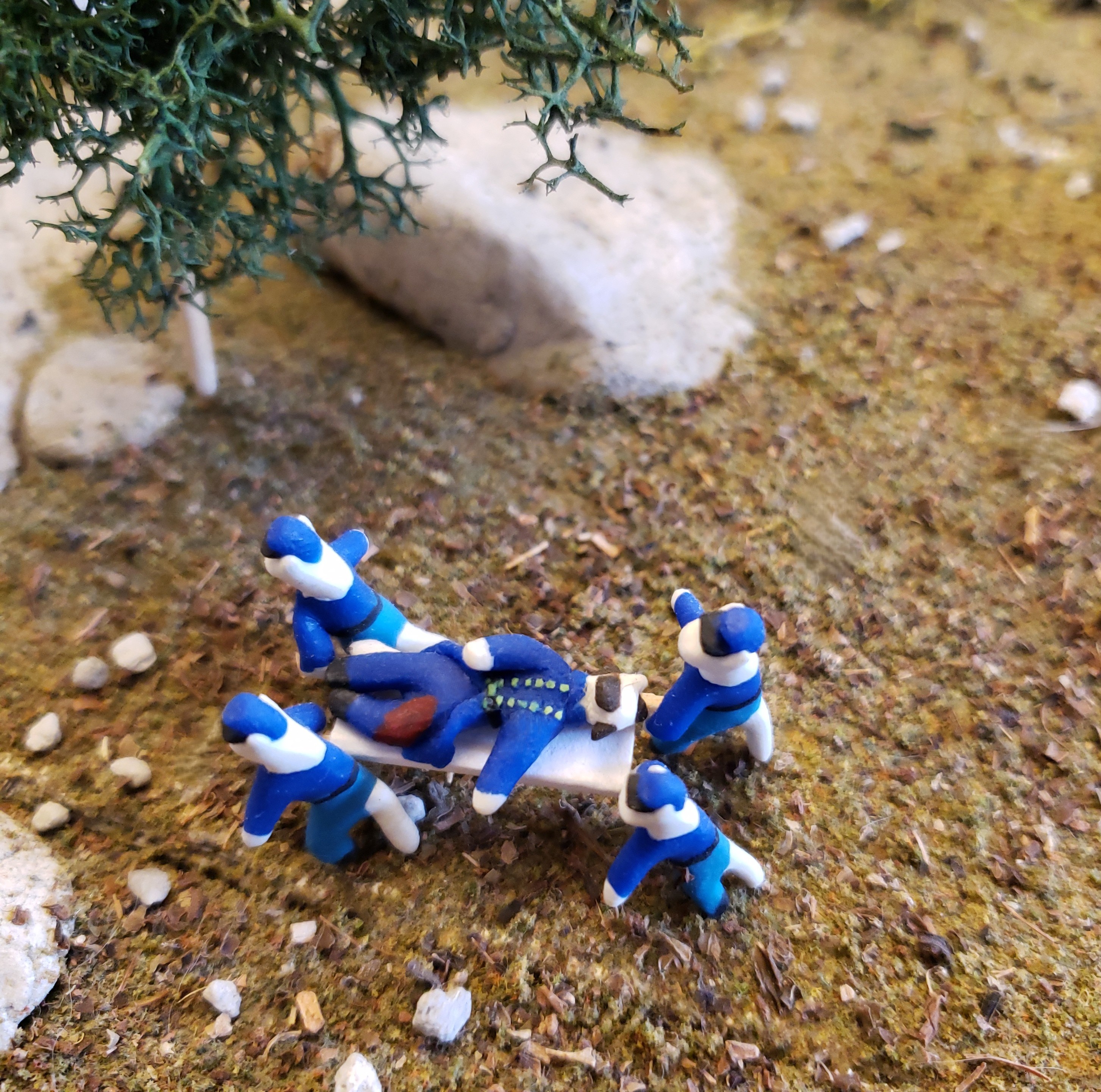
Just in time to avoid capture, he remembered that he is a neutral party in the diorama fighting, and so he went to help direct Cat 9000’s stretcher-bearers to the aid station.
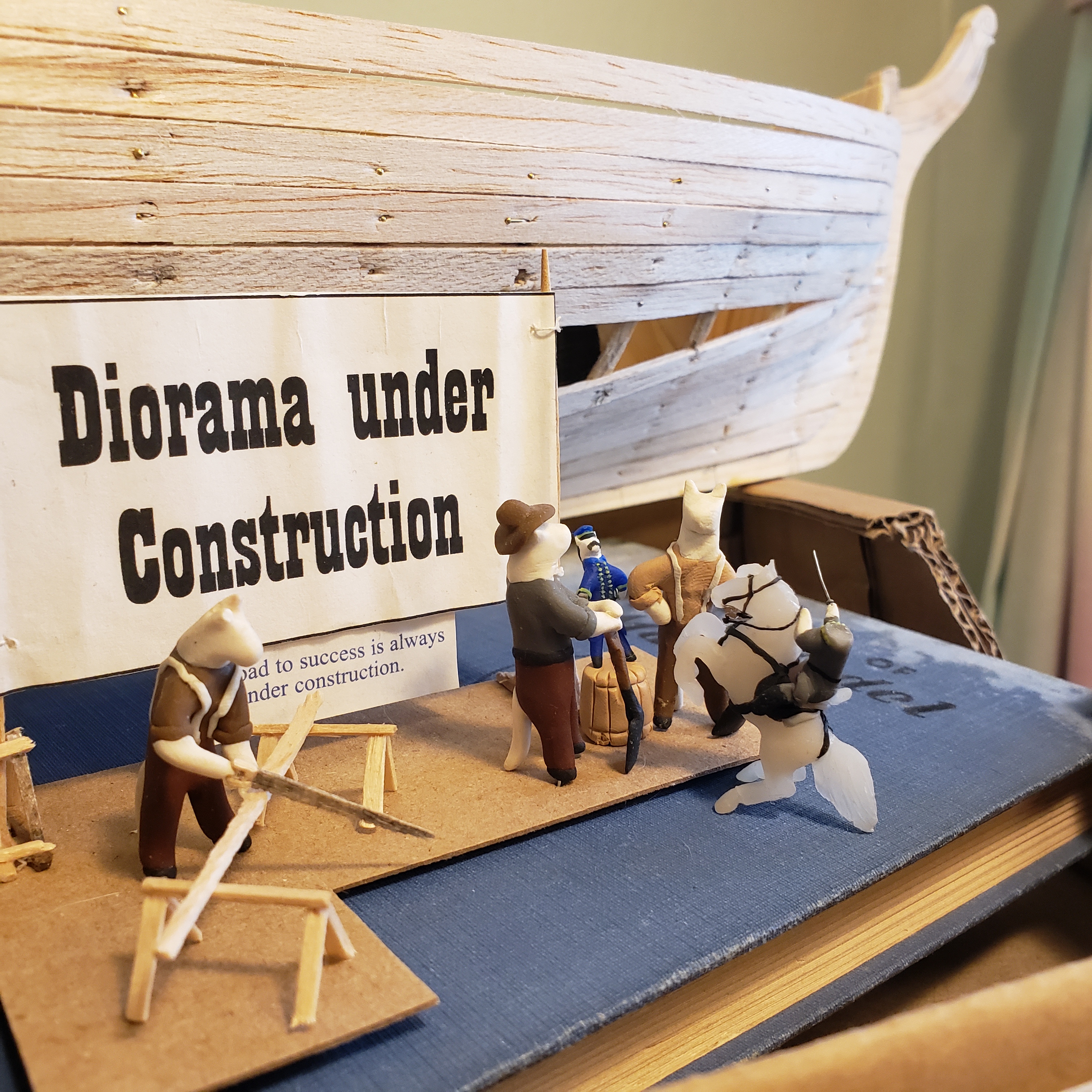
He finished his journey at the shipyard, where he and Cat 10,000 consulted about the progress on USS Cumberland’s hull, then met with some of the construction crew. Even though he really doesn’t know anything about ships and their construction, he suggested that the big hole in the hull should be patched.
In an earlier Mewsing, we looked at the historical figures behind our original clay Civil War Cats. Today, we focus on our first known K-Cat.
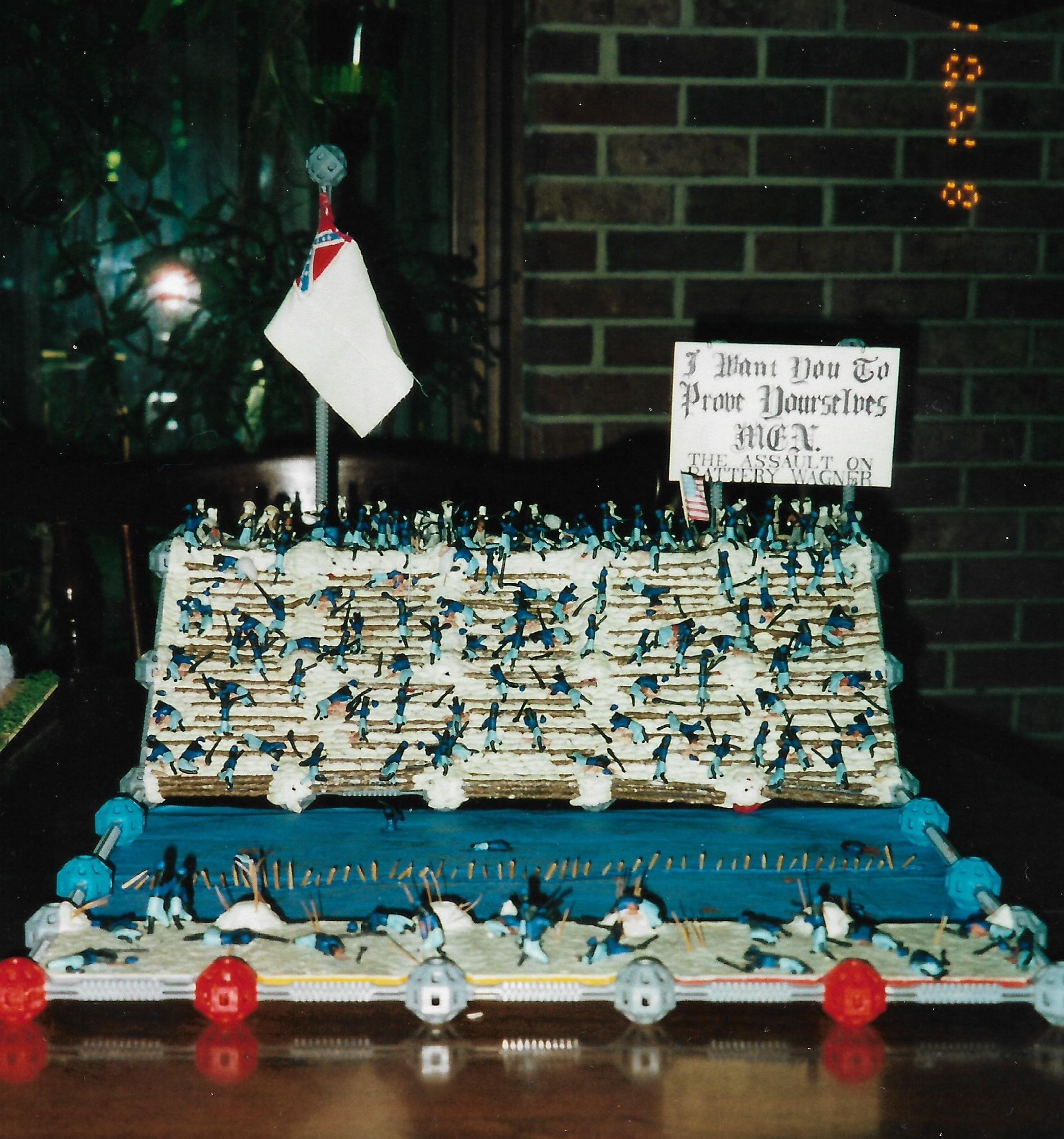
Battery Wagner – begun in Oct. 1999
The idea of keeping a Cat Census did not come to us right away, and so we do not know who our 1,000th and 2,000th cats are. But we began counting and keeping track as we revamped our diorama of the 54th Massachusetts Regiment’s attack on Battery Wagner, to make it to-scale. We reached Cat 3,000 at the end of 1999, in time to place him on the diorama at midnight, January 1, 2000. Yes, we took the diorama to our friends’ New Year’s Eve celebration, just so we could install Cat 3K on Y2K!
Cat 3K is not an identified officer or man. Nowadays, we like to pick a specific individual to honor as a K-Cat, but originally, it was purely whoever was next to be made. So, Cat 3K represents an average soldier of the 54th Massachusetts.
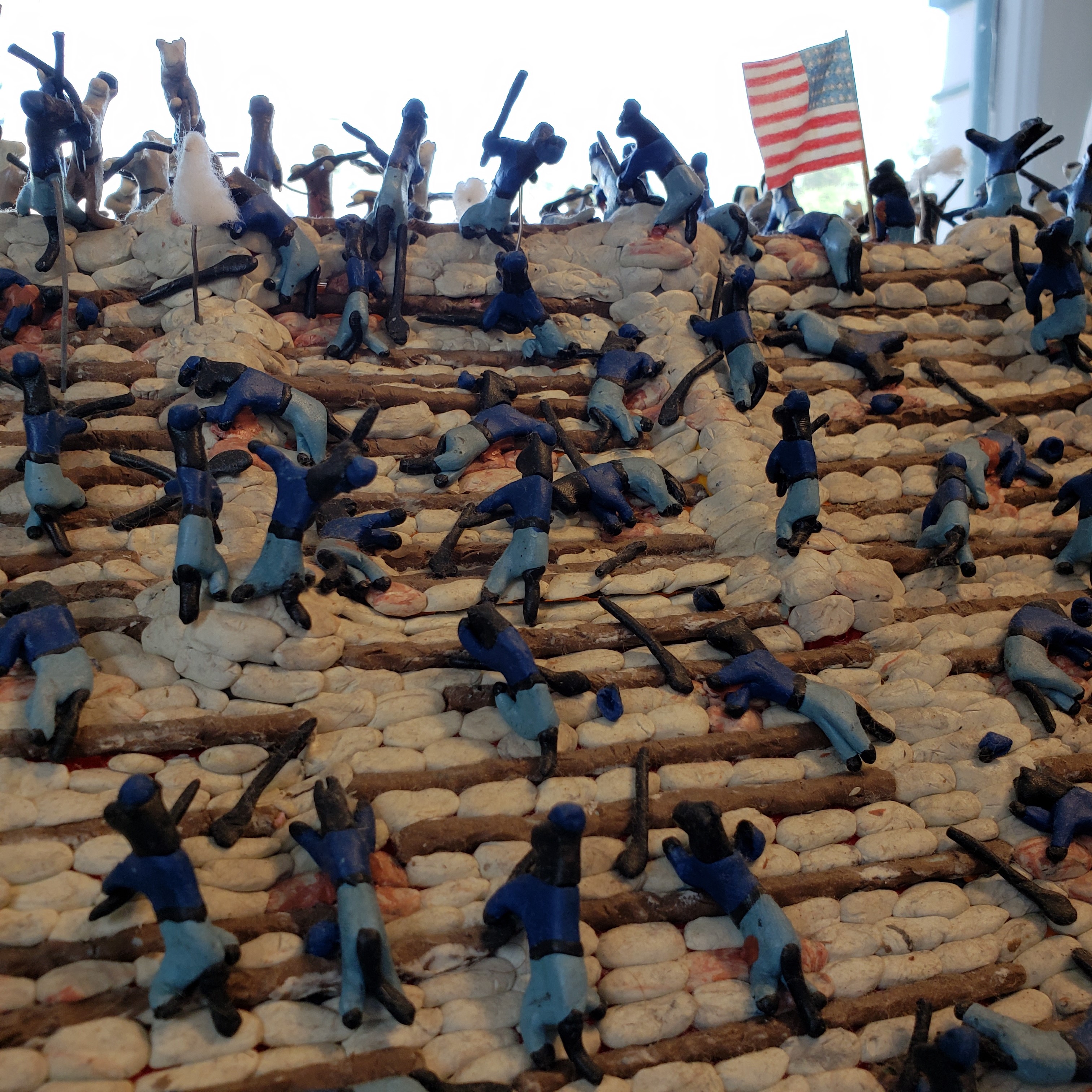
A month after the Emancipation Proclamation decreed that African-American men would be “received into the armed services of the United States,” Governor John Andrew of Massachusetts issued the Civil War’s first call for “colored” soldiers, and the 54th Massachusetts Volunteer Infantry was formed.
Many of the men came from outside Massachusetts. Some came from as far away as Canada, the Caribbean, and various southern states. Because the North was still queasy about colored soldiers, the officers of the regiment had to be white. The enlisted men could only advance in rank as far as non-commissioned officer status.
Even though they had been told that they would receive the same pay as white soldiers, the men of the 54th received reduced pay. And out of that, money was taken to cover the cost of clothing—something that was not done in white regiments! The men and their officersrefused to accept their wages until both black and white earned equal pay for equal work. The fight for equal pay lasted for over a year, until the war was nearly over.
As if the prejudice from civilians and the army were not enough, the Federal government itself was slow to support colored soldiers. The men of the 54th headed south knowing that the Confederate Congress had announced that every captured black soldier would be sold into slavery, and every white officer in command of black troops would be executed—and the Federal government had not yet given any indication that it would stand up for its own troops. It was not until after the fight at Battery Wagner that the U.S. Government threatened retaliation on Confederate prisoners if the Confederacy went through with their word.
The regiment’s first taste of action came on July 16, 1863, in a skirmish on James Island, SC. Their actions in that fight earned them the respect of the white soldiers around them. Two days later, their steadfastness in the assault on Battery Wagner proved to the nation that black men could fight as well as white men.
Tens of thousands of black men would enlist before the war’s end. President Lincoln credited them with helping to win the war.
In Part One, we looked at the history of our clay Civil War cats and our personal journey to start Civil War Tails. Today, we want to talk about four lessons we have learned along the way, and help you to apply them to yourself:
Allow yourself to dream.
Identify the kernels inside you that you keep coming back to.
When you take the plunge…stick it out.
Make a difference.
First, allow yourself to dream. Do not dismiss your dreams as impossible. Allow yourself to consider the possibility. When Rebecca took small business courses in college, she was merely toying with the idea of a museum, figuratively poking at it. The idea of starting a museum sounded so big and grand that it seemed impossible. But pursuing a dream is like eating an elephant. Take it one step at a time and…maybe you can. Be open to your interests, work towards your dream where and when you can, and you may be surprised at where it leads!
Second, identify the kernels that you keep coming back to. What are you passionate about? What idea keeps rattling around in your head?
Sometimes it takes time to identify them. And sometimes it requires listening to the people around you. Other people can help you discover the kernel that will bring out your potential, because it is easier for them to see your gifts, talents, or passions that you think of merely as “just a hobby” or “just the way I am.” Or, they might help you find a way to do something with your skills, because they know of jobs or opportunities that you have never thought of. Or, as with us and Helen, they might have the persistence to keep mentioning a good idea until you finally listen!
Once you’ve identified the kernel, develop it. See how your other strengths, skills, talents, passions, interests, and knowledge can help to develop that kernel. For example, starting (and running) our museum involved more than just our cat-making abilities.
It took knowledge: Ruth, being a lawyer, knew what type of lawyer we needed to find to help us set up the business and take care of the legal requirements.
It took skills: Rebecca’s work as waitstaff taught her that customers are not just paying for the food, but for the experience. And the staff is part of making that experience enjoyable and memorable. That is knowledge and a skill that translates to a museum—and any job. People come not just for the dioramas, but for the experience. How can we make the experience enjoyable and memorable for our visitors?
It took passion: People often comment how much they enjoy seeing our passion, whether in the amount of work and time it took to make the dioramas, or in chatting with us and hearing us pour out the stories that inspired our dioramas.
But once you have dreamed and identified the kernels in your life and taken the plunge to develop them—then what?
Our third point, stick it out. We’re very fortunate to have a museum centered around our passions. But in all honesty, even with a dream job, you won’t love every day. So how do you keep going?
We have a very practical tip, which we have found helpful: Remember the 5-stars. That is, remember the good responses and interactions. Let’s face it, you can have tons of 5-star reviews and Likes, but it’s the lone 1-star review that sticks in your head and starts you doubting and second-guessing. So, remember the 5-stars.
We have taken to writing down the nice comments we get from museum visitors. Then, at the end of each month, we compile them into a “monthly report.” That way, when we’re feeling discouraged, we can go back and read comments like, “This was a joy!” “This is the best museum we’ve been to!” or even, “This was better than Mardi Gras in New Orleans!” (yes, someone actually said that!)
Keeping a log or diary of the good days is a very practical way to remember why you do what you do, to help you keep plugging forward, and to reorient you back to your original goal or aim.
Lastly, whatever you do, do it with excellence, and you will make a difference. You may not see it day by day, but as you reflect on past months and years, and especially if you keep a “5-star log,” you can see the impact you are having on others.
Over the years, we have developed specific strengths, skills, talents, interests, passions and knowledge to become the Civil War Tails Diorama Museum. The result has impacted people with our passion, detail, and historical accuracy.
As kids, we were detail-oriented perfectionists.
Over time, we developed our skills in research and analysis, our knowledge, our perfectionism, our steady hands and patience, our attention to detail, and our desire for accuracy.
Now, licensed battlefield guides enjoy seeing a historically-accurate, to-scale, miniature view of one point in time on the battlefield they know so well. And people who had their doubts about clay cats appreciate the detail and accuracy.
As kids, we liked making things out of clay and whatever we had around the house.
Over time, we honed our skills to greater precision and detail and learned about new materials, so now we can recreate battlefield topography and precise rock formations from photographs.
Now, visitors can visualize what they are learning about. One visitor said the Civil War Tails experience was “life-changing,” because this was the first time she could visualize what the battle looked like.
As kids, we liked the individual “people stories.”
Over time, we developed our passion to not only recreate for ourselves but also to share the stories of the people in the Civil War.
Now, we are
Raising awareness of less-known actions, including East Cavalry Field here at Gettysburg
Inspiring kids to study history even to the point of forming their own history club or making their own dioramas
Making history accessible for adults who were not interested in it before. Something “quirky” can be unexpectedly awesome and informative, and help to make a “boring” subject interesting!
Your strengths and skills and talents, your interests, passions, and knowledge can impact lives. Develop them. Value life-long learning. Take training opportunities with an open mind and enthusiasm. Remain curious and open to new experiences and knowledge. Keep honing your skills.
If you do what you do well, it will impact people, even in ways you do not expect. We did not set out thinking, “We’re going to make a difference.” But we have. By pursuing excellence in our research, materials, and presentation, what used to be “just clay cats” has helped people see history in a new way, helping to honor and tell stories of the people in the Civil War.
Today we start a two-part Mewsing. Part One looks at how we developed a childhood hobby into a successful business. Part Two will encourage you (kids and adults alike) to take some of the lessons we have learned from our experience and apply them to your own lives.
We were homeschooled all the way through high school. Growing up, we enjoyed reading, and our mom would pick up books on all subjects. Two of them were biographies about Generals Ulysses S. Grant and Robert E. Lee. When we were 11, Rebecca read those biographies and liked the generals. So, she made them out of modeling clay.
We had always fiddled with clay, making all sorts of little animals. And since we had cats as pets, when we were kids everything was about cats. It was only natural (in our minds) that when Rebecca made the generals out of clay, they came out as cats in uniform with beards.
We kept reading Civil War books and kept making clay cats of people who caught our interest. After a couple of years, we began to set them up in small scenes of the events we were reading about. Over time, the dioramas became larger and more detailed and accurate.
Our parents created an encouraging environment for creativity and learning, allowing us to pursue our interests. They never told us we were silly for making Civil War cats. Instead, they invested their time to take us to battlefields and reenactments. They fed our interest by buying us hundreds of Civil War books over the years. Dad helped us build the topographical bases for our largest dioramas. Mom contributed fabric for tents and flags on the dioramas and helped us to sew Civil War dresses for the lessons we taught in high school. Mom and Dad are still our biggest fans, still supporting and encouraging us in many, many ways. Civil War Tails would not have been possible without them.
So how did this hobby become a museum?
When we were kids, we transported our clay cats in boxes that we labeled “Clay Civil War Cat Museum.” Obviously, we had no museum and no particular reason to believe we would. But that was our dream.
All the way through high school and college, that’s all it was: a dream. We knew what we liked to do—but a hobby is not a career. And it seemed a grandiose dream: we could never start a museum!
But Rebecca took small business courses during college, just toying with the museum idea.
After college, Ruth became a lawyer, but Rebecca never knew what she wanted to be when she grew up. She remembers thinking, “I just like making dioramas.” Eventually, she realized, “No, I also enjoy sharing them with others.” But even then, she didn’t know what to do with that realization.
High school gave us two opportunities that turned out to be “trial runs” before a variety of people and ages. We didn’t know what was to come, but we did see that everyone really liked our Civil War dioramas of little clay cats. We taught Civil War lessons to other homeschooled students who really enjoyed seeing the dioramas we used as visual aids.
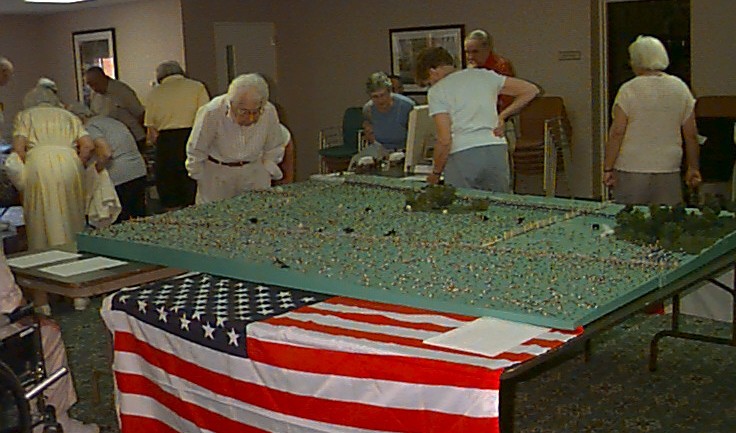
We also worked as waitstaff at a retirement community. Mom told us, “If you make friends with the residents, they’ll become like grandparents to you.” And she was right. We loved the residents there. Naturally, we wanted to share our clay cats with them, and so began the tradition of taking the dioramas in for one afternoon a year, for the residents and staff.
Every year, one resident, Helen, would say, “You should take these into schools!” And we would laugh and joke, “You wanna be our agent?”
In 2012, Rebecca thought, “Maybe I should consider the idea, instead of brushing it off each year.” She did, but we soon realized that travel is hard on the dioramas, and they were multiplying and getting larger.
So we decided, “Maybe we should bring the kids to the dioramas, instead of the dioramas to the kids.” We began searching for a commercial property in Gettysburg, in order to start a museum. But we would not have taken that step if we had not finally listened to Helen.
Now, here we are, having made our hobby into a career. A dream come true!
Stay tuned for Part Two, where we’ll consider life after the dream becomes reality—and give you some takeaways to inspire your own journey!
In today’s Mewsing, we spotlight the two generals whose biographies inspired Rebecca to make our original two clay Civil War cats thirty years ago. While we have spotlighted the cats before, today we take the time to look at the men behind them.
Hiram Ulysses Grant was born on April 27, 1822 to Jesse Root Grant and Hannah Simpson Grant. Jesse preferred the name Ulysses, so that is what he called his son, rather than Hiram.
Even at a young age, Ulysses was fearless. When he was less than two years old, a neighbor fired a pistol next to the boy’s head, just to see what would happen. Unfazed, Ulysses reached for the firearm instead. When he was five years old, a pony tried to buck him off, but he clung to its mane until it stopped bucking.
In 1839, at his father’s insistence, Ulysses attended the United States Military Academy at West Point. He found he had been registered under the name “Ulysses S. Grant” because the Congressman who nominated him had submitted his name incorrectly. The register could not be changed, and so as long as he wore the Army’s uniform, he would be Ulysses S. Grant.
In 1844, just before he left for the Mexican War, he and Julia Dent became engaged. Four years later, a few months after the war ended, Ulysses married Julia. Over the next ten years, they added three sons and a daughter to their family.
The Grants were not rich; at times they were dirt poor. But Ulysses was a compassionate man who would help anyone in need. And he was determined. Once, a man’s mule was seized to satisfy a court judgement. Ulysses knew the man was poor and needed the mule, so he bought it at auction for fifty dollars and gave it back to the original owner. But the mule was seized again because technically it had not changed owners. Ulysses went back to the auction and bought it again, this time for five dollars, and gave it to the man. The mule was seized again! Ulysses bought it a third time, and told the man to take it to another county and trade it for another mule. If that didn’t work, Ulysses said, “I am going to have that old mule even if I have to buy it once a week all summer!”
Such determination would continue to hold a prominent place in his character during the Civil War.
In 1862, Grant—by then a brigadier general—laid siege to Fort Donelson. After failing to break out, the Confederates asked for a cease-fire. Grant replied, “No terms except unconditional and immediate surrender can be accepted.” The next day, Fort Donelson surrendered, and U. S. Grant gained the nickname “Unconditional Surrender” Grant. As soon as President Lincoln heard of the surrender, he promoted Grant to major general. Later that year, after the bloody battle of Shiloh, people at home wanted Grant replaced. Lincoln responded, “I can’t spare this man. He fights.”
In November, Grant began his campaign to take the fort at Vicksburg. After a siege that lasted for months, Vicksburg surrendered on July 4, 1863, giving the Union control of the Mississippi River and splitting the Confederacy in half.
The next year, Congress passed a bill to create the rank of lieutenant general. On March 9, Lincoln formally gave Grant his commission. Only one other man in the nation’s history had carried that rank: George Washington.
Grant remained in the east with Gen. George Meade’s Army of the Potomac. Now general-in-chief of all the Union armies, Grant knew the way to win the war was to pressure the Confederates on all sides, to never give their armies time to regroup, and to press them into submission quickly.
On May 5, 1864, the battle of the Wilderness began. Towards the end of the second day, things looked bleak for the Union army. Panicked officers came to Grant, telling him the army was falling apart. He calmly whittled a stick until one officer exclaimed, “I know Lee’s methods well by past experience. He will throw his whole army between us and the Rapidan, and cut us off completely from our communications.”
Grant’s patience snapped and he replied, “I am heartily tired of hearing about what Lee is going to do. Some of you always seem to think he is suddenly going to turn a double somersault and land in our rear and on both our flanks at the same time. Go back to your command and try to think what we are going to do ourselves, instead of what Lee is going to do!”
On the evening of May 7, the Union army pulled out, but they did not retreat north, as the soldiers expected. Instead Grant pressed southward, around Lee’s army.
Throughout May, the Union army repeatedly hammered Lee’s line, but failed to break it. Still, Grant pressed southward instead of retreating. After the bloody battle of Cold Harbor, people at home began calling him “Butcher Grant.” But he did not want thousands of men to die. Once he said that sometimes he could hardly bring himself to give the order for battle because of the death and misery that would follow. The high death toll was the inescapable cost for continuing to press Lee’s army, and pushing onward to end the war.
Mid-June 1864 saw the armies settling into the siege of Petersburg, on the outskirts of Richmond. Finally, in April 1865, the Confederates pulled out of Richmond and Petersburg, and four days later, the Union army nearly surrounded Lee’s at Appomattox Court House. After a failed last attempt to break through the Union line, Lee met Grant in the parlor of Wilmer McLean’s house and surrendered the Army of Northern Virginia. Grant gave him generous terms; when Lee pointed out that many of his men owned their horses, Grant said that any man who claimed to own a horse or mule could take it with him to work his farm. He also ordered rations to be given to the starving Confederates.
Grant went to Washington to meet with Lincoln, and on the 14th of April the president invited Ulysses and Julia to join him and Mary at Ford’s Theater. The Grants declined because they had plans to visit their children in school in New Jersey (and Julia couldn’t stand Mary Lincoln). When the Grants reached Philadelphia at midnight, they were shocked to hear that President Lincoln had been shot and was not expected to live.
In 1868, the Republican Party nominated Grant for president, even though he did not want it. When he received the news of his election, he sadly told Julia, “I am afraid I am elected.”
One of the first things President Grant did was to push for a Panama Canal, built by American engineers and under American control. His terrible experience in 1851, while crossing Panama on the way to California with his regiment, had convinced him of a canal’s necessity.
On March 30, 1870, he signed the 15th Amendment into law, giving African-Americans the right to vote.
In 1872, Grant won election to a second term, to his chagrin. Toward the end of that term, he told Julia, “After I leave this place, I never want to see it again.” He managed to avoid nomination for a third term and later told a friend, “I was never as happy in my life as the day I left the White House. I felt like a boy getting out of school.”
In February 1885, Grant learned he had advanced throat cancer, with only a few months to live. He had been considering writing his memoirs, and now he wrote or dictated as much as he could. One day he dictated 10,000 words! He finished his memoirs a couple of weeks before his death on July 23, 1885.
***
Robert Edward Lee was born on January 19, 1807, the son of the Revolutionary War general “Light Horse Harry” Lee. Accepted into West Point when he was seventeen, Robert graduated near the top of his class. He served as an engineer in the Mexican War, and then as Superintendent of West Point from 1852-55. In 1859, when the abolitionist John Brown led a raid on the arsenal at Harpers Ferry, Col. Lee was sent with marines to arrest him.
As war loomed, Lee opposed secession, and wrote, “I am willing to sacrifice everything but honor for [the Union’s] preservation.” At the same time, he believed he had a higher duty to his state. If Virginia seceded, he said, “I shall return to my native State and share the miseries of my people.” On April 19, 1861, he learned that Virginia had seceded. The next day he resigned from the United States army.
In May 1862, Lee assumed command of the Army of Northern Virginia. As he led the army to victory after victory over the next two years, and as the men learned how much he cared for his soldiers, instead of “Granny Lee,” his men affectionately dubbed him “Marse Robert.”
After the defeat at Gettysburg in July 1863, Lee accepted full responsibility. Even as he met the survivors of Pickett’s Charge on July 3, he told them, “It is all my fault.” As the army retreated the next day, he told Gen. Longstreet, “It’s all my fault. I thought my men were invincible.” When he returned to Virginia, he offered to resign, but President Davis knew Lee was still the best choice for commander of the army.
The defeat at Gettysburg and the increasing hardship as supplies dwindled in the Confederacy did not dampen the soldiers’ love for Lee. In April 1864, Longstreet’s corps returned from a temporary assignment in Tennessee. When the men saw Lee, they “hung around him and seemed satisfied to lay their hands on his gray horse or to touch the bridle, or the stirrup, or the old General’s leg—anything that Lee had was sacred to us fellows who had just come back. And the General—he could not help from breaking down…tears traced down his cheeks…”
Lee always thought of his men. At Christmastime,1864, he was invited to dinner. During the meal, the hostess noticed he had not eaten his turkey, and she asked if he did not like it. He replied that he was saving it and hoped he could take it with him to give to an ill staff officer. The hostess then set aside some turkey so Lee could eat his.
Lee’s concern for others did not stop at his own men. Despite the raging war, he saw the Union soldiers as fellow men, not merely enemies to be destroyed, and he consistently referred to them as “those people” instead of “Yankees” or pejoratively. Once, when an officer said he wished all the Yankees were dead, Lee asked, “How can you say that, General? Now, I wish they were all at home attending to their own business, and leaving us to do the same.”
During the siege of Petersburg, a Union prisoner complained to Lee that a Confederate had stolen his hat. The general told him to point out the man and when he did, Lee had the Confederate return the hat. One of the other prisoners wrote, “I wondered at him taking any notice of a prisoner in the midst of battle. It showed what a heart he had for them.”
Another time, a general said they should warn Grant to stop destroying their supplies, or else they would not feed the Union soldiers they captured. Lee replied, “The prisoners that we have here, General, are my prisoners; they are not General Grant’s prisoners, and as long as I have any rations at all I shall divide them with my prisoners.”
The end came at last on April 9, 1865. Gen. Gordon’s infantry and Gen. Fitzhugh Lee’s cavalry attempted unsuccessfully to break the Union line. Finally, Gordon sent the message, “Tell General Lee I have fought my Corps to a frazzle, and I fear I can do nothing unless I am heavily supported by Longstreet’s Corps.”
Lee listened to the report, then said, “Then there is nothing left for me to do but to go and see General Grant, and I would rather die a thousand deaths.” Knowing his duty did not make the decision any easier. As he looked toward the Union line, he mused, “How easily I could be rid of this, and be at rest! I have only to ride along the line and all will be over! But it is our duty to live.”
So, dressed in his finest uniform and a red sash, Lee rode to Appomattox Court House to surrender. When it was over and he returned to his lines, his men crowded around him, cheering him. Gradually the cheer died away as they saw their general’s face and then they began to ask, “General, are we surrendered?”
Choking down tears, Lee replied, “Men, we have fought the war together, and I have done the best I could for you. You will all be paroled and go to your homes until exchanged.” Then, almost inaudibly, “Good-bye.”
Lee reached Richmond on April 15. He at once began encouraging reconciliation and urging his fellow southerners to accept their defeat and to work to rebuild the devastated South. Knowing that many would follow his example, he applied for a pardon. Because he was the commanding general, he was never pardoned, but many of his soldiers were. On September 28, 1870, Lee walked home in the rain from a church meeting. That night he fell ill. He died two weeks later on October 12. His last words were the command given when an army broke camp: “Strike the tent.”
Today we look at another FAQ and consider the question, “How do you decide what’s next?” (For our previous FAQs, check out our Mewsings index.)
We always have a wish list of diorama ideas, but it does not remain static. Generally speaking, the list falls into the following categories, with specific diorama ideas bopping up and down within their category or between categories.
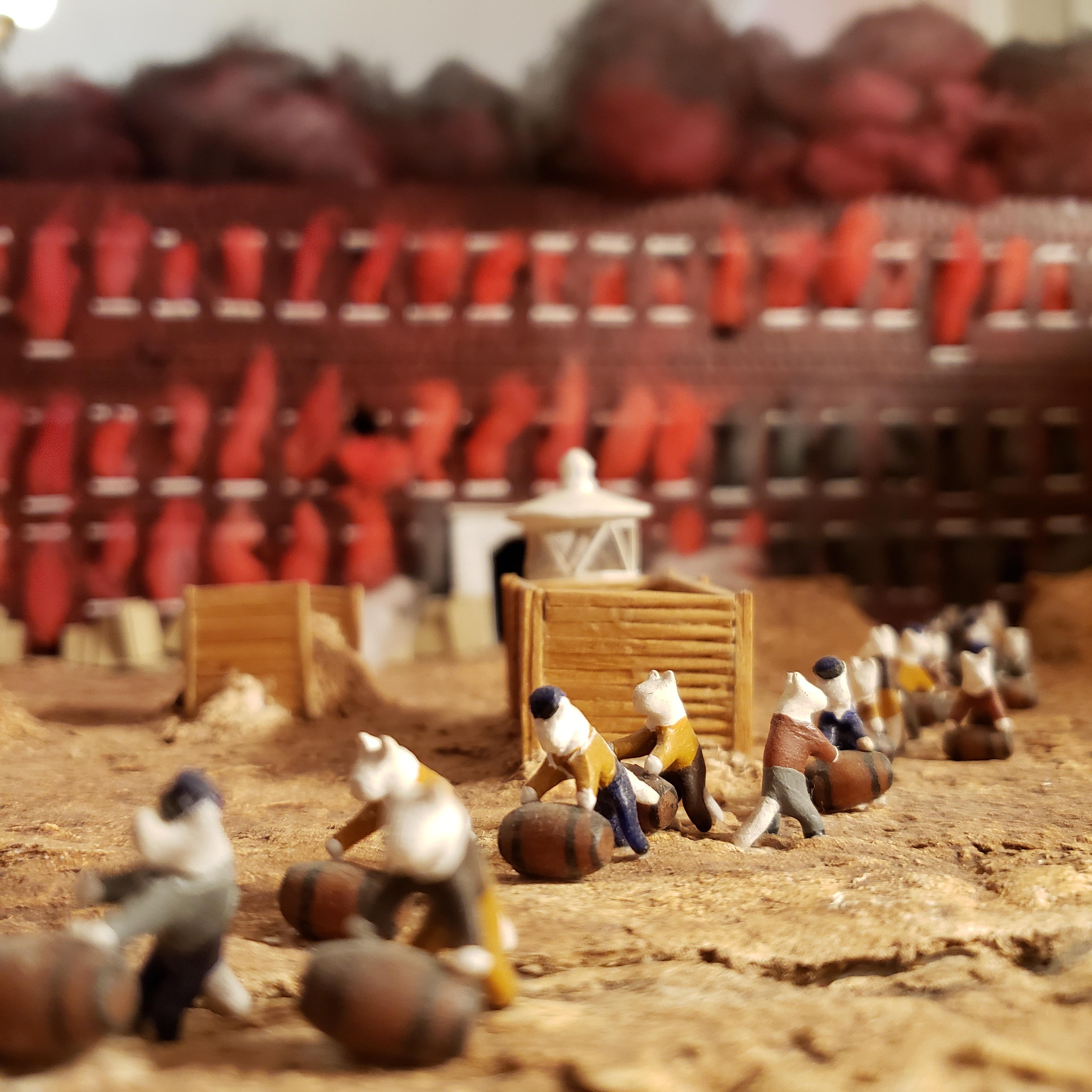
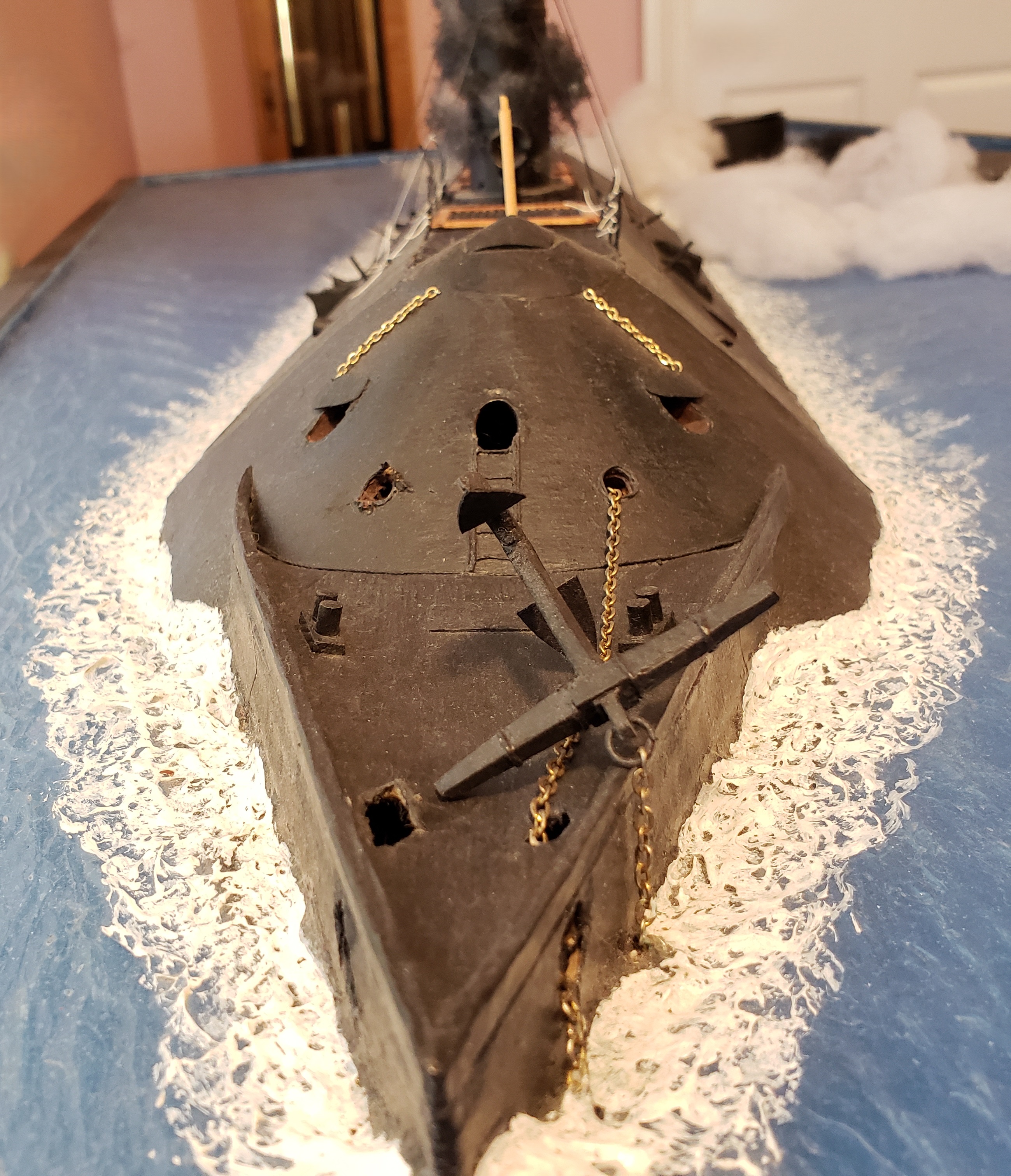
Top of the list – these are the ideas that have “clawed their way to the top” by the time we are ready to choose a new diorama. Usually, this category only has a handful of ideas, and they hold extra interest for us, making us really, really want to make them someday. For example, every time we would read about USS Cumberland fighting the ironclad CSS Virginia, the story of her crew’s desperate fight against impossible odds would tug at our heartstrings. She needed a diorama.
Middle of the pack – these are ideas that have stuck to the list over the years with a little more desire or importance, but have not yet made it into the top handful. It also includes dioramas that we have started and “should” finish but we need a little extra inspiration to get us moving again.
Bottom of the totem pole – these are ideas that are not quite forgotten, but are superseded by others. It includes ideas brought on by interactions in the museum, as we recognize gaps in our dioramas, see areas that would benefit our visitors, or add suggestions. For example, we do not have the 1st day of Gettysburg or the Western Theater (Mississippi area) well represented. This category and the middle one are constantly swapping diorama ideas, as our thoughts and inspiration ebb and flow.
So, when push comes to shove, how do we pick one? As an example, we will use our decision-making process for choosing the next diorama after we finished “The Boys Are Still There” on February 9, 2024.
1) Follow your heart.
The first consideration is which idea has clawed its way to the top of the list, at the moment. This is usually pretty easy, since even the “Top of the List” category usually has a favorite that particularly moves or inspires us more than the others. In February 2024, that was a new version of the 54th Massachusetts Infantry’s assault on Battery Wagner.
2) Variety is the spice of life.
Sometimes there are other considerations, instead of purely choosing the idea that has our attention. In our example, Battery Wagner would have been a shoe-in—except that we had just finished a major infantry diorama that stretched over 11 years. Since we still want Battery Wagner to be the next major diorama, but were not ready to dive into another huge project, we had to pick a small, less extensive scene to serve as an interlude.
3) What’s the best choice for the interlude?
We considered a few “quick*” options from the first two categories:
A cavalry skirmish* at Rockville, MD – already started
USS Cumberland vs. CSS Virginia – only* two ships
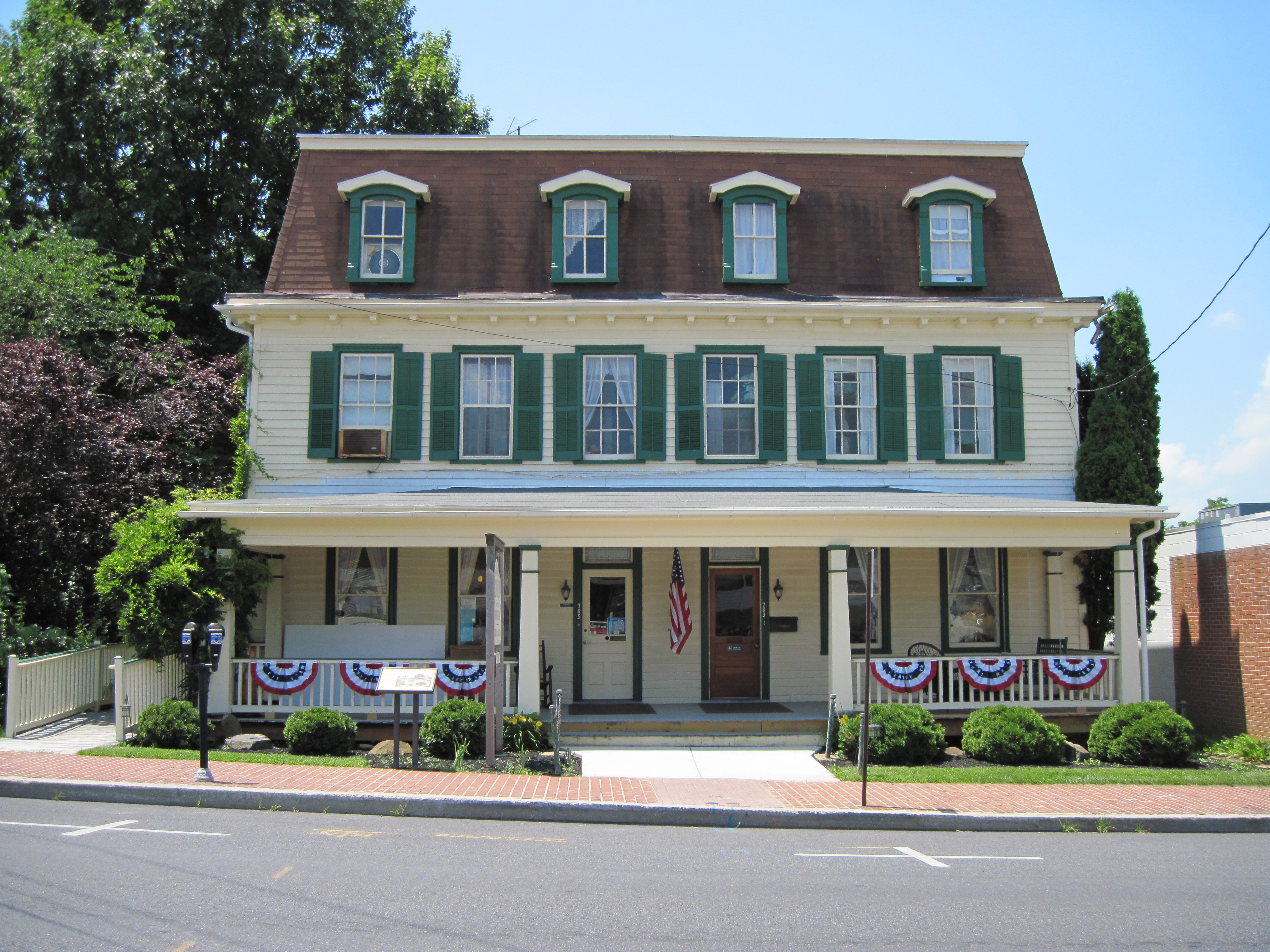
The McClean house at Appomattox – already started
4) Weigh additional factors.
Cumberland was a no-brainer for the “interlude” diorama. Not only would it be small* and simple*, but the disaster of the March 8, 1862 battle of wood v. iron increases the importance of the next day’s “draw” between the ironclads USS Monitor and CSS Virginia. While speaking with visitors to the museum, we have realized that many people do not know about the first day’s battle. So, not only did our hearts vote for Cumberland, but we felt it would be an important addition to the museum. Plus, the best way to motivate Rebecca to do something is to involve a ship in it!
Since Rebecca would be the one making the ships and would not need help until making the crews, Ruth made her own choice between Appomattox and Rockville. Both were ideas that Ruth would take the lead on, and both were already started. So the choice came down to preference: a diorama where the measurements of the house needed to be redone, or a nice easy*, quick* little* cavalry skirmish. She chose the latter.
So there you have it! Battery Wagner is still waiting its turn, but surely* only for a few* years.
*So we thought. As it turns out:
Rockville will probably measure 2’x4’, with ~40 Union and ~100 Confederate cavalry, plus houses on both sides of the street. This would make it roughly half the size of “Come On, You Wolverines”!
Cumberland will be similar in size to the current diorama of the ironclads (as expected), but will involve scratch-building a full-rigged ship from wood. Oh, and did we mention that the cats on Cumberland will not be visible, unless the entire spar deck (the top deck) and the masts lift off? And Rebecca is busy geeking out, so we’re a year into the project, and she is still figuring out where each stay or brace leads. Ruth just cheers her on.
Today we take a journey through 30 years of Civil War cats by looking at our K-Cats and how the dioramas have progressed over the years.
Cat 3,000 – January 1, 2000
Cat 3,000 was placed on the diorama “I Want You to Prove Yourselves” at midnight, January 1, 2000. We had just begun keeping a Cat Census, so he is the first K-Cat! We do not know who Cats 1,000 and 2,000 are.
Cat 4,000
We reached Cat 4,000 while making “The Fate of Gettysburg.” At the time that we made him, we did not yet know about “turf,” and so the diorama was just painted green.
Cat 5,000 – June 25, 2005 (10-year anniversary)
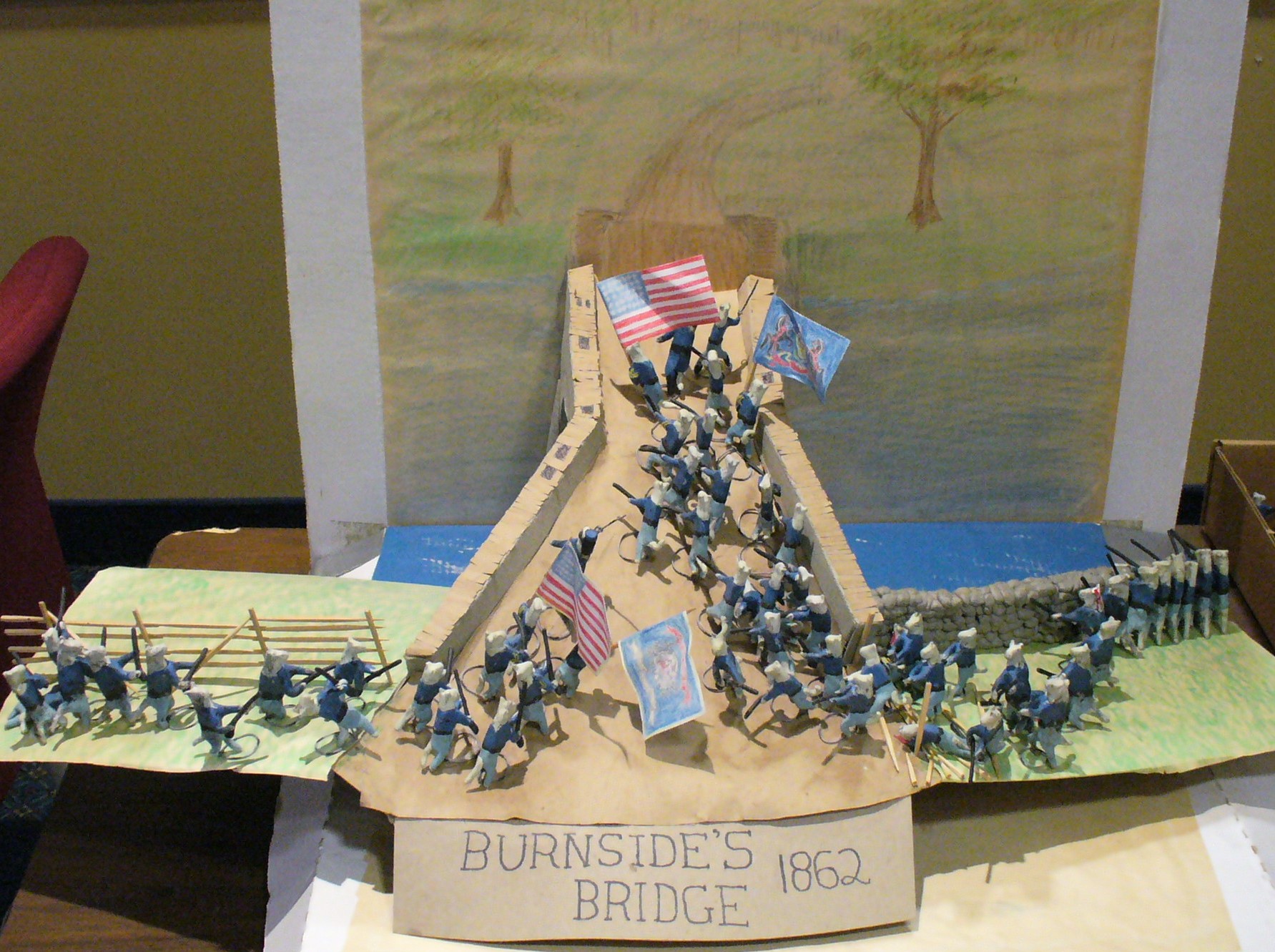
Cat 5,000 was installed on “Desperation at Skull Camp Bridge” on June 25, 2005, our 10-year anniversary. At that time, the “water” was a piece of plastic wrap, wrinkled to form ripples. The diorama received a revamp in 2017 to add Realistic Water, with splashes and ripples made from Liquitex Gloss Super Heavy Gel.
Cat 6,000
We chose to make Cat 6,000 as Col. Joshua Chamberlain. The 20th Maine were the first cats installed on “The Boys Are Still There,” and we have a photo from 2014 which shows Cat 6K installed. Incidentally, the first cat installed on the diorama was Sgt. Andrew Tozier, carrying the 20th Maine’s flag.
Some other photos showing the status of the diorama around that time. We were busy painting cats and in the early stages of installing ground cover:
Cat 7,000
Cat 7,000 is Capt. Ellis Spear, commanding the left wing of the 20th Maine. He was probably installed around 2015.
Here are some photos of the progress, dating from around 2017 and 2018.
Cat 8,000
Cat 8,000 is on “The Fate of Gettysburg,” less than a foot away from Cat 4,000. How did the two end up on the same diorama, but so far apart in number? Because in 2011, we revamped the diorama to add the ground cover. This is also when we added ~1,000 cats to the diorama. We finally finished adding them, including Cat 8K, in 2016.
Cat 9,000 – July 2, 2022
Cat 9,000 is Col. Strong Vincent, installed on the diorama on July 2, 2022. Nearly two years would pass before we finished the diorama in February 2024, but it was getting closer! The ground cover was (finally!) finished, and we had just begun to install Hazlett’s battery.
Cat 10,000
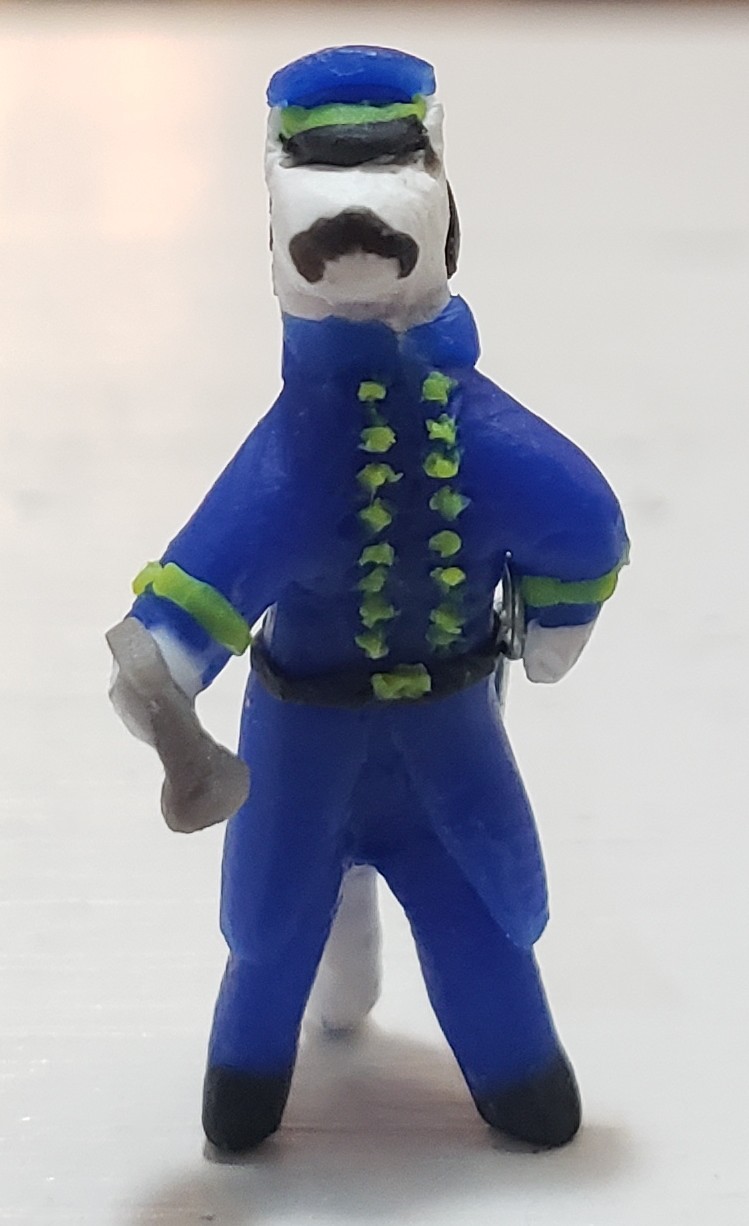
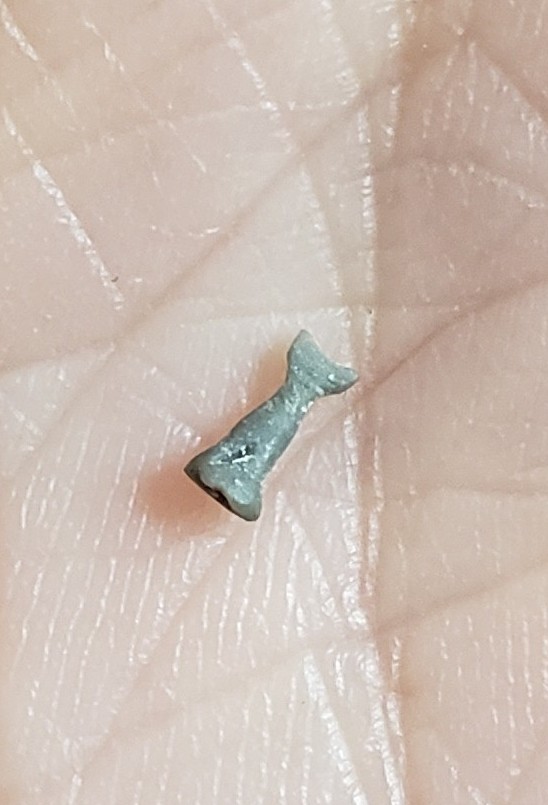
In 2024, we finally reached Cat 10,000—Lt. George Morris of USS Cumberland. He will spend a while in storage, waiting for Rebecca to make his ship, but we are very excited to have reached this K-Cat milestone by our 30-year anniversary!
We have come a long way in our abilities in the 25 years since Cat 3K. Cat 3K is a “shrunk” cat, standing 1.5” tall. Nine months after we installed him, when we began “The Fate of Gettysburg,” 1-inch tall was the smallest we could make. The close-up of Cat 4K indicates how well we could do a “plaid” shirt at the time. Fast-forward to Cat 10K, who stands ¾-inch tall. His hailing trumpet is less than 5/32-inch long, carefully sanded to shape with a tiny file!
Let’s journey a little farther into the world of detail in Civil War Tails:
Little Round Top:
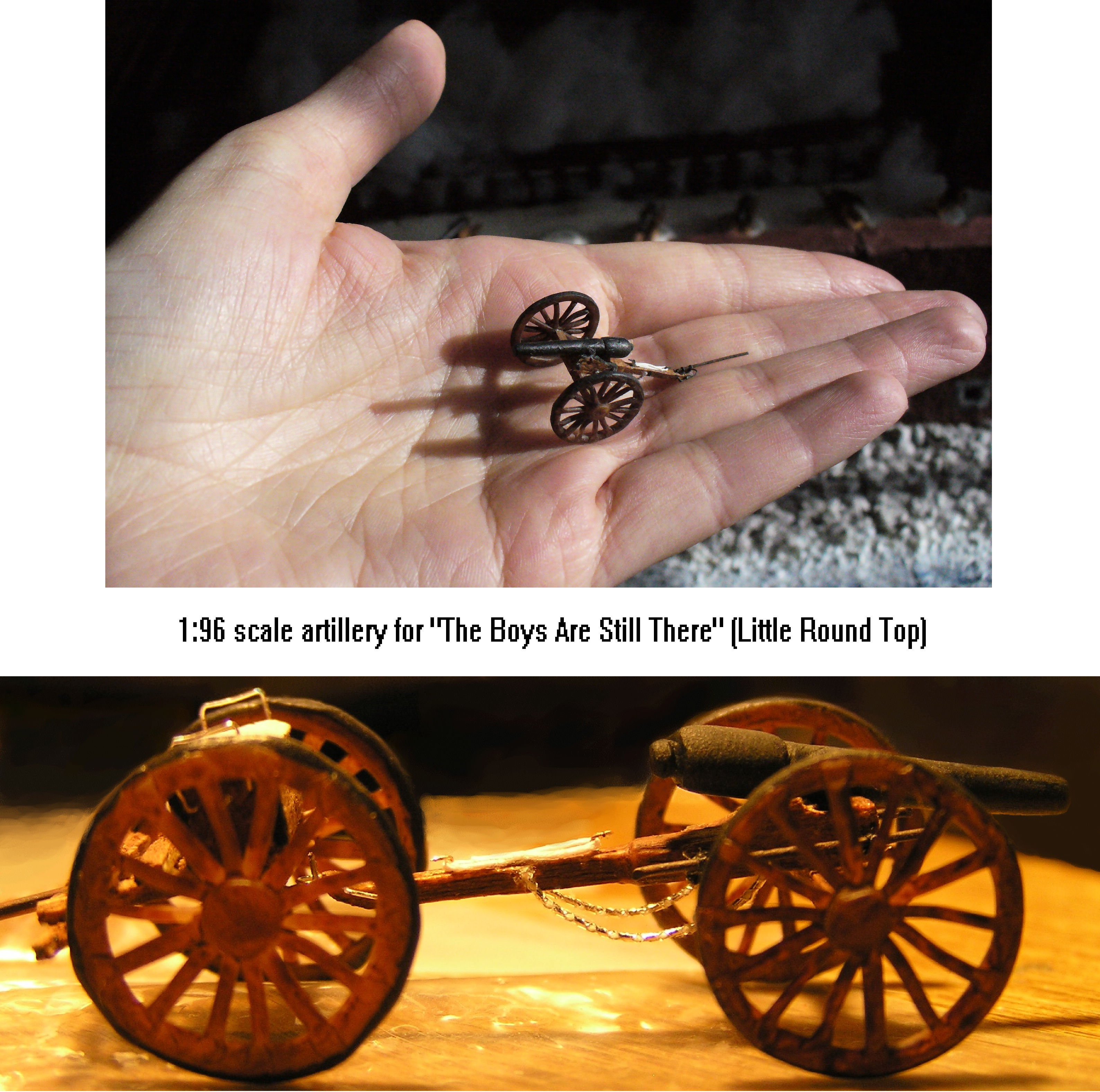
The cannons are made from Sculpey and scraps of wood.
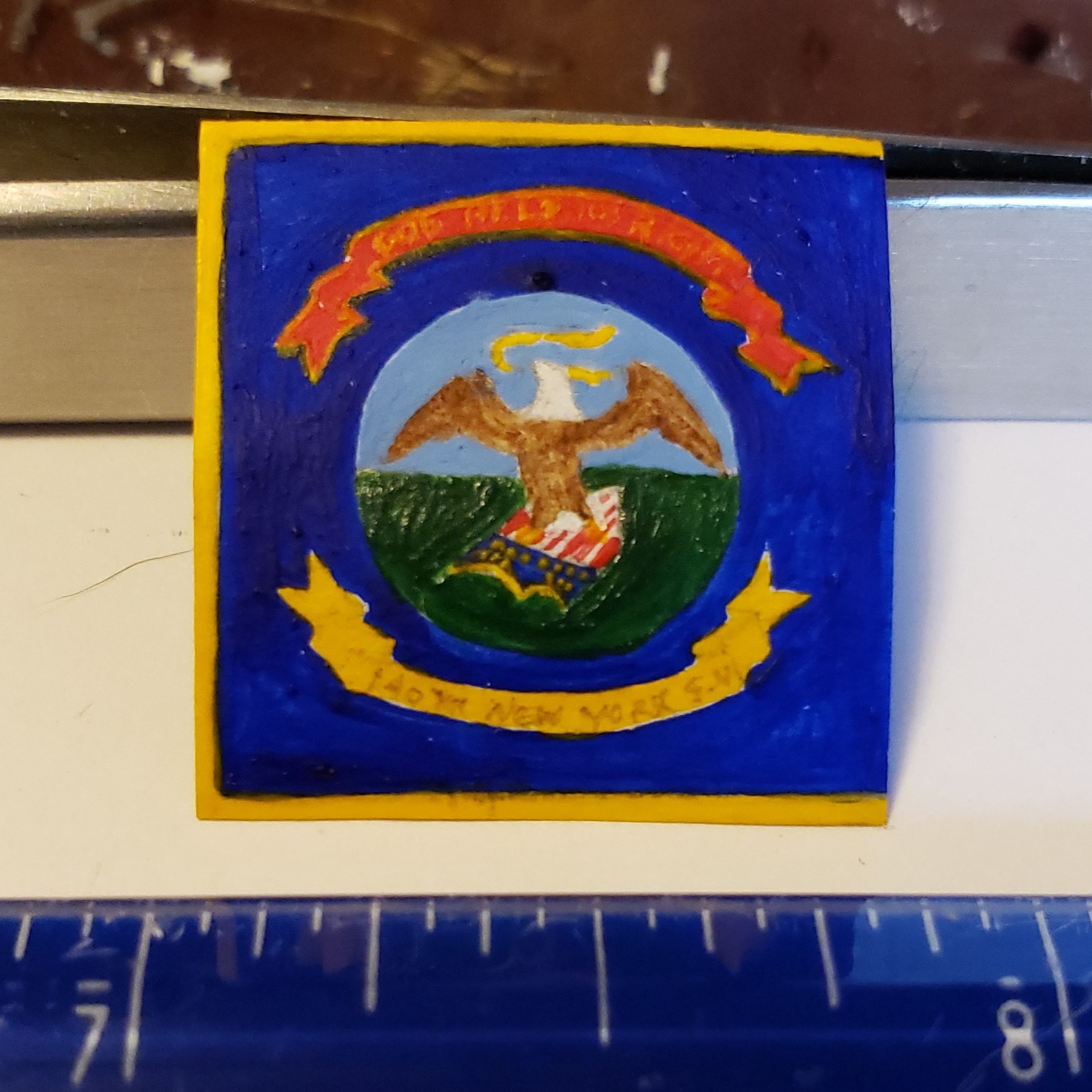
Each flag is hand-painted, following pictures of the actual flags, if we can find them. This one belongs to the 140th New York.
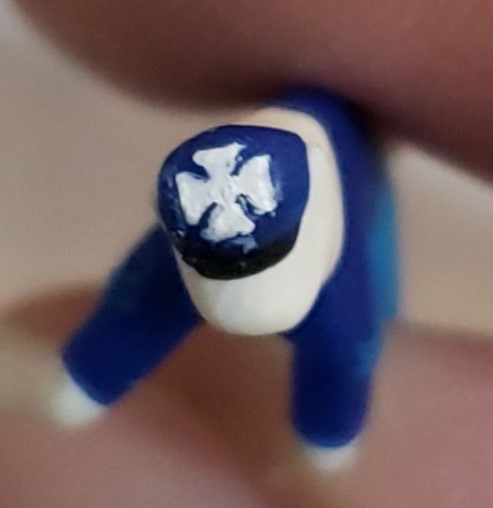
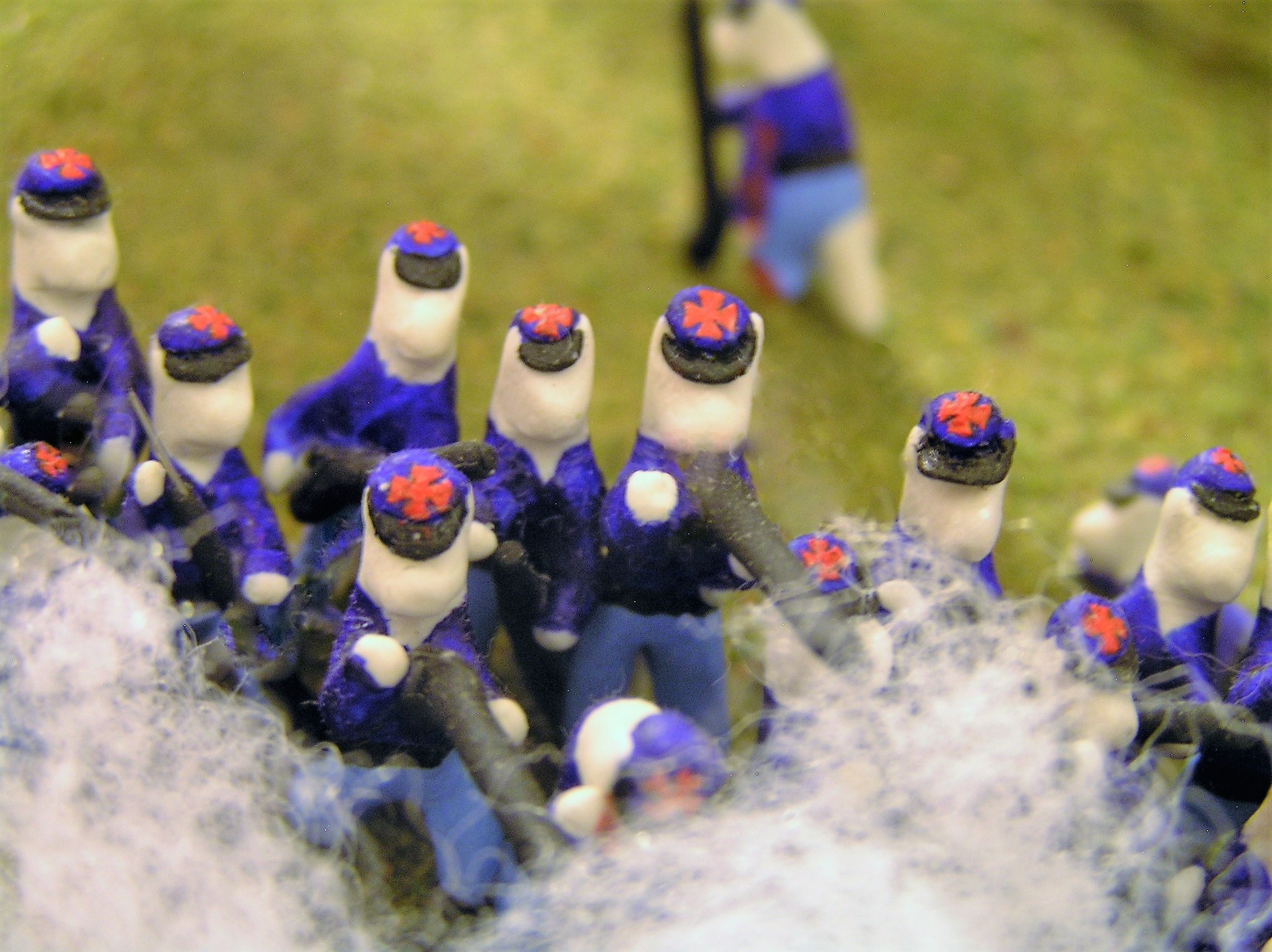
And, of course, the corps badges, which average 1/16-inch diameter.
The last corps badge to be painted!!
Sekigahara:
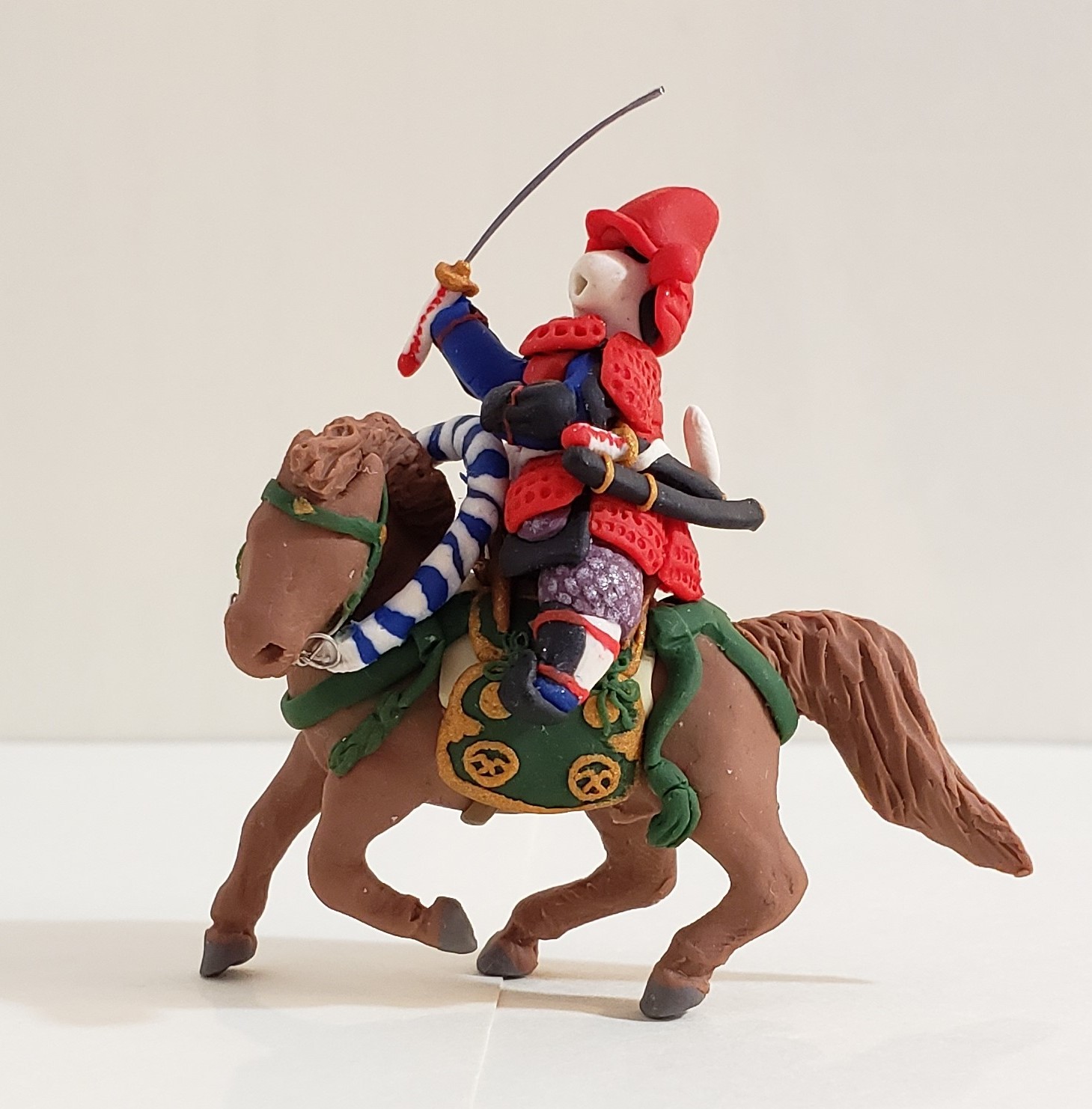
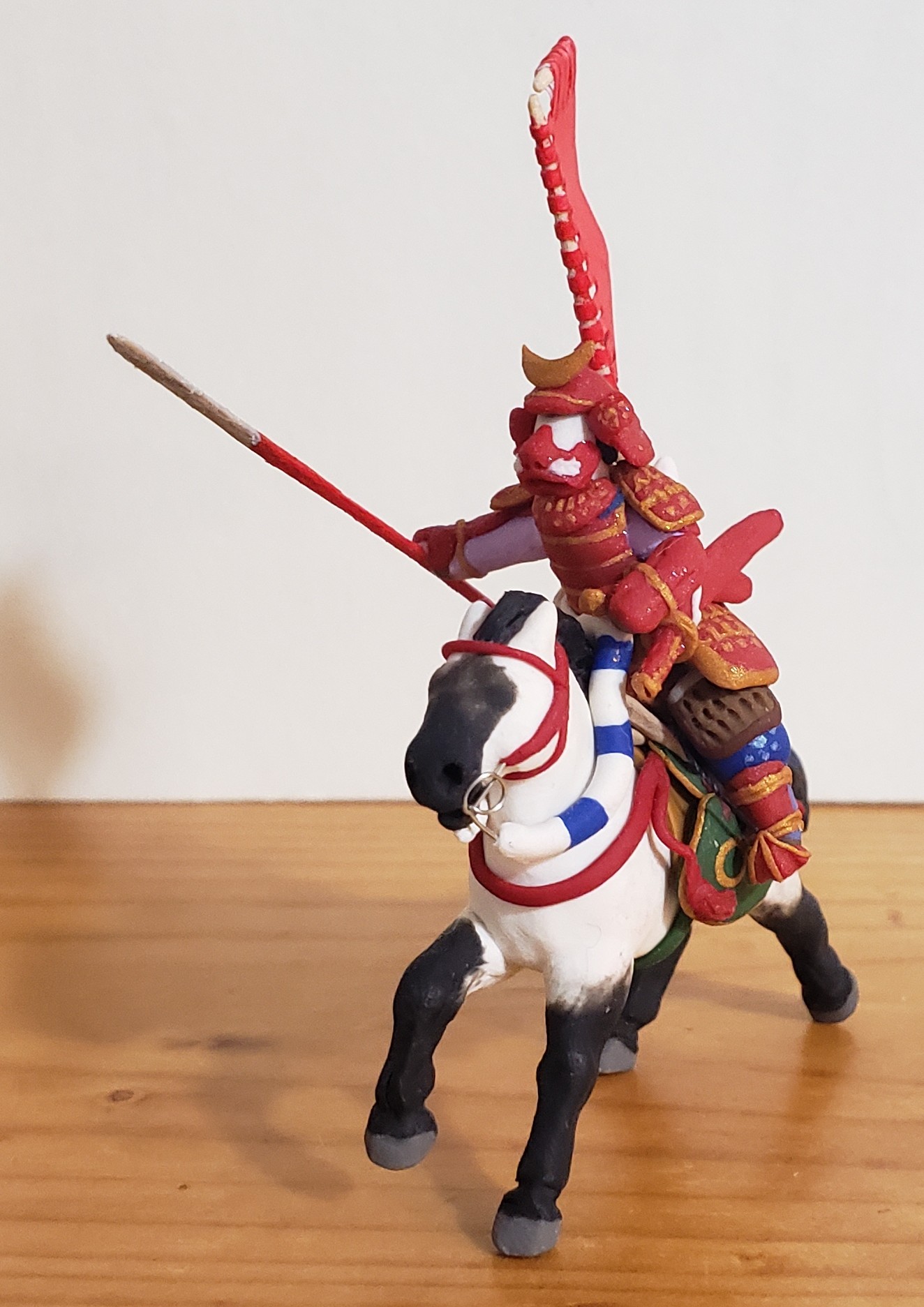
The samurai that Ruth makes for our Sekigahara display are 1.25-inch tall, made solely from colored Sculpey III (no paint) and with only a toothpick for a tool. She makes each according to the way a samurai would dress. This means that a lot of meticulously-added detail is covered up by subsequent layers!
Kobayakawa Hideaki is Rebecca’s favorite example to show visitors, because she tried to help with putting the dots on his pants. She did two rows, and then decided to stick to cheerleading Ruth instead! It is fun for us to see which crazy details we each prefer, and we stand in awe of each other’s nuttiness 😊
Ii Naomasa…
…and one of his “Red Devils”
USS Cumberland:
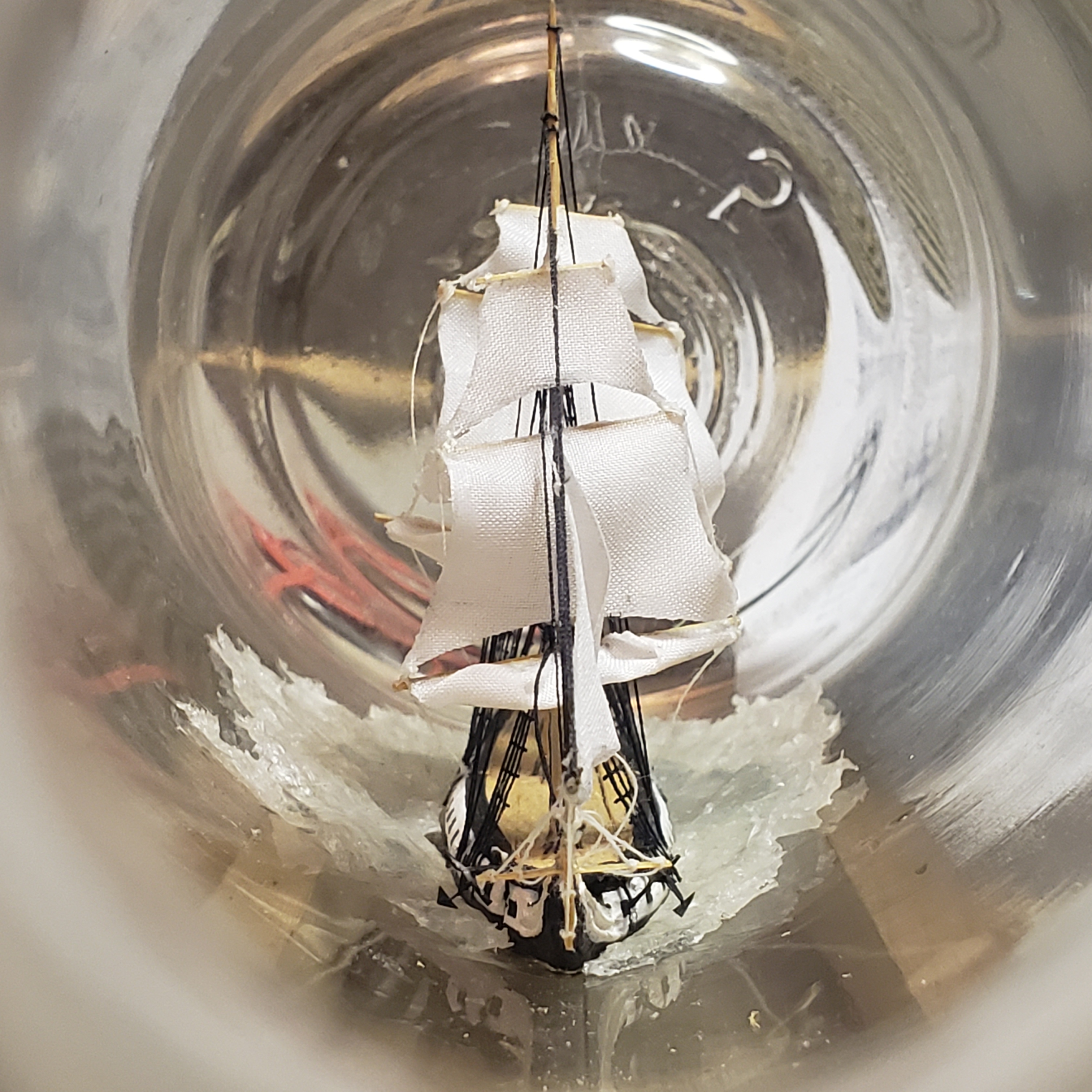
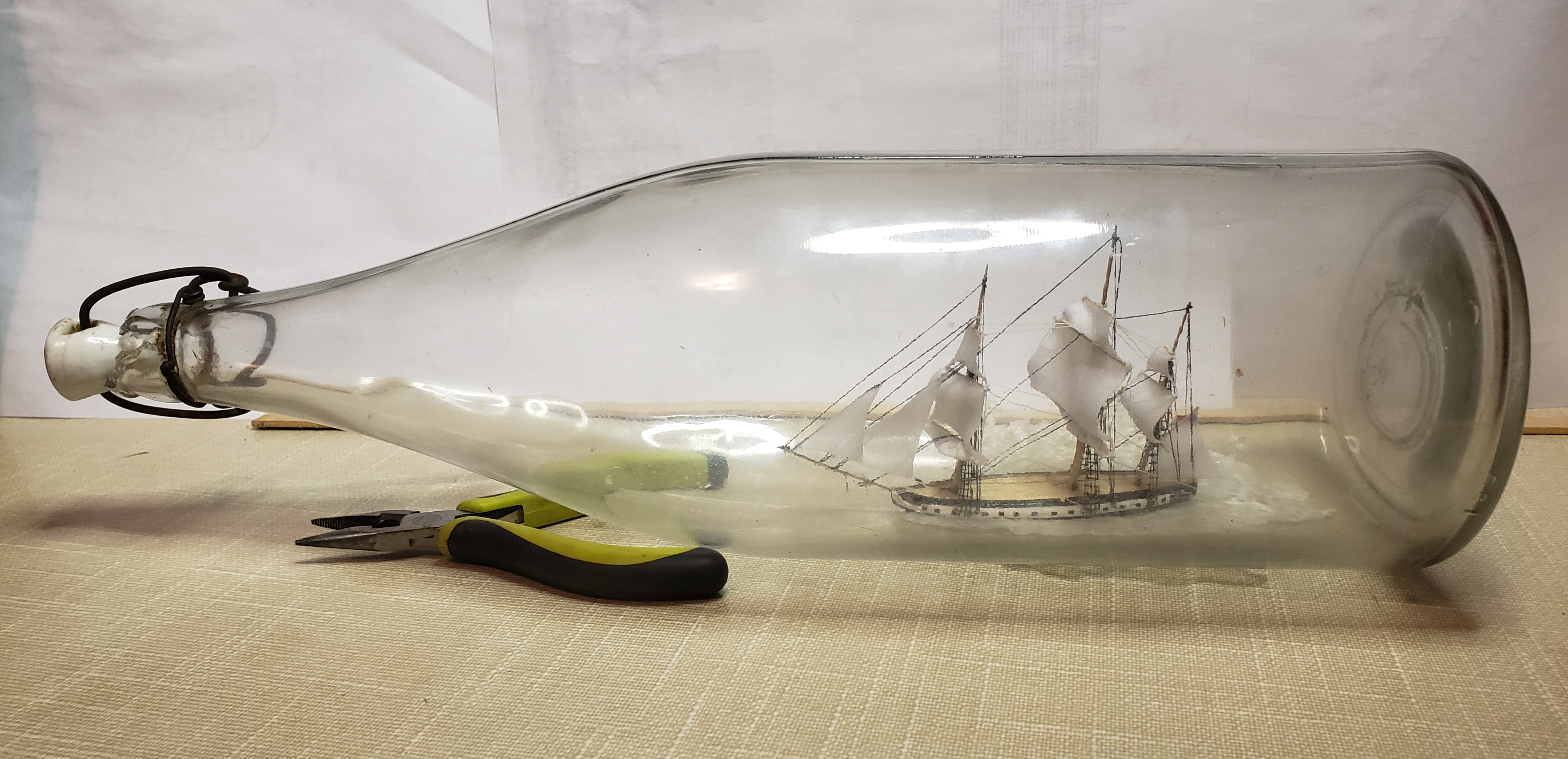
Instead of dots on pants, Rebecca’s nuttiness consists of…scratch-building ships in bottles. At Civil War Tails, you will see USS Cumberland in a bottle she found in Civil War Tails’ basement. In order to make the ship large enough to fill the bottle, she made the hull in three sections that could fit through the bottle’s mouth (as long as nothing, not even a thread, sat between the largest fighting top and the deck). She then had to glue down the shrouds and stays inside the bottle. At this point, Ruth’s mind explodes and she goes and makes samurai!





































 Civil War Tails at the Homestead Diorama Museum - Gettysburg miniatures