The Fighting 69th

P1160367 69th PA

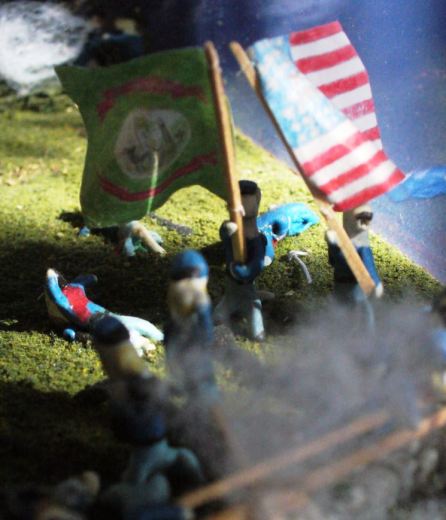
One of my favorite Union regiments from July 3, 1863 at Gettysburg is the 69th Pennsylvania. They were Irish immigrants and some had only been in the United States for a matter of months before they joined the Union army. The regiment did not start out as the “69th,” but was re-designated to reflect the Irish Brigade’s famous 69th New York regiment.

Back in the 1800’s, immigrants were looked down on and feared. With all the Germans and Irish coming in, how was an honest “old family” American to get a job? Does this sound familiar? Some things never change. The men of the 69th, like their fellow immigrants, were trying to work hard for their families and now were fighting hard–for their new home country. If they could prove themselves on the field, maybe they would be accepted in society.

On July 3rd, the 69th found themselves bearing the brunt of Gen. George Pickett’s charging Confederates. As Confederates swarmed over the stone wall at the Angle, the 69th stood alone, refusing to budge from their section of wall. On their right, there was nothing but gray uniforms. On their left, there was only an artillery battery, firing as best it could–but kicking stones into the backs of the men of the 69th.

As the men of the 69th fired as fast as they could, their brigade commander, Gen. Alexander Webb, joined them. One of his regiments had retreated and another stood on the crest, firing but refusing to advance. So he joined the plucky Irishmen of the 69th. What I find ironic is that up until then, he had despised the Irishmen. I wonder if he changed his opinion of them after the battle!

Gen Webb

Gen. Webb joins the 69th PA

Even with their right flank bent back into an L-shape by the pressing Confederates, the 69th held their position. In time, reinforcements arrived and pushed the Confederates back over the wall. The battle of Gettysburg was a Union victory, thanks in part to the Irishmen of the 69th Pennsylvania, who stood firm beneath the flags of their past and their future–the green of Ireland with its sunburst and keep, and the Union Stars & Stripes.

69th flags

The flags of the 69th PA

What Time Is It??

For most of us in the U.S., it’s time for Daylight Savings Time again, that time of year when we move our clocks forward an hour and “lose” an hour of sleep. They didn’t have to do this during the Civil War, which also means that if you want to experience the actual time of day of a Civil War event, you have to take DST into consideration.

Gettysburg is my favorite battle, and there’s something special about standing on the fields of Pickett’s Charge at 3 p.m. on July 3rd. But if I really thought about it, I should be standing there at 4 p.m.

Or, for example, on the 150th anniversary of the Battle of Cedar Creek (October 19, 1864), I stood on the battlefield in the dark, trying to figure out what “DST” time would be equivalent to 5:30 a.m. in 1864. For some of us, that takes some mental gymnastics. Still, perhaps it explains why armies tended to head out on a march at 4:30 a.m. Maybe it was because the sun was just beginning to rise, not because the generals had nothing better to do than drag their men out of bed in the middle of the night.

So if, this summer, you try to experience a Civil War site at the right time of day for the battle, remember to factor in DST!

OLYMPUS DIGITAL CAMERA

Welcome to Civil War Tails!

What do Gettysburg, Fort Sumter, ironclads, and cats have in common?? The Civil War Tails at the Homestead Diorama Museum! Check it out!

Our museum is full of dioramas we made by hand so you can see a 3-D snap-shot from the Civil War. Get a bird’s-eye view of a battle or get down to eye-level and see what a soldier would have seen. See the soldiers, the horses, the cannons, and the places. They’re all made with a one-to-one ratio, so each soldier on one of our dioramas represents one soldier during the real battle, not ten or twenty. And since they’re made to scale, if the hill looks really big to climb under rifle fire, that’s because it was!

And I’ll bet you’re wondering why our name is Civil War Tails. It’s not a typo. We started making soldiers when we were 11 years old and we have always loved cats, so the first soldiers were cats. In uniform. With beards. Now, years later, we still think that’s quirky and fun, and we hope you’ll agree.

But you don’t have to notice the tails to learn the history! Come see the smoky desperation in Fort Sumter during the bombardment that started the war. See how tattered Pickett’s Charge was by the time the Confederates struggled across the stone wall at the Angle at Gettysburg. Appreciate just how big and rocky Little Round Top was as the Confederates climbed it. Glimpse the suffering of Union POWs at Andersonville Prison (our great-great-grandfather’s step-brother, Pvt. Luke Brown of the 8th Pennsylvania Cavalry, is portrayed on that diorama!).

Sure, the cat angle is fun, but we want you to learn about the men and women behind the cats. As you look at our 3-D rendition of what they experienced, think about how they fought for what they believed in, and how their sacrifice ensured that we would have the rights and the great nation we enjoy now. This museum is meant to honor their memory by keeping it alive.

So come learn with us—and then find your own way to keep history alive!

We hope you enjoy your visit at Civil War Tails!