This past April, we were excited to make Cat 10,000 as Lt. George Morris of USS Cumberland. Today, we “mews” about the significance of Cat 10K for us, as well as who he represents and why.
Since 1999, we have kept track of every thousandth cat on our Census. (For more on our Census and K-Cats, see our Mewsing on Cat 9000 here.) As the Census neared 10,000, we felt that Cat 10K should be someone particularly special. Of course, he also had to come up naturally on a current project. Initially, we thought he would be on “The Boys Are Still There” (Little Round Top). But in February, we finished that diorama still 172 cats shy of 10,000. So, we began looking ahead.
As we did so, we also realized that 2025 will mark 30 years of making Civil War cats and 10 years of the Civil War Tails Diorama Museum! Naturally, the calendar for such a happy anniversary should focus on our K-Cats—which meant we needed to make Cat 10K this Spring! (Yes, the calendars are available here!) The push to make him meant that we needed to “fish or cut bait” on who he would be.

Having finished Little Round Top, we both started new dioramas. Ruth began working on a cavalry fight in Rockville, Md. We considered making Cat 10K to represent Col. Charles Russell Lowell, commanding the Union cavalry. Rebecca began working on CSS Virginia ramming USS Cumberland. Who on the ships could be a K-Cat candidate? While there were several options, Lt. George Morris stood out to both of us.
March 8, 1862, dawned a gorgeous but very ordinary Saturday in Hampton Roads, Va. On the Union ships, life went about as normal—washing laundry, holystoning the decks, and mending clothing, all in preparation for Sunday inspection. Cumberland’s captain, William Radford, headed off to USS Roanoke to serve on court-martial duty that day, leaving Lt. Morris, his second-in-command, in charge.* Little did they know that today, the one day the captain happened to be away, Morris and his crew would be thrown into a situation that no one in the Union Navy had ever experienced.
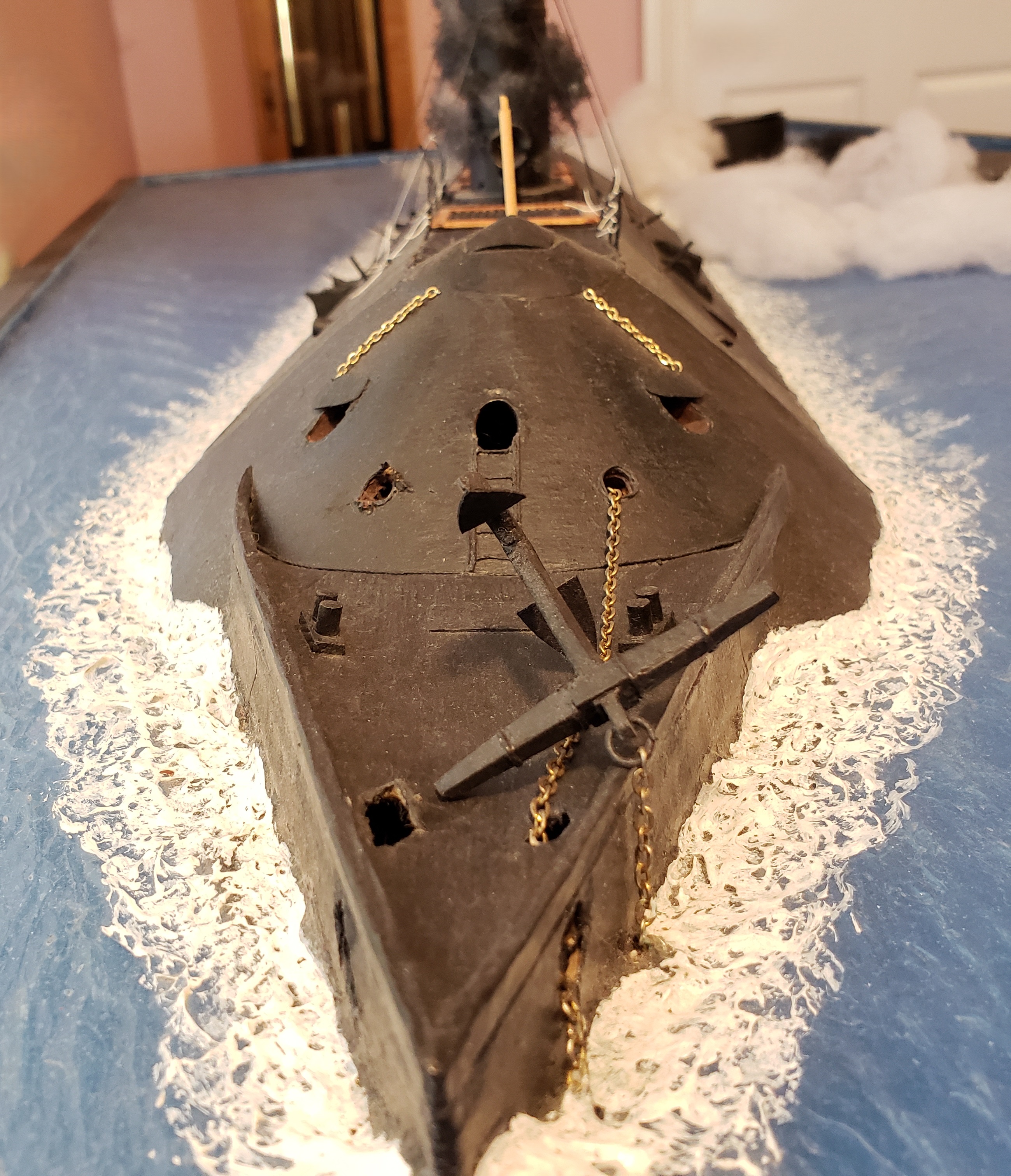
Around 12:30 p.m., everything about that ordinary day changed. The ironclad CSS Virginia entered Hampton Roads and turned towards the Union flotilla. Capt. Franklin Buchanan planned to ram Cumberland first, because her two 10-inch pivot guns concerned him. Virginia approached Cumberland from the front, so for a time the Union sloop could not bring any guns to bear. Eventually, the Union sailors were able to swing their ship slightly, and opened fire.
Even though Cumberland was half the size of newer ships like USS Merrimack, from which Virginia was constructed, she was not wimpy. When she fired a full broadside (eleven of her 9-inch guns), she sent a total of 880 pounds of iron to her target! Her crew had full confidence in their ability to face any opponent. Now, however, they watched their shots bounce off the Confederate ironclad, doing no damage. Still, they continued firing.
Virginia’s first shot in reply killed five Marines on Cumberland’s quarterdeck and wounded others. Her second shot killed fifteen of a seventeen-man gun crew, and severely wounded the gun captain. Those two shots were harbingers of the wooden ship’s fate.
Virginia rammed Cumberland on the starboard bow, opening a 7-foot hole in the wooden hull. Cumberland began sinking immediately. Still, her gun crews kept firing.
The two ships pounded each other for approximately 45 minutes at close range. Union Marine Daniel O’Connor records that his gun’s second shot was fired at a mere 45 yards! Even at such short range, the shot glanced off the iron casemate, doing nothing more than throwing sparks as it scraped along the iron. Meanwhile, every shell from Virginia wreaked havoc among the gun crews of the wooden ship. Enormous splinters ripped fromthe bulwarks and deck caused even more casualties. Cumberland, who that morning had been a beautiful, “splendid type of the frigate of old times” (Lt. Thomas Selfridge, forward division), was now “a scene of carnage and destruction never to be recalled without horror” (Master Moses Stuyvesant, aft division).
Lt. Morris oversaw the action from the quarterdeck or spar deck. What must have gone through his mind as he watched Virginia’s shells shattering Cumberland and destroying her men?
Several stories tell of a Confederate officer calling on him to surrender and of Morris’ firm refusal. There is debate as to whether or not the incident actually happened. However, O’Connor, who served on a gun crew in the stern near where Morris likely stood, records the story in a letter to his brother, written less than a week after the event.
According to O’Connor, Morris replied to the Confederate, “No! And d— you, you coward, you have made a slaughter house of the ship! We will sink with our colors first!”
“Sink it is,” the Confederate replied.
When O’Connor recorded his account he was not seeking glory for himself, Morris, or the ship; he was just writing home of his experiences. His words ring true as the gritty reply from a ship fighting to the bitter end, and give us a glimpse into Morris’ steadfast determination.
No one could blame Morris if he had chosen to surrender. Lt. Selfridge, in his reminiscences, noted, “There would have been no dishonor in surrendering to such odds,” since Cumberland faced an ironclad opponent twice her size and, in all reality, never stood a chance. But Cumberland never struck her colors. Selfridge continues,
and yet what would have been the result [of surrendering]? The Merrimac fresh from the surrender of the Cumberland, would have destroyed the fine steam frigate Minnesota…would have captured the remaining naval force at Hampton Roads,…and when the Monitor arrived late Saturday night she would have found herself alone.
As it was, Virginia was at the mercy of the tide, and the longer she dealt with Cumberland, the less time she had to maneuver without risking running aground. Morris’ decision and Cumberland’s sacrificial fight bought time for the other ships.
Morris’ decision was not in opposition to the feelings of his crew. First-hand accounts from his officers and men do not show regret that the ship kept fighting. In fact, the thought of surrender or escape seems never to have crossed their minds; they manned their guns until the order came to abandon ship.
By 3:35 p.m., Cumberland’s bow had sunk so far that the water reached the main hatch in the middle of the ship. Lt. Morris sent word to get any wounded who could walk out of the cockpit below decks—“Save all who can!”—and then finally ordered, “All hands save yourselves!”
Men climbed out of gun ports and hatches, or jumped overboard. Some wounded managed to make it off, but those below decks or too badly injured to move drowned. Cumberland sank in 54 feet of water, so her masts remained above the surface, allowing men to climb the rigging and wait for small boats to rescue them.
Acting Master’s Mate Charles O’Neil jumped overboard and managed to scramble into the sailing launch. He recalled seeing men in the water all around the boat, including Lt. Morris, “struggling by himself.” O’Neil passed him a boathook and drew him alongside. As O’Neil and others pulled him into the boat, Morris said, “Don’t let go of me, for I can’t swim.”
Can you imagine standing on the deck for nearly an hour, watching the bow sink lower and lower, knowing that saving the ship is impossible, and knowing that you can’t swim? (The inability to swim was not unusual for a sailor of that time.) If Morris had surrendered, he could have ensured a safe trip to shore in a boat. But he did not let his personal situation or fears affect his actions as commander. It was not until he was in the water that he thought of himself. Even then, as soon as he reached shore and saw his boatload of men safely off, he returned to Cumberland’s wreck to recover the flag and any survivors.^ Whatever fear he had felt while in the water, whatever exhaustion he must have felt after the adrenaline rush of the last hour, he still did his duty as the ship’s commander, thinking of the men left behind and the Stars and Stripes left flying undaunted and defiant.

So, what became of Cumberland’s gallant crew and Lt. Morris? Long after the war, Selfridge wrote, “And yet the government bestowed neither promotion or medals upon the officers and crew of the Cumberland.” He also felt that history had already forgotten Cumberland and her crew, and that “the memory of her deeds are almost unknown.”
Dioramas, for us, are a way to honor and remember a story, and ever since we first read about Cumberland years ago, we felt she begged for a diorama. As Confederate Lt. John Taylor Wood (Virginia) wrote, “No ship was ever fought more gallantly.” This is why we are excited to begin this work.
As we read the anecdotes about Morris, we agreed with the conclusion made by a Confederate observer on shore, “A gallant man fought that ship.” As we discussed candidates for Cat 10K, we felt that Morris’ story also seemed to embody the determination of Cumberland’s crew as a whole. Honoring him would honor the entire crew.
Some might say it’s “only” a clay cat, it’s “only” a diorama. But we look forward to sharing Cumberland’s story with museum visitors. It will be helpful to have both dioramas in order to show the contrast between the first day of iron vs. wood, and the second day of iron vs. iron. But closer to our hearts is the desire to commemorate Cumberland and her crew. Sharing a historical story has always been the purpose of our dioramas, from our first little scene in 1998 to the completion of “The Boys Are Still There” in 2024. It is one thing to mention Cumberland’s fight as we speak about Virginia and Monitor, but it is another thing to show it. Even in the early stages of research, we feel a weight of responsibility to do all we can to convey the emotion of Cumberland’s story and the steadfastness of her gallant crew, and to get the details right in order to best portray a ship “Destroyed But Not Conquered.”
Note: spelling and punctuation in the quotes have been updated, as needed.
*As soon as Capt. Radford learned that Virginia had come out, he took a boat to shore, found a horse, and galloped for Cumberland. By the time he arrived, his ship had already been destroyed.
^Morris found neither. Other small boats had picked up survivors, and Lt. Selfridge, who also returned to the wreck, had recovered the flag.
 Civil War Tails at the Homestead Diorama Museum - Gettysburg miniatures
Wow! What a great retelling about the Cumberland – and the war. And I enjoyed seeing a peek at your new calendar! Another winner! Congrats! Love, Mom
LikeLike
Pingback: “The Boys Are Still There” – 11 Years in the Making | Civil War Tails at the Homestead Diorama Museum – Gettysburg miniatures