Christmas Angels

Christmas is a time when we think about angels. It began over 2,000 years ago, when angels appeared to some shepherds, announcing that Christ had come to save the world from sin and its penalty of death. Over the centuries, traditions grew, and now we put angels on top of our nativity scenes and dress our little kids up in wings for the church pageant. But this week at Civil War Tails, we’re thinking about another December angel. Maybe you know his story.

306-usw-kirkland

A scene inspired by Sgt. Kirkland

On December 13, 1862, Union troops threw themselves against the Confederate position at Fredericksburg, Virginia, charging over and over across an open field to hit the stone wall on the rise above them. Sound familiar? Seven months later, the Confederates would do much the same thing at Gettysburg.

After the fighting had dwindled away, Confederate Sgt. Richard Kirkland sat in safety behind the stone wall and listened to the cries of the Union wounded. The calls for help and water bothered him until he could no longer sit and do nothing. Gathering as many canteens as he could from the Confederates around him, he clambered over the wall and hurried down to the Union wounded.

At first, Union troops fired at Sgt. Kirkland—until they realized his mission of mercy between the lines. Undaunted, Sgt. Kirkland gave water to as many wounded as he could before returning to his own lines once more. Since then, he has been known as the Angel of Marye’s Heights.

I can’t help but wonder, with the battle occurring only a few weeks before Christmas, if his actions saved lives that otherwise would not have seen another Christmas or the end of the war? A drink of water is such a small thing, but it can make a difference to one who has lost blood from a wound, and a simple act of kindness can lift one’s spirits and give hope.

This Christmas, perhaps you can be a Christmas angel to someone. An act of kindness may seem insignificant to you, but maybe it is the difference between life and death (emotionally, financially, spiritually) to the recipient. You may never know the end of the story—only God and the other person will—but that’s OK. Like Sgt. Kirkland, let’s do the right thing—not looking for reward or praise for ourselves but purely out of love and concern for the other person.

After all, isn’t selfless love the real reason for Christmas? Sgt. Kirkland knew he was risking his life when he crossed that wall, but he did it anyway because he wanted to save the lives of his enemies. When Jesus was born, he was the Son of God, knowingly coming to not just risk his life but to lose it when he died on the cross. He came because he, too, wanted to save the lives of his enemies—us, the ones who aren’t perfect and can’t be perfect. This Christmas, let’s have the same selfless love and desire to help others, even our enemies.

Merry Christmas, everyone.

How Important Was Little Round Top?

The fight for Little Round Top is one of those topics that has two well-divided sides among those of us who love history. On the one hand, there are those who argue that the fight for Little Round Top saved the Union Army by preventing the Confederates from getting artillery up on the hill and enfilading the Union line.  On the other hand, there are those who argue that the Confederates could not have gotten artillery up there, so it’s a moot point.

Could the Confederates have gotten artillery up that hill?  This seems to be the basic question.  I have not done heavy reading on the pros and cons of the two sides of the issue, but I can’t help but think, if Lt. Hazlett managed to wrestle his battery to the crest of Little Round Top, why would we think the Confederates would not be able to?

p1240681

If Longstreet’s men had taken Little Round Top that afternoon—either by pushing Vincent’s brigade off (by breaking the 20th Maine or by breaking the right flank had O’Rorke not arrived in time) or by arriving before Vincent (Longstreet himself said that he was ten minutes late in occupying the hill, the timing was so close)—the Confederates could have had all night (or longer) to work guns up the hill.  They did manage to get Capt. Smith’s guns off Houck’s Ridge near Devil’s Den during the night of July 2-3.  That is not quite the same, but it is still moving a couple-thousand-pound cannon on a rocky slope in the dark, preferably without injury.

If the Confederates did get cannons up the hill, could the artillery have inflicted damage?  On July 3, Hazlett’s battery, under the command of Lt. Rittenhouse, pounded Kemper’s brigade, on Pickett’s right flank, as the Confederates crossed the fields to the Angle and Copse of Trees.  Whatever the extreme range of the guns would be—depending on the type of cannon that the Confederates would hypothetically bring onto Little Round Top—the center of the Union army is clearly reachable.  Certainly the left flank would be exposed and vulnerable, since Little Round Top commands the ground north of itself.  Artillery pounding the Union left flank would weaken the line and could enable Confederate infantry to begin rolling up the flank, just as Stonewall Jackson’s infantry had rolled up the Union right flank at Chancellorsville.

Does the fate of Gettysburg hang on Little Round Top?  Maybe, maybe not.  The more I read, the more I am convinced that a lot of little things combined to bring about the Union victory.  But I think Vincent’s brigade, Hazlett’s battery, and O’Rorke’s 140th New York Regiment certainly helped to save the Union army.

Suggested Reading this Remembrance Day Weekend

Here at Civil War Tails, we’re excited to welcome local author Juliana Love for a book signing this Saturday, November 19th. Come on out for the Remembrance Day Parade at 1:00 p.m. and then swing by Civil War Tails to meet Juliana, as well as some members of the cast of her upcoming movie “This Fair and Blighted Land,” based on the first book of her series.

Juliana Love has written a series of novels that blend the story of the battle of Gettysburg with present day adventures in a way that will keep you turning every page.  While the stories center around modern day Summer Ray Sherwood and the ghostly General of the Unknowns Michael McDaniels, these books are much more than a ghost story.  They draw us into Summer Ray’s struggle with traumatic brain injury (TBI) and her journey to discover her purpose in life in the wake of a terrible accident.

It is a sometimes-chaotic world, with demons and angels, shadowed memories and glimpses into the past 150 years ago, pain and resentment—but also glory and hope and the promise of healing and peace.  From the depths of depression and suicide, Summer Ray embarks on a journey that will test her faith in her loving God as she searches for healing for herself and also seeks to bring peace to the Unknown soldiers whose identities history has lost and forgotten forever.

A Little Halloween Fun…

We are often asked whether our house is haunted, particularly given its history related to the old orphanage. As far as we know, it’s not, but then again…you never know what you might find after hours!

desperation-at-skull-camp-bridge-bay-ghost

The Angle comes to life…

p1230981-angle

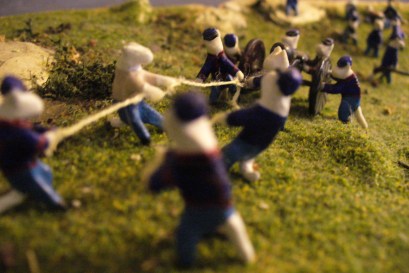
As the 69th Pennsylvania fights for their lives.

p1240512-69th-ghosts-green-tint


Ghosts patrol the night waters…

merrimack-ghost-ship

And fill the shadowed forests.

p1220596-spear-ghost

OLYMPUS DIGITAL CAMERA

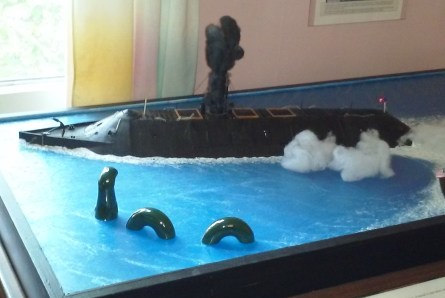
Here, there be monsters!

nessie-visits-the-ironclads

And apparitions!

ghost-in-cloud-blurred

Happy Halloween, everybody 🙂

ghost-on-lrt-blurred


Snatching Victory from the Jaws of Defeat . . . And Defeat from the Jaws of Victory

Today is the anniversary of the Battle of Cedar Creek, a battle you may not know about, but should! Not only is it a classic story of the complete reversal of fortunes, but it is said to have helped Pres. Lincoln achieve reelection.

p1240975-sheridan-close-clean

In the fall of 1864, Union Gen. Phil Sheridan’s mission was to destroy the “breadbasket of the Confederacy,” the Shenandoah Valley in Virginia. By the middle of October, he had defeated the Confederate army under Gen. Jubal Early at the battles of Winchester and Fisher’s Hill and conducted “the Burning,” laying waste anything that could be used by the southern armies. The Union army figured they were pretty much done their work, and Sheridan was called away to a meeting in Washington.

But the Confederates weren’t done with the Union army, yet. Gen. John Gordon saw an opening to strike, and after a night march, his men burst out of the predawn darkness and fog at 5 o’clock in the morning on October 19th. The Union soldiers were hardly even awake—some weren’t—and were completely routed. They didn’t even have time to dress, let alone fight back. Only the VI Corps held their ground for a while and prevented complete disaster.

Sheridan and his party were 12 miles away in Winchester, on the way back from Washington. Hearing gunfire in the distance, the small, feisty general jumped on his tall black gelding, Rienzi, and trotted towards the front. This was to become known as “Sheridan’s Ride,” and is often romanticized into Sheridan galloping twenty miles. But no horse can gallop even twelve, so it is likely that he trotted, although it was probably a fast trot! Those twelve miles must have felt like a lifetime, hearing the cannon fire and not being able to do anything yet, then seeing the fragments of a shattered army trickling by and wondering what was going on up ahead.

As Sheridan met retreating soldiers, he waved his cap and urged them to “Face the other way!  We will make coffee out of Cedar Creek tonight!” With cheers, the men began to reform. Sheridan jumped Rienzi over some entrenchments and rode down the line, inspiring his men.

A lull fell over the battlefield as the Union army reformed and the exhausted, hungry Confederates plundered the camps.  Then, at 4 p.m., Sheridan launched a counterattack that pushed the Confederates back across Cedar Creek. Early’s one chance at victory had ended like the other battles and, ultimately, the Confederate effort to stop Sheridan—in defeat.

Cedar Creek was a major victory, and some credit it with contributing to Pres. Lincoln’s reelection.  Up until then, Lincoln’s chances were slim.  Gen. Grant was racking up the butcher’s bill in Virginia, and it was looking like Gen. McClellan might win the presidential race, which would have resulted in peace—and a split nation.  The turnaround at Cedar Creek gave Lincoln a glorious victory that he could use to his advantage, and that would ultimately mean a united country.

Bay…or Sorrel?? What Happened to Gen. Kemper?

Sometimes dioramas can lead you to find interesting connections between facts–connections that might otherwise go unnoticed. My research for the Angle during Pickett’s Charge led me to a conclusion that I haven’t seen in any of my reading. Perhaps you have–I would be happy to hear back from you on that!

It all began with accounts that mention General Kemper being mounted on a bay horse and other accounts that mention him on his “mettlesome sorrel.”

“What’s the big deal?” you may ask.

Well, it may sort out where the general was finally wounded. Here we go:

I like horses, and we would need to know which it was if we wanted to portray Gen. Kemper on a diorama. So it puzzled me as to what color horse he really had. After all, back then, I’m sure most if not all of the soldiers would know the difference between a sorrel and a bay:

p1070929-skullcamp-sorrel-clean

Sorrel (brown with brown mane)…


desperation-at-skull-camp-bridge-bay-clean

…Bay (brown with black mane)

Then I found differing accounts of Gen. Kemper’s wounding. Some placed him near the Codori farm when he was wounded. Others placed him right at the stone wall. A visit to the battlefield shows a big difference between the two locations. The farm is probably 1/3 mile away from the wall.

So here’s my theory: Gen. Kemper started the charge on his sorrel, which fell at the Codori farm. Soldiers saw him (and his horse) go down and then didn’t see him remount a bay (probably a staff officer’s). Other soldiers then saw him on a bay as they neared the wall. Then, Gen. Kemper himself fell wounded up by the stone wall.

This is just a theory from my attempts to reconcile conflicting accounts. What do you think?

Returning Home to Nothing

Lydia Leister was a widow and mother of six when the Union and Confederate armies converged on Gettysburg in 1863. Like others in the town, she fled her home during the battle. By the time she returned to her home, she had lost nearly everything.

p1240962-autoThe Union commanding general, George Meade, had made his headquarters in the Leister home, located on Taneytown Road just over the hill from the Angle. During the Confederate bombardment preceding Pickett’s Charge, shells meant for the Union positions at the Angle overshot and hit Lydia’s property instead, damaging the house and killing soldiers’ horses tied in the yard.

When Lydia returned, she was probably relieved to see that her house still stood, but that feeling must have been dampened by the stench of sixteen horses lying dead around her home and the fact that her fences had all been destroyed. She would have seen that her entire crop of wheat had been trampled into the ground by passing soldiers. She had put in extra wheat that year, hoping to pay off her land. Now, she would be lucky if she had enough to get her family through the winter.

Getting closer to her house, Lydia would have seen that both posts supporting her porch roof had been blown away. Looking up, she would have noticed a hole in her roof, maybe also the hole in the end of her house. Running inside, she would have seen that the shot that came through her roof had knocked out a rafter, and that another shot through her house had destroyed a bedstead. She may even have had water in her house from the July 4th rain, coming through the hole in the roof. Wandering through her house, Lydia would have noticed that all of her food had disappeared, except for a little bit of flour.

But the loss and destruction did not end for Lydia on July 4th when the army left the area. The rotting horses in her yard spoiled her spring so that she had to have a well dug. Her peach tree was killed when dead horses were burned near it.

By the time a correspondent visited two years later, all Lydia had received for her losses was a few dollars from selling the bones of the dead horses. The correspondent found a woman “centered in her own losses” and caring nothing for the broader picture of what the country may have lost or gained by the battle. Can we blame her?

19th Century Tech Woes

p1160341-signal-corps-closeupTechnology is an amazing thing. Perhaps more amazing is the way we take it for granted. We gripe all too quickly when it doesn’t work, but how often do we think about how fascinating it is to be able to click a mouse and have something happen on the screen, all communicated by…well, I don’t even know!

During the Civil War, communication depended on couriers (who could be shot) or the telegraph (whose wires could be cut). There was no WiFi. There were no radio signals. If the courier was killed, the orders never got there, and fighting units ended up stranded.

Before the war, Albert Myer and E.P. Alexander developed a communication system that could be used by an army when the distances were too great for a courier on horseback. It was a 19th Century cell phone: fully mobile, it could travel with the army and did not require setting up a landline (telegraph wires). Encryption was necessary though–at the war’s start, Alexander when South and Myers went North, which meant both sides had the technology and could read the messages!

What was this new-fangled tech, you ask? The Signal Corps or “wig-wag” system. A typical station involved three men: one to use a flag to send coded messages, one to read incoming messages, and one to write it all down. The system used a series of numbers. A dip of the flag to the left was a 1, a dip to the right was a 2, and a dip straight in front was a 3. “3” was used to signal the end of a word (3), sentence (33), or message (333). “1” and “2” were used in combinations to represent letters or words.

  • “1 3 12 33 11222 3 111 333” = “Advance artillery. Resume attack.” (using set phrases)
  • “Jump.” = 2211 [J] 221 [U] 2112 [M] 2121 [P] 333 [end of message]. (spelling it out)

Stations could be set up miles from each other, thanks to telescopes, and they could work at night, using torches instead of flags. The system worked quite well. Except for the weakest part: the humans.

Sending messages only worked if the crew on the receiving end noticed the continuous wig-wagging meant to get their attention. On July 3, 1863, a signal station on a mountain miles away from Gettysburg noticed the Confederates moving an awful lot of cannons into position along Seminary Ridge. Frantically, the station signaled to its relay with the Union army. They were never noticed, so their warning was never delivered!

Fortunately for the Union army, the ensuing smoke caused the Confederate artillery to overshoot, inflicting less damage than intended and allowing for a Union repulse of Pickett’s Charge. As it turned out, the breakdown in communication technology did not end in the Union army’s destruction. But I imagine there was a soldier cussing out his limited technology!

Some things never change.

Celebrating Our First Anniversary!

On Labor Day Weekend, we’ll be celebrating our First Anniversary here at Civil War Tails! Join us Friday-Saturday (September 2-3) and Labor Day (September 5), for $1 off admission and a scavenger hunt with prizes.

The kitties and their humans would like to thank everyone who has visited us over the last year. We have had a great time meeting you and chatting with you, sharing the stories on our dioramas and learning from your knowledge of the Civil War, too! We also want to thank everyone who has kept up with us online, even if we haven’t met you in person yet (there’s always next year!). It is encouraging to see the interest from all of you even in this, the first year of operation.

We look forward to many more years of sharing history with you and giving you a glimpse of what it would have looked like–minus the tails!

Please note that our hours on Labor Day will be different than usual. We’ll be opening at 10:00 a.m. but closing at 4:30 p.m. because, much though the cats would love to keep sharing history with you, their humans have other plans. 

P1230976

2017 Calendar Offers a Peek at Skull Camp Bridge

Desperation at Skull Camp Bridge 07 blur crop

Detail

The 2017 Civil War Tails calendar is now on our shelves! In it, you’ll find pictures from not only dioramas we have on display, but also a couple of dioramas that are in storage, awaiting release. One of these tells the story of Skull Camp Bridge. Never heard of it? Well . . .

On June 27, 1863, the Confederates evacuated Shelbyville, Tennessee, to avoid being cut off from the main army. Gen. Joseph Wheeler’s small force of cavalry formed the rearguard and fought to hold back the Union cavalry so that the wagon trains could escape and because they expected Gen. Bedford Forrest’s cavalry to join them shortly.

After much fighting, Gen. Wheeler withdrew over the bridge, figuring that Gen. Forrest was not coming after all. However, when he learned that Gen. Forrest was within sight of Shelbyville, he re-crossed the bridge with 400 volunteers. Things did not go well. The Union cavalry broke through his line and overran his cannons, and an overturned caisson blocked the bridge.

Some of the Confederates scattered up and downstream in the growing dusk. Some were captured. Sixty, with Gen. Wheeler, cut their way through the Union line and leaped at full speed into the river fifteen to twenty feet below. Only about twenty made it across the river. Gen. Forrest, hearing the firing, crossed safely four miles downstream.