Today is the anniversary of the Battle of Cedar Creek, a battle you may not know about, but should! Not only is it a classic story of the complete reversal of fortunes, but it is said to have helped Pres. Lincoln achieve reelection.
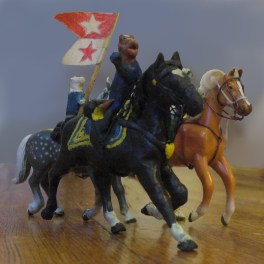
In the fall of 1864, Union Gen. Phil Sheridan’s mission was to destroy the “breadbasket of the Confederacy,” the Shenandoah Valley in Virginia. By the middle of October, he had defeated the Confederate army under Gen. Jubal Early at the battles of Winchester and Fisher’s Hill and conducted “the Burning,” laying waste anything that could be used by the southern armies. The Union army figured they were pretty much done their work, and Sheridan was called away to a meeting in Washington.
But the Confederates weren’t done with the Union army, yet. Gen. John Gordon saw an opening to strike, and after a night march, his men burst out of the predawn darkness and fog at 5 o’clock in the morning on October 19th. The Union soldiers were hardly even awake—some weren’t—and were completely routed. They didn’t even have time to dress, let alone fight back. Only the VI Corps held their ground for a while and prevented complete disaster.
Sheridan and his party were 12 miles away in Winchester, on the way back from Washington. Hearing gunfire in the distance, the small, feisty general jumped on his tall black gelding, Rienzi, and trotted towards the front. This was to become known as “Sheridan’s Ride,” and is often romanticized into Sheridan galloping twenty miles. But no horse can gallop even twelve, so it is likely that he trotted, although it was probably a fast trot! Those twelve miles must have felt like a lifetime, hearing the cannon fire and not being able to do anything yet, then seeing the fragments of a shattered army trickling by and wondering what was going on up ahead.
As Sheridan met retreating soldiers, he waved his cap and urged them to “Face the other way! We will make coffee out of Cedar Creek tonight!” With cheers, the men began to reform. Sheridan jumped Rienzi over some entrenchments and rode down the line, inspiring his men.
A lull fell over the battlefield as the Union army reformed and the exhausted, hungry Confederates plundered the camps. Then, at 4 p.m., Sheridan launched a counterattack that pushed the Confederates back across Cedar Creek. Early’s one chance at victory had ended like the other battles and, ultimately, the Confederate effort to stop Sheridan—in defeat.
Cedar Creek was a major victory, and some credit it with contributing to Pres. Lincoln’s reelection. Up until then, Lincoln’s chances were slim. Gen. Grant was racking up the butcher’s bill in Virginia, and it was looking like Gen. McClellan might win the presidential race, which would have resulted in peace—and a split nation. The turnaround at Cedar Creek gave Lincoln a glorious victory that he could use to his advantage, and that would ultimately mean a united country.
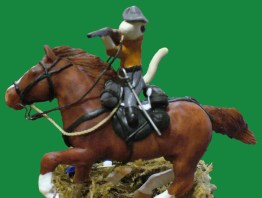

 The Union commanding general, George Meade, had made his headquarters in the Leister home, located on Taneytown Road just over the hill from the Angle. During the Confederate bombardment preceding Pickett’s Charge, shells meant for the Union positions at the Angle overshot and hit Lydia’s property instead, damaging the house and killing soldiers’ horses tied in the yard.
 Technology is an amazing thing. Perhaps more amazing is the way we take it for granted. We gripe all too quickly when it doesn’t work, but how often do we think about how fascinating it is to be able to click a mouse and have something happen on the screen, all communicated by…well, I don’t even know!
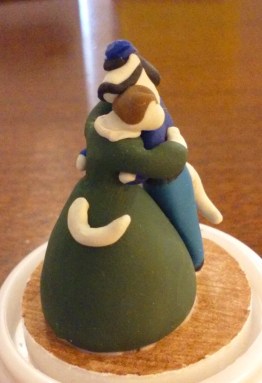 It’s been said that a good book (or any work of art) leaves you with questions, wanting to know more. Today, I was working on assembling cats in small domes to sell in our gift shop. They’re all cute, and sometimes it’s hard to part with them because they turned out so well, but this time there was a husband and wife set that Ruth made that struck me the first time I saw them, and has continued to make me pause every time I look at them.
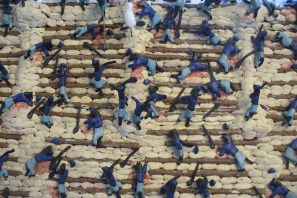 Today is the 153rd anniversary of the first time the men of the 54th Massachusetts Volunteer Infantry saw combat. In two days, we will reach the 153rd anniversary of their second fight: the assault on Battery Wagner. It was there that the men of the 54th proved that they could fight . . . by losing nearly half of the men who went into battle.
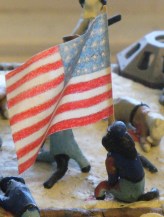 The regimental color-bearer, John Wall, fell, but Sgt. William H. Carney picked up the flag. He knelt on the wall with the colors until the regiment fell back. By the time he reached the hospital, Sgt. Carney had been wounded in the head, breast, arm, and both legs. He simply told the men in the hospital, “I but did my duty. The dear old flag never touched the ground.” For his courage, Sgt. Carney received the Congressional Medal of Honor in 1900. His was the earliest action for which the Medal of Honor was awarded to a black soldier.

