A First Step

Today is the anniversary of the surrender of General Robert E. Lee’s Army of Northern Virginia to General U.S. Grant at Appomattox Court House, Va. We had the privilege of traveling to Appomattox for the 150th anniversary last year. One thing I took away from the trip (besides red Virginia mud!) was a new appreciation for Gen. Grant and the way he handled the surrender. I touched on this briefly last week, but wanted to share some more thoughts on the topic.

Gen. Lee and his army were the enemy. But Gen. Grant recognized that they were now his countrymen again. He gave the Confederates generous terms, and every decision was designed to promote recovery (allowing them to take their horses or mules to work their farms) and peace (ordering his own men not to cheer and rub it in). He even had rations issued to feed the starving soldiers. Because Gen. Grant saw his enemy as human beings and not just defeated foes, healing began immediately after the end of the fiercely-fought war.

What do you think? As you think about your life and the people you disagree with, would you be able to set aside past disagreements and take that first step towards reconciliation and healing? Are we able to see the humanity in people we have fought with, whether a spouse or an enemy combatant, and show them kindness instead of rubbing it in? Gen. Grant could not change the heart of a nation, but he did what he could to start the healing. We can follow his example and take that first step forward in our own relationships, towards healing.

Purpose

As we near the anniversary of the surrender of Gen. Lee’s Confederate army at Appomattox, I’ve been doing some thinking about the man who brought it all about–Gen. Ulysses S. Grant.

Before the war, Grant seemed like a failure.  He tried his hand at all sorts of jobs, but none worked out.  The only thing he seemed good at was soldiering–but the United States was at peace.  When the Civil War broke out, Grant returned to the army and, it seemed, his element.  While Union generals kept losing to Lee in Virginia, Grant steadily won in the western theater.  On July 4, 1863, he accepted the surrender of Vicksburg, MS, effectively cutting the Confederacy in half.  Taking Vicksburg launched him into the nation’s view.  When Pres. Lincoln placed him in command of all the Union armies in 1864, Grant won the war in a year.

Gen. Grant was not a pretty fighter; he did what he had to, slugging it out at Petersburg, Cold Harbor, and the Wilderness.  He was not a dandy; his photos show a simple soldier who has seen too much war.  But a pretty dandy was not what the North needed.  Lincoln needed a soldier to reunite the country.  Gen. Grant showed that, as a soldier, he knew exactly how to end the war.  It has been said that he and Gen. Sherman gave the world its first taste of ‘total war.’  But he knew it was necessary, in order to bring peace.  And when all was said and done, he showed–through his kindness to the conquered Confederates of Lee’s army–that Southerners were not his enemies and his ‘total war’ tactics were not personal.  He did what was necessary to win, and then he did what was in his power to bring healing to the torn nation.

All his life, Grant seemed like a fish out of water–but when all hell broke loose, he was exactly what this nation needed.  Perhaps you are at a loss about your purpose in life.  Be patient.  It took U.S. Grant over 40 years to find his.


The Fighting 69th

P1160367 69th PA

One of my favorite Union regiments from July 3, 1863 at Gettysburg is the 69th Pennsylvania. They were Irish immigrants and some had only been in the United States for a matter of months before they joined the Union army. The regiment did not start out as the “69th,” but was re-designated to reflect the Irish Brigade’s famous 69th New York regiment.

Back in the 1800’s, immigrants were looked down on and feared. With all the Germans and Irish coming in, how was an honest “old family” American to get a job? Does this sound familiar? Some things never change. The men of the 69th, like their fellow immigrants, were trying to work hard for their families and now were fighting hard–for their new home country. If they could prove themselves on the field, maybe they would be accepted in society.

On July 3rd, the 69th found themselves bearing the brunt of Gen. George Pickett’s charging Confederates. As Confederates swarmed over the stone wall at the Angle, the 69th stood alone, refusing to budge from their section of wall. On their right, there was nothing but gray uniforms. On their left, there was only an artillery battery, firing as best it could–but kicking stones into the backs of the men of the 69th.

As the men of the 69th fired as fast as they could, their brigade commander, Gen. Alexander Webb, joined them. One of his regiments had retreated and another stood on the crest, firing but refusing to advance. So he joined the plucky Irishmen of the 69th. What I find ironic is that up until then, he had despised the Irishmen. I wonder if he changed his opinion of them after the battle!

Gen Webb

Gen. Webb joins the 69th PA

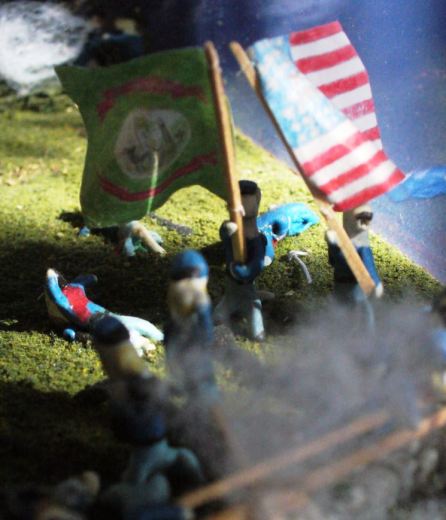
Even with their right flank bent back into an L-shape by the pressing Confederates, the 69th held their position. In time, reinforcements arrived and pushed the Confederates back over the wall. The battle of Gettysburg was a Union victory, thanks in part to the Irishmen of the 69th Pennsylvania, who stood firm beneath the flags of their past and their future–the green of Ireland with its sunburst and keep, and the Union Stars & Stripes.

69th flags

The flags of the 69th PA

What Time Is It??

For most of us in the U.S., it’s time for Daylight Savings Time again, that time of year when we move our clocks forward an hour and “lose” an hour of sleep. They didn’t have to do this during the Civil War, which also means that if you want to experience the actual time of day of a Civil War event, you have to take DST into consideration.

Gettysburg is my favorite battle, and there’s something special about standing on the fields of Pickett’s Charge at 3 p.m. on July 3rd. But if I really thought about it, I should be standing there at 4 p.m.

Or, for example, on the 150th anniversary of the Battle of Cedar Creek (October 19, 1864), I stood on the battlefield in the dark, trying to figure out what “DST” time would be equivalent to 5:30 a.m. in 1864. For some of us, that takes some mental gymnastics. Still, perhaps it explains why armies tended to head out on a march at 4:30 a.m. Maybe it was because the sun was just beginning to rise, not because the generals had nothing better to do than drag their men out of bed in the middle of the night.

So if, this summer, you try to experience a Civil War site at the right time of day for the battle, remember to factor in DST!

OLYMPUS DIGITAL CAMERA

Small But Mighty

We’ve all heard the saying, “Small, but mighty.” I thought of it the other day while looking at our diorama of the USS Monitor and the CSS Virginia (Merrimack). We tend to think of the fight between the ironclads as just ending in a draw and that’s it. Sure, the Monitor didn’t get fried by the Virginia, but does that make her “mighty,” or just durable?

On the night of March 8, 1862, the Union flotilla in Hampton Roads was a-shambles. The USS Cumberland had been sunk. The USS Congress was burning and would explode. The USS Minnesota was stuck aground. Union sailors had lost 256 of their friends that day from the Cumberland and the Congress alone. As they sat in the dark, waiting for dawn, they could only assume that morning would bring the Virginia back to finish what she had started. The Minnesota would be the leviathan’s lunch.

But then they noticed something on the horizon, a tiny speck of light. It was the Monitor. No one knew it, but at that moment, the odds evened out. Instead of 256 to 10 as on the 8th, the next day’s hours of fighting between the ironclads would end with only a few wounded on each ship.

The Monitor did not inspire confidence. When her commander, Lt. Worden, assured the grounded Minnesota‘s captain of his assistance, Capt. Van Brunt had his doubts as he peered down at the pygmy of a ship. When the Virginia and the Minnesota fired at each other the next morning, they fired over the Monitor! Could the Monitor-with her two guns-stand against the “horrid creation of a nightmare”?

Well, she did. And not only did she survive the pounding of the Virginia‘s guns on March 9th, but she fulfilled her mission: to save the Minnesota. No matter how the Virginia came at the Minnesota, the tiny Monitor was always there, blocking her path, like a feisty terrier.

The Monitor was small, a cheesebox on a raft, but she proved herself mighty that day. In fact, Lt. Worden and his little ironclad proved their worth so well that the Union went on to build more of the curious-looking ironclads, confident now that the size of the vessel didn’t matter.

Welcome to Civil War Tails!

What do Gettysburg, Fort Sumter, ironclads, and cats have in common?? The Civil War Tails at the Homestead Diorama Museum! Check it out!

Our museum is full of dioramas we made by hand so you can see a 3-D snap-shot from the Civil War. Get a bird’s-eye view of a battle or get down to eye-level and see what a soldier would have seen. See the soldiers, the horses, the cannons, and the places. They’re all made with a one-to-one ratio, so each soldier on one of our dioramas represents one soldier during the real battle, not ten or twenty. And since they’re made to scale, if the hill looks really big to climb under rifle fire, that’s because it was!

And I’ll bet you’re wondering why our name is Civil War Tails. It’s not a typo. We started making soldiers when we were 11 years old and we have always loved cats, so the first soldiers were cats. In uniform. With beards. Now, years later, we still think that’s quirky and fun, and we hope you’ll agree.

But you don’t have to notice the tails to learn the history! Come see the smoky desperation in Fort Sumter during the bombardment that started the war. See how tattered Pickett’s Charge was by the time the Confederates struggled across the stone wall at the Angle at Gettysburg. Appreciate just how big and rocky Little Round Top was as the Confederates climbed it. Glimpse the suffering of Union POWs at Andersonville Prison (our great-great-grandfather’s step-brother, Pvt. Luke Brown of the 8th Pennsylvania Cavalry, is portrayed on that diorama!).

Sure, the cat angle is fun, but we want you to learn about the men and women behind the cats. As you look at our 3-D rendition of what they experienced, think about how they fought for what they believed in, and how their sacrifice ensured that we would have the rights and the great nation we enjoy now. This museum is meant to honor their memory by keeping it alive.

So come learn with us—and then find your own way to keep history alive!

We hope you enjoy your visit at Civil War Tails!