A Little Halloween Fun…

We are often asked whether our house is haunted, particularly given its history related to the old orphanage. As far as we know, it’s not, but then again…you never know what you might find after hours!

desperation-at-skull-camp-bridge-bay-ghost

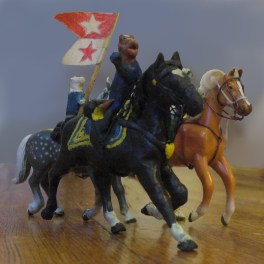
The Angle comes to life…

p1230981-angle

As the 69th Pennsylvania fights for their lives.

p1240512-69th-ghosts-green-tint


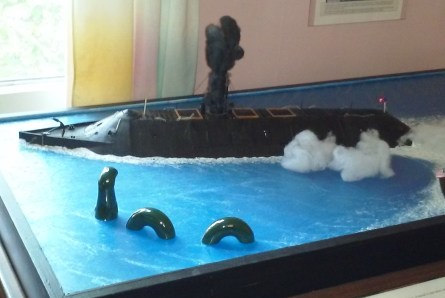
Ghosts patrol the night waters…

merrimack-ghost-ship

And fill the shadowed forests.

p1220596-spear-ghost

OLYMPUS DIGITAL CAMERA

Here, there be monsters!

nessie-visits-the-ironclads

And apparitions!

ghost-in-cloud-blurred

Happy Halloween, everybody 🙂

ghost-on-lrt-blurred


Snatching Victory from the Jaws of Defeat . . . And Defeat from the Jaws of Victory

Today is the anniversary of the Battle of Cedar Creek, a battle you may not know about, but should! Not only is it a classic story of the complete reversal of fortunes, but it is said to have helped Pres. Lincoln achieve reelection.

p1240975-sheridan-close-clean

In the fall of 1864, Union Gen. Phil Sheridan’s mission was to destroy the “breadbasket of the Confederacy,” the Shenandoah Valley in Virginia. By the middle of October, he had defeated the Confederate army under Gen. Jubal Early at the battles of Winchester and Fisher’s Hill and conducted “the Burning,” laying waste anything that could be used by the southern armies. The Union army figured they were pretty much done their work, and Sheridan was called away to a meeting in Washington.

But the Confederates weren’t done with the Union army, yet. Gen. John Gordon saw an opening to strike, and after a night march, his men burst out of the predawn darkness and fog at 5 o’clock in the morning on October 19th. The Union soldiers were hardly even awake—some weren’t—and were completely routed. They didn’t even have time to dress, let alone fight back. Only the VI Corps held their ground for a while and prevented complete disaster.

Sheridan and his party were 12 miles away in Winchester, on the way back from Washington. Hearing gunfire in the distance, the small, feisty general jumped on his tall black gelding, Rienzi, and trotted towards the front. This was to become known as “Sheridan’s Ride,” and is often romanticized into Sheridan galloping twenty miles. But no horse can gallop even twelve, so it is likely that he trotted, although it was probably a fast trot! Those twelve miles must have felt like a lifetime, hearing the cannon fire and not being able to do anything yet, then seeing the fragments of a shattered army trickling by and wondering what was going on up ahead.

As Sheridan met retreating soldiers, he waved his cap and urged them to “Face the other way!  We will make coffee out of Cedar Creek tonight!” With cheers, the men began to reform. Sheridan jumped Rienzi over some entrenchments and rode down the line, inspiring his men.

A lull fell over the battlefield as the Union army reformed and the exhausted, hungry Confederates plundered the camps.  Then, at 4 p.m., Sheridan launched a counterattack that pushed the Confederates back across Cedar Creek. Early’s one chance at victory had ended like the other battles and, ultimately, the Confederate effort to stop Sheridan—in defeat.

Cedar Creek was a major victory, and some credit it with contributing to Pres. Lincoln’s reelection.  Up until then, Lincoln’s chances were slim.  Gen. Grant was racking up the butcher’s bill in Virginia, and it was looking like Gen. McClellan might win the presidential race, which would have resulted in peace—and a split nation.  The turnaround at Cedar Creek gave Lincoln a glorious victory that he could use to his advantage, and that would ultimately mean a united country.

Returning Home to Nothing

Lydia Leister was a widow and mother of six when the Union and Confederate armies converged on Gettysburg in 1863. Like others in the town, she fled her home during the battle. By the time she returned to her home, she had lost nearly everything.

p1240962-autoThe Union commanding general, George Meade, had made his headquarters in the Leister home, located on Taneytown Road just over the hill from the Angle. During the Confederate bombardment preceding Pickett’s Charge, shells meant for the Union positions at the Angle overshot and hit Lydia’s property instead, damaging the house and killing soldiers’ horses tied in the yard.

When Lydia returned, she was probably relieved to see that her house still stood, but that feeling must have been dampened by the stench of sixteen horses lying dead around her home and the fact that her fences had all been destroyed. She would have seen that her entire crop of wheat had been trampled into the ground by passing soldiers. She had put in extra wheat that year, hoping to pay off her land. Now, she would be lucky if she had enough to get her family through the winter.

Getting closer to her house, Lydia would have seen that both posts supporting her porch roof had been blown away. Looking up, she would have noticed a hole in her roof, maybe also the hole in the end of her house. Running inside, she would have seen that the shot that came through her roof had knocked out a rafter, and that another shot through her house had destroyed a bedstead. She may even have had water in her house from the July 4th rain, coming through the hole in the roof. Wandering through her house, Lydia would have noticed that all of her food had disappeared, except for a little bit of flour.

But the loss and destruction did not end for Lydia on July 4th when the army left the area. The rotting horses in her yard spoiled her spring so that she had to have a well dug. Her peach tree was killed when dead horses were burned near it.

By the time a correspondent visited two years later, all Lydia had received for her losses was a few dollars from selling the bones of the dead horses. The correspondent found a woman “centered in her own losses” and caring nothing for the broader picture of what the country may have lost or gained by the battle. Can we blame her?

19th Century Tech Woes

p1160341-signal-corps-closeupTechnology is an amazing thing. Perhaps more amazing is the way we take it for granted. We gripe all too quickly when it doesn’t work, but how often do we think about how fascinating it is to be able to click a mouse and have something happen on the screen, all communicated by…well, I don’t even know!

During the Civil War, communication depended on couriers (who could be shot) or the telegraph (whose wires could be cut). There was no WiFi. There were no radio signals. If the courier was killed, the orders never got there, and fighting units ended up stranded.

Before the war, Albert Myer and E.P. Alexander developed a communication system that could be used by an army when the distances were too great for a courier on horseback. It was a 19th Century cell phone: fully mobile, it could travel with the army and did not require setting up a landline (telegraph wires). Encryption was necessary though–at the war’s start, Alexander when South and Myers went North, which meant both sides had the technology and could read the messages!

What was this new-fangled tech, you ask? The Signal Corps or “wig-wag” system. A typical station involved three men: one to use a flag to send coded messages, one to read incoming messages, and one to write it all down. The system used a series of numbers. A dip of the flag to the left was a 1, a dip to the right was a 2, and a dip straight in front was a 3. “3” was used to signal the end of a word (3), sentence (33), or message (333). “1” and “2” were used in combinations to represent letters or words.

  • “1 3 12 33 11222 3 111 333” = “Advance artillery. Resume attack.” (using set phrases)
  • “Jump.” = 2211 [J] 221 [U] 2112 [M] 2121 [P] 333 [end of message]. (spelling it out)

Stations could be set up miles from each other, thanks to telescopes, and they could work at night, using torches instead of flags. The system worked quite well. Except for the weakest part: the humans.

Sending messages only worked if the crew on the receiving end noticed the continuous wig-wagging meant to get their attention. On July 3, 1863, a signal station on a mountain miles away from Gettysburg noticed the Confederates moving an awful lot of cannons into position along Seminary Ridge. Frantically, the station signaled to its relay with the Union army. They were never noticed, so their warning was never delivered!

Fortunately for the Union army, the ensuing smoke caused the Confederate artillery to overshoot, inflicting less damage than intended and allowing for a Union repulse of Pickett’s Charge. As it turned out, the breakdown in communication technology did not end in the Union army’s destruction. But I imagine there was a soldier cussing out his limited technology!

Some things never change.

Celebrating Our First Anniversary!

On Labor Day Weekend, we’ll be celebrating our First Anniversary here at Civil War Tails! Join us Friday-Saturday (September 2-3) and Labor Day (September 5), for $1 off admission and a scavenger hunt with prizes.

The kitties and their humans would like to thank everyone who has visited us over the last year. We have had a great time meeting you and chatting with you, sharing the stories on our dioramas and learning from your knowledge of the Civil War, too! We also want to thank everyone who has kept up with us online, even if we haven’t met you in person yet (there’s always next year!). It is encouraging to see the interest from all of you even in this, the first year of operation.

We look forward to many more years of sharing history with you and giving you a glimpse of what it would have looked like–minus the tails!

Please note that our hours on Labor Day will be different than usual. We’ll be opening at 10:00 a.m. but closing at 4:30 p.m. because, much though the cats would love to keep sharing history with you, their humans have other plans. 

P1230976

2017 Calendar Offers a Peek at Skull Camp Bridge

Desperation at Skull Camp Bridge 07 blur crop

Detail

The 2017 Civil War Tails calendar is now on our shelves! In it, you’ll find pictures from not only dioramas we have on display, but also a couple of dioramas that are in storage, awaiting release. One of these tells the story of Skull Camp Bridge. Never heard of it? Well . . .

On June 27, 1863, the Confederates evacuated Shelbyville, Tennessee, to avoid being cut off from the main army. Gen. Joseph Wheeler’s small force of cavalry formed the rearguard and fought to hold back the Union cavalry so that the wagon trains could escape and because they expected Gen. Bedford Forrest’s cavalry to join them shortly.

After much fighting, Gen. Wheeler withdrew over the bridge, figuring that Gen. Forrest was not coming after all. However, when he learned that Gen. Forrest was within sight of Shelbyville, he re-crossed the bridge with 400 volunteers. Things did not go well. The Union cavalry broke through his line and overran his cannons, and an overturned caisson blocked the bridge.

Some of the Confederates scattered up and downstream in the growing dusk. Some were captured. Sixty, with Gen. Wheeler, cut their way through the Union line and leaped at full speed into the river fifteen to twenty feet below. Only about twenty made it across the river. Gen. Forrest, hearing the firing, crossed safely four miles downstream.

Letting Go…Or Holding On?

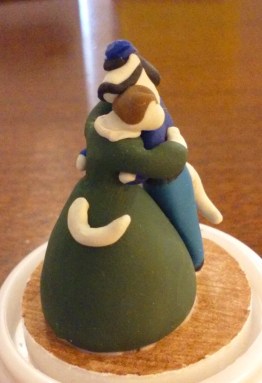
Reunion 162It’s been said that a good book (or any work of art) leaves you with questions, wanting to know more.  Today, I was working on assembling cats in small domes to sell in our gift shop.  They’re all cute, and sometimes it’s hard to part with them because they turned out so well, but this time there was a husband and wife set that Ruth made that struck me the first time I saw them, and has continued to make me pause every time I look at them.

Every detail about them is perfect in conveying just how much the little lady does not want to let her husband go.  Something about how her head is nestled against his shoulder makes me want to know more, every time I look at her.  Is he leaving for the first time?  Or was he home on leave, and the parting is so much harder than the first time, now that she knows the fears that will haunt her until his return?  Or is the war over at last, and her nightmares can end, now that he is home, safe and sound, and she knows, finally, that she will never have to let him go, ever again?

Our figures are cats, but like all art, they can draw out our emotions and leave us wanting to know more about each one’s story.  Sometimes that catches us by surprise—even when we are the ones who made them!

What is a Hero?

Last week, we considered the heroic actions of the men of the 54th Massachusetts Volunteer Infantry in 1863, including Sgt. William Carney, who received the Congressional Medal of Honor for his actions at Battery Wagner. Lately, we’ve been doing a lot of thinking about the question…what is a hero?

Just this past July 18th, Lt. Col. Charles Kettles was awarded the Medal of Honor for his actions in Vietnam.  On May 15, 1967, when he learned that 8 men had been missed and left behind in an ambush, he turned his battered UH-1 helicopter around and went back for them (you can read more about Lt. Col. Kettles here).  Because of him, their names are not on the black granite wall of the Vietnam Memorial.  Because of him, they survived.  But he did not consider his actions special that day.  He thought it was just what war is.  He had just done what he had to do. He wasn’t trying to be a hero.

P1220137

Lt. Col. Kettles’ story reminds me of another young soldier who just did what he had to and thought nothing of it.  During the heaviest fighting of the 20th Maine’s defense of Little Round Top on July 2, 1863, Sgt. Andrew Tozier stood at the apex of the regiment, practically alone, holding the flagstaff in the crook of his elbow and firing a rifle he had picked up from a wounded comrade.  Col. Chamberlain saw him and admired the way he was “defending his sacred trust.”  Capt. Spear also saw him and noted that he was calmly chewing on a piece of cartridge paper.  Like Maj. Kettles, Sgt. Tozier was just doing what he could to take care of business.  He wasn’t thinking about being a hero.  After their respective wars ended, both men returned to quiet lives.

That is why I find it so fascinating to study history, to see how people react in the crucible—Henry V’s ragged, outnumbered army at Agincourt in 1415; officers and men in the hell of Pickett’s Charge; Sgt. Tozier on Little Round Top; Ida Straus telling her husband, “where you go, I go,” before going down with the Titanic, together; Jack Phillips, the Titanic’s wireless operator who remained at his post, sending the distress signal until the power finally went out; salvage divers to the wrecks at Pearl Harbor; fighter pilots over the Philippines, facing Japanese Zeroes; Maj. Kettles in Vietnam.  So many opportunities to turn and run, to give up or give in—and instead so many stories of valor because it was what was needed and the right thing to do.

What I find most fascinating about the Medal of Honor heroes I’ve read about is that they all say the real heroes are their buddies, not them.  For me, this humility makes them even more special.   Lt. Col. Kettles says the men under his command that day are the true heroes, because they had no choice but to follow his orders and they did.  Audie Murphy, the most decorated soldier of WWII, said the true heroes were the ones who didn’t make it home.

A couple years ago, I had the honor of meeting Gary Wetzel, a Vietnam veteran who also earned the Medal of Honor.  I remember him telling me that he didn’t deserve the Medal.  A quick search on Wikipedia tells me that after his helicopter was shot down on January 8, 1968, he was severely wounded and yet was able to take out an enemy position with his machine gun and then help wounded comrades, even as he bled profusely from multiple wounds, including a nearly-severed left arm.  I’m pretty sure the soldiers he defended and helped would agree that he deserved the Medal.  Meeting him was an indescribable honor for me, and a memory I will always cherish. Not one of these men did what they did with a medal in mind.  Whenever I read the story of a soldier who has been awarded the Medal of Honor, and it tells of their reactions, not once have I read that the fellow thought he was going to get the medal, not one has said he deserved it.  Each one thinks someone else should have gotten it instead.

We need these stories to remind us that heroes are not big-chested guys who fly around saving people; they’re ordinary folk who are just doing their jobs.  The firefighters at the World Trade Center did not enter the buildings thinking about being heroes.  No, they went in because it was the right thing to do, to help the injured, to find the trapped, to get everyone out—to serve their fellow man.  If you were to study every story of tragedy that grips us, I am willing to bet that in each one of them, the hero is thinking of someone else and not themselves—a fallen son, the buddies around him, the good of the nation and the families at home, the stranger in trouble.  Search for these stories, hunt for them, and take them to heart.  Heroes don’t try to be heroes—they’re just ordinary folk who do the right thing when it’s asked of them.

Courage of Every Kind

P1240627Today is the 153rd anniversary of the first time the men of the 54th Massachusetts Volunteer Infantry saw combat. In two days, we will reach the 153rd anniversary of their second fight: the assault on Battery Wagner. It was there that the men of the 54th proved that they could fight . . . by losing nearly half of the men who went into battle.

The 54th Massachusetts was one of the first regiments of black soldiers raised during the Civil War. Theirs is a story of courage—of every kind.

It takes courage to do the right thing, even if people think less of you because of it. Robert Gould Shaw was in a good position as a captain when he was asked to command a regiment of “colored” soldiers. It was a post that would subject him to ridicule, maybe even ruin his future prospects. After initially refusing the position, Shaw reconsidered and accepted command of the 54th. He determined to prove that his men could fight as well as white men.

It takes courage to keep going, despite an uncertain future. When the 54th headed south, they did so knowing that the Confederate Congress had declared that every black soldier captured would be sold into slavery. Every white officer in command of black troops would be executed. Would their own government defend them, if they were captured? They had no idea. It was not until after the fight at Battery Wagner that the U.S. Government threatened retaliation on Confederate prisoners if the Confederacy went through with their word.

It takes courage to risk your life to save another person’s life. In their first taste of combat, the 54th skirmished on James Island, SC, contesting every inch and holding their position long enough to save the trapped 10th Connecticut. One Connecticut soldier wrote home after the battle: “But for the bravery of three companies of the Massachusetts 54th (colored), our whole regiment would have been captured…they fought like heroes.” Later, other white regiments greeted them with the cries: “Well done! We heard your guns!” and “Hurrah boys! You saved the 10th Connecticut!”

And then, there’s the courage exhibited on July 18, 1863.

A mere two days after James Island, the regiment faced a much greater test. Col. Shaw offered his regiment to lead the assault on Battery Wagner. It was a place of honor . . . but a costly one. Col. Shaw had his own reservations as to whether he would survive the fight. Yet as the regiment prepared to advance, one of his captains recalled of Col. Shaw, “His bearing was composed and graceful, his cheek had somewhat paled, and the slight twitching of the corners of his mouth plainly showed that the whole cost was counted.”

When Gen. Strong pointed to the flag bearer and asked who would carry the flag on if the man should fall, Col. Shaw set an example when he calmly replied, “I will.” He then told his men, “I want you to prove yourselves men. The eyes of thousands will look on what you do tonight.”

The regiment advanced through cannon and rifle fire, across a ditch filled with several feet of water, across buried land mines, across sharpened stakes and felled trees with sharpened branches, and up the sloping wall of Wagner. Col. Shaw reached the top of the wall and cried, “Forward, 54th!” and fell dead.

P1240626 Lt Emerson

Rather than lose their nerve at the death of their commander, the men of the 54th hung on. They fought hand-to-hand. Officers picked up rifles alongside their men. One man’s broken arm didn’t stop him from piling cartridges on his chest for Lt. Edward Emerson to use.
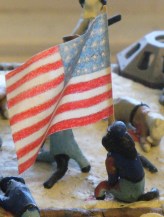
P1240606 Sgt CarneyThe regimental color-bearer, John Wall, fell, but Sgt. William H. Carney picked up the flag. He knelt on the wall with the colors until the regiment fell back. By the time he reached the hospital, Sgt. Carney had been wounded in the head, breast, arm, and both legs. He simply told the men in the hospital, “I but did my duty. The dear old flag never touched the ground.” For his courage, Sgt. Carney received the Congressional Medal of Honor in 1900. His was the earliest action for which the Medal of Honor was awarded to a black soldier.

The regiment advanced with about 600 men and lost nearly 300. Although more Union troops finally joined the fighting, the 54th was initially unsupported. Nevertheless, in this, the second time they had seen combat, the men of the 54th did not falter or give up on their mission. They not only proved themselves men, but they proved themselves to be men of the highest caliber.

Understanding war…through dioramas?

Last week I was asked, how can dioramas help us understand war in general?  It’s a question I’ve never considered, and the answer I found took me a little by surprise.  A diorama is such a simple thing, and yet its meaning and purpose is so much richer than I ever thought.  Here is my answer.

It depends on the focus of the diorama.  Typically, dioramas focus on the overall battle or story of the given subject.  I wonder if ours are unique in that we want to tell the stories of individuals.  All of our larger dioramas have information panels with stories of individuals or units, as well as the general overview of what you’re looking at.

As I write the stories to put on display, I am continually struck by how much we can relate to the people back then.  At the Angle, there was Capt. Michael Spessard, who had just seen his son fall mortally wounded on the way across the fields.  I think every parent can relate to his feelings as he reaches the Union position at the stone wall.  Is it any surprise to a father or mother reading his story, that he will refuse to surrender, and even after his would-be captors wrestle his sword away from him, that he will chase them away, pelting them with rocks?  Or the story of Sgt. Andrew Tozier—growing up with an abusive alcoholic father, but going on to earn the Medal of Honor on Little Round Top at Gettysburg.  How many kids nowadays need to hear his story and learn that their character–not their past–dictates their future and their potential?

We live in a culture that focuses on death and pain, ghosts and gore.  Studying war, you find yourself in a strange clash between destruction and glory, pain and valor, death and salvation.  For all the stories of pools of blood, you can find stories of rescue and relief.  Col. Oates losing his brother on Little Round Top, Spessard losing his son, Capt. Cocke losing sight of his brother at the Angle.  And then you have Pvt. Grine venturing between the firing lines to bring wounded enemy soldiers back to safety and the field hospitals, you have the story of John Chamberlain’s relief at finding his brothers Tom and Lawrence safe after their hard fighting leading the 20th Maine.

In the paintings of the great masters, the most striking ones are dark with a ray of light piercing through.  I think that is why we keep coming back to study war—to search for those stories of light, of man at his best.  It’s not the stories of destruction; it’s the stories of standing firm, of doing what is right, of helping others, of determination, desperation, and mercy.  And if you let those stories sink in, you can’t help but think, “Would I do that?  Could I do that?”  If our dioramas can interest people in those stories and inspire them to be the type of person who stands firm, who does the right thing, who thinks of the people around them and not of themselves when trouble comes, I think our cats will have done their work.

P1220562 Spessard crop and fix