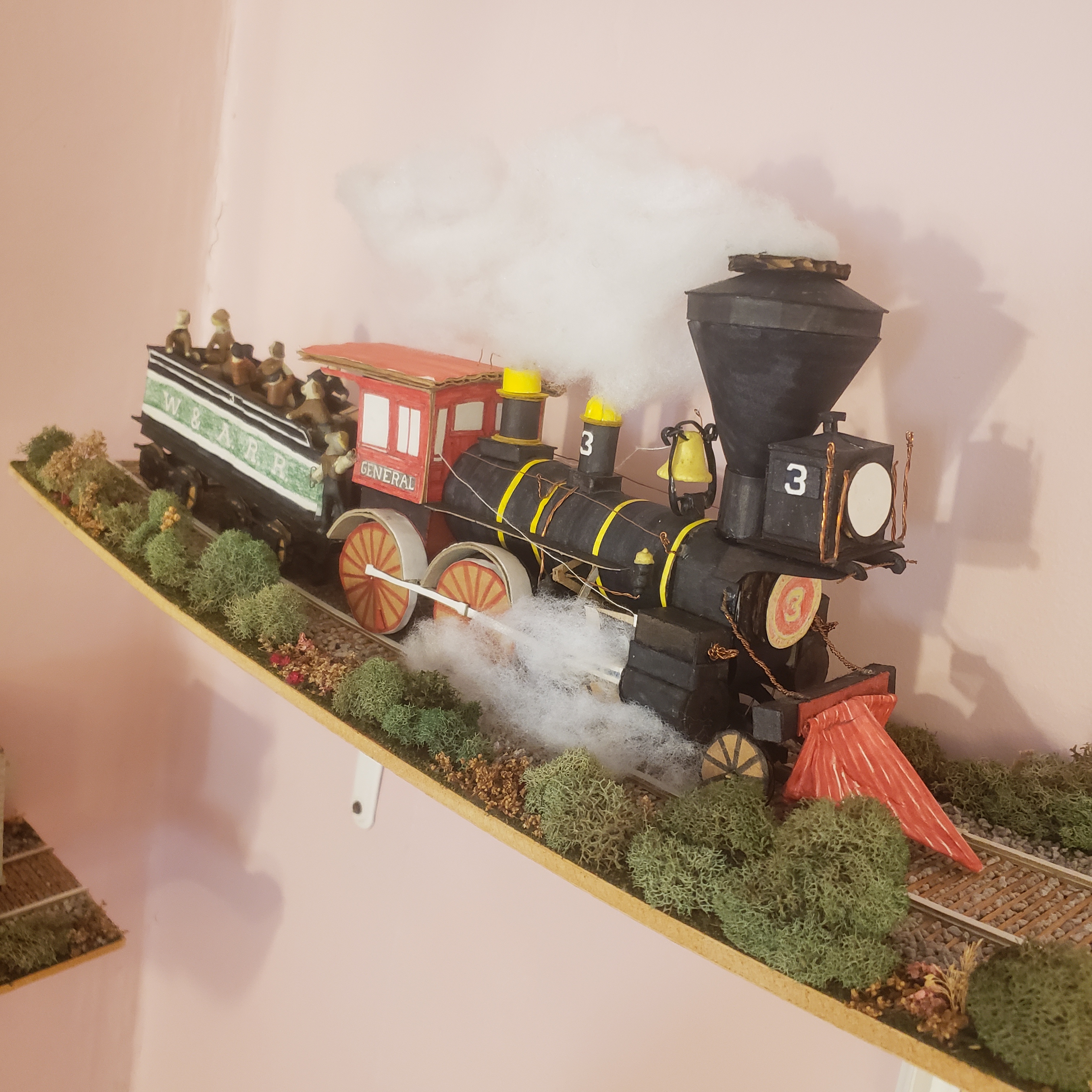
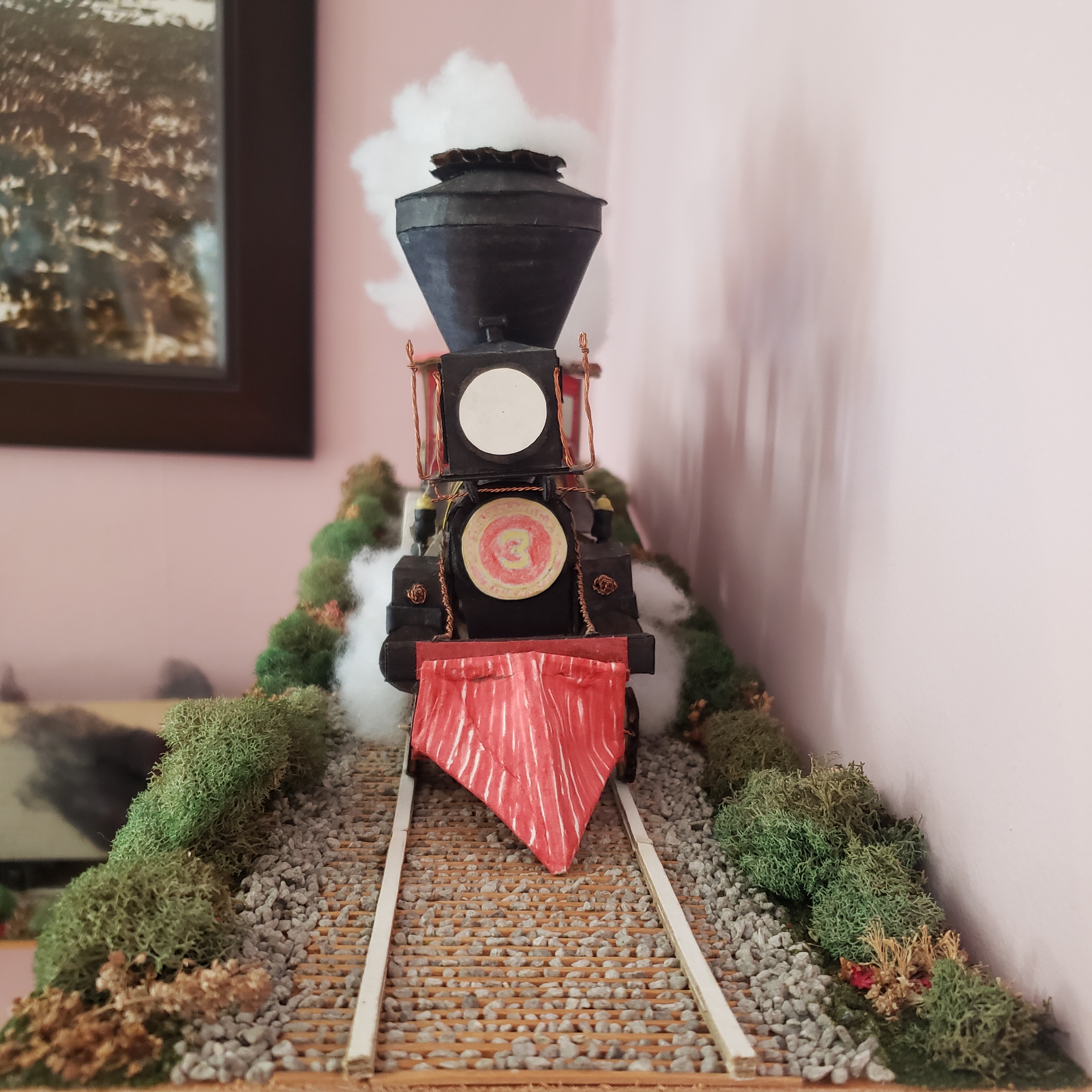
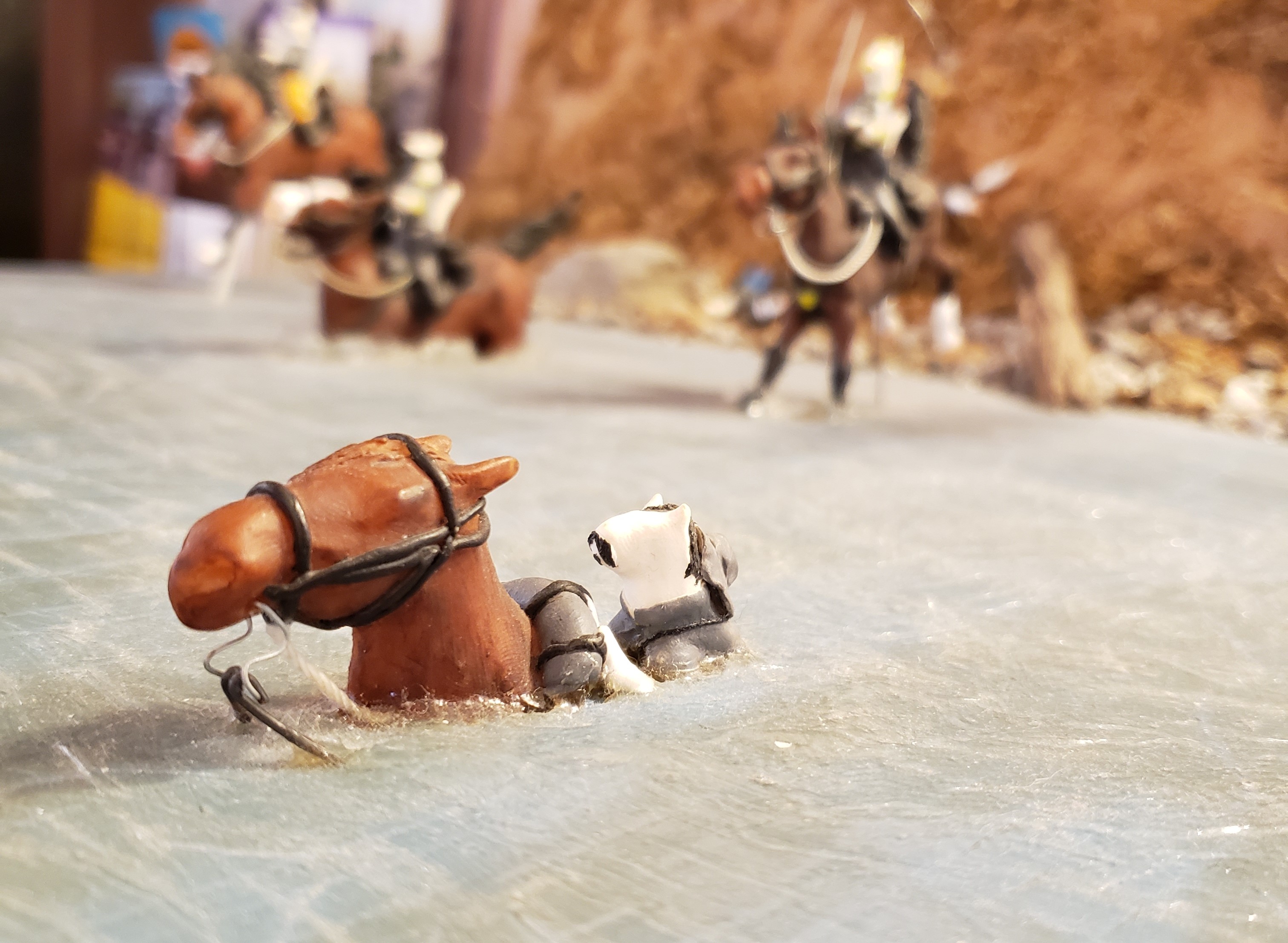
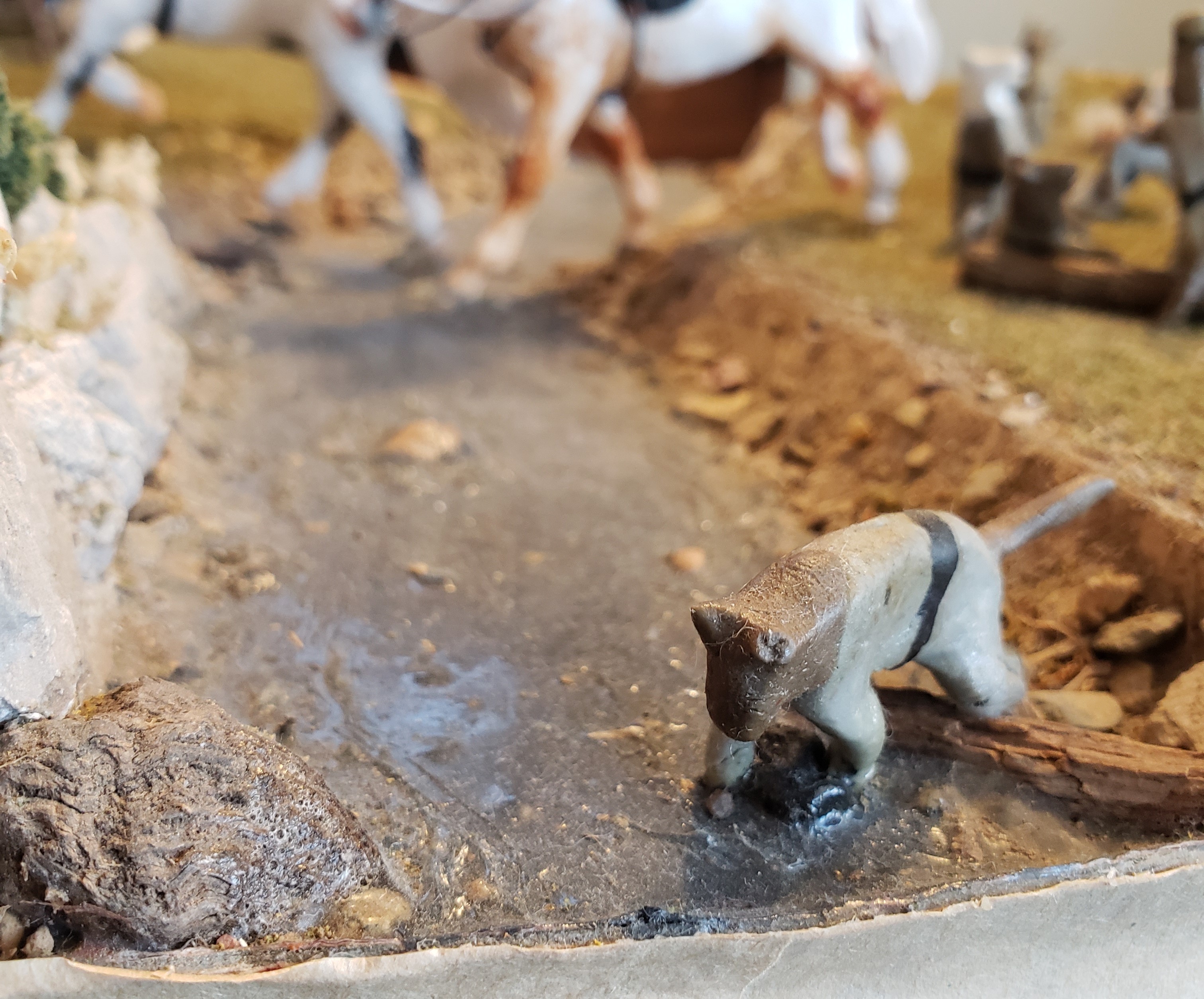
In this month of heat waves, the cats at Civil War Tails would like to offer some tips on how to beat the heat!
First, some tips on what not to do:
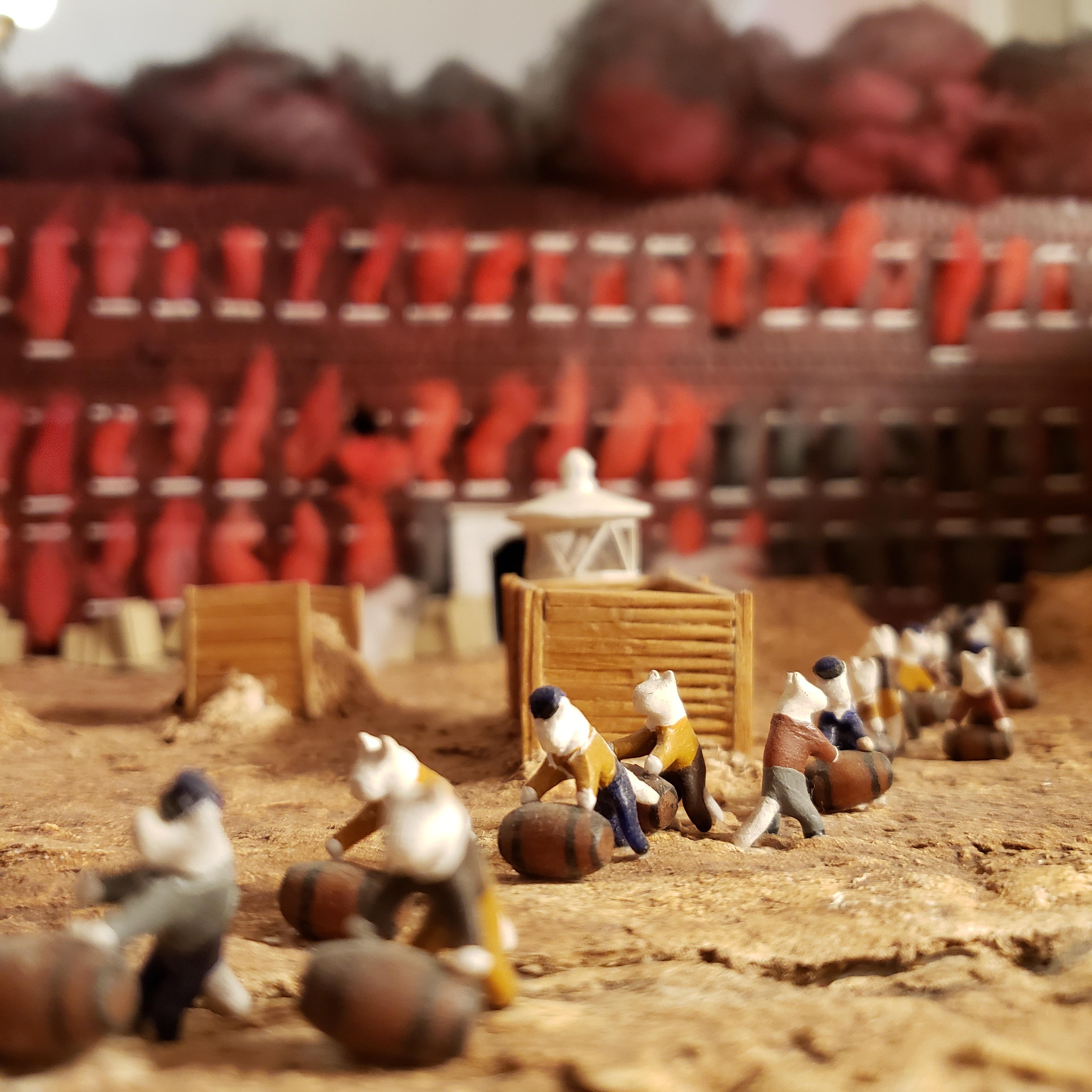
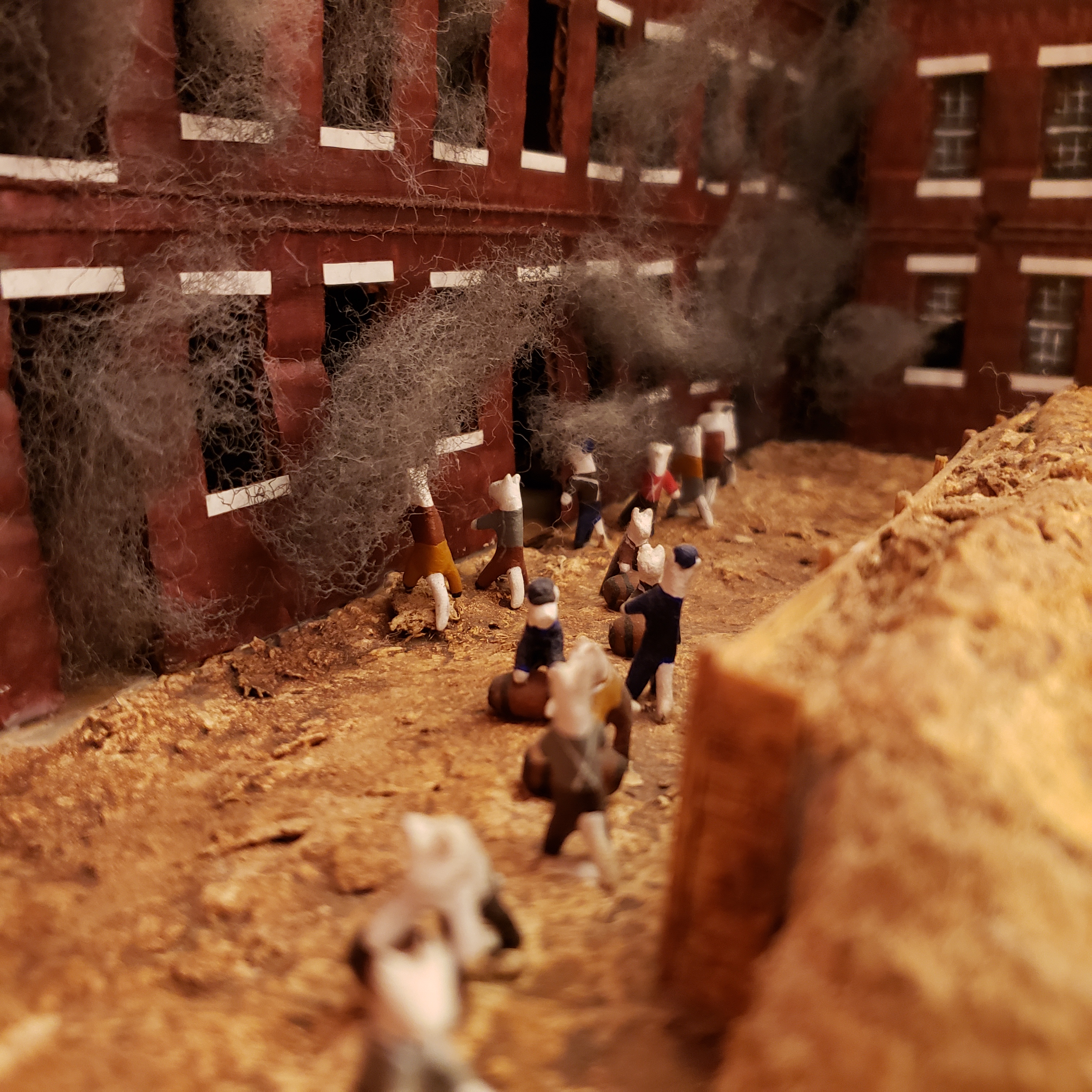
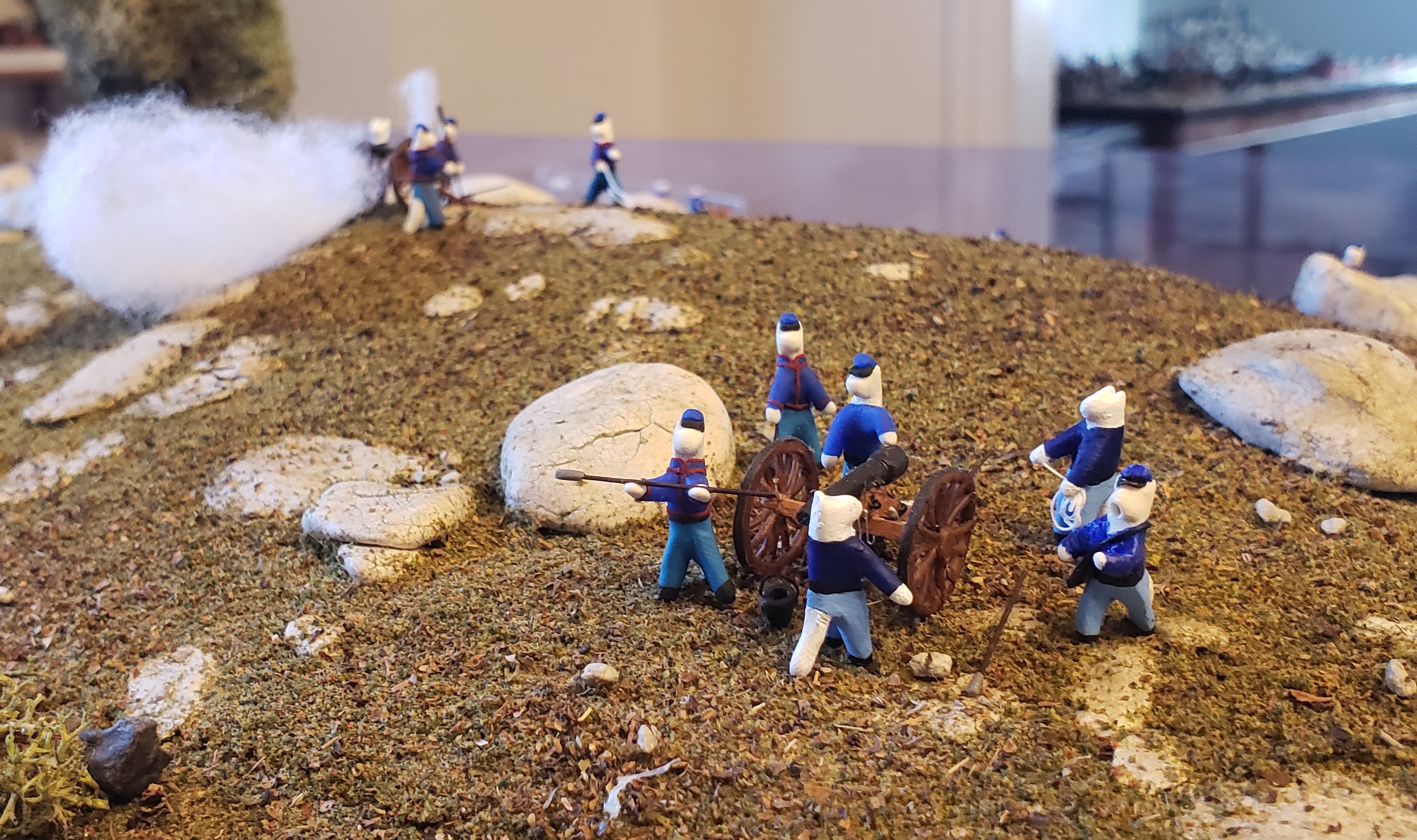
Do not roll barrels of gunpowder out of the powder magazine of a burning building. Instead, just close the magazine door, bank it with dirt, and run for the nearest air conditioner.
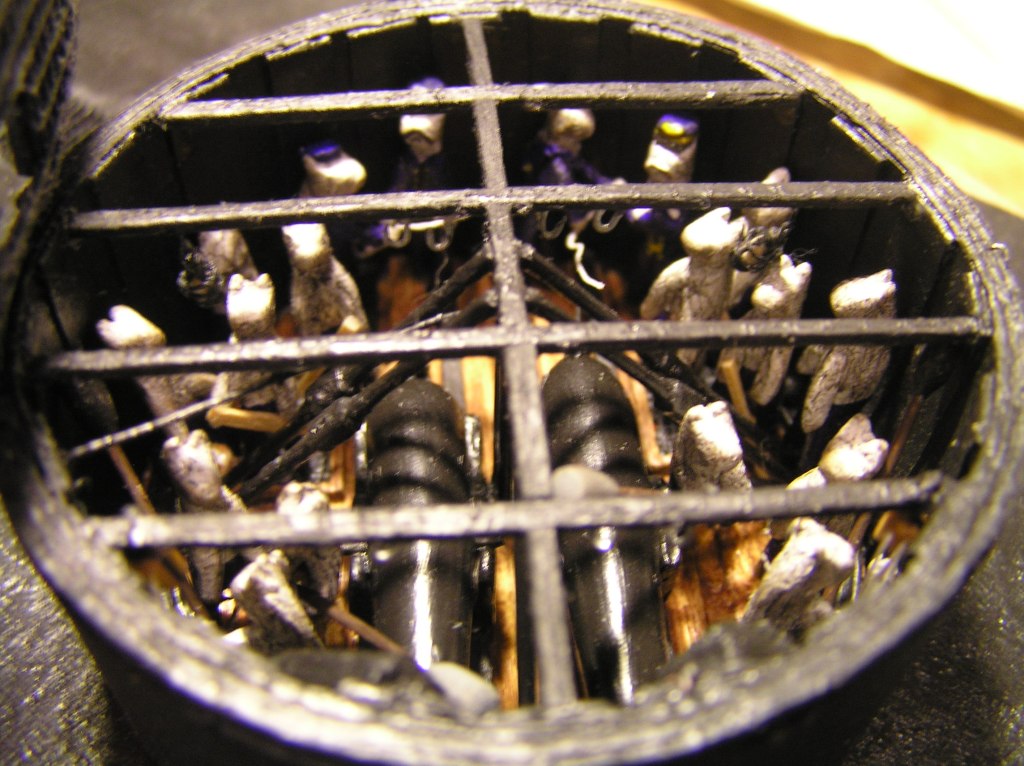
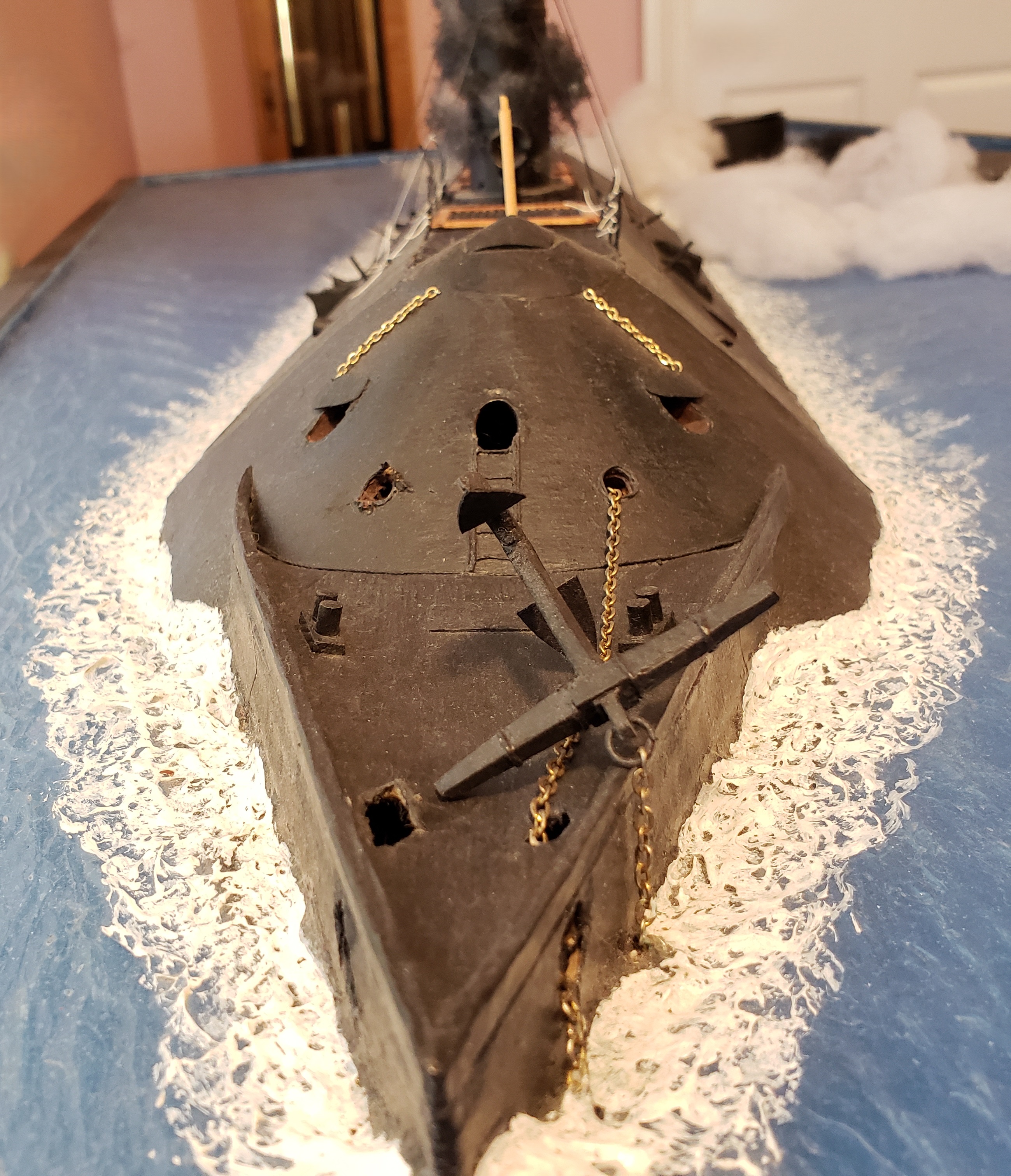
Do not sit inside the turret of a monitor—you will bake! …Unless you’re a tuna casserole and need to bake.
Now, what to do:
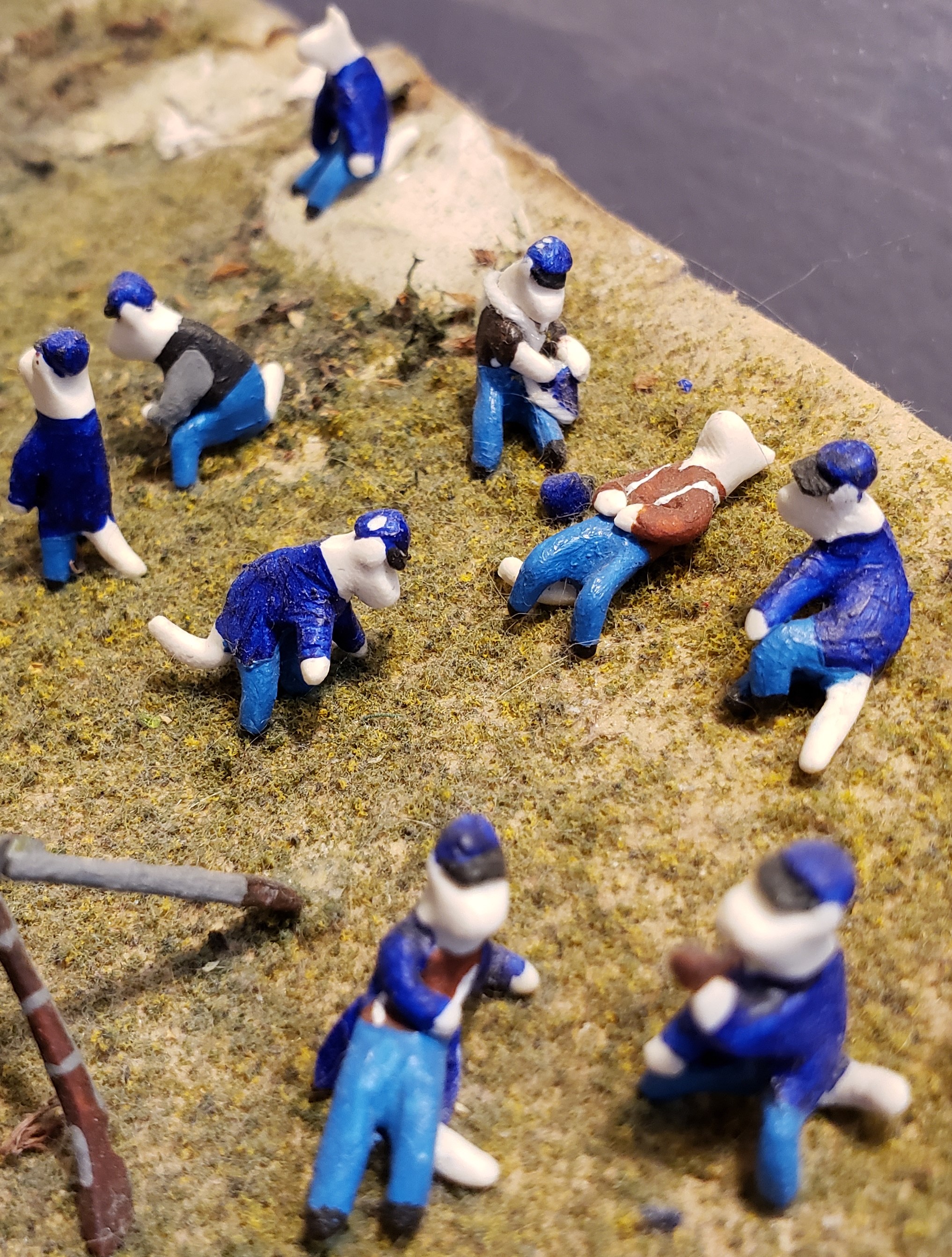
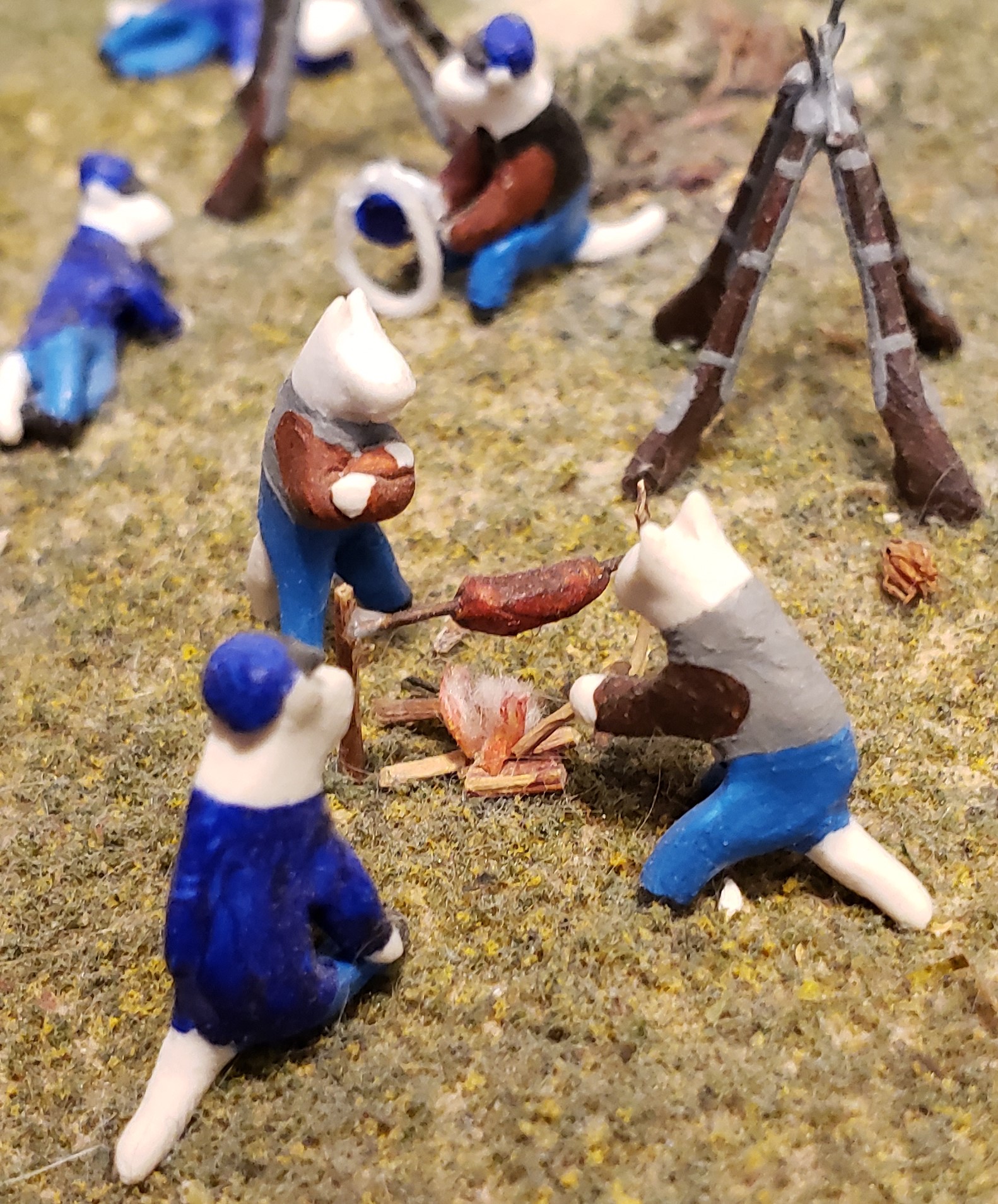
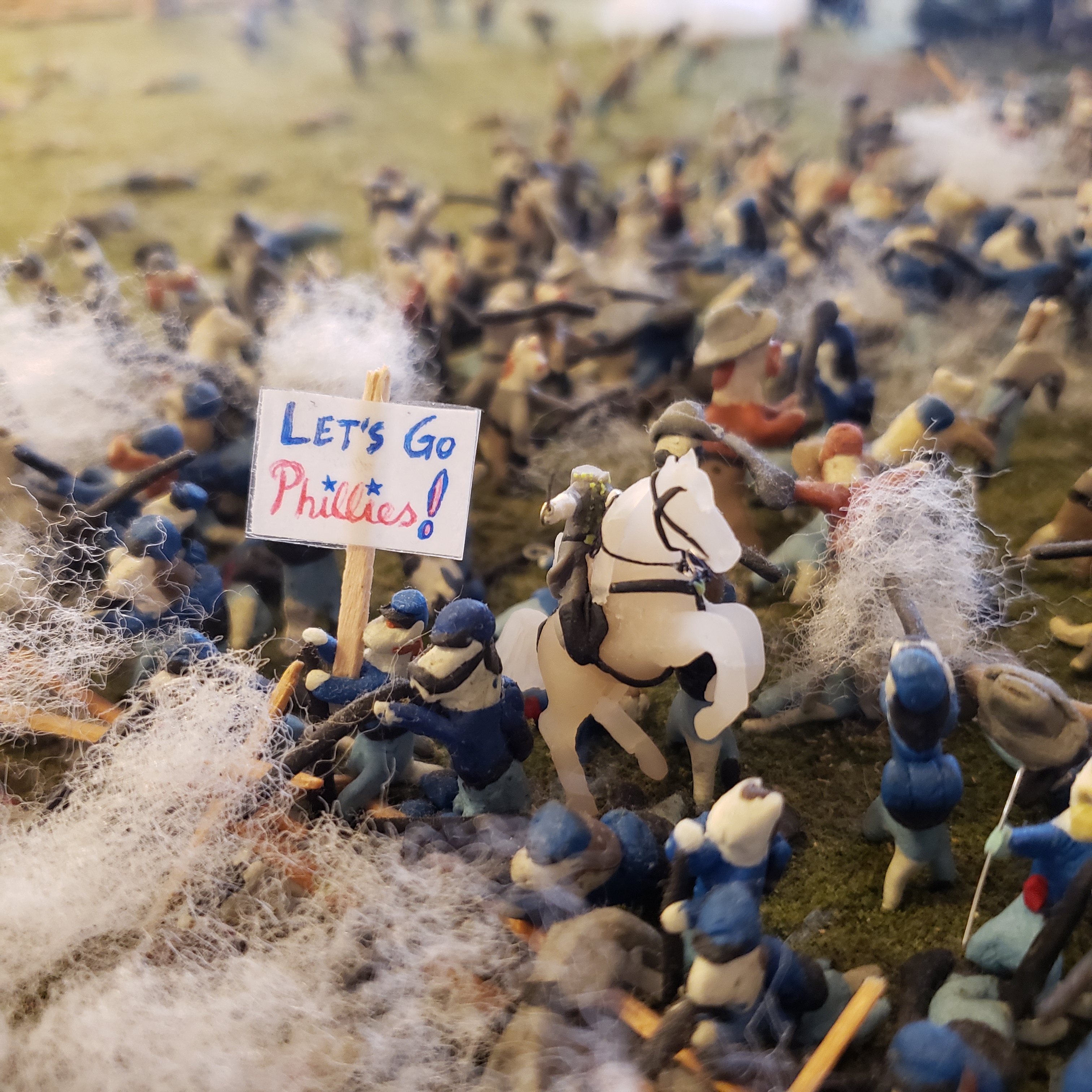
Lounge in the grass and watch the clouds go by while the BBQ cooks on the grill
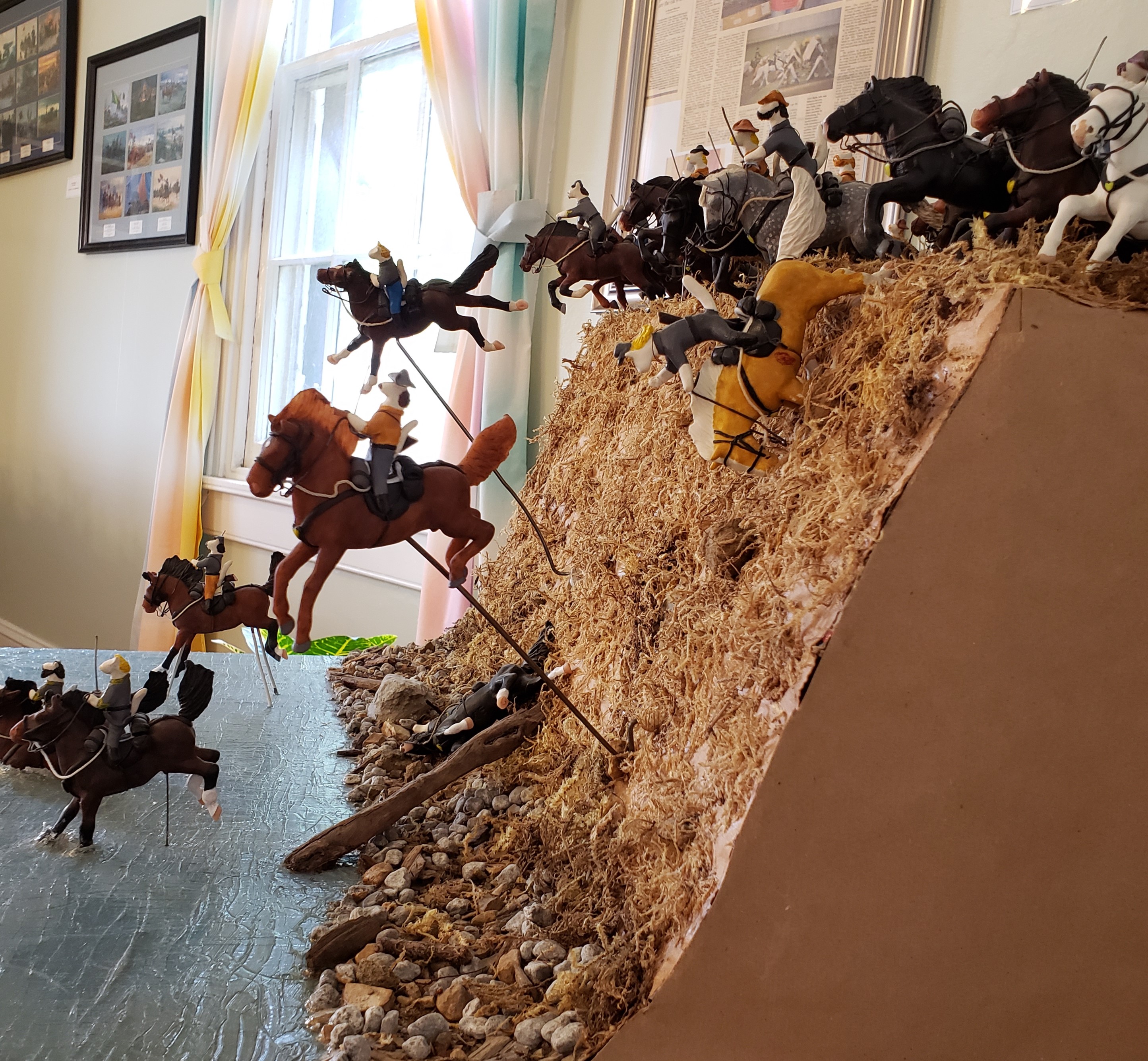
Dive full-speed off a 15-foot bank into the river
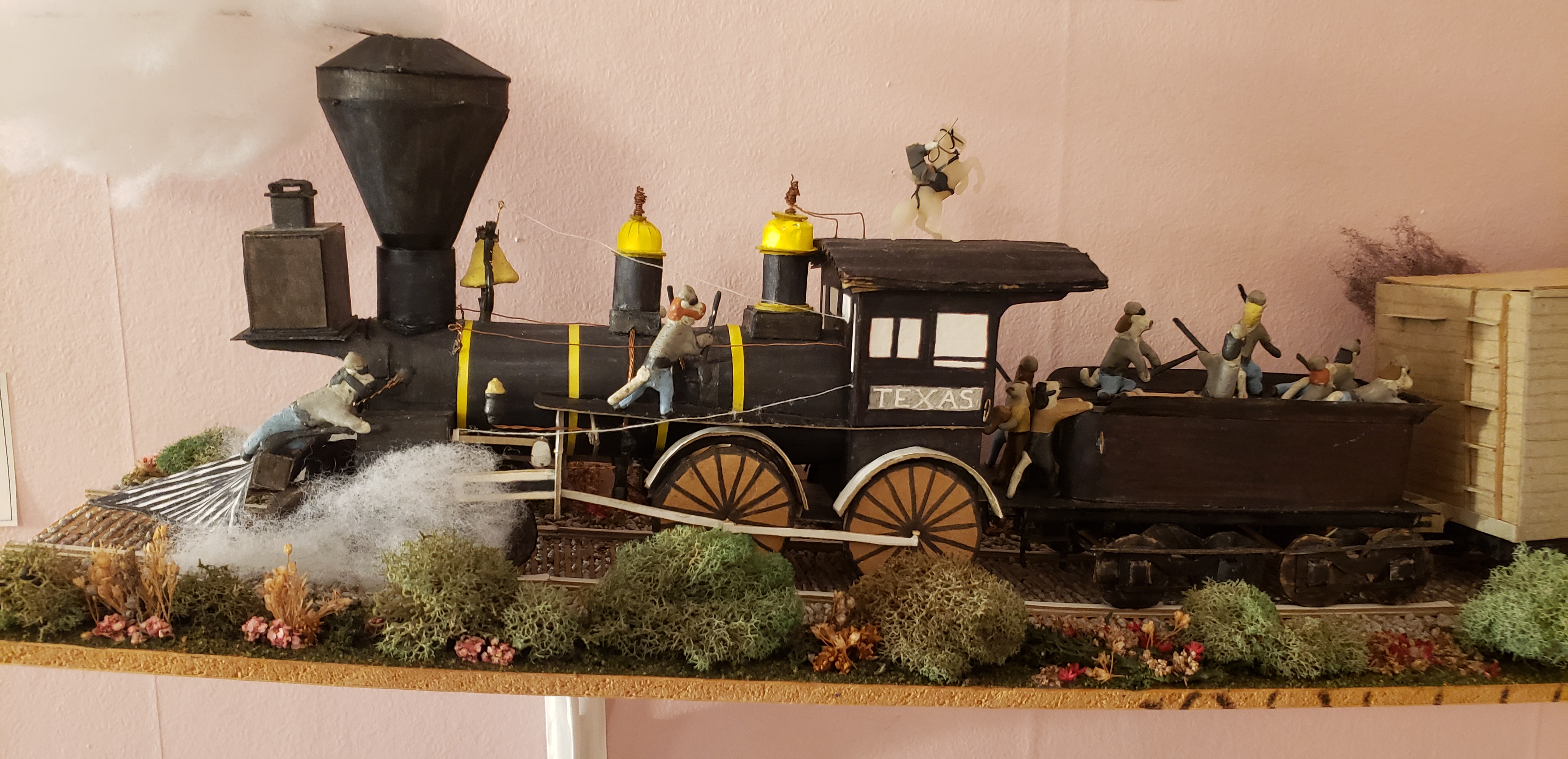
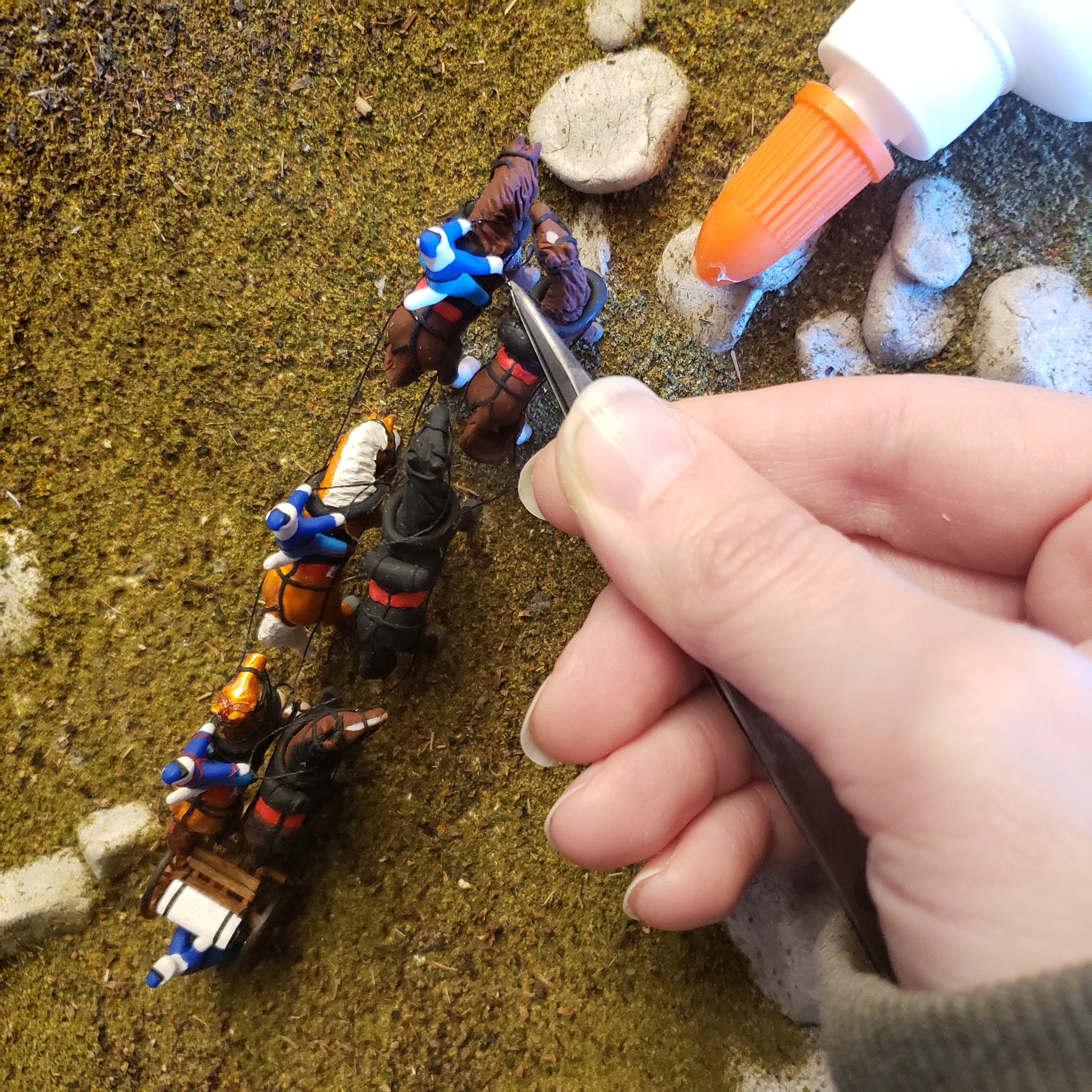
Ride a train through the countryside—the faster, the better!
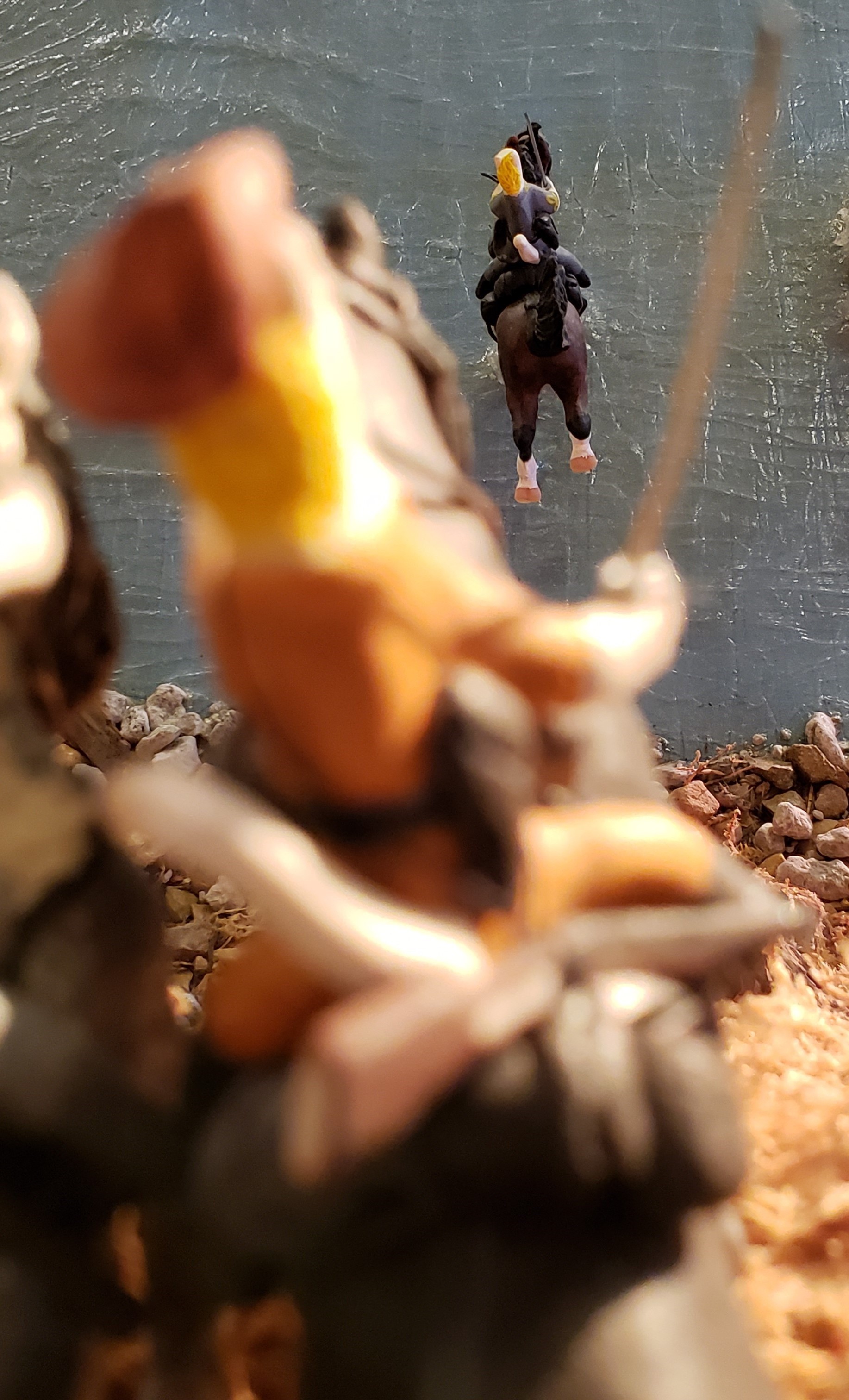
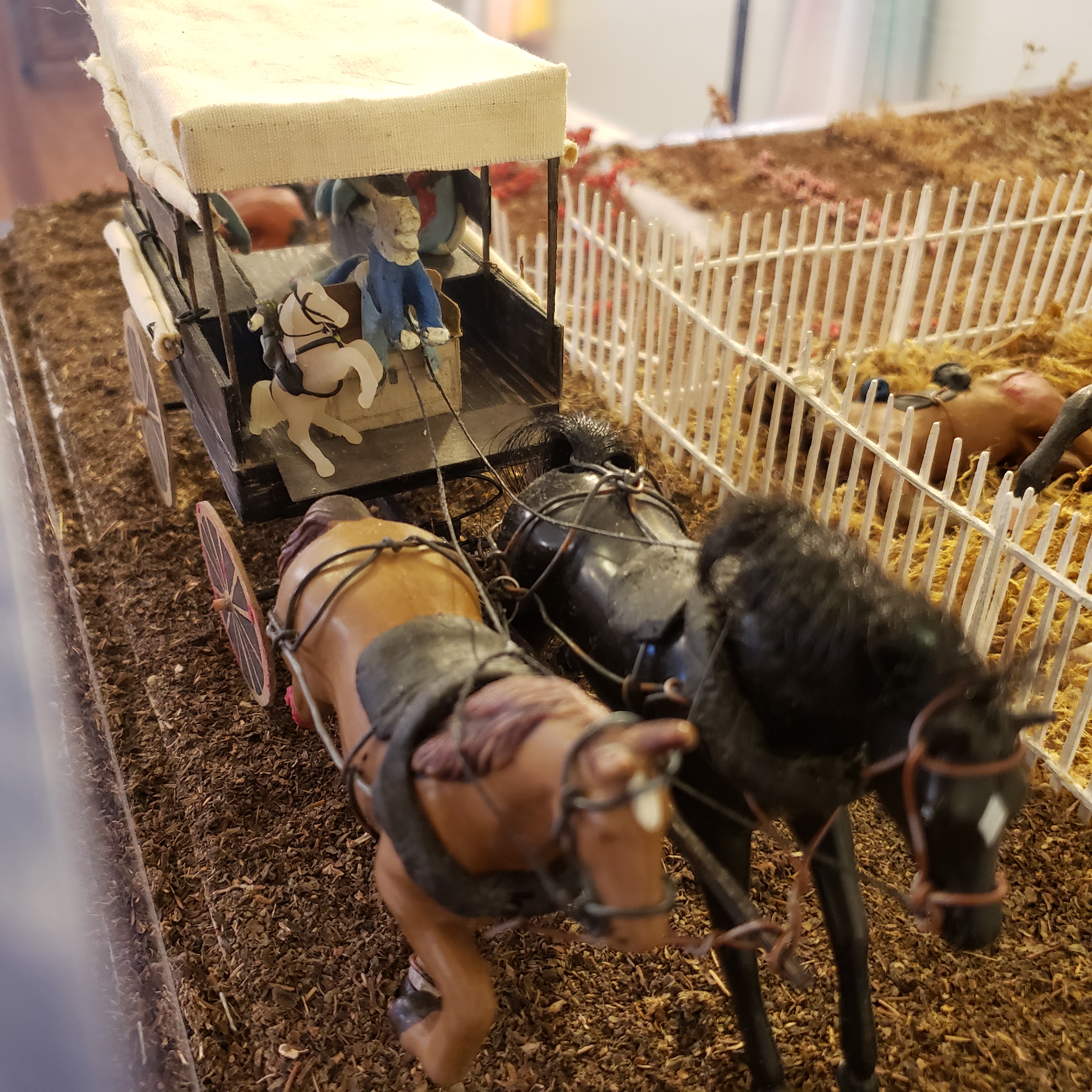
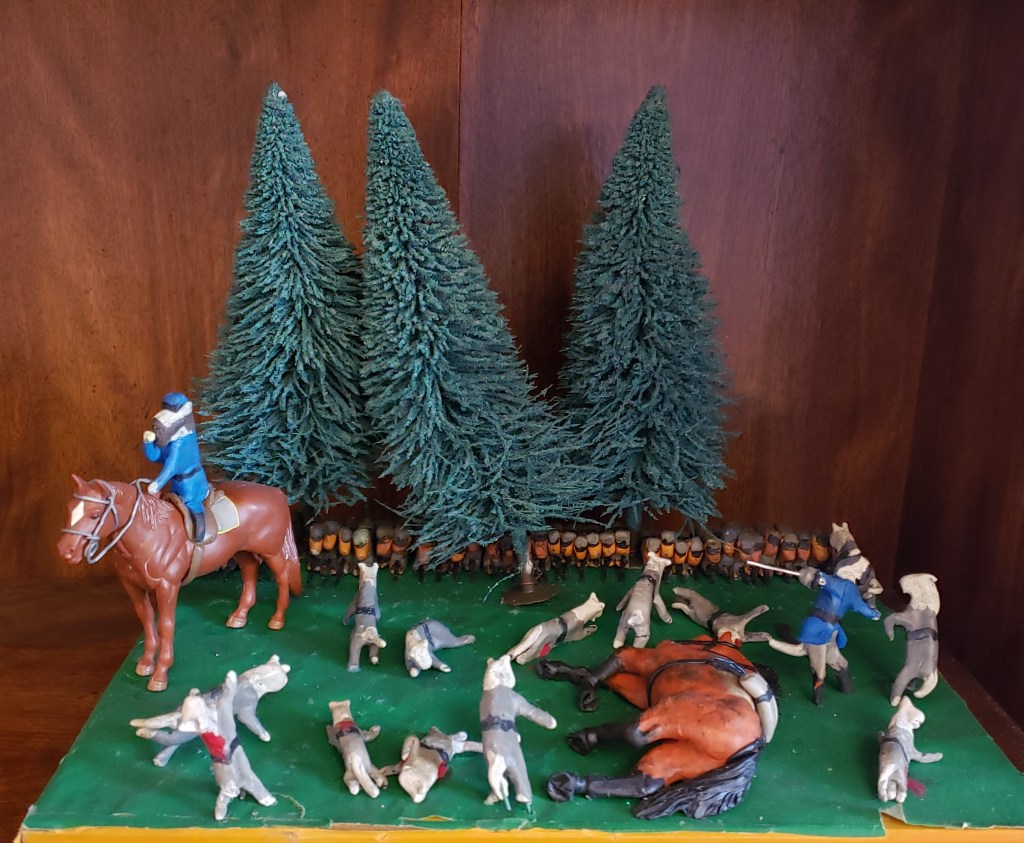
Go swimming. (This tip is recommended by the horses of “Desperation at Skull Camp Bridge,” but not particularly recommended by the cats.)
Dig a tunnel. It’s cooler deep in the earth, just a little stuffy.
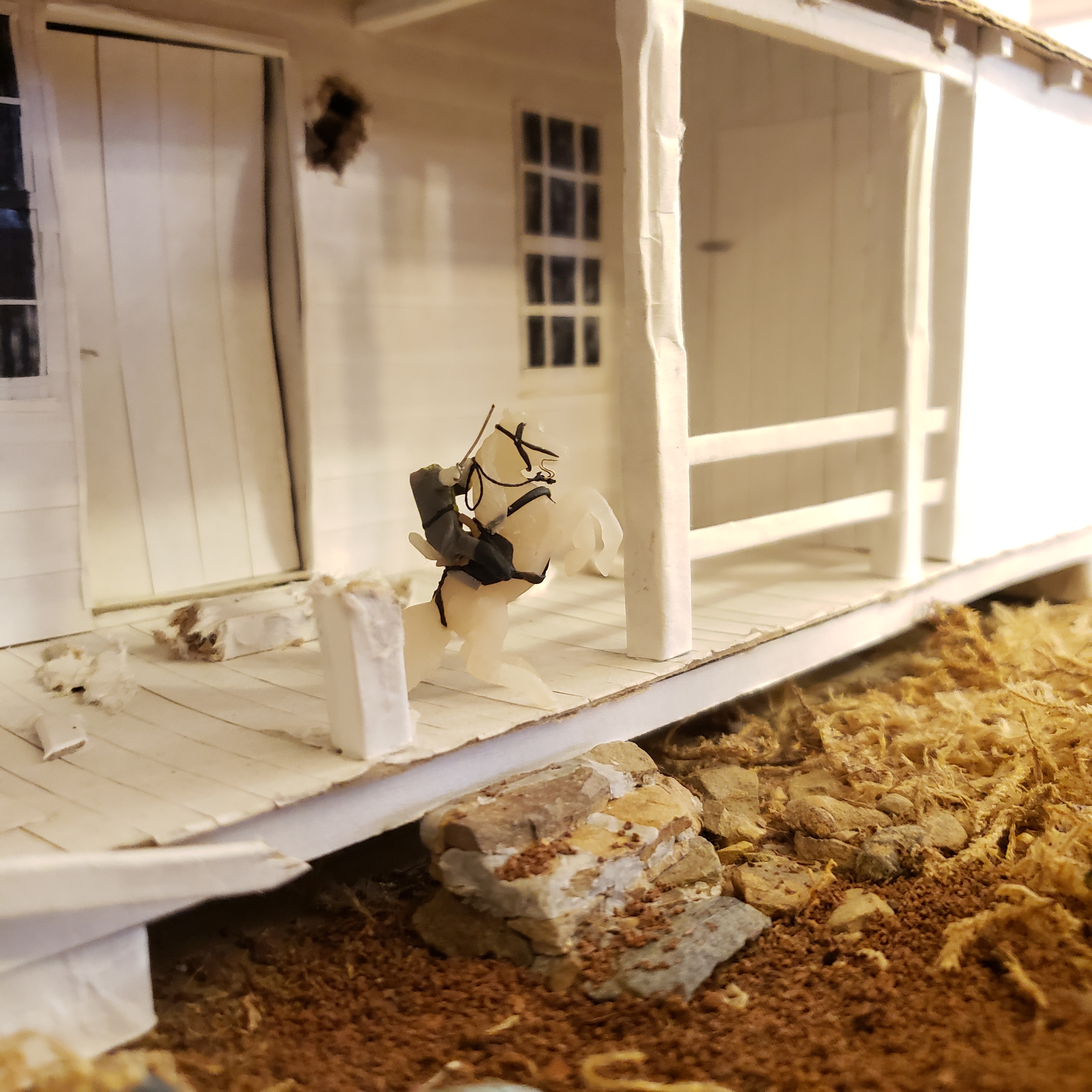
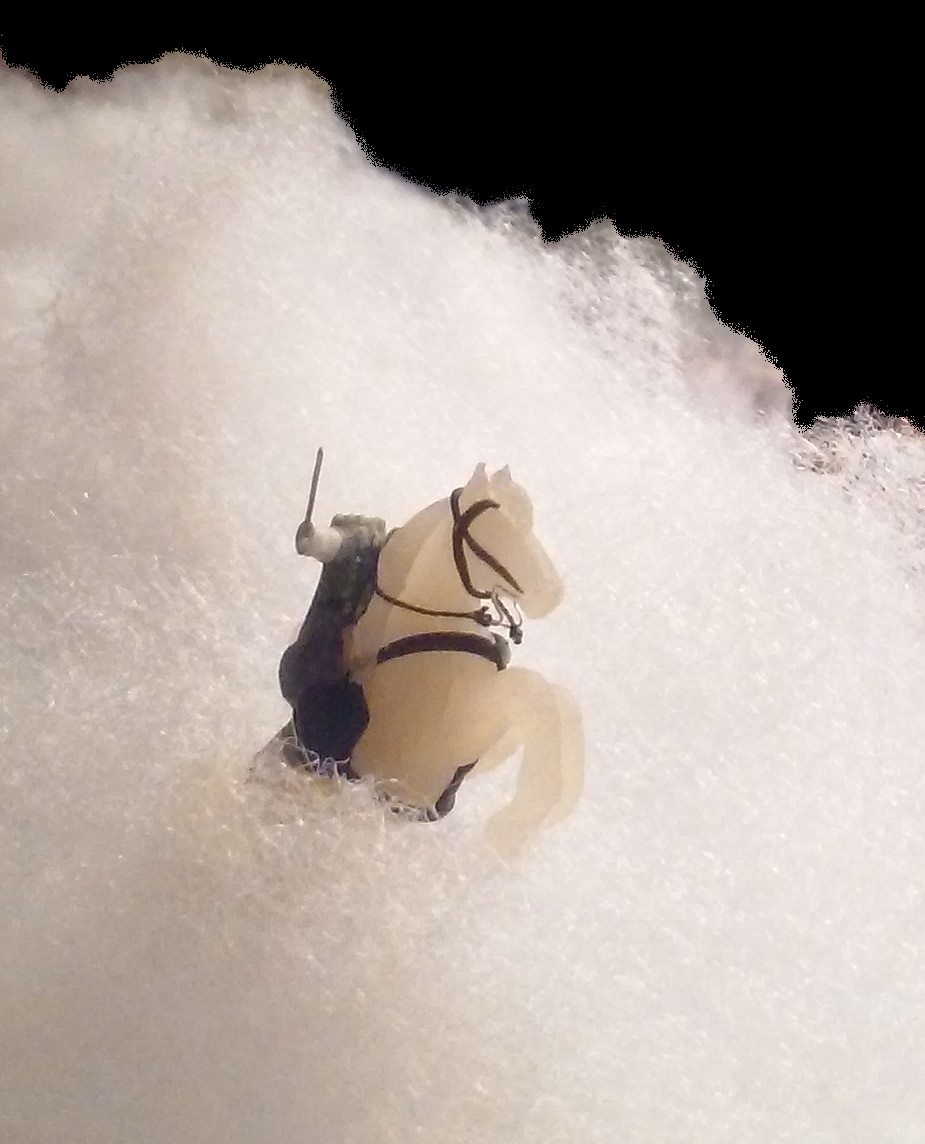
Ride your horse in the nearby stream—just make sure he doesn’t roll in it with you still in the saddle!
Fill a bucket of water to pour over your head. …Or maybe this cat is recommending falling into the creek. Your guess is as good as ours!
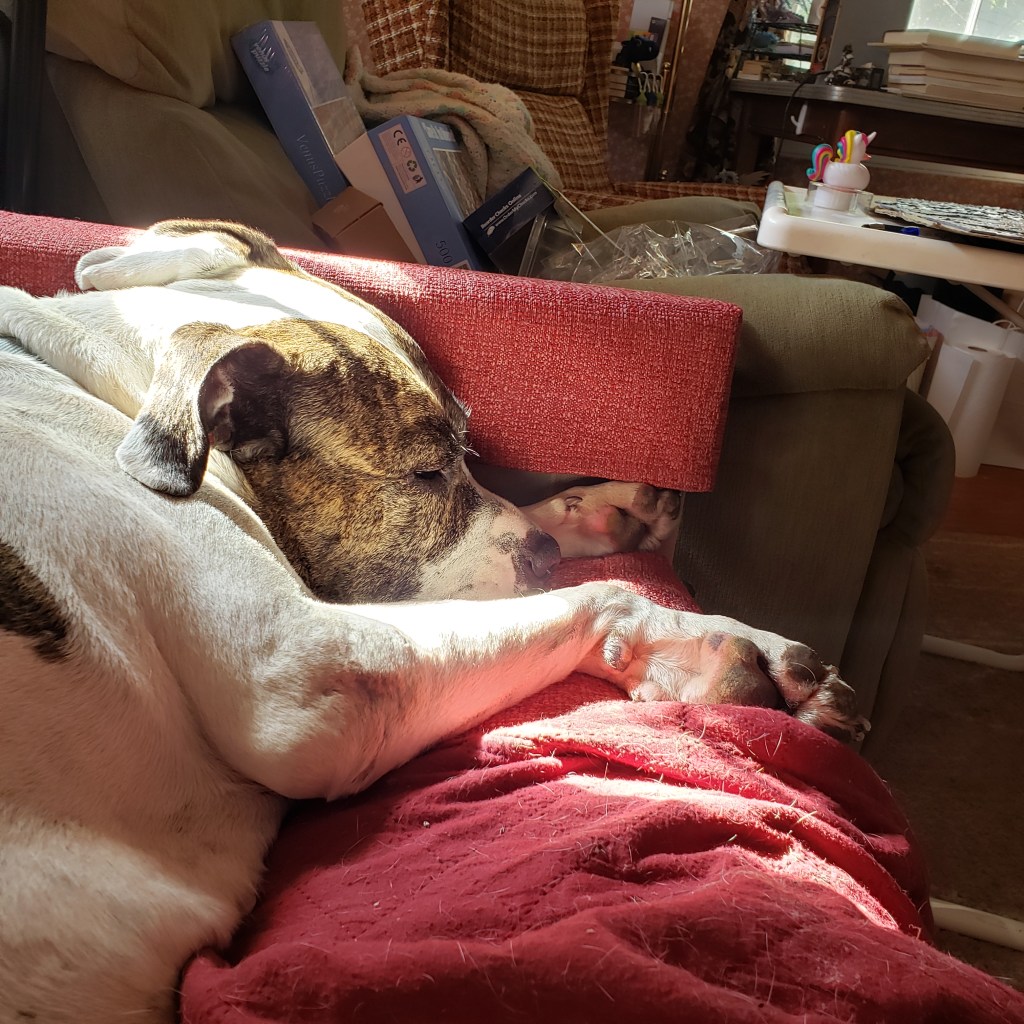
A tip from Patrick the Only Clay Dog and Joanie the Museum Dog—take a nap! Patrick recommends napping in the grass. Joanie recommends a sofa under an air conditioner!
This past April, we were excited to make Cat 10,000 as Lt. George Morris of USS Cumberland. Today, we “mews” about the significance of Cat 10K for us, as well as who he represents and why.
Since 1999, we have kept track of every thousandth cat on our Census. (For more on our Census and K-Cats, see our Mewsing on Cat 9000 here.) As the Census neared 10,000, we felt that Cat 10K should be someone particularly special. Of course, he also had to come up naturally on a current project. Initially, we thought he would be on “The Boys Are Still There” (Little Round Top). But in February, we finished that diorama still 172 cats shy of 10,000. So, we began looking ahead.
As we did so, we also realized that 2025 will mark 30 years of making Civil War cats and 10 years of the Civil War Tails Diorama Museum! Naturally, the calendar for such a happy anniversary should focus on our K-Cats—which meant we needed to make Cat 10K this Spring! (Yes, the calendars are available here!) The push to make him meant that we needed to “fish or cut bait” on who he would be.
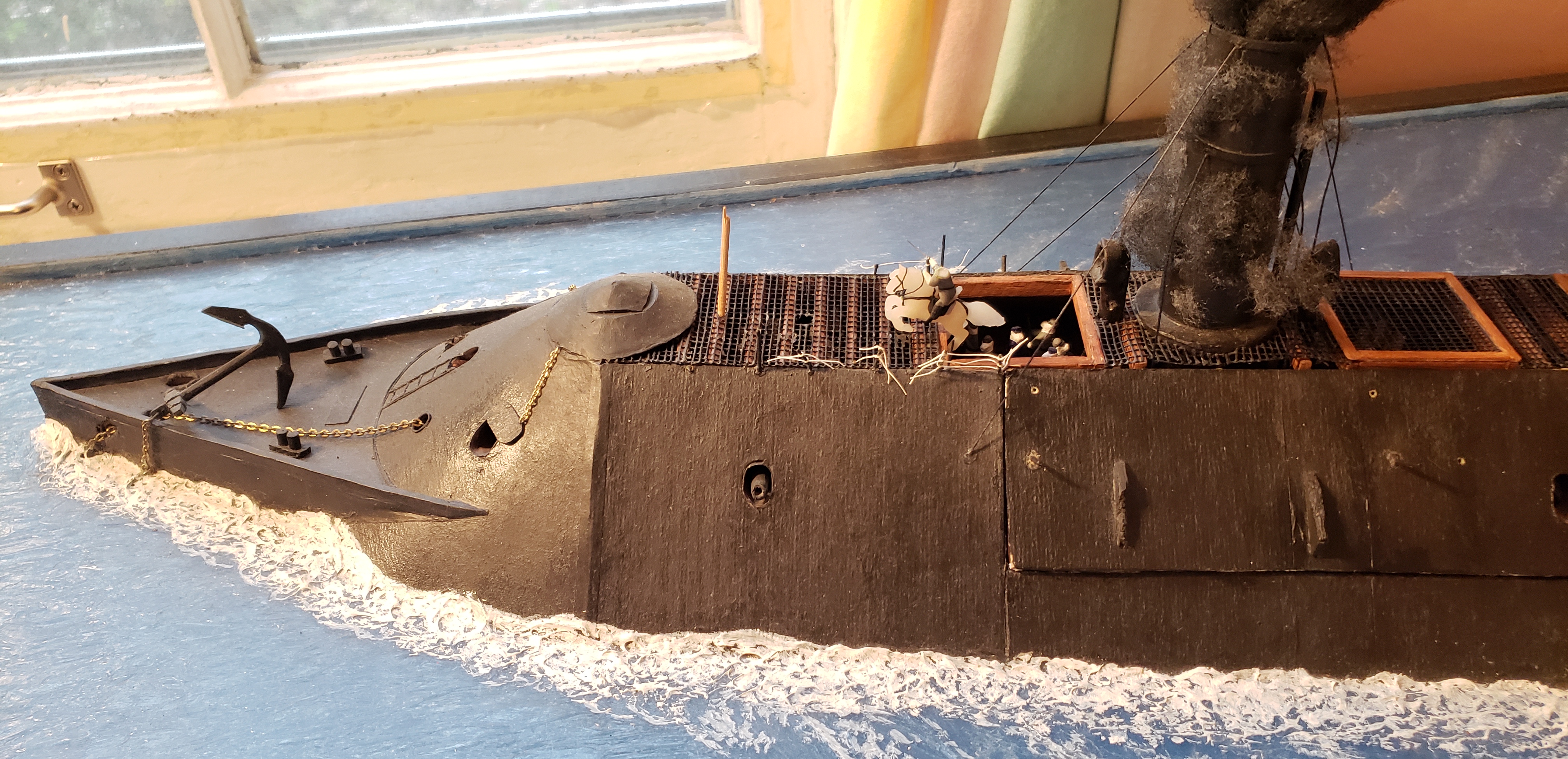
Having finished Little Round Top, we both started new dioramas. Ruth began working on a cavalry fight in Rockville, Md. We considered making Cat 10K to represent Col. Charles Russell Lowell, commanding the Union cavalry. Rebecca began working on CSS Virginia ramming USS Cumberland. Who on the ships could be a K-Cat candidate? While there were several options, Lt. George Morris stood out to both of us.
March 8, 1862, dawned a gorgeous but very ordinary Saturday in Hampton Roads, Va. On the Union ships, life went about as normal—washing laundry, holystoning the decks, and mending clothing, all in preparation for Sunday inspection. Cumberland’s captain, William Radford, headed off to USS Roanoke to serve on court-martial duty that day, leaving Lt. Morris, his second-in-command, in charge.* Little did they know that today, the one day the captain happened to be away, Morris and his crew would be thrown into a situation that no one in the Union Navy had ever experienced.
Around 12:30 p.m., everything about that ordinary day changed. The ironclad CSS Virginia entered Hampton Roads and turned towards the Union flotilla. Capt. Franklin Buchanan planned to ram Cumberland first, because her two 10-inch pivot guns concerned him. Virginia approached Cumberland from the front, so for a time the Union sloop could not bring any guns to bear. Eventually, the Union sailors were able to swing their ship slightly, and opened fire.
Even though Cumberland was half the size of newer ships like USS Merrimack, from which Virginia was constructed, she was not wimpy. When she fired a full broadside (eleven of her 9-inch guns), she sent a total of 880 pounds of iron to her target! Her crew had full confidence in their ability to face any opponent. Now, however, they watched their shots bounce off the Confederate ironclad, doing no damage. Still, they continued firing.
Virginia’s first shot in reply killed five Marines on Cumberland’s quarterdeck and wounded others. Her second shot killed fifteen of a seventeen-man gun crew, and severely wounded the gun captain. Those two shots were harbingers of the wooden ship’s fate.
Virginia rammed Cumberland on the starboard bow, opening a 7-foot hole in the wooden hull. Cumberland began sinking immediately. Still, her gun crews kept firing.
The two ships pounded each other for approximately 45 minutes at close range. Union Marine Daniel O’Connor records that his gun’s second shot was fired at a mere 45 yards! Even at such short range, the shot glanced off the iron casemate, doing nothing more than throwing sparks as it scraped along the iron. Meanwhile, every shell from Virginia wreaked havoc among the gun crews of the wooden ship. Enormous splinters ripped fromthe bulwarks and deck caused even more casualties. Cumberland, who that morning had been a beautiful, “splendid type of the frigate of old times” (Lt. Thomas Selfridge, forward division), was now “a scene of carnage and destruction never to be recalled without horror” (Master Moses Stuyvesant, aft division).
Lt. Morris oversaw the action from the quarterdeck or spar deck. What must have gone through his mind as he watched Virginia’s shells shattering Cumberland and destroying her men?
Several stories tell of a Confederate officer calling on him to surrender and of Morris’ firm refusal. There is debate as to whether or not the incident actually happened. However, O’Connor, who served on a gun crew in the stern near where Morris likely stood, records the story in a letter to his brother, written less than a week after the event.
According to O’Connor, Morris replied to the Confederate, “No! And d— you, you coward, you have made a slaughter house of the ship! We will sink with our colors first!”
“Sink it is,” the Confederate replied.
When O’Connor recorded his account he was not seeking glory for himself, Morris, or the ship; he was just writing home of his experiences. His words ring true as the gritty reply from a ship fighting to the bitter end, and give us a glimpse into Morris’ steadfast determination.
No one could blame Morris if he had chosen to surrender. Lt. Selfridge, in his reminiscences, noted, “There would have been no dishonor in surrendering to such odds,” since Cumberland faced an ironclad opponent twice her size and, in all reality, never stood a chance. But Cumberland never struck her colors. Selfridge continues,
and yet what would have been the result [of surrendering]? The Merrimac fresh from the surrender of the Cumberland, would have destroyed the fine steam frigate Minnesota…would have captured the remaining naval force at Hampton Roads,…and when the Monitor arrived late Saturday night she would have found herself alone.
As it was, Virginia was at the mercy of the tide, and the longer she dealt with Cumberland, the less time she had to maneuver without risking running aground. Morris’ decision and Cumberland’s sacrificial fight bought time for the other ships.
Morris’ decision was not in opposition to the feelings of his crew. First-hand accounts from his officers and men do not show regret that the ship kept fighting. In fact, the thought of surrender or escape seems never to have crossed their minds; they manned their guns until the order came to abandon ship.
By 3:35 p.m., Cumberland’s bow had sunk so far that the water reached the main hatch in the middle of the ship. Lt. Morris sent word to get any wounded who could walk out of the cockpit below decks—“Save all who can!”—and then finally ordered, “All hands save yourselves!”
Men climbed out of gun ports and hatches, or jumped overboard. Some wounded managed to make it off, but those below decks or too badly injured to move drowned. Cumberland sank in 54 feet of water, so her masts remained above the surface, allowing men to climb the rigging and wait for small boats to rescue them.
Acting Master’s Mate Charles O’Neil jumped overboard and managed to scramble into the sailing launch. He recalled seeing men in the water all around the boat, including Lt. Morris, “struggling by himself.” O’Neil passed him a boathook and drew him alongside. As O’Neil and others pulled him into the boat, Morris said, “Don’t let go of me, for I can’t swim.”
Can you imagine standing on the deck for nearly an hour, watching the bow sink lower and lower, knowing that saving the ship is impossible, and knowing that you can’t swim? (The inability to swim was not unusual for a sailor of that time.) If Morris had surrendered, he could have ensured a safe trip to shore in a boat. But he did not let his personal situation or fears affect his actions as commander. It was not until he was in the water that he thought of himself. Even then, as soon as he reached shore and saw his boatload of men safely off, he returned to Cumberland’s wreck to recover the flag and any survivors.^ Whatever fear he had felt while in the water, whatever exhaustion he must have felt after the adrenaline rush of the last hour, he still did his duty as the ship’s commander, thinking of the men left behind and the Stars and Stripes left flying undaunted and defiant.
So, what became of Cumberland’s gallant crew and Lt. Morris? Long after the war, Selfridge wrote, “And yet the government bestowed neither promotion or medals upon the officers and crew of the Cumberland.” He also felt that history had already forgotten Cumberland and her crew, and that “the memory of her deeds are almost unknown.”
Dioramas, for us, are a way to honor and remember a story, and ever since we first read about Cumberland years ago, we felt she begged for a diorama. As Confederate Lt. John Taylor Wood (Virginia) wrote, “No ship was ever fought more gallantly.” This is why we are excited to begin this work.
As we read the anecdotes about Morris, we agreed with the conclusion made by a Confederate observer on shore, “A gallant man fought that ship.” As we discussed candidates for Cat 10K, we felt that Morris’ story also seemed to embody the determination of Cumberland’s crew as a whole. Honoring him would honor the entire crew.
Some might say it’s “only” a clay cat, it’s “only” a diorama. But we look forward to sharing Cumberland’s story with museum visitors. It will be helpful to have both dioramas in order to show the contrast between the first day of iron vs. wood, and the second day of iron vs. iron. But closer to our hearts is the desire to commemorate Cumberland and her crew. Sharing a historical story has always been the purpose of our dioramas, from our first little scene in 1998 to the completion of “The Boys Are Still There” in 2024. It is one thing to mention Cumberland’s fight as we speak about Virginia and Monitor, but it is another thing to show it. Even in the early stages of research, we feel a weight of responsibility to do all we can to convey the emotion of Cumberland’s story and the steadfastness of her gallant crew, and to get the details right in order to best portray a ship “Destroyed But Not Conquered.”
Note: spelling and punctuation in the quotes have been updated, as needed.
*As soon as Capt. Radford learned that Virginia had come out, he took a boat to shore, found a horse, and galloped for Cumberland. By the time he arrived, his ship had already been destroyed.
^Morris found neither. Other small boats had picked up survivors, and Lt. Selfridge, who also returned to the wreck, had recovered the flag.
Today we look at another FAQ and consider the question, “How did you end up here?” (For our previous FAQ on what inspired us to make our cats, click here.)
When we began making our Civil War cats in 1995, they were just toys. We would have them fight our other toys and even wrote stories based off of the elaborate battles, campaigns, and adventures that “our guys” had. Then, in 1998, we began setting them up in scenes which, in time, developed into dioramas.
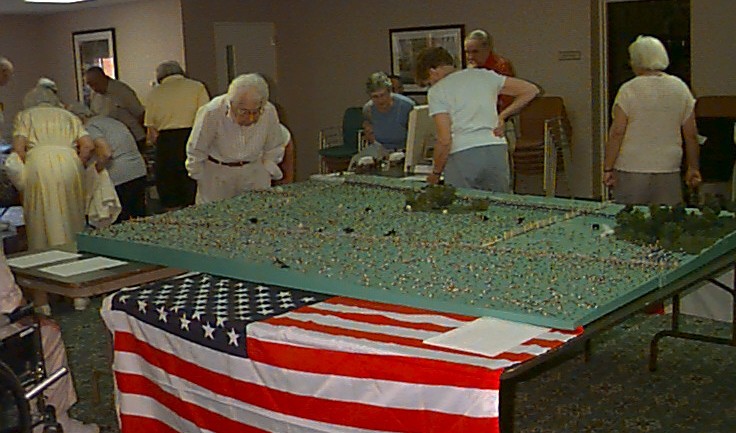
In high school, we taught lessons on the Civil War to other homeschooled students. The children really enjoyed seeing the dioramas that we used as visual aids. We also began working at a local retirement community. While the details are lost to time, somehow we arranged to bring our dioramas in to display for the residents for an afternoon. It became a yearly event, and the residents loved seeing our dioramas. Every year, one resident in particular, Helen, suggested, “You should take these into schools!” We would just laugh and joke, “You want to be our agent and contact the schools?”
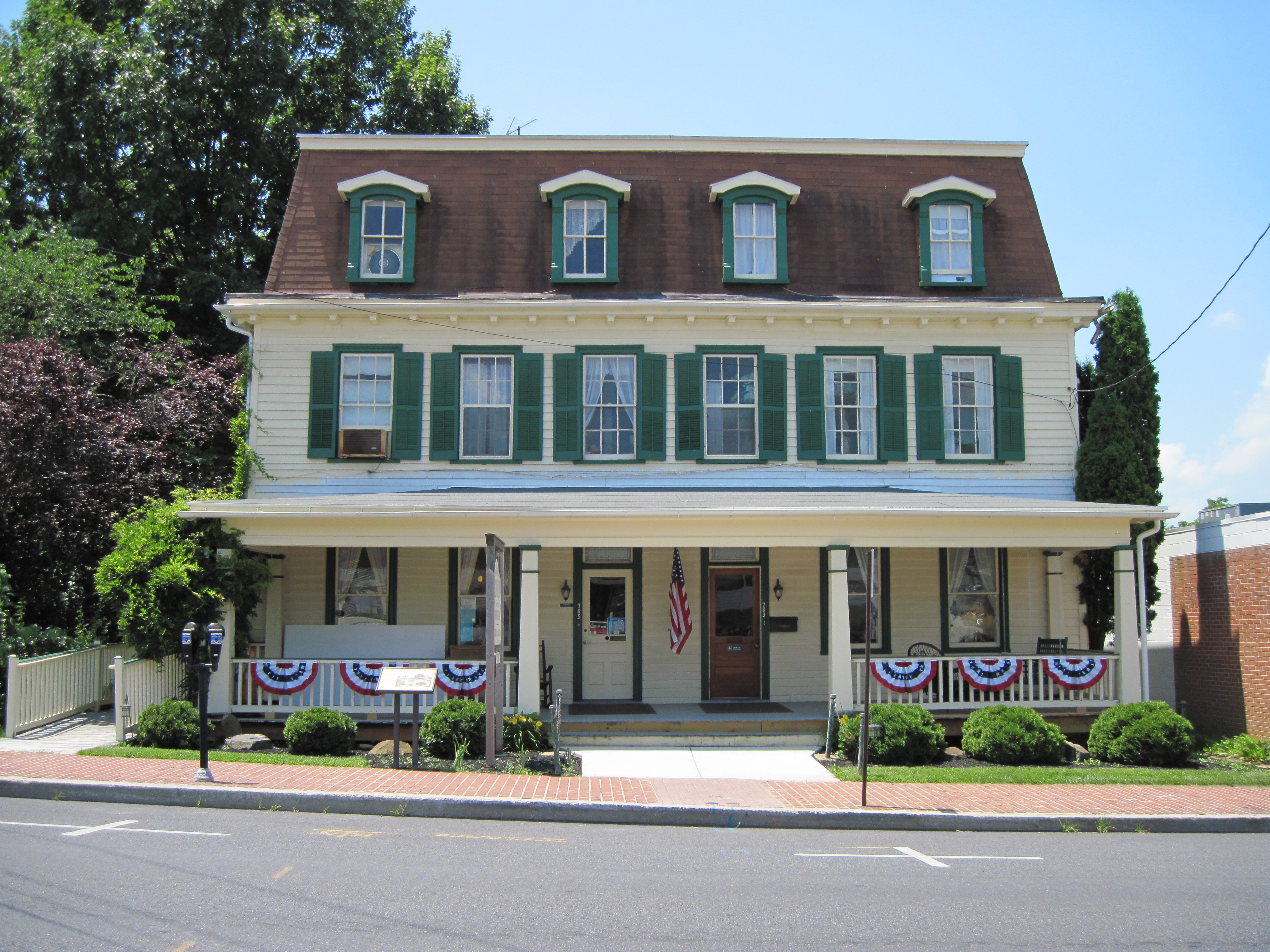
In 2012, we decided to seriously consider Helen’s idea. As it turned out, that was also the year that Rebecca dropped one of the six sections of “The Fate of Gettysburg” in the truck while unloading it, and many of the cats, along with their fallen hats and guns, rolled off! By that year, we also had Fort Sumter (which is very heavy) and knew that the planned Little Round Top would be a massive eleven feet long. So, we concluded that not only is transportation hard on the cats, but, quite frankly, the dioramas wouldn’t fit in a classroom! Not to mention that it took us a couple hours to set up the display and a couple more to break it down. So we thought, “Maybe the kids should come to the dioramas instead.” Shortly afterward, Rebecca began poking around real estate listings, just to see what was in Gettysburg. Why Gettysburg when we were in the Philadelphia area? Well, it’s a no-brainer location for a Civil War museum and, conveniently, it is Rebecca’s favorite battlefield. In April of 2013, our Civil War cats made the 100-mile trek down the PA Turnpike to their new home.
Civil War Tails would not be possible without the support of our parents over the years—from encouraging our imaginations as kids to supporting us in our crazy idea to move out here to open a cat diorama museum! And for (still) chipping in their time, resources, and skills when we need help with the dioramas and museum.
This also would not have come about if not for the enthusiasm of the students and residents who absolutely loved seeing our little clay cat dioramas. Their reactions showed us that people would enjoy seeing our work and helped us to believe that the museum would be a success. From our early days of making cats, we labeled their storage boxes with “Clay Civil War Cat Museum.” But could such a thing really happen? Could we own a museum? Nah! Well, Helen’s persistent comment each and every year prompted us to… start a museum!
A big thank you to all of you who have come to Civil War Tails or have followed us on social media, confirming that the students and residents were right. We are looking forward to 2025, when we will celebrate 30 years of Civil War cats and 10 years of Civil War Tails! We have been encouraged and touched by the interactions with and reactions of thousands of you, our visitors. And we have enjoyed inspiring many of you and your children to learn more or create more.
Yes, our eleven-year-old selves had no idea what we were starting with those first few clay cats!
Today we celebrate the completion of our diorama of Little Round Top, “The Boys Are Still There”!
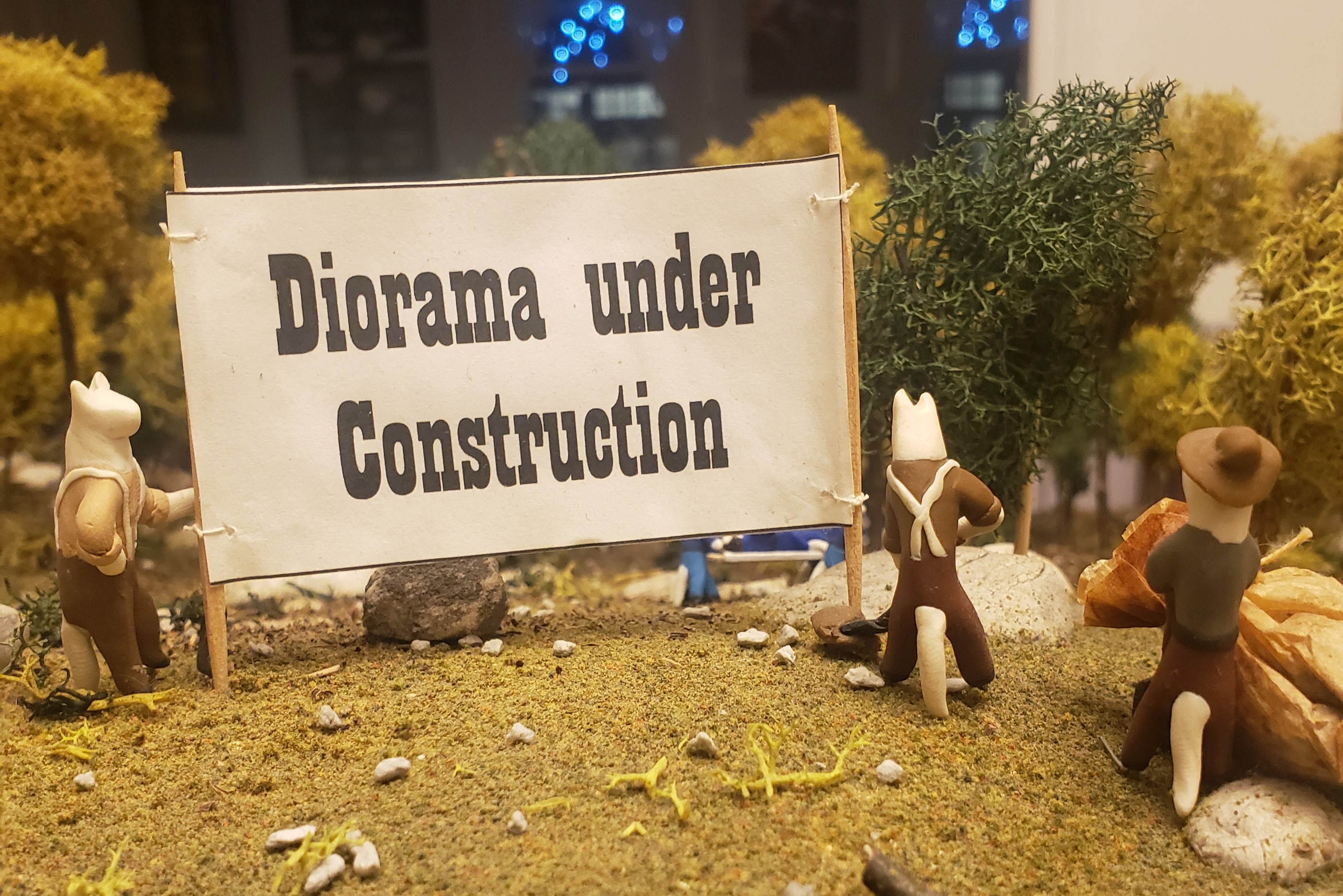
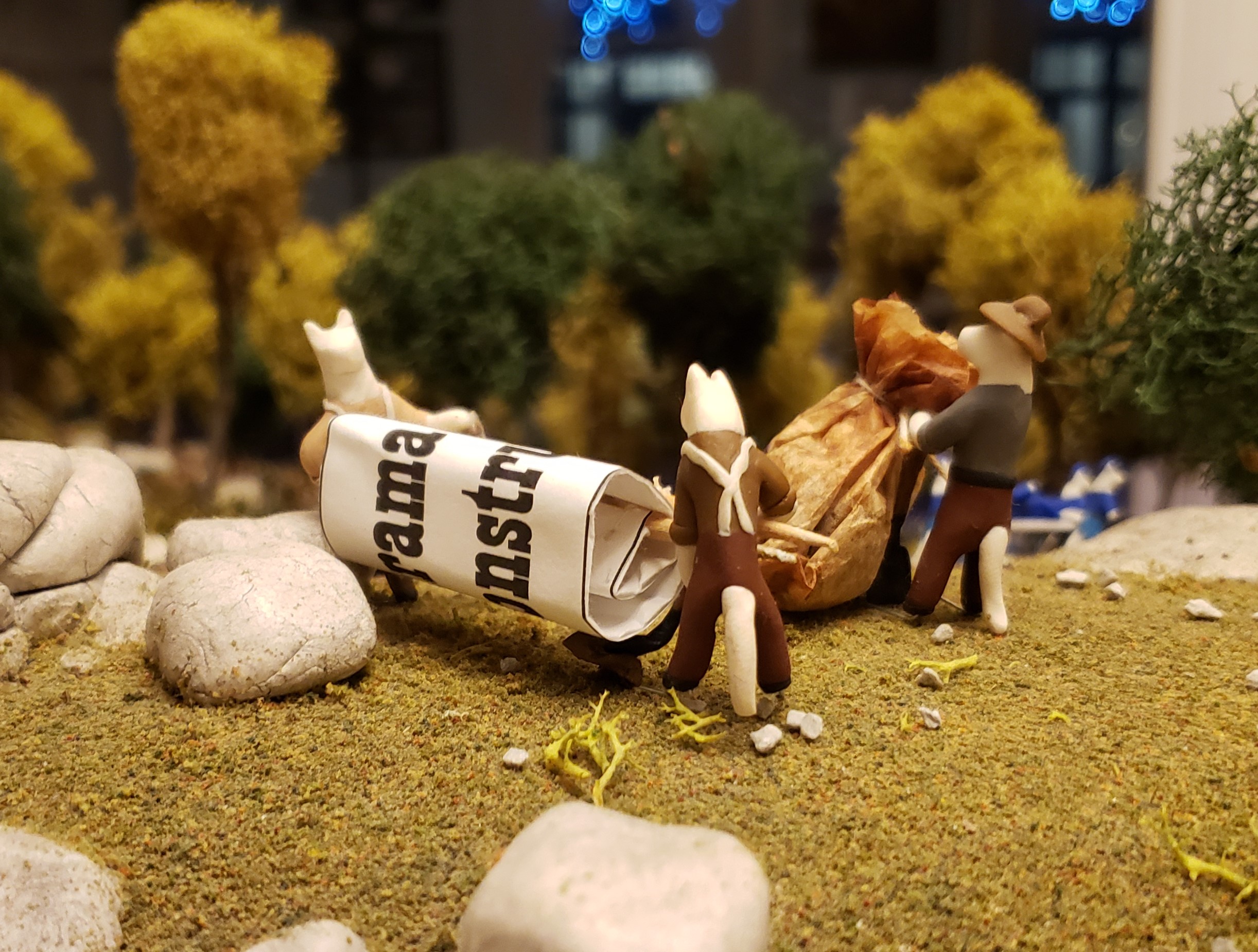
On February 9, 2024, we placed the last trees and ground cover, and the diorama was done! Our construction crew could finally pack up their billboard and head off to a well-earned vacation!
Dedication:
And then we found Mr. Bennett’s work. By reconciling soldiers’ first-hand accounts, he has reached a very clear picture of what Col. O’Rorke, Adj. Farley, and the regiment most likely did. Not only has he written articles and a regimental history for the 140th New York, but he graciously supplied us with the first-hand accounts and his own writings, and answered our questions. We cannot thank him enough for his help. “Invaluable” only scratches the surface.
Trivia:
Our page on “Making Little Round Top” tells how we designed and made the topography, and our page on Little Round Top tells the history, but here is some fun trivia about the diorama:
Little Round Top rocks (DAS)
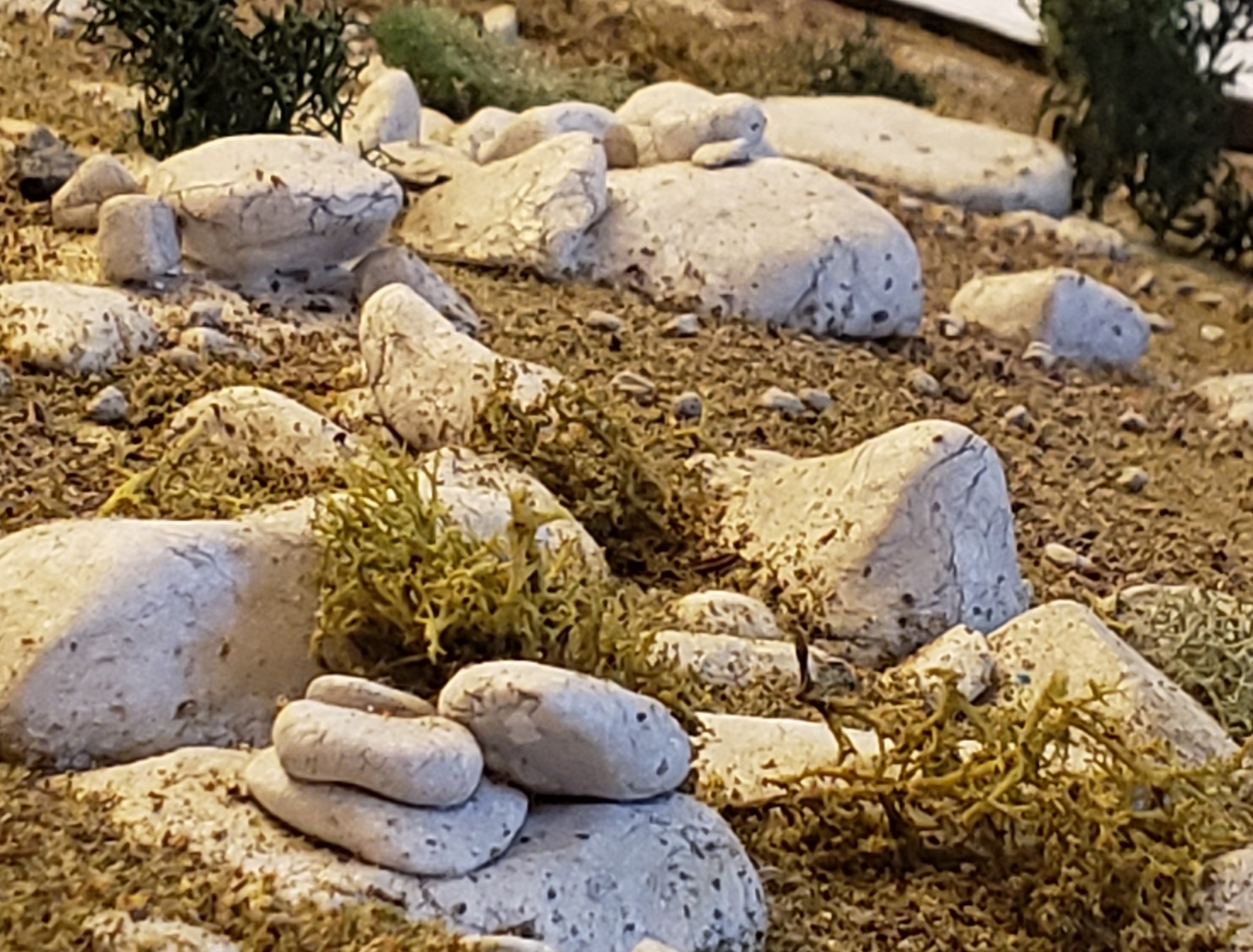
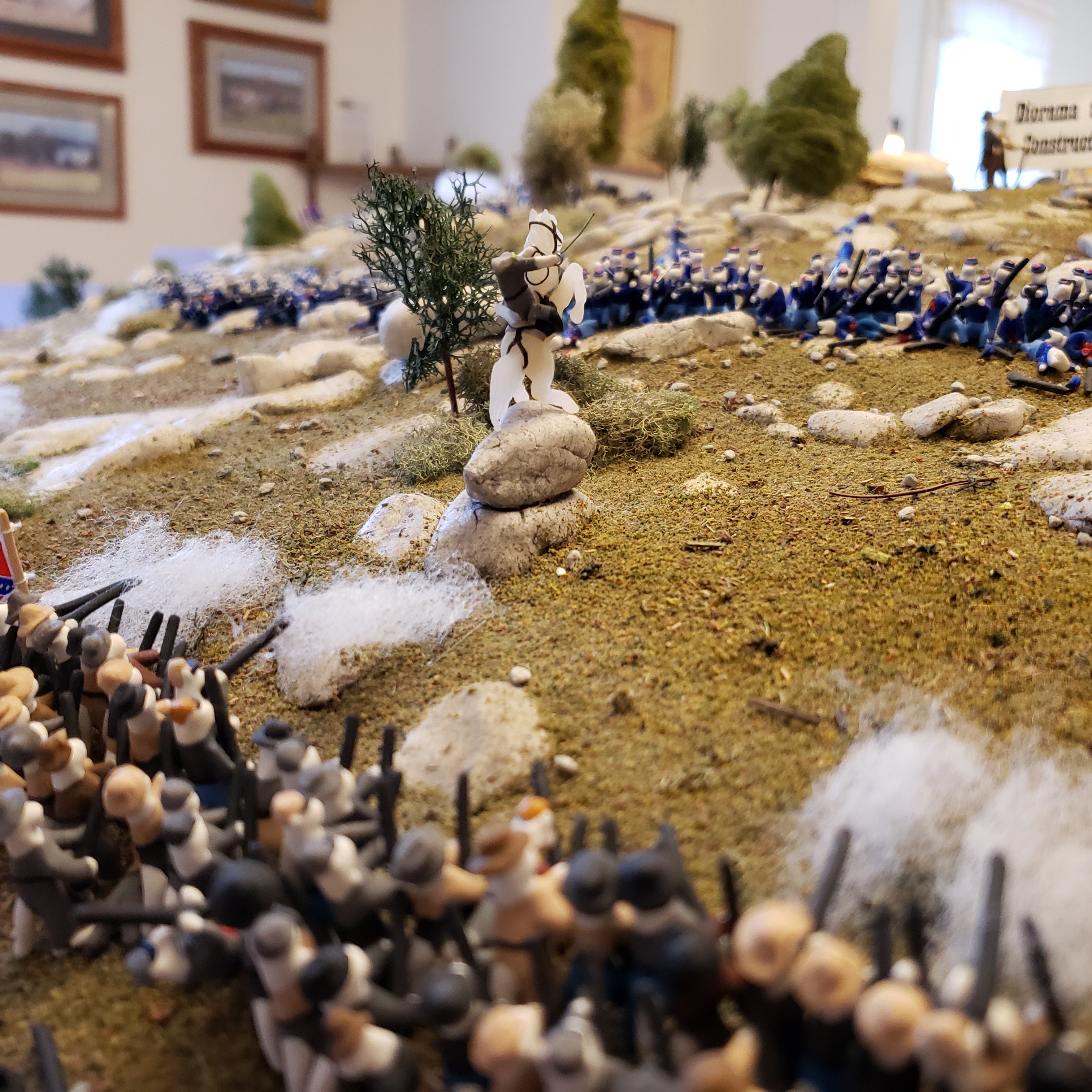
There are 2,600 hand-sculpted clay boulders on the diorama based off of photos from the battlefield (period, early 20th Century, and current). Our dad still remembers how cold it was when the three of us tromped over the hill in the dead of winter, taking hundreds of photos of thousands of rocks. (Hey, winter is a good time for rock photography—there are no leaves on the trees!) And yes, Rebecca counted all 2,600. Apparently, counting the cats wasn’t nerdy enough for her! Now, this trivia probably has you wondering, do rocks outnumber cats? Or do cats outnumber rocks?
There are 2,650 cats on the diorama: 1,525 Union and 1,125 Confederate. In case you’re curious, that is just shy of our diorama of the Angle. “The Fate of Gettysburg” holds 3,000 cats.
This is the 2,000th cat installed on Little Round Top. He is a private in the 16th Michigan. Rebecca did not give him a corps badge purely so we could be sure to remember which he is. It also helps that he is near the big rock that the 16th Michigan’s monument stands upon today.
Col. Patrick O’Rorke (140th New York)
The last cat made for the diorama is Col. Patrick O’Rorke.
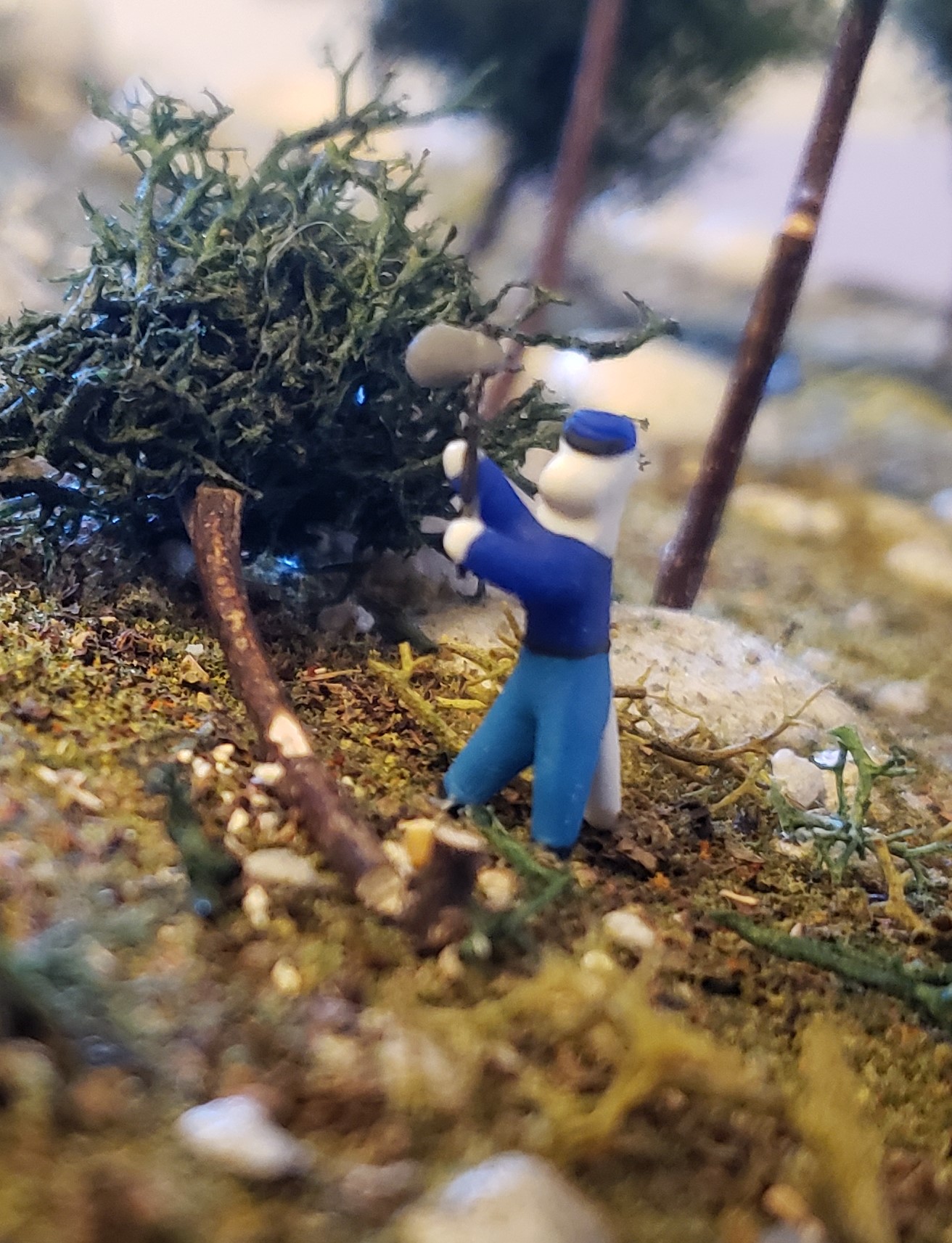
The last cat installed is one of the engineers or “sappers” working to clear a route for Hazlett’s artillery and Weed’s brigade of infantry.
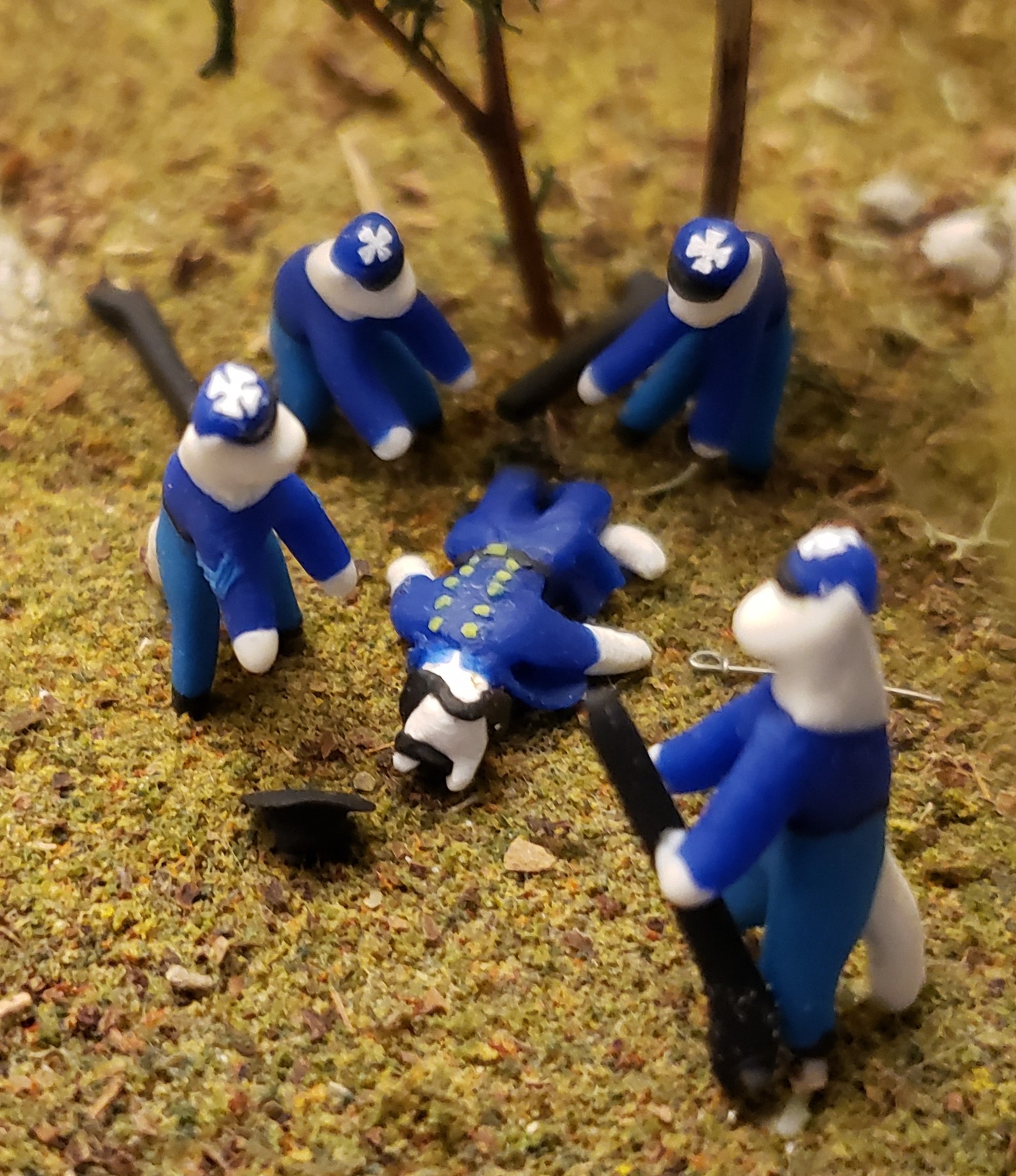
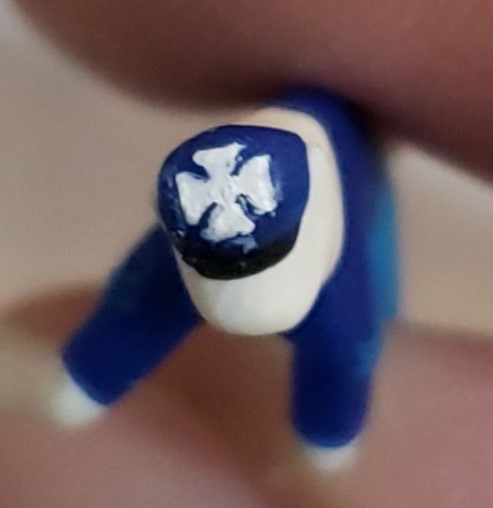
The last corps badge Rebecca painted is on Sgt. John Wright, of the 140th New York. He and several others carried Col. O’Rorke’s body to the rear. After painting badges on nearly all of the Union infantry’s kepis, it was a strange moment for Rebecca when she realized that she probably will never have to paint another Maltese cross corps badge! Or, at least not for a while.
Three K-Cats are on the diorama. A K-Cat marks each 1,000 on the Cat Census that we keep.
Cat 6000 is Col. Joshua Chamberlain, 20th Maine
Cat 7000 is Maj. Ellis Spear, 20th Maine
Cat 9000 is Col. Strong Vincent
So, what total did “The Boys Are Still There” bring our Cat Census to? 9,828. We are a mere 172 cats away from Cat 10,000!! Stay tuned! (But don’t hold your breath—we need to do some research on USS Cumberland, first.)
Oops, we just spilled the beans! What’s next, you were about to ask?
Rebecca is beginning research for a diorama of the ironclad CSS Virginia (Merrimack) sinking the wooden sloop of war USS Cumberland, as a companion to our diorama depicting the inconclusive duel between the ironclads the following day. As we interact with visitors, we have come to realize that many people don’t know about the first day’s fight—a day which has been called the worst defeat for our navy until Pearl Harbor. As part of that day’s fighting, Virginia rammed Cumberland, and then the two ships pounded each other until the Union sloop sank. While Cumberland’s shots had no serious effect on the ironclad, Virginia’s wreaked havoc on the wooden ship. Lt. John Taylor Wood aboard Virginia remembered, “No ship was ever fought more gallantly.”
Ruth is working on a cavalry skirmish in Rockville, Md., in 1864. Facing charging Confederate cavalry, Col. Charles Russell Lowell ordered his Union cavalrymen to dismount and turn their horses loose, in order to have every man on the firing line. Ordinarily, one in every four men would hold the horses. In his book The Guns of Cedar Creek, author Thomas A. Lewis likens the order to telling sailors to scuttle their ship in the middle of the ocean. Fortunately for Lowell’s men, other Union soldiers caught the horses, and his thin line was able to break up the Confederate attack.
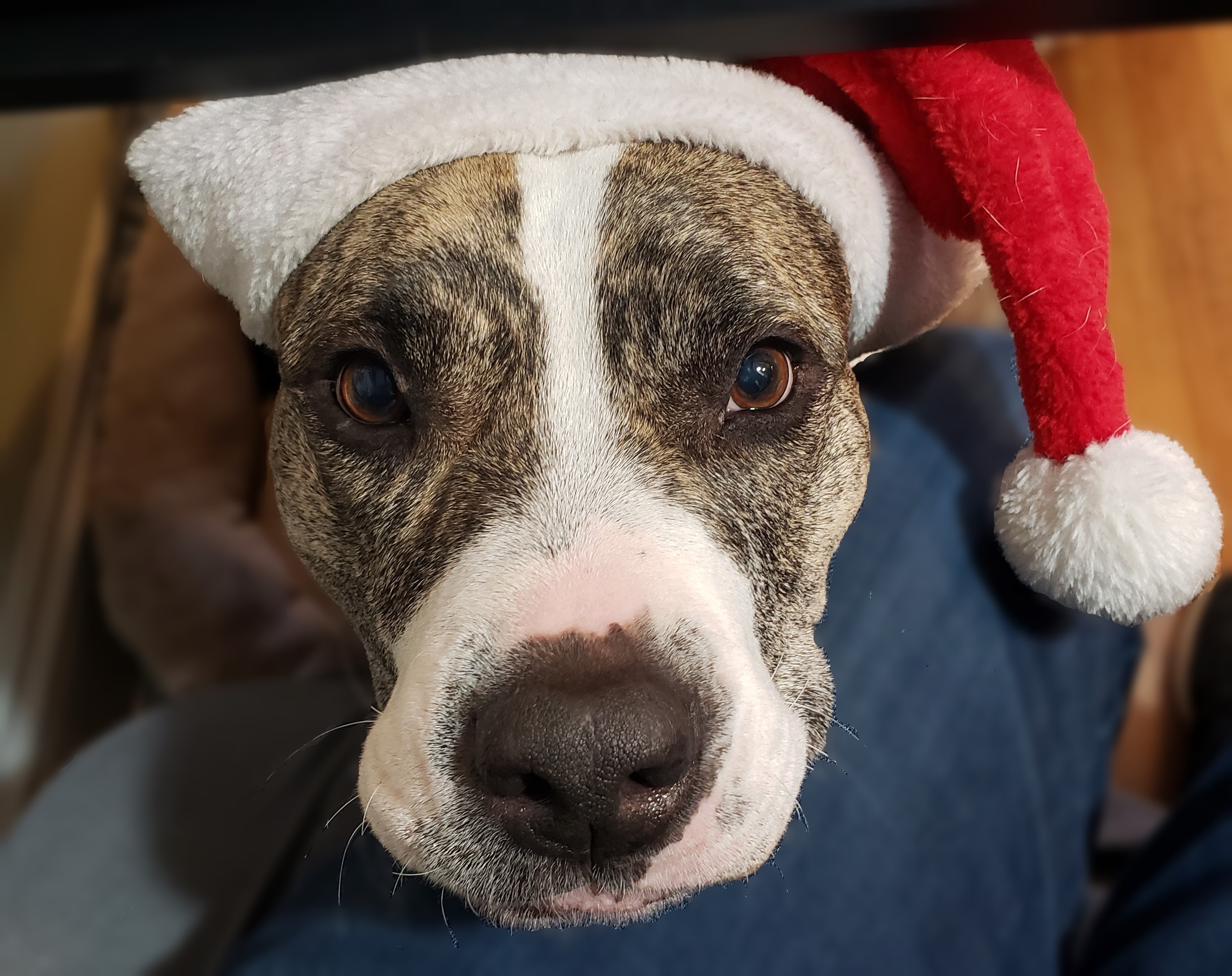
“Merry Woofmas” from Joanie the Museum Dog of Civil War Tails! She has her begging face and Christmas hat on as she writes to Santa this year…
Dear Santa,
This is Joan, the Villalobos dog. I have a new name and address this year. I’m Joanie, now, and guess what? I got a home! I live at Civil War Tails in Gettysburg, PA now. That’s “tails” not “trails.” I hope it’s not confusing. Oh, the cats here say that you know where we are, because they saved you from COVID in 2020. That’s good, because some people have trouble finding us, so I was worried you might not find me this year.
I feel a little silly writing to you. I feel like I already got my Christmas presents. I have a really nice home, with more toys than I know what to do with, and lots of blankets and beds. I get a chomp treat every day, too. My home came with an amazing sofa. I didn’t know what a sofa was or how to get onto it, but I learned quickly. It’s such a nice bed! It’s perfect for rolling on and squishing my face into! My hoomans tell me, “Watch out! You’ll roll off!” but I don’t know what that means. Sometimes I end up on the floor and I don’t know what happened, but I just jump back on. It makes my hoomans laugh, so that makes me happy.
I’m trying hard to be a good pup, Santa. But sometimes, I mess up. I don’t mean to, but I’m still learning how to be a house dog, so please don’t count it as being naughty! You see, sometimes, I forget that my hooman is on the walk with me and I try to chase squirrels. Other times, I love her so much that I want to defend her from other dogs, but she doesn’t like me doing that, either. When we’re home, I follow her everywhere to make sure she’s safe, but if she leaves me, I get lonely and steal her sweatshirt. But I don’t hurt it; I just want it to keep me company. She doesn’t seem to mind, so I think I’m not being naughty?
Everything is so different from New Orleans! I love being outside, exploring what Pennsylvania is like. First, it was exciting learning about Yankee squirrels. Now, the leaves are falling off the trees. Up in town they’re okay to walk on, but I don’t like walking on the big oak leaves around our house. I try to hop over them as quick as I can. Now it’s getting cold. But that’s okay because I have a warm coat that Nana made. And brisk, breezy days are so exciting! There’s just so much to sniff on the wind! Sometimes, my hooman asks, “What is the wind saying to you? What stories does it tell?” I wish I could tell her. I don’t suppose you could make me able to speak Hooman?
My hoomans even gave me a job at the museum. I like wearing my bandana and saying hi to visitors. Sometimes, I’m so sleepy that I miss them. Sometimes, I wish my hooman and I could just snuggle on the sofa all day. But other days we spend so much time on the sofa that I’m happy to go back to work in the museum. So it all works out.
If you have extra space on your sleigh, Santa, I would love a big chomp. Sometimes I dream of one that’s two feet long, with a red bow on it. And maybe some cookies! My hoomans have a big tray of cookies, and they look so good. If dogs can have cookies, could I have a few?
Merry Woofmas,
Joanie
Don’t tell Joanie, but the treats on her Christmas list are already tucked away and waiting for her!
Merry Christmas to all, from Rebecca, Ruth, Joanie, and the 9,740 cats at Civil War Tails!
As we look forward to family and food here at Civil War Tails on Thanksgiving Day, we would like to take a moment to reflect over this past year.
Thank you to all of our wonderful visitors for making Civil War Tails a part of your trip to Gettysburg. Thank you for supporting us another year (our best yet!). Thank you for your kind words and the joy you bring us! Thank you for letting our clay cats bring you joy. Thank you for letting us share our museum with you, and for sharing our museum with your family, friends, and even total strangers!
We have taken to jotting down memorable comments and interactions on a daily basis. It is so much fun to look back over a month or year! I would guess the most-heard comments this year are “Amazing!” and “Fantastic!” We love seeing our dioramas afresh, through the eyes of our visitors.
Thank you for making our little clay cats feel like celebrities! One favorite memory is of one visitor who had seen our post about the 2000th cat installed on Little Round Top. When she saw him “in person,” it was like she was meeting a celebrity! Another favorite memory is of a guest who saw our diorama “Desperation at Skull Camp Bridge” on our website. The story fascinated her so much that she researched the action before coming. When she finally saw our diorama “in the flesh,” she commented, “I have goosebumps!”
As with every year, we love thinking back over how our museum has inspired kids. We received a very sweet note from a little boy who has been inspired by our dioramas. We also enjoyed repeat visits from kids who have been here before and asked their parents to come again or who were bringing first-time family members. (Theron, we still plan/hope to finish Little Round Top before you return in the spring!)
Thank you also for your outpouring of support when we lost our sweet, perfect museum dog Kelly. Thank you for welcoming Joanie and for helping to give her a pawfect job and furever home. (Thanksgiving Day is the 3-month anniversary of her adoption!)
Thank you, as always, to our mom and dad, without whose encouragement this would never have happened, and without whose support Civil War Tails would not be possible.
Last, but most importantly, thanks be to God for giving us not only 8 years of Civil War Tails but our best museum year, by far!
We look forward to 2024 and hope to enjoy many more moments with you, our visitor-friends, whether in person or on social media.
Today we look at another set of FAQs, this time about how we started. (You can find our first FAQ Mewsing here.)
“What inspired this?”
The simple answer is, “It just happened.” When we were 11 years old, Rebecca read biographies of Generals Lee and Grant. Liking the two generals, she made them out of modeling clay. Then we became interested in the Civil War and kept making the officers we liked, and troops for them to command. Making our armies kept us reading, and reading fed our armies. A few years into it, we began making dioramas, inspired by the stories we read. Sometimes, we show generic scenes, such as a camp. But most often, we show a specific story. Our first “permanent” diorama (i.e. on a shelf, not the floor) portrayed the moment when Gen. Jackson received his nickname “Stonewall” at First Bull Run, showing that even early in our Civil War interest, it was the stories of the individuals that fascinated us.
“Why cats?” – the most common question we hear. Since we always had cats as pets when we were kids, we “catified” and personified everything. And so Lee and Grant naturally came out as cats in uniform, with beards.
“Is there a deeper meaning to their being cats?”
Nope! In fact, we can tell that there was no conscious intent because, a few years later in high school, when people started asking, “Why are they cats?” Rebecca’s initial reaction was, “I don’t know. I was eleven; I wasn’t thinking about remembering why I did it.” So, we had to ponder and surmise what our 11-year-old selves were thinking! It helped when we remembered that when we would play Robin Hood as kids, we would always be cats, and the imaginary Sheriff of Nottingham and bad guys would be dogs. So clearly the “catification” of humans began well before we made Lee and Grant out of clay. Now, their being cats serves a purpose by making the difficult subject of the Civil War accessible to visitors, both children and adults alike.
The Gettysburg National Military Park has been busy on the actual Little Round Top, completing the paved path around the New York monument (the castle) and finishing the path all the way to Hazlett’s Battery’s monument. They have even returned the cannons to their places!
Progress continues on the Little Round Top diorama at Civil War Tails, too! The Park Service began the rehabilitation of Little Round Top at the end of July 2022, but we at Civil War Tails didn’t decide to actually race them until October. (And no, the Park Service doesn’t know we are racing them. It is just for our own motivation and amusement.)
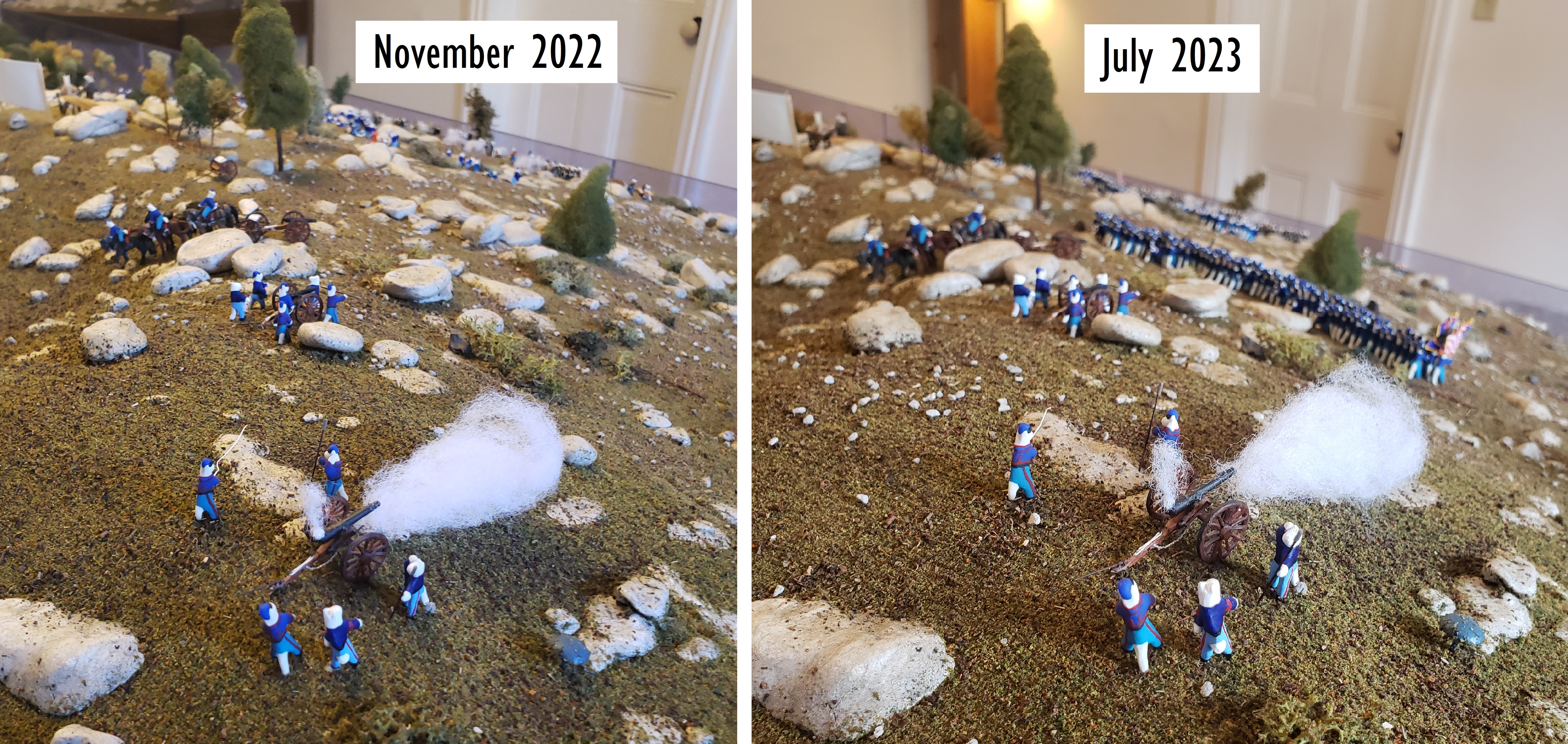
In November, we installed the first of Hazlett’s artillery on the crest. Gun #1 is firing, and Gun #2 is being loaded.
We also installed the limbers for Guns #1 and #2.
Limber for Gun #2:
Limber for Gun #1:
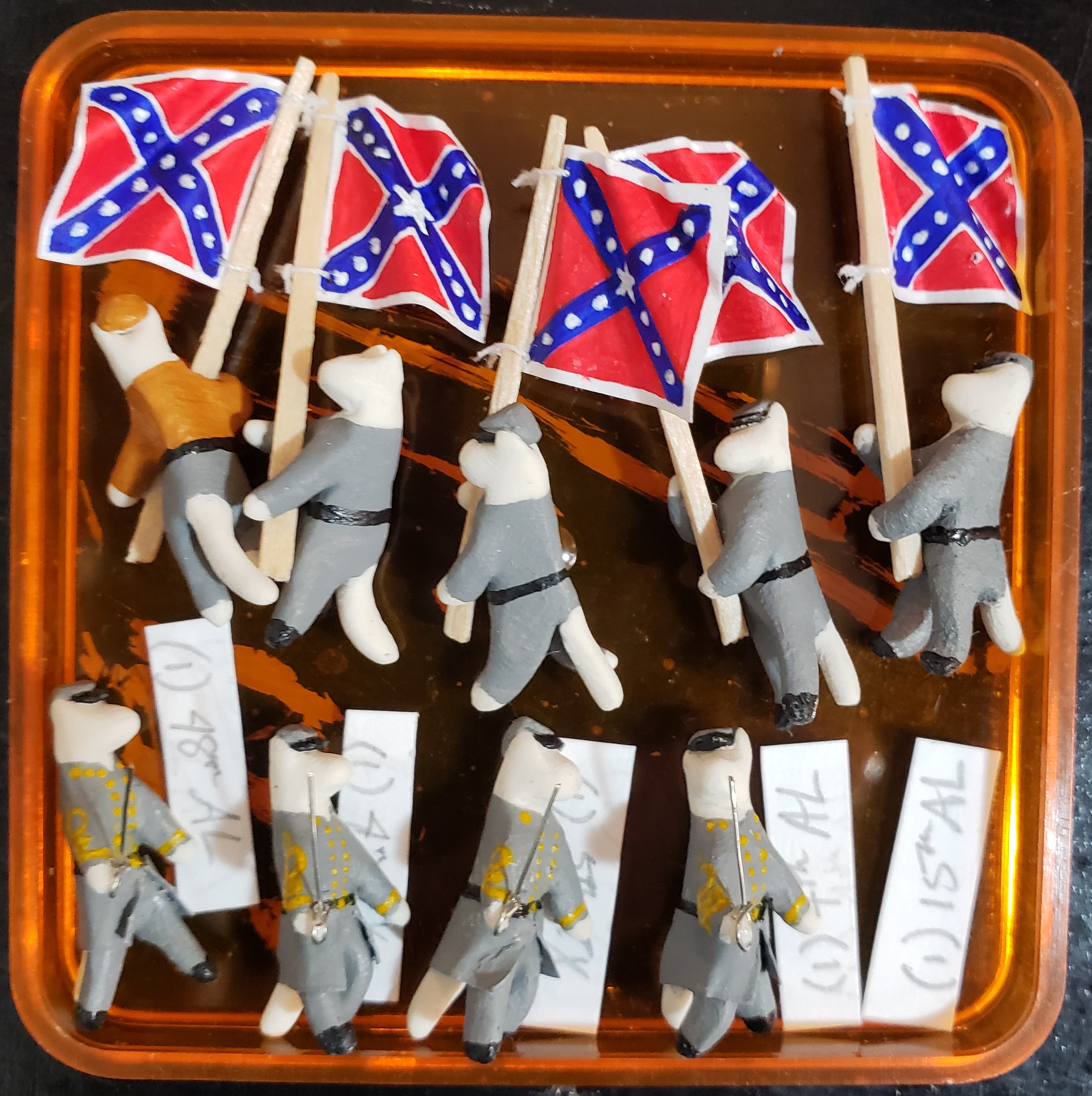
In December, we painted and installed the Confederate officers and flags. (Click on an image to see the caption.)
By February 2023, we were finishing installing Companies A and G of the 140th New York:
…with, of course, the elixir that powers our progress—coffee!
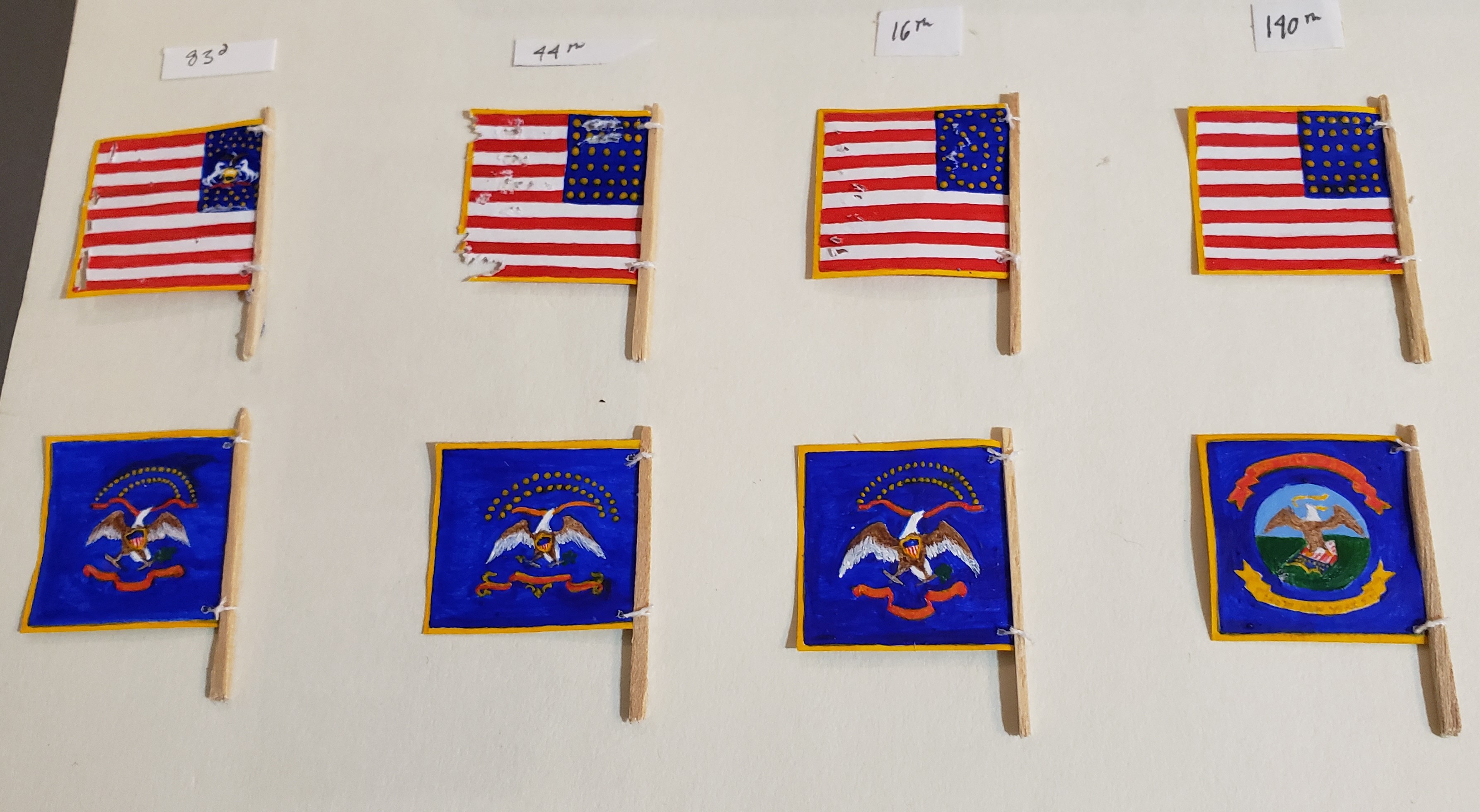
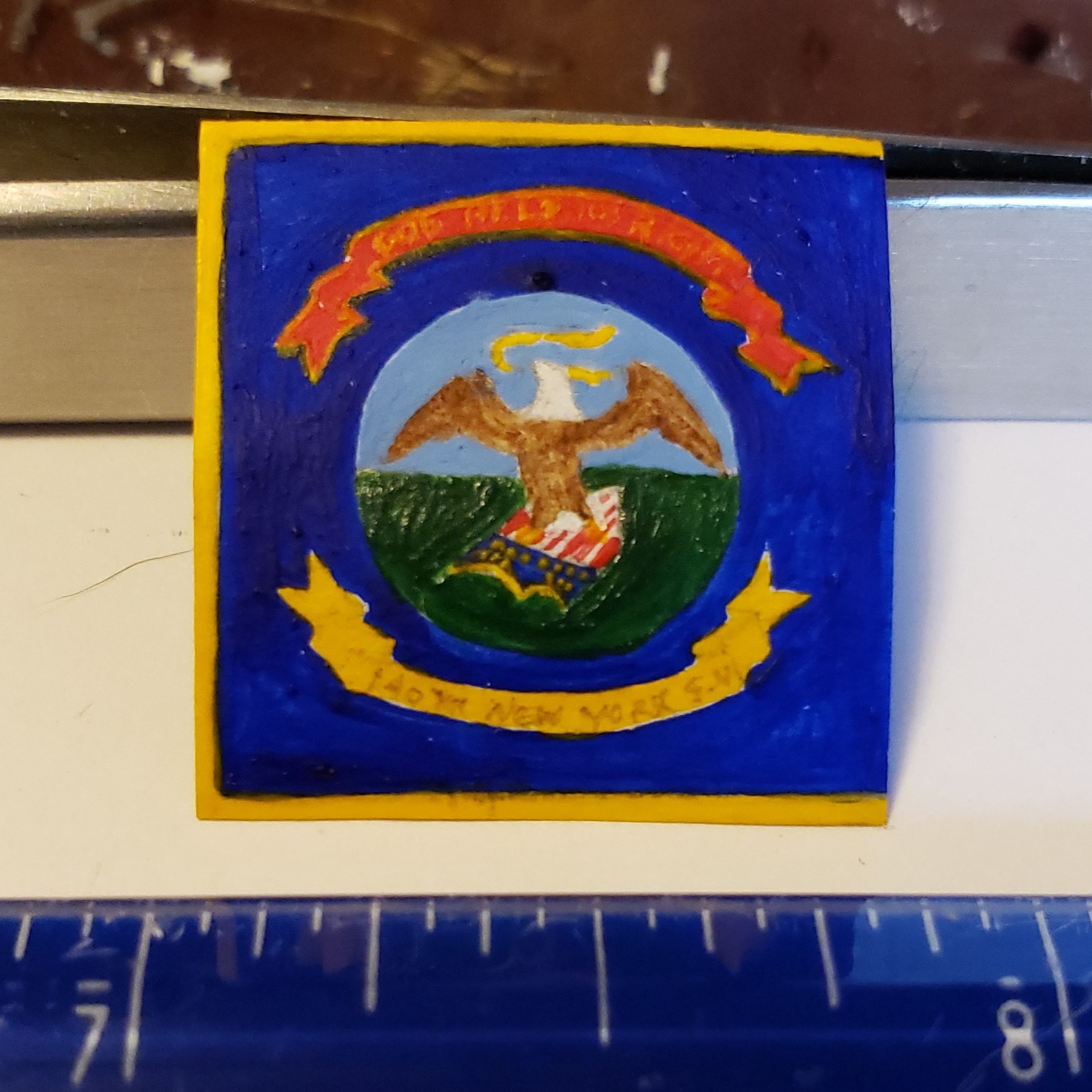
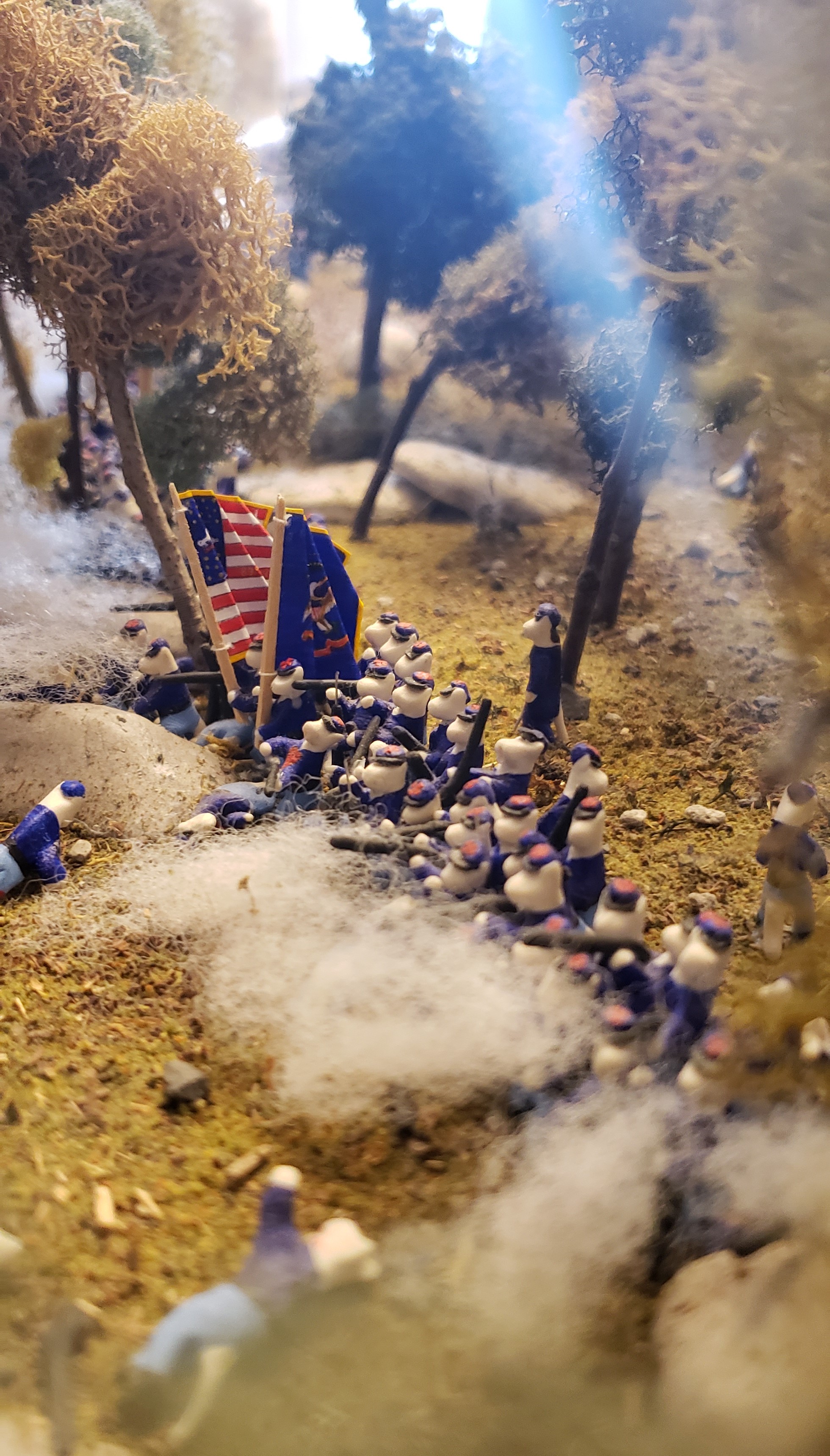
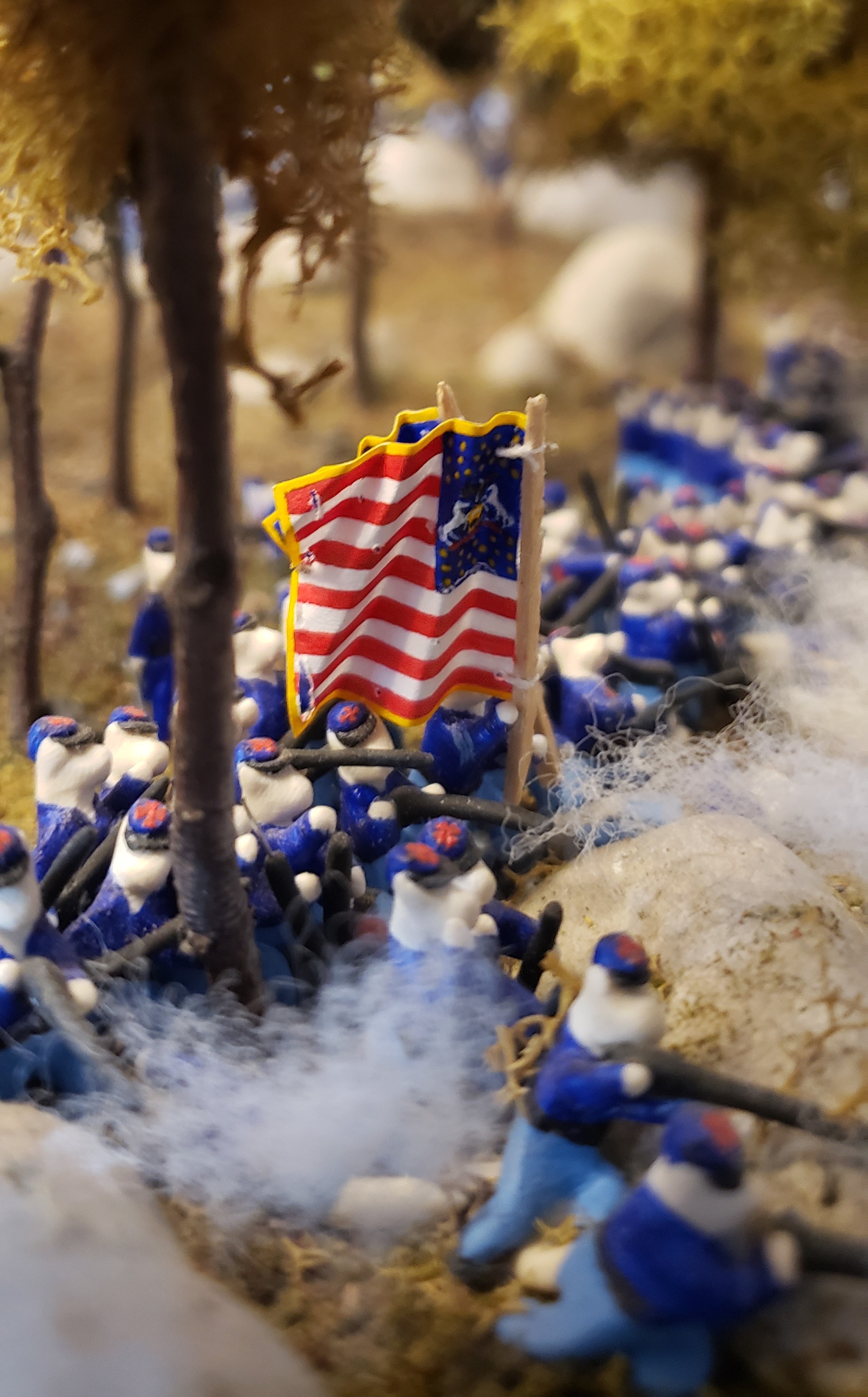
From December to February, we were also busy painting the Union flags. Each regiment has both national and regimental colors. The 140th New York has an unusual regimental flag, with a different design on either side. Many thanks to Mr. Brian Bennett for his research and artwork of the flag, so I could tell what I was looking at in photos of the original flag!
The two sides of the 140th New York’s regimental colors:
Click on an image for the caption.
On March 28, 2023, the 2,000th cat was placed on Little Round Top as we finished installing the line of the 44th New York and 16th Michigan.
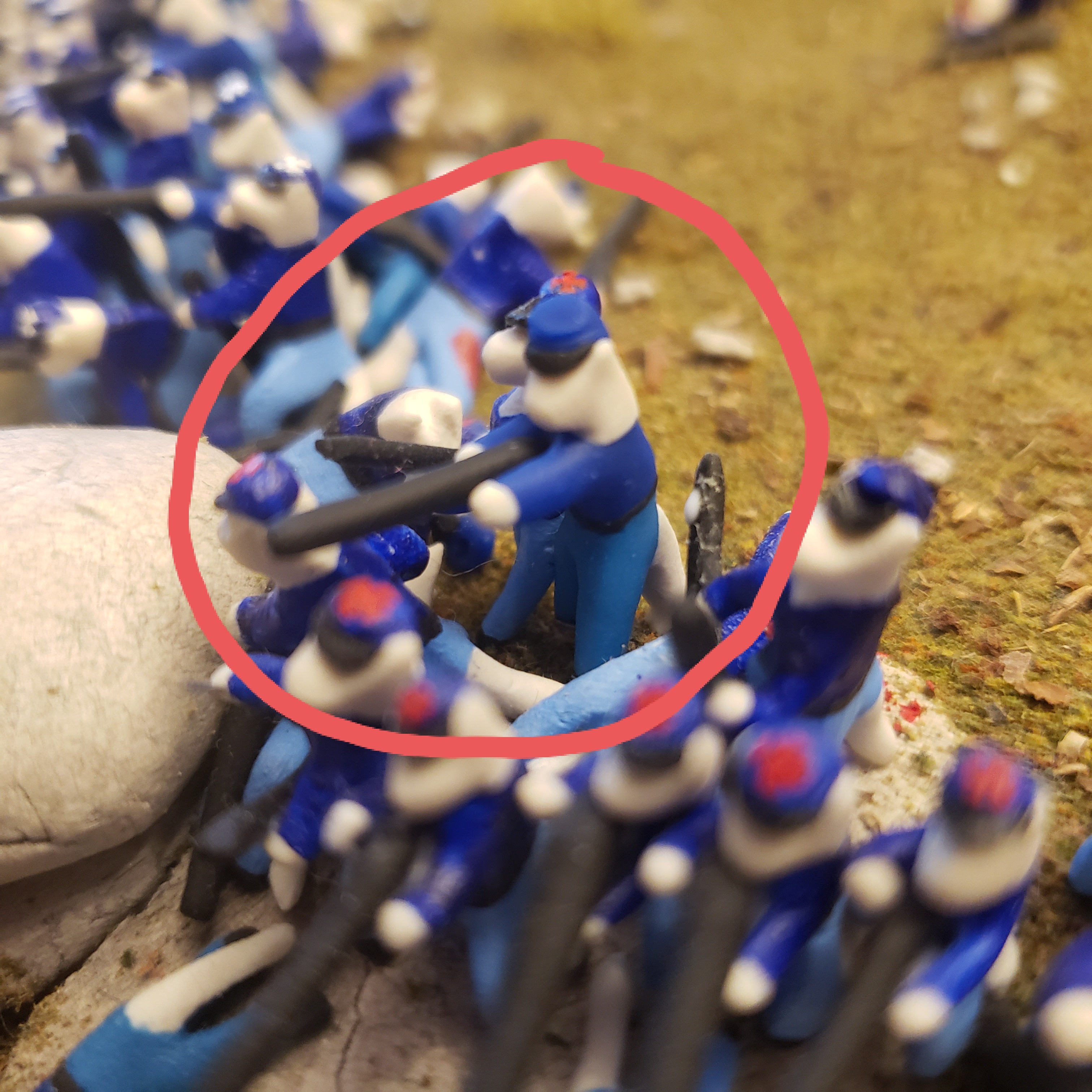
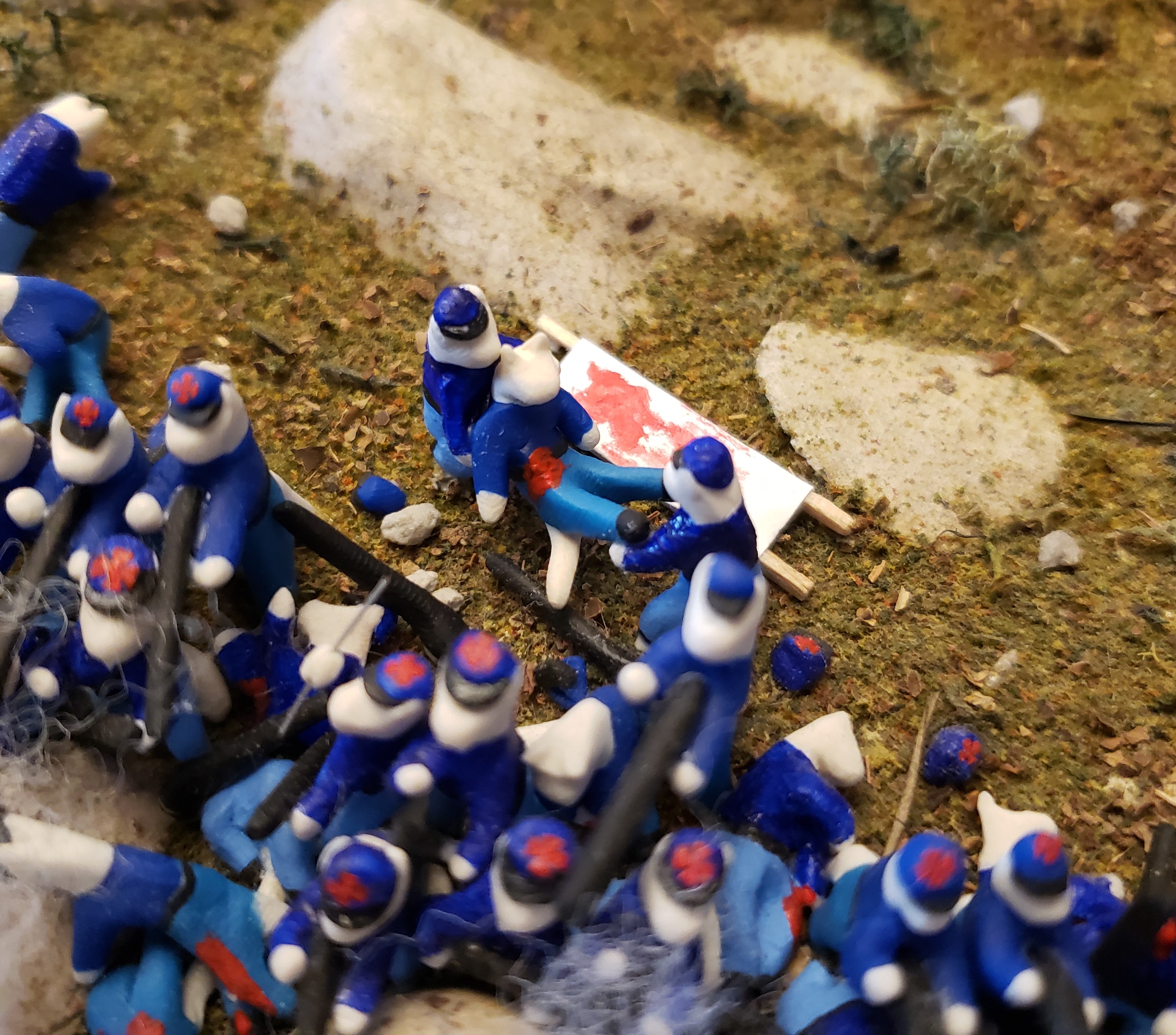
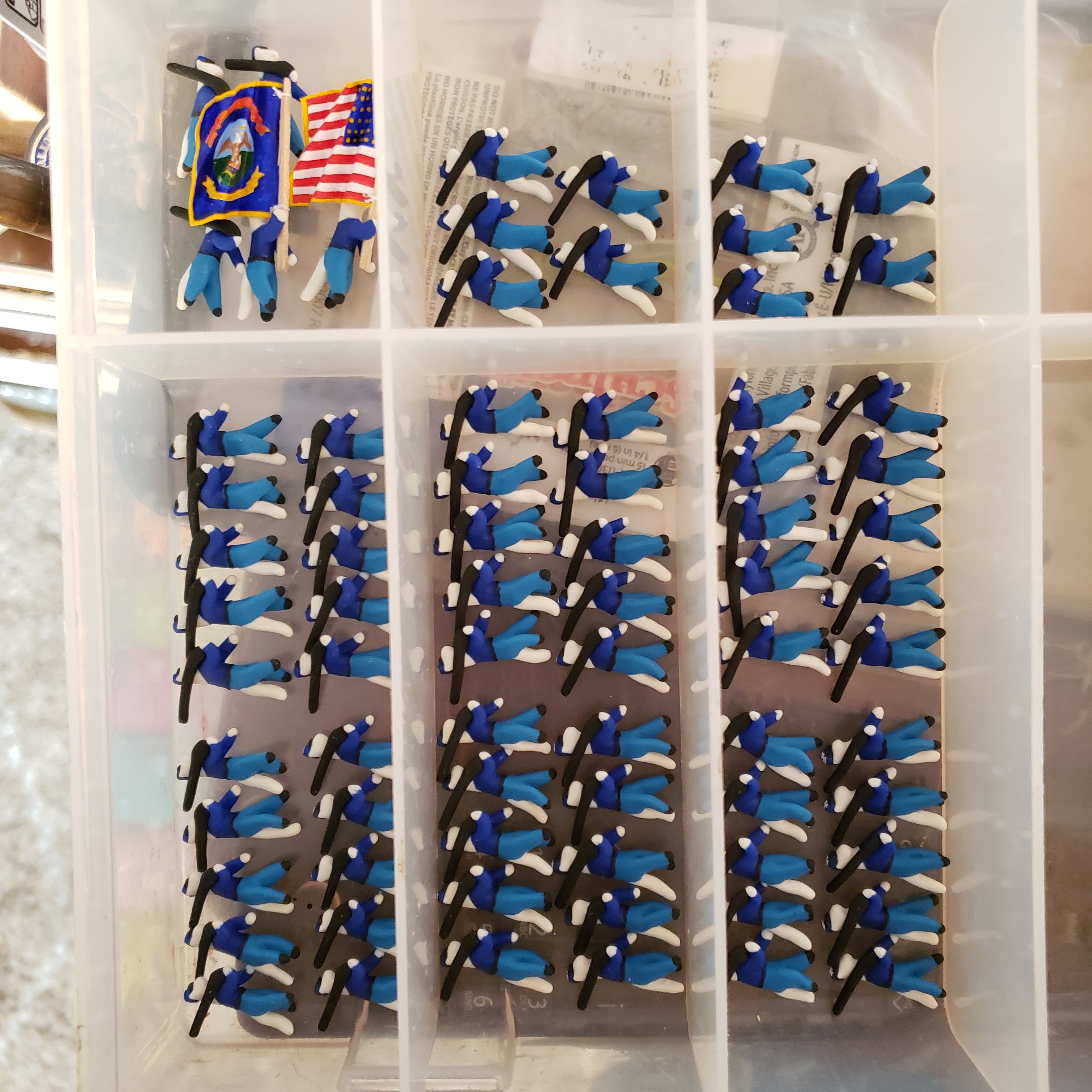
We ended up with extra kneeling infantrycats in various poses related to loading and firing their rifles. So, we got creative with how to use them up, when we needed standing Union and advancing Confederate soldiers, not kneeling.
Quite a few were able to be used as “falling after being shot.”
Others are tending their wounds.
Surprisingly, we found we could use some as stretcher bearers, either picking up wounded on the battle line or dropping them off at the aid stations.
In May, we began installing the eight companies of the 140th New York that paused on the crest to form into line before left-obliquing to join Companies A and G. Of course, just like the other Union soldiers, they need corps badges painted on their kepis before installation.
May:
June:
July:
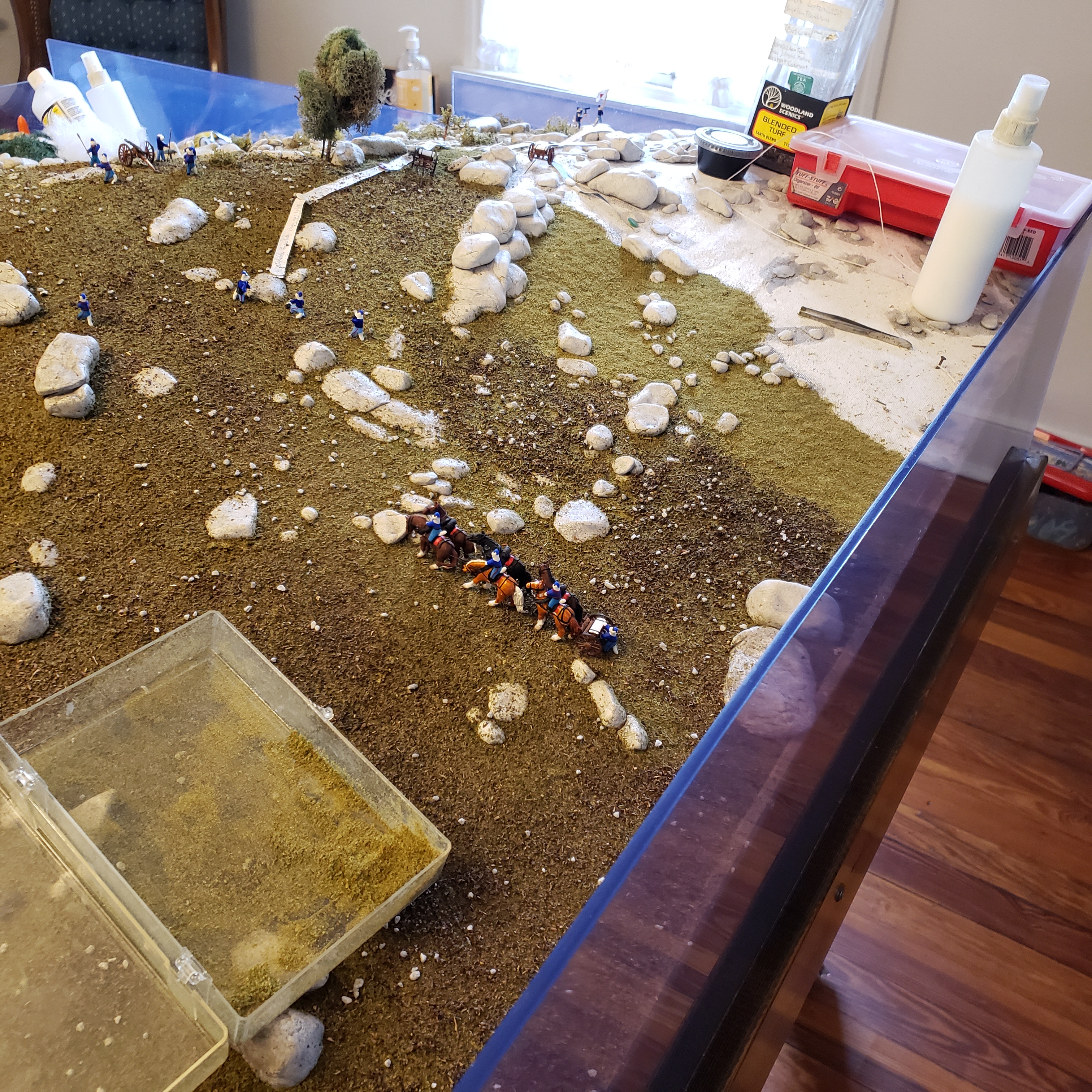
In early July, we also finally finished the ground cover!
Today is the 160th Anniversary of the first day of the battle of Gettysburg. Thinking about all of the events planned in town to commemorate the event also prompts us to ponder the questions Why care? Why study history? Today’s Mewsing suggests a few answers.
Where We Come From
Some parents hope their kids will follow in their footsteps. When we study history, we are like those kids, looking to our forebears to learn who we are, in this case as citizens of the United States.
On the flip side, other parents hope their kids will not make the same mistakes as they did. Looking to the past allows us to learn from the mistakes of past generations, just as future generations will hopefully learn from our mistakes.
We should look at both sides of this coin as we study history. An emphasis on one over the other will lead us to either idolize and sugarcoat the past or throw our entire history in the trashcan.
Perspective to Understand and Evaluate Our Own Time
An even balance when studying history leads to perspective. Learning about past events can help us to understand and evaluate the times and world we live in. Nothing happens in a vacuum, and it helps to understand what led up to an event, past or present. It can lend insight into what could happen in the future, based on past courses of events. This can prompt us to encourage or change current trends, or it can reassure us that things like this have happened before and folks have made it through.
Who We Are (National “Genealogy”) and How Experiences Have Shaped Our Nation
An important reason to study history is to learn our “genealogy” as a nation. On a personal level, it can be interesting to study genealogy and learn where our family came from, what occupations the individuals held, where they lived, and so forth. Have your family’s generations moved around a lot? Or did they stay in one town for generation after generation? So too, it can be interesting to see what led to the forming of our nation, what prompted various actions and events, and so forth.
This can also lead us to see how experiences have shaped the country, just as our own personal experiences shape us. For example, our reaction to something might be shaped by how we were raised, the current stress in our lives, and how much coffee we have had so far today. When studying history, we might ask what experiences, big or small, influenced or prompted an event.
Motivations and Examples
Studying the human stories—individuals, and not just broader concepts and movements—can inspire or teach us to be better people ourselves. As children, we learn by watching older kids and adults. So too, we can learn from the examples in history, both good and bad.
But because human beings are complex, we need to recognize that an individual can have both aspects to emulate and to avoid. So for example, a brilliant army commander can have a dubious character. But his personal life or beliefs don’t mean we cannot admire his leadership or tactical prowess. Likewise, his skill as a military leader does not mean we need to applaud his beliefs or personal character.
Looking at what drove people to act helps us to understand what was important to them. We should then evaluate whether or not those ideals, goals, and convictions are still important today, particularly if people were willing to die for them. We also need to realize that motives are often complex and multi-layered, as people do “what they need to,” to get “what they want.” So, while we might not agree with a particular motivation or action, we might agree with the broader concept underlying it, or vice versa.
As you study history, no matter the subject and aspect, remember that our job as students of the past is to evaluate what we read and not to blindly embrace or discard a person, event, culture, or time period as a whole.
So, read some history today! Pick out the good and admirable, learn from the bad, and appreciate the work of previous generations who were living their lives the best they could, day-by-day, just as we are.
If the idea of reading history scares you, try out our book! (Available here or here.) Yes, that’s a shameless plug, but hey, it’s easy to read and chockful of pictures of cats!