Is a diorama ever finished? In today’s mewsing, we consider how continuing to learn shapes our projects.
The question sometimes comes up while visitors look at “The Fate of Gettysburg,” whether our dioramas are finished or if we continue to work on them. The answer is both. Sometimes, the diorama needs modifications. Other times, a diorama itself is finished, but in need of a new version. Why the changes? Because as the years pass, we continue to learn, whether about materials or history.
Our Pickett’s Charge diorama is a good example of both. When we began “The Fate of Gettysburg” in 2000, it was a new version of our previous diorama. In a desire to make Pickett’s Charge to-scale, we scrapped the old diorama (which was itself modified several times) and began a brand-new version on a new base where it could be to-scale, topographical, and a specific point in time. We painted the base green for grass, installed 1,900 cats, and it was done. You might think that was that. We did.
Until 2011.
While making our Devil’s Den diorama in 2009, we discovered “Turf” by Woodland Scenics. Made of specks of colored foam, turf is a ground cover that finally worked as grass for ¾-inch cats! Up until then, we had experimented with types of moss, but nothing was small enough for 1-inch cats or smaller. Over the summer of 2011, we revisited “The Fate of Gettysburg” and added turf to the green-painted surface. Yes, that meant adding tweezer-fulls of specks of foam around each and every cat who was stuck down on the diorama!
While we did so, Rebecca realized that she had lost the list of identified officers and men, so she reread all of our books on Pickett’s Charge and compiled a new list (and then found the old one). As she read, she realized that if we doubled the width of our diorama, we would have nearly all of the Confederate line at the point in time portrayed. In other words, we have most of Pickett’s division on the diorama. And she concluded that most of the division is stalled out at the stone wall, not having crossed it following Gen. Armistead. So, all of that meant that we needed to add approximately 1,000 Confederates along the wall, as well as others advancing into the Copse of Trees and fighting hand-to-hand with the 69th Pennsylvania.
We also realized that ten years earlier, we had forgotten to think of the killed and wounded horses from Lt. Cushing’s battery. The guns have been abandoned by the time portrayed, and so we never thought about what was left behind. So, as Rebecca reread the books, she kept an eye out for the involvement of Cushing’s battery, not only in the cannonade of the afternoon, but also in the morning’s artillery duel and the fighting the day before.

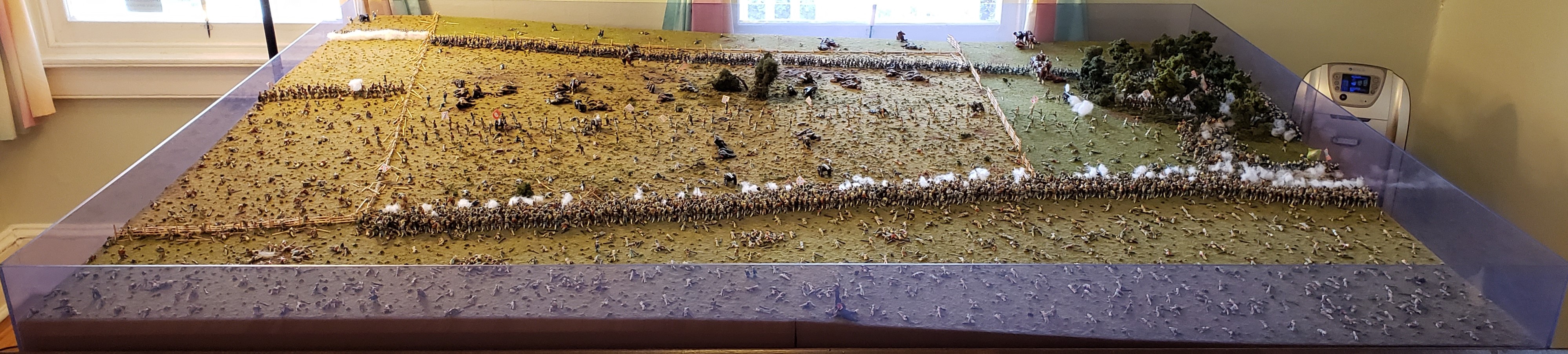
So, what began as simply adding green “turf” ended up involving adding horses, debris from exploded limbers and caissons, various colors of dried tea for kicked up dirt from shells and shot from the cannonade, Confederates along the wall and in the Copse, and more Union cats in the Copse. Even now, we still have a few more adjustments that we want to make, in order to have it more accurate.
Continuing to learn about materials led to the revamp in the first place. Reading the same books as we had the first time around but ten years later meant noticing new details and reaching new conclusions, which in turn led to modifying the figures on the diorama.
Another example is “I Want You To Prove Yourselves,” our diorama of the 54th Massachusetts Regiment charging Battery Wagner. It was our first to-scale diorama (also a new version of an older one). We were in high school when we made it, and as we read the description of Battery Wagner, we could not understand how a fort could be built of sand and palmetto logs. How could sand be built into a fort? It’s hard enough to stick sand together for a big sand castle, much less a fort. The only way we could think for it to work would be to use sandbags. So, we made the wall of our fort with logs and sandbags.
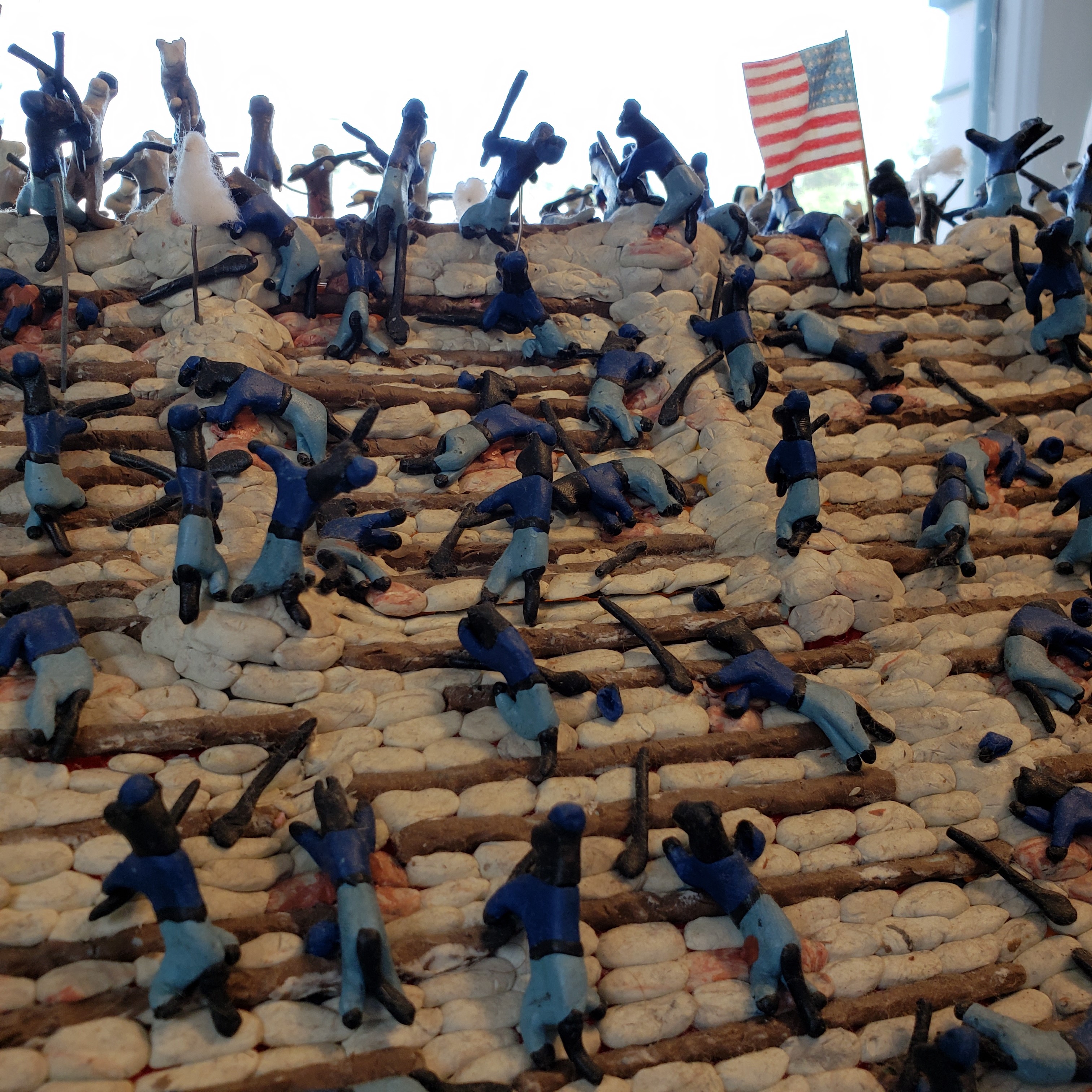
Now, 25 years later, we have learned that the logs would form the structure underneath, and the sand is mounded up against the walls (for a portrayal of Battery Wagner, see Keith Rocco’s painting “54th Massachusetts Infantry at Fort Wagner“). As a result of our continued learning, we plan to make a new diorama someday, showing the fort’s construction correctly, as well as taking the opportunity to have the entire 54th Massachusetts Infantry.
As we grow older, our daily experiences shape how we analyze what we read. So, we bring insights to our reading that we didn’t know when we were younger. As we practice our hobbies, we increase our abilities, perhaps to add detail or complexity. Sometimes we can go back and add to an older project and improve it, and sometimes we need to start fresh with a new version.
Continue to learn by reading, observing, and listening. And as you work on your projects—whether dioramas, crafts, writing, painting, drawing—let your new discoveries shape your creations!
 Civil War Tails at the Homestead Diorama Museum - Gettysburg miniatures
Another winner!! this is why i always encourage peeps to keep in touch with you via your website, telling them that you post a new blog every month or two, and that they are very interesting. Indeed! Love, Mom
LikeLike