It is easy to gloss over historical photographs when their subjects are dark, blurry, distant, or ordinary. But in so doing, we can overlook minute details that are, in fact, visible. In today’s mewsing, we consider some of the discoveries that Rebecca made when closely studying the photograph taken of USS Cumberland c.1859-1860.
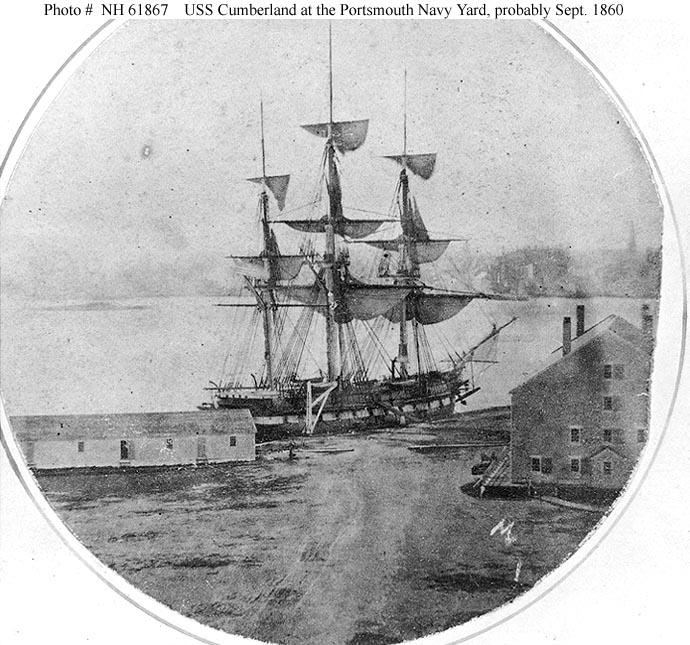
Initially, I wished the photograph was a strict side-view image, to make measuring and calculating easier. But the angled view turned out to be more helpful, by allowing me to see specific details in Cumberland’s rigging.
I am greatly indebted to The Ship Model Builder’s Assistant, written by Charles G. Davis in 1926. The author, who served on tall ships, explains in great detail not only how ships are rigged generically, but how their design and rigging changed over the centuries. The information on rigging that I used to analyze Cumberland’s photo is from his book.
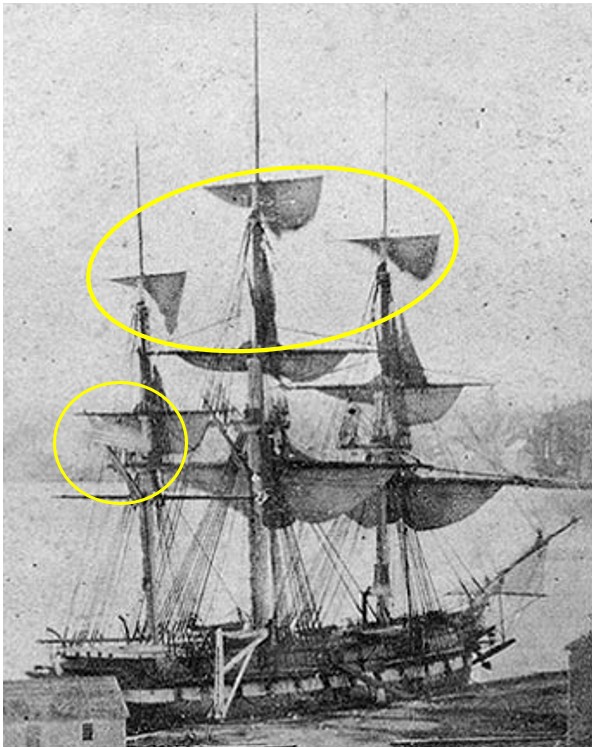
Drying the Sails
On the morning of March 8, Cumberland lay at anchor with her sails drying. When Virginia appeared and Cumberland beat “to quarters,” part of the preparation for battle was to furl the sails.
The photo shows what she probably looked like early that morning. She is at anchor and clearly not going anywhere (note the gangway leading to the dock), but her sails are not furled. Instead, they are hanging slack. A slight fuzziness to the lower left edges of the topgallants suggests they are flapping in the breeze that the flag indicates.
Bowsprit Details
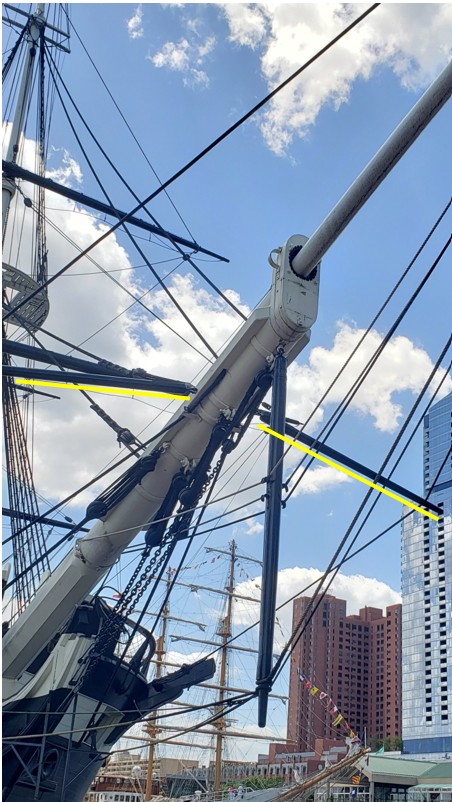
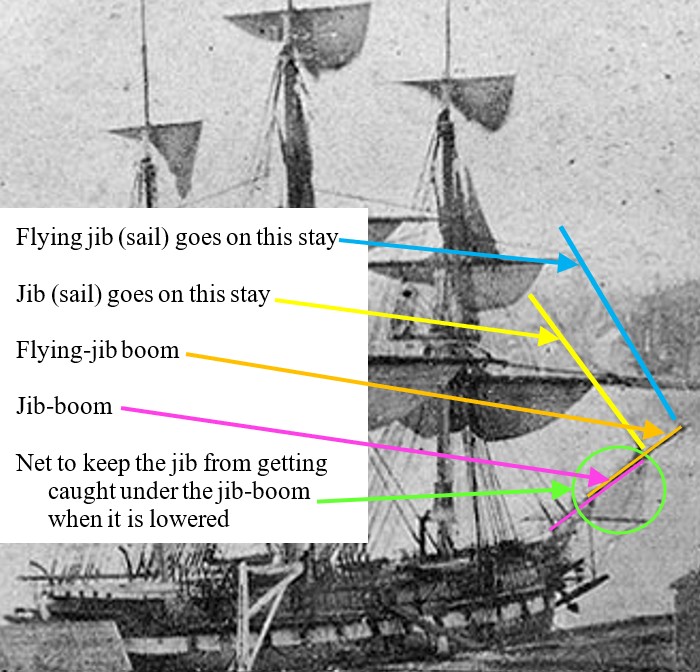
By the 1860s, the spritsail-yard was being replaced by “whisker booms,” which you can see on USS Constellation in Baltimore, MD. Cumberland’s appears to hang underneath the bowsprit, indicating a yard instead of two booms hooked to either side of the bowsprit.
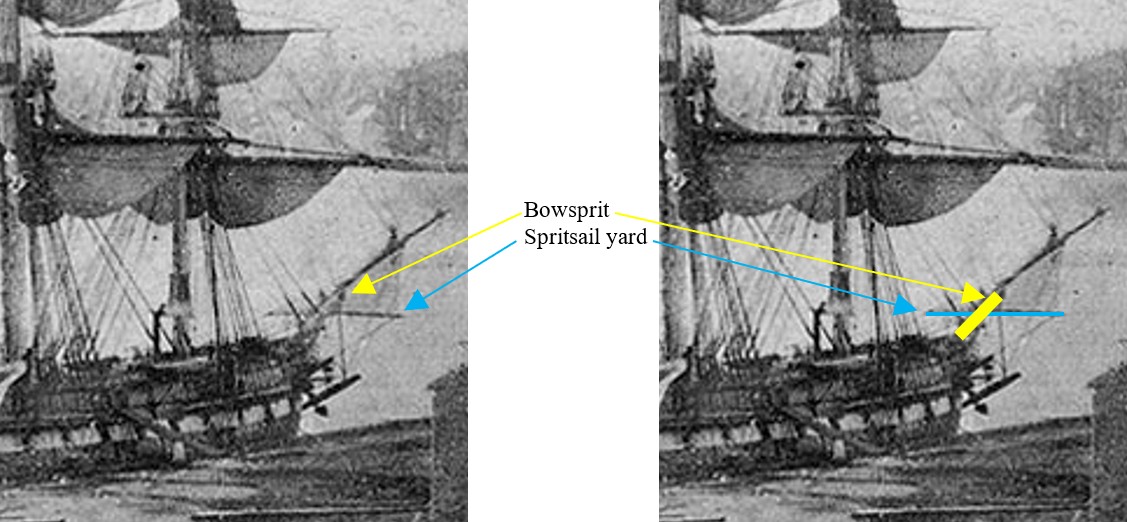
We can also see the net spread to keep the jib from getting under its jib-boom. The net also indicates that Cumberland is carrying a flying-jib boom beyond the jib-boom.
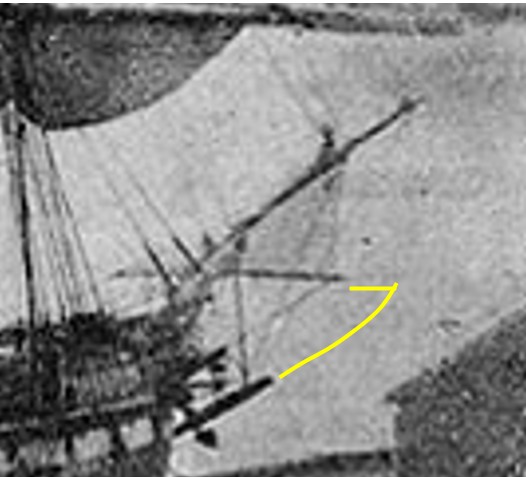
This led me to notice the ghost of a line indicating that the spritsail-yard extended farther than the net and therefore farther than I thought (marked in yellow). This helped to explain why my calculations indicated a longer yard than in the photo—I was not seeing the whole yard.
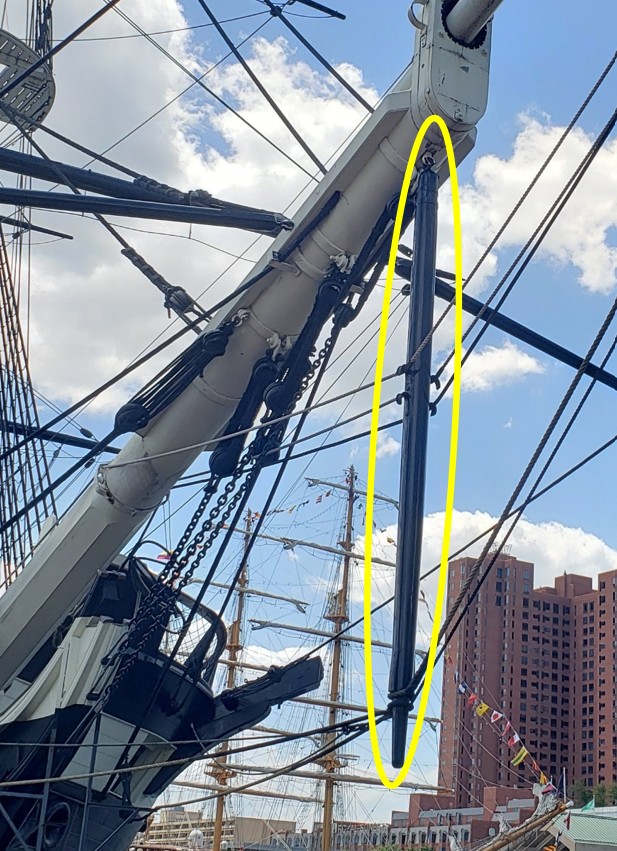
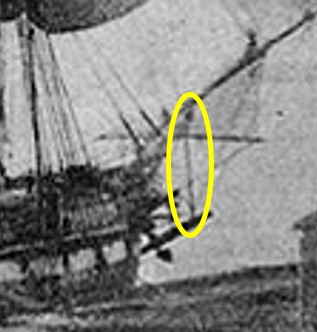
Early dolphin strikers were a single spar, but in the early 1800s, a double dolphin striker (shaped like an inverted V) was developed to accommodate the additional ropes of flying jibs. In the 1820s, the swinging dolphin striker appeared—a single spar again, but with hooks on either side for the ropes. Cumberland’s photo shows one piece, not the inverted V, suggesting that she has a swinging dolphin striker.
Spencer gaffs
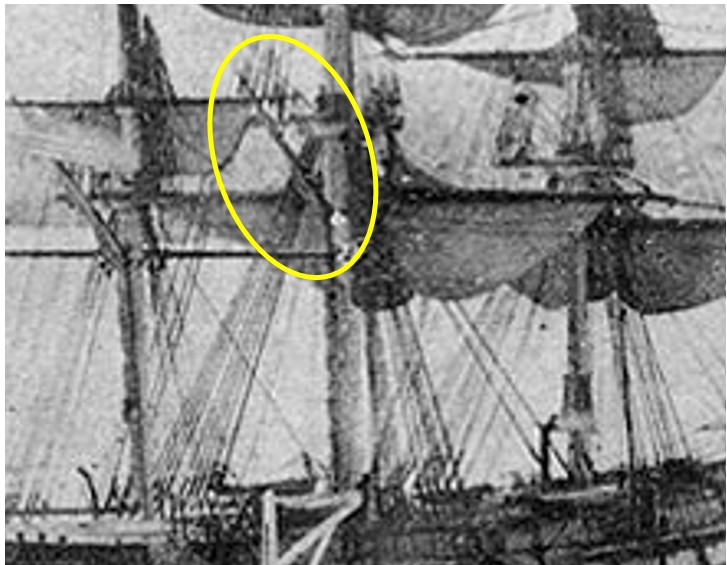
Spencer gaffs appeared around 1812 and could be on the mainmast, foremast, or both. Cumberland’s photo clearly shows a spencer gaff on her mainmast, but not on her foremast.
Fore-Braces
Historically, the fore-braces led to the main-masthead. Around 1830, this changed, and they led to the rail, like the main-braces.
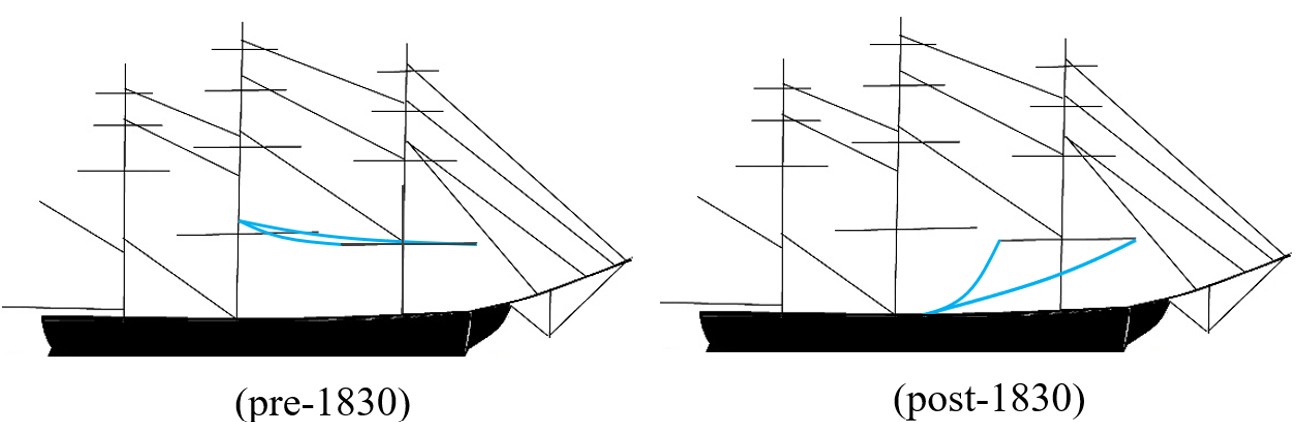
Cumberland’s fore-braces are not shown in the photo, but I wondered if I could determine which style she used, by studying a variety of contemporary lithographs and paintings. Author Charles Davis points out that artists are notoriously inaccurate at portraying rigging, so I was curious to see if many agreed, if they were split, or if they were clearly inaccurate.
Online, I found four contemporary artistic renderings of Cumberland, plus one of Congress and one of USS Merrimack. Discerning when each was drawn or painted proved tricky. However, four appear to be lithographs or engravings from 1843-1862. The Merrimack lithograph is undated, but seems contemporary.
- 1843 lithograph of Cumberland as a frigate
- undated lithograph of Merrimack
- 1853 engraving of Cumberland as a frigate
- 1862 “Harper’s Weekly” engraving of the ramming
- 1862 Currier & Ives lithograph of the sinking
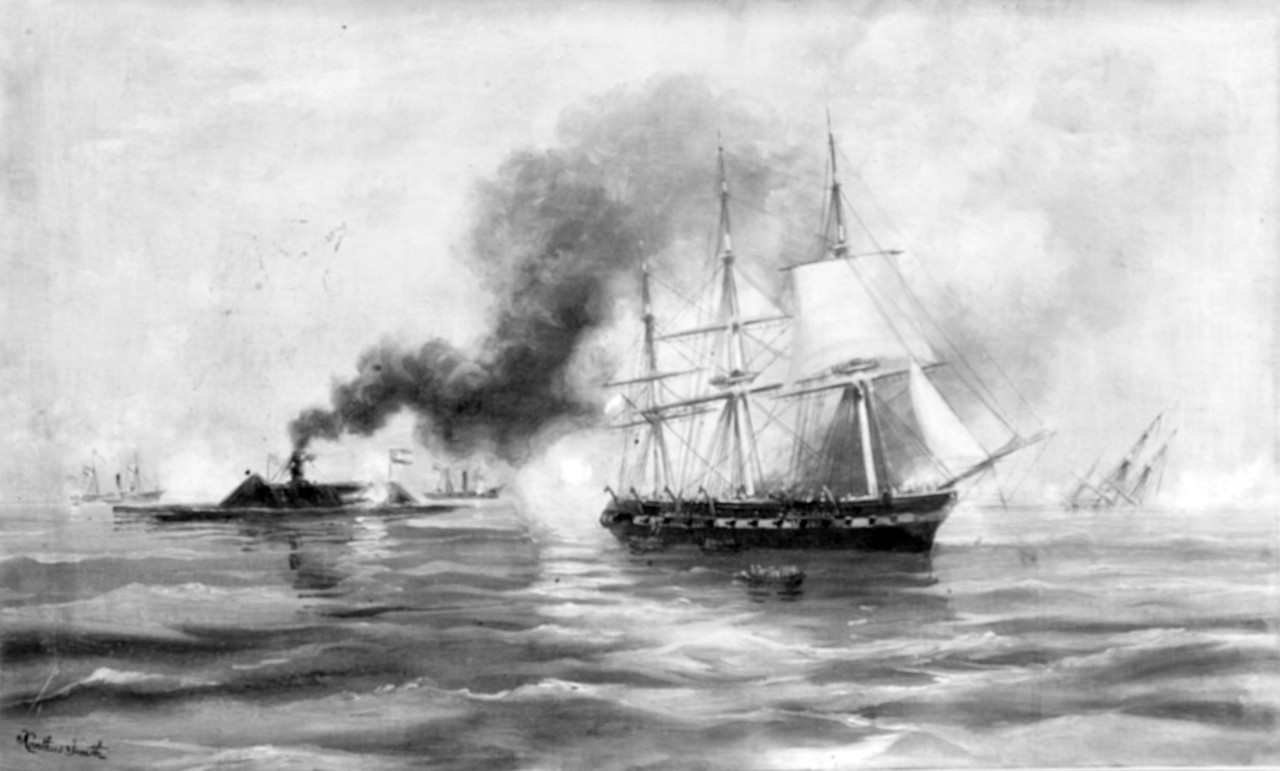
- ~1865-1870 rendering of Congress by Xanthus Russell Smith
The painting of Congress facing Virginia intrigued me, because of the artist Xanthus Russell Smith. He grew up in Philadelphia, then lived in the suburbs in Glenside. Thanks in part to his mother, he became an artist. During the Civil War, he served as a clerk in the Union Navy. While onboard ships, he viewed his surroundings as an artist would, and sketched the ships he saw. The Navy recognized his talent and had him sketch battle damage on ironclads, so they could analyze the damage caused by various sizes of shot.
After the war, he began painting naval battles, most notably Mobile Bay and the fight between CSS Alabama and USS Kearsarge. He contacted veterans with his preliminary sketches so they could give feedback and help him to make each painting accurate. For example, he contacted Lt. Greene of Monitor, who gave him feedback on Virginia’s shot-up smokestack, among other things.
The style of naval painting that he did was popular until the 1870s. When the popularity waned, he turned to other types of paintings and artwork to support himself. This suggests the date of his Congress painting as 1865-1870. His attention to accuracy and his knowledge of ships (having served on them) suggests that he would know what type of rigging Civil War ships tended to have. If his work implies that Congress, an older frigate, had fore-braces that led to the rail, then I am willing to take his word for it.
The conclusions:
- Smith’s rendering of Congress shows her fore-braces leading to the rail
- 3 out of 4 contemporary renderings show Cumberland’s fore-brace agreeing with Smith’s Congress (the 1843 lithograph of Cumberland as a frigate does not show fore-braces)
- the undated Merrimack lithograph shows the pre-1830 style
These results allowed me to lead the fore-braces to the rail, instead of the masthead, with a fair amount of confidence.
When I discovered the photograph of USS Cumberland, I thought it was cool to have it, but I had no idea how helpful it would be. After all, a ship is a ship is a ship, right? But while a model ship can be made using general rules of thumb and equations for tall ships, the fact is that a ship’s captain could modify his ship if he liked, or a ship might be modified with the times, as Cumberland was when the Navy razéed her into a sloop-of-war. The photograph not only shows what has been modified or not as ship designs progressed, as we discussed here, but also shows several unique aspects of Cumberland—but those are for another time.
Thanks to a photographer’s single photo, we will have a model of Cumberland that is more accurate than I would have ever hoped for!
Sources:
- Davis, Charles G. The Ship Model Builder’s Assistant. Salem, MA: Marine Research Society, 1926.
- McNew, Barbara. “The Fury and Terrible Beauty.” U.S. Naval Institute. June 2000. <https://www.usni.org/magazines/naval-history-magazine/2000/june/fury-and-terrible-beauty>. Last visited: 20 May 2025.
- “Xanthus Russell Smith.” Wikipedia: the Free Encyclopedia. Last updated: 5 May 2025. <https://en.wikipedia.org/wiki/Xanthus_Russell_ Smith>. Last visited: 20 May 2025.


#/media/File:Portsmouth_wiki.jpg)
#/media/File:Cumberland-frigate-Currier-Ives.jpeg)
#/media/File:USS_Merrimack_-_NH_46248.jpg)
#/media/File:USS_Cumberland_holding_a_grand_ball_in_the_harbor_of_La_Spezia,_Kingdom_of_Sardinia_(1853)_-_Ballou's_pictorial_drawing,_5_April_1856..jpg)


I’m not a ship expert as you are, so you lost me, but i’m sure your fellow ship experts enjoyed your article very much. 🙂
Love, Mom
LikeLike