On March 9, 1862, CSS Virginia (Merrimack) and USS Monitor met as the first ironclads to fight ironclads. Today, we take a look at the process of making our diorama of the two ships, “The Horrid Creation of a Nightmare vs. the Little Pygmy.” We hope you enjoy our trip down Memory Lane 2012!
 CSS Virginia in dry-dock. Ordinarily, we would have built the ships entirely of cardboard, but since Rebecca had just “inherited” some light wood from a fellow model-builder, she decided to experiment with making the hulls out of wood. Virginia’s bow and stern are made of wood that was shaped to the bulkheads, while the middle section is cardboard. The casemate (the “barn-roof” part) is all cardboard. Note the missing section of the casemate—this is so that part is removable to allow you to see inside. Removing the entire side is impractical since the curve of the ends of the casemate require them to be securely anchored to the side panels.

“The Foundry” — painting Virginia‘s gun carriages, gun barrels, and propeller

The bow pivot gun in place. Due to the design, we had to install the pivot guns and their crews before enclosing the ends of the casemate.
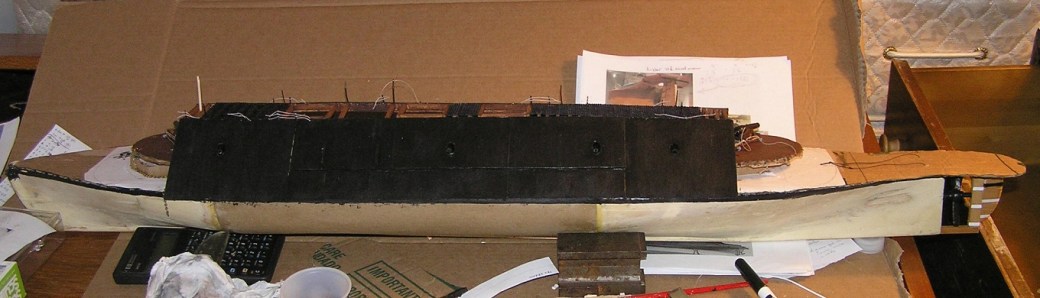
The hatches and the iron on the casemate have been painted, and the propeller is installed. The aft pivot gun is visible as well. The removable panel of the casemate has been made and set in place.

The photos above were taken just before the ends of the casemate were glued into place, and are the only record of what these cat crews look like—aside from the tops of their heads as seen through the grating above them!
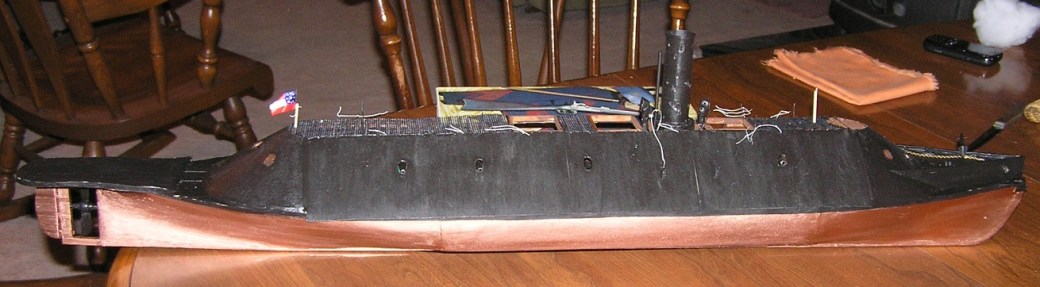
Virginia is nearly finished. Only six inches of the “eaves” of the armored casemate extended below the surface of the water. Otherwise, under the water, Virginia was the unarmored, wooden, copper-plated hull of USS Merrimack.

Gun crews are installed—Virginia is finished!
On to USS Monitor!
 Here, a few of the future crew are inspecting the work on the upside-down hull. (You can also see that Civil War cats drive Ford Mustangs!)

Peeking out of a gun port on the turret
The process of making the turret. Since the real turret has been raised from the ocean floor, one can find photos online of the turret and its structure. We were thrilled to be able to build our model so accurately!

The inside of the turret is finished—port lids, supports, turning mechanism, lanterns, cannonballs, guns, and gun crew are installed.
Monitor’s only gun crew was inside the turret. If one of Virginia’s shells entered an open gun port, it could destroy the crew and leave Monitor with no one to work her guns. Fortunately for Monitor, this did not happen.
Since they have also salvaged at least one lantern from Monitor‘s wreck, we just had to include the lanterns in the turret. These are about 3/16 inch tall!

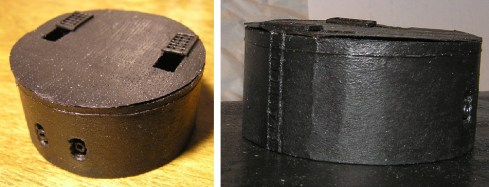
The roof is installed, finishing the turret. We made it removable, and the ladder (made of black thread) that leads up the side of the turret serves as a hinge.

Left: Monitor‘s steering wheel, installed before the pilothouse. Right: a view into the pilothouse.
Lt. Worden is at the top of the picture, the helmsman in the middle, and the pilot at the bottom. You can just barely see the steering wheel in front of the cats. Given the dimensions of the real pilothouse, it’s amazing three men fit inside! Fitting three (chunky) cats is even more interesting—don’t ask how they don’t fall down the hatch! But then, they are cats…

Monitor‘s rudder and unique 4-bladed propeller

Monitor‘s anchor with windlass
John Ericsson designed a new way to raise and lower an anchor underwater, just one of Monitor’s unique features. You may ask to see the anchor if you come into the museum. Since raising the deck of Monitor is risky for the anchor, which can catch itself on the anchor well, we rarely show it—but we would be happy to, if you ask!

Some of Monitor‘s crew–painted and ready…or, almost ready. (Lt. John Lorimer Worden, commanding Monitor, is on the left of the bottom row)

To be finished, both ship’s crews needed to be “blackened by powder.” We have a teabag of an unknown type of tea which is very black–and perfect for smudging cats to get them dirty.
 Monitor finished! Note the gap between her black upper deck and her red hull. This is for the plexiglass “water,” since the ship is made in two parts. The hull glues to the underside of the plexiglass, and then the deck rests on top and remains removable. In designing the ship, we had to make sure to remember to factor in the thickness of the plexiglass and the gap, so Monitor did not end up an extra 1/8 inch thick.
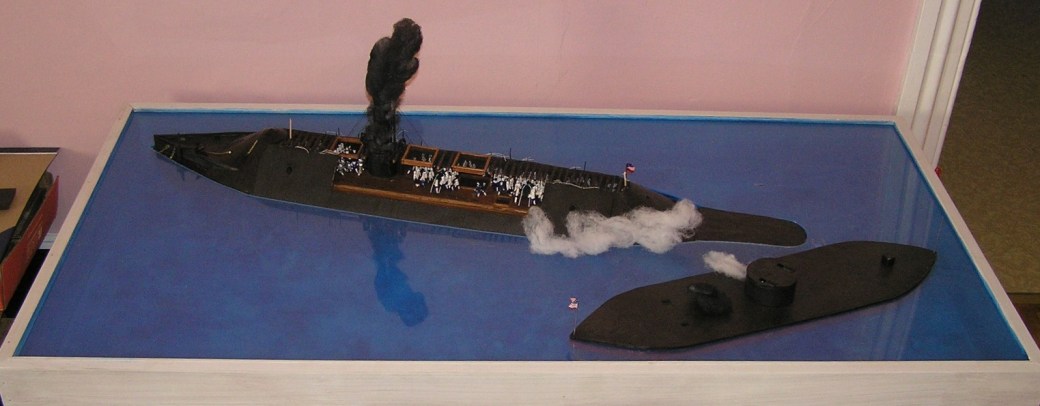
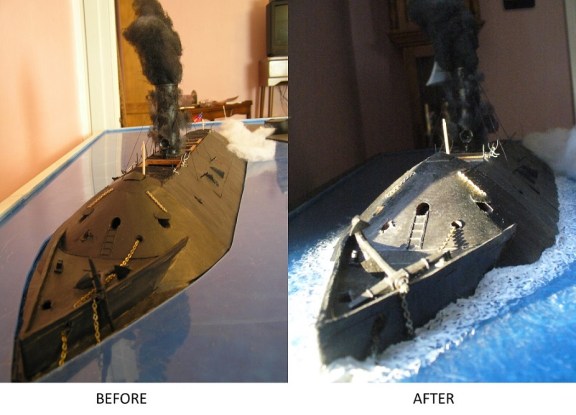
Installed and waiting for waves!

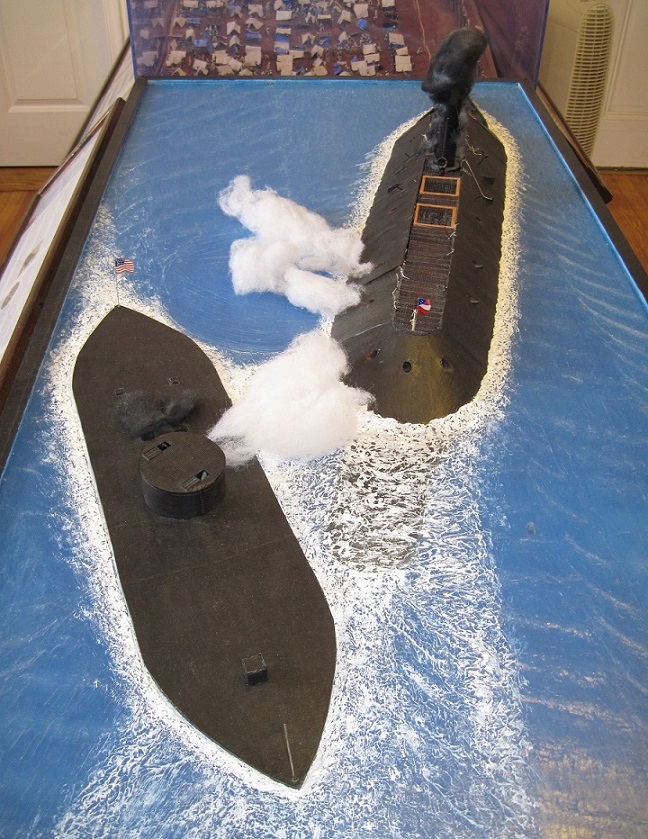
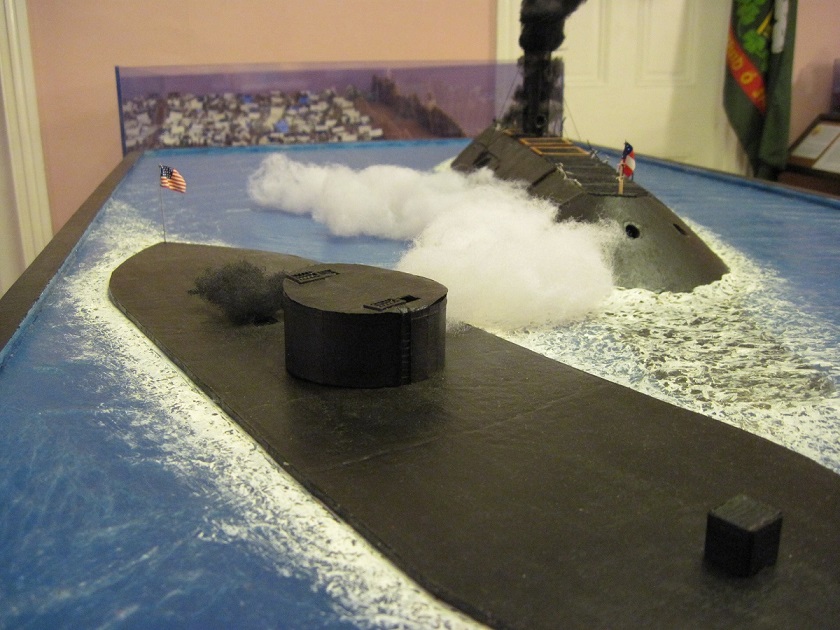
Finished!
 They decided to play a joke on their colonel and some of the other officers. They went to the colonel’s quarters armed with eight or ten snowballs each, and put a blanket over the chimney. Capt. Langston had been told about the joke ahead of time, so as soon as he realized the blanket was in place, he added more logs to the fire and went out to join the pranksters.


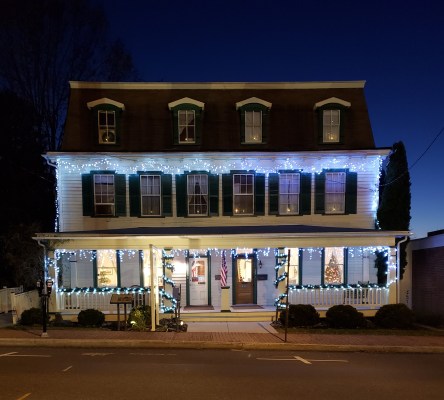
 Christmas trees were just becoming popular, thanks to Queen Victoria adopting the German tradition. They were not the large trees that we are used to; rather, a Christmas tree in the 1860’s would be smaller and stand on a table in the center of the room. Branches would be cut out until the remaining branches formed layers. Presents were placed on the branches, with larger presents on the table. Presents during the Civil War were often handmade, such as hand-carved toys, cotton or flannel animals, hickory nut and flannel dolls, candied fruits in paper cornucopias, gingerbread cakes, needle cases, or slippers. Of course, because of the war, presents were often scarce, particularly in the South. Mothers in the Confederacy would have to come up with excuses as to why Santa wouldn’t make it to their house for Christmas. Imagine if your mother told you that Santa couldn’t get through the Northern blockade or, even worse, had been shot!
 Just as it is today, children would hang stockings for Santa to fill. They might even know the story “’Twas the Night Before Christmas,” since it was written in the 1820’s. The family could also enjoy carols, such as “Deck the Halls,” “O Come, All Ye Faithful,” “Hark, the Herald Angels Sing,” “Silent Night,” “What Child is This,” “Away in the Manger,” “Joy to the World,” and “Oh Little Town of Bethlehem.” Some specifically American carols were “It Came Upon a Midnight Clear,” “We Three Kings,” and “Up on the Housetop.” However, for all of you who have not sent out Christmas cards yet, it’s okay—cards were popular in Europe but the fad would not take hold in the United States for another decade!


 1. the “big flat Larry’s II” toothpick:
 2. the long toothpick:
 3. the square toothpick:
 Want to do a sailor on a ship’s deck? The square toothpick is just for you! Since their width and shape are uniform, they’re perfect for ships’ planks.
  If you’re making the whole ship, using a thin corrugated cardboard (which has enough of a ribbed look to pass as planking) would be better, but toothpicks are the way to go for individual sailors, such as those we sell in display domes, or small areas like the inside of USS Monitor’s turret.
 The leftover tips that get chopped off are good for the spikes that the Confederates put in Battery Wagner’s moat, which the 54th Massachusetts Regiment had to navigate through.
 4. the round toothpick:

 5. the flat toothpick:
 Saving the best for last! This toothpick is our workhorse. Fence rails, railroad ties, small-scale flagstaffs, picket fences, gun carriages, traverses and machicoulis galleries, even a ladder up a flagpole… The list goes on and on. Save the skinny ones for ¾” flagstaffs, the curved ones for rocking chairs, the blunt ended ones for fence rails… I’m pretty sure there’s nothing a flat toothpick can’t make—hence my buying a box of 2,500 of them (and then sorting them!).


 Civil War Tails at the Homestead Diorama Museum - Gettysburg miniatures