The Right to Life

Several times recently, while discussing prisoners of war, a child has asked me, “Why didn’t they just kill them?” One such question came while talking about prisoner exchange and Andersonville, the prisoner of war camp in Georgia. The basis for the question came from the child’s experience with a video game where, apparently, wounded enemy fighters keep coming at you until you kill them, teaching the player to always kill the enemy no matter what.

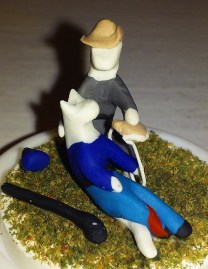
013 GrineThe second incident came while talking about Pvt. Philip Grine of the 83rd Pennsylvania. During the fighting on Little Round Top, he ventured out between the fighting lines twice to retrieve wounded Confederates. He was killed while trying to get a third. A child asked me why he did what he did. “To get their stuff?” No, to get them to the aid station for medical treatment. “Why? They’ll just start fighting him again. I would have killed them.”
Can the ideas of treating POWs humanely and of showing compassion to injured men really be so foreign to a child? As our children grow and learn what to believe and think, we need to make sure they know what is right. If we lay the right foundation, they will be able to evaluate outside ideas (from games, books, movies, etc.) and keep them in the right context.

Let me suggest that the most basic foundation for a good worldview is a respect for life. The Declaration of Independence points out that all humans have “certain unalienable rights”—rights that we have had since the beginning of time and creation, and that are not dependent on what a king or president says. The most important one is the right to life.

If humans have the right to life, then preserving that life is the right thing to do. There are times when war is necessary, but war is not a carte blanche for going out and killing all the enemy to the last man (which is why we have the Geneva Conventions). If an enemy has given up fighting, the honorable thing to do is to preserve their life and treat them as a human being again, even if five minutes ago you had “dehumanized” them to justify shooting them in battle. Yes, war is paradoxical. In his memoirs of WWII, Audie Murphy wrote about the strange paradox of gunning down attacking Germans and then, after capturing them, treating their wounds.

Without the basic respect for life—if we do not see a defeated enemy soldier as a human being—we open the door to war crimes and atrocities:

At Fort Pillow during the Civil War, African-American soldiers were massacred after they had surrendered.

During WWII, German SS troops (not to be confused with the Wehrmacht, the German army) rounded up 80 prisoners who had surrendered, herded them into a barn, and then tossed in grenades and strafed them with machine gun and rifle fire. As if that weren’t enough, they brought out some of the POWs and executed them by firing squad. Somehow, 15 prisoners in the barn survived. This was not the only time the SS killed POWs in cold blood.

In bushido, the code of the Japanese samurai, to lose is to lose your honor (respect). This is why defeated samurai would commit seppuku (ritual suicide) to die with honor. This view meant that Japanese soldiers in WWII had no respect for defeated enemy soldiers, since the latter had lost their honor. As a result, POWs were murdered, brutally mistreated, and tortured. During the Bataan Death March, Allied POWs were made to march over 80 miles, in extreme heat, without food, with little to no water, and in constant fear of random beatings or death by bullet or bayonet. Any who fell by the roadside were shot or bayoneted, but prisoners were not permitted to help their weaker buddies (prompting prisoners to come up with alternatives, like speaking encouragement). Any attempts by local Filipinos to give food or water resulted in beatings of prisoners and locals alike.

Do we want our children to have such a mindset?

But, you say, my child doesn’t think that! But the only difference between “Why didn’t they just kill the enemy soldiers (POWs)” and the SS just killing the enemy soldiers (POWs) is a matter of degree. What our children fill their minds with will shape who they become. If they cannot see the “other side” as anything but an enemy that must be destroyed, then they are at risk of losing a heart for their fellow man. And how will they know to separate the enemy on the screen from the “enemy” in their real life? How will they respond when faced with a bully, an annoying co-worker or boss, family troubles, or people with different opinions and beliefs?

027 USwA worldview of respecting your fellow man is not a view that ignores the realities of the world we live in; it is a view that works to make the real world better. Let us foster a respect for life in our children—even for the “enemy.”
 

Patrick, the Only Dog at Civil War Tails

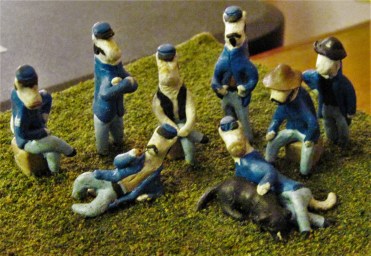
PatrickCivil War Tails is a museum of cats—almost 9,000 of them! But we do have one dog. He’s not a soldier; as Rebecca says, he’s a “dog-dog.” A little black mutt with maybe a bit of bull terrier in him, he’s the regimental mascot of a group of cat-soldiers who are having their photo taken. Many regiments had dogs as mascots, some of which were bull terriers (now known as pit bulls), including Jack, perhaps the most famous dog mascot, and Sallie, who can be seen on the 11th Pennsylvania Infantry monument here at Gettysburg.
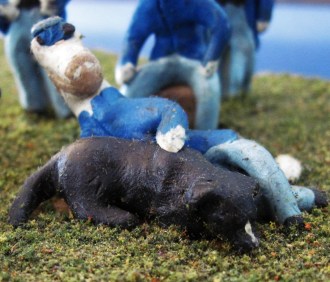
Since his arrival, our little canine has enjoyed the prestige of being the only dog in the museum, but he never had a name! He represents all the dog mascots and officers’ pets of the war, rather than portraying a specific dog, and so the little fellow has remained a generic dog. Until now.

Patrick crop2Yesterday, we welcomed “Loyalty of Dogs” to our museum, and in honor of the visit, we’ve named our only dog “Patrick” after a beloved pet who looked a bit like our little guy. It was great meeting the wonderful lady behind “Loyalty of Dogs,” and it’s an honor to name our cats’ mascot after one of her furry family members!
So, give your pup a bone and your kitty a treat, and help us celebrate our only dog finding his name! Welcome, Patrick!

The Battle of Aldie

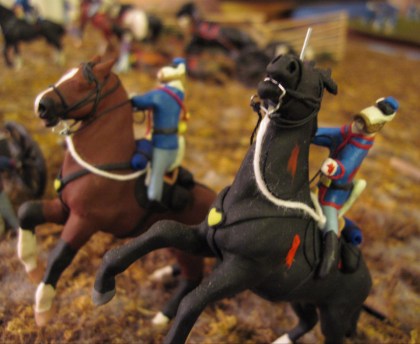
Today we’re spotlighting one of our older mini-dioramas. On June 17, 1863, Union cavalry clashed with Jeb Stuart’s Confederates near Aldie, Virginia. Gen. Alfred Pleasonton’s troopers were trying to locate the Confederate army, and Gen. Stuart’s men formed a screen to mask the army’s movements northward into Pennsylvania. Over the next week, the two sides clashed several times, but the Union cavalry failed to break through and find the main army.

The Battle of Aldie 2 This mini-diorama focuses on an individual encounter during the fighting at Aldie. Gen. Hugh Kilpatrick’s brigade attacked the Confederate line piecemeal and was unable to dislodge them from their position on a ridge. Kilpatrick sent the 1st Massachusetts around the Confederate flank, but the regiment was ambushed and lost nearly half its men. During the fighting, Col. Thomas Rosser of the 5th Virginia slashed Maj. Henry Lee Higginson of the 1st Massachusetts on the right side of his face. Despite also being shot and left for dead, the major survived. He and Tom Rosser would meet again, but not on the battlefield—this time they met in peace after the war.
Remembering…

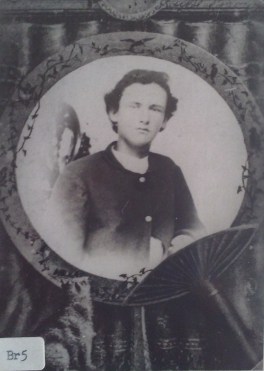
luke-brown-photo.jpgOn Memorial Day, we take the time to remember the men and women who have paid the ultimate price to keep our great nation safe and free. And so, this weekend, Ruth and I are remembering Pvt. Luke W. Brown, 8th Pennsylvania Cavalry, who died 154 years ago while serving to preserve the Union.
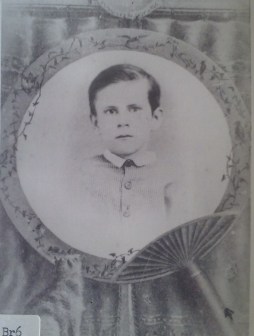
Luke was the half-brother of our great-great-grandfather Elmer. He lived in Millville, N.J. with his mother and siblings, and after his father’s death in 1859, he was the man of the house. He stood 5’7” tall, with brown hair, blue eyes, and a fair complexion. He worked as a glassblower.

In September 1861, at the age of 17, Luke traveled to Philadelphia and enlisted in the 8th Pennsylvania Cavalry. A year and a half later, in January 1863, he wrote home in a letter that our family still has. The regiment was on the Rappahannock River, on picket duty. Since armies settled down for the winter, soldiers would build log buildings instead of living in their usual tents. In his letter, Luke mentions that his log shanty is about the size of the chicken coop at home. He also mentions the soldiers who shared it with him, Privates Pierson Westcott and Albert Murphy. Of particular interest to us, he also mentions Elmer, who would have been 8 years old and was crippled and attending school.

As the Gettysburg Campaign developed that June, Luke was captured, possibly at the cavalry fight at Aldie, VA. He was paroled in July, reaching Washington, D.C. about a week after the battle of Gettysburg.

That October, the 8th Pennsylvania was involved in a fight near Warrenton, VA. The regiment ran low on ammunition, but their request for more was denied. As Confederate cavalry bore down on them, the Union troopers tossed aside their empty carbines and used their revolvers. The 8th was overwhelmed and many, including Luke and Pierson, were captured.

They were taken to Libby Prison in Richmond, where Pierson died of severe smallpox on February 9. Eventually, Luke was transferred to Camp Sumter at Andersonville, GA. He would never leave. Records say that Luke died at Andersonville on either July 9 or September 9, 1864. The different causes of death—starvation, scurvy, diarrhea, and gunshot wound—probably reflect various aspects of the same root cause: scurvy. Not only can it bring on diarrhea, but scurvy can reopen old wounds since the body is unable to properly maintain scar tissue. Luke is buried in Grave #8286. We are indebted to Union prisoner Pvt. Dorence Atwater, the “clerk of the dead,” who kept his own secret record of the Union dead at Andersonville. Thanks to his records, we were able to visit Luke’s grave in 1999.

Elmer-youngOnly nine years old when his brother died, Elmer never forgot the last time he watched Luke ride away. When he grew up, he named his son after the brother who never came home. Our family has had a Luke Brown ever since, through five generations.
A Glimpse into Cavalrycat Rehab, Part 3: Marching Orders

IMG_0410 1st horse on!

The first horse on the diorama!

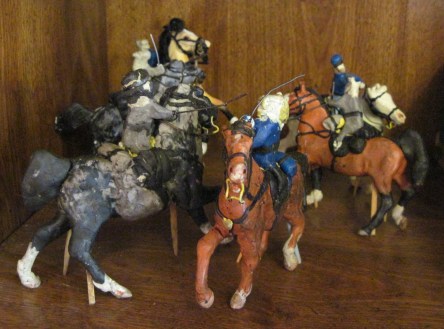
Now that Rebecca has finished her research, the cavalrycats have received their marching orders. A couple weeks ago, we began installing horses on “Come On, You Wolverines!” When finished, the diorama will have about 300 horses on it. Nearly every horse will be fastened down, using wire and several pins. Rebecca, our statistician, is attempting to count how many pins we use!

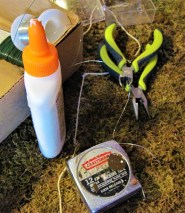
IMG_0447Here are some of the tools Rebecca uses when installing horses: white glue, tape measure, wire cutters, and needle nose pliers. She also uses tweezers with very long, thin tips (you can see them in the photos of wiring the horses together, below). They are not your ordinary tweezers—we bought ours from Micromark, which has a great variety of supplies for model and diorama builders.
IMG_0417

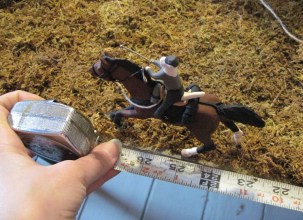
Measuring the distance between ranks

When in close column of squadrons, the cavalry ranks should be 27 feet apart, which is 9 inches on the diorama. The rank itself takes up another 9 feet nose-to-tail (3 inches on the diorama). Rebecca double-checks the spacing frequently, to make sure the ranks don’t curve or drift (like handwriting on a blank piece of paper!).

Each hoof that touches the ground is being wired down. After Rebecca places the horse, she marks where his hooves are with pins, then carefully removes the horse (without bumping the pins) so she can press the pins down into the surface of the diorama.

Rebecca is using green wire for the black legs, and silver wire for the white legs. (Check your local Walmart’s craft area for green wire for floral decorating and silver wire for jewelry or bead crafts.)  Rebecca has to be careful not to over-tighten the wire or she risks breaking the horse’s fetlock.

Now it’s time to wire the horse down. Rebecca uses needle nose pliers to twist the wire around the pin.

Once the horse is secure, Rebecca squeezes white glue under the hoof and around the pin. Using the pliers, she presses the pin all the way into the base of the diorama, which anchors the horse well. Then she nudges some of the moss “grass” over the glue to hide the head of the pin.

When possible, Rebecca is wiring the horses to each other as well, using the rings on their saddle girths. First, she marks where the next horse will go, then she puts the wire on his legs. Then she sends silver wire through his girth ring and the ring on the finished horse.

Once the second horse’s hooves are wired down, she twists the wire connecting their girth rings to secure them together. It’s not always a snug connection, but it will help steady them and ease some of the stress on their legs if the diorama gets tipped.

And that’s it!  Repeat the process a few hundred times, and the diorama will be done!

Tails or Tales?

Sometimes people ask us if the name on our sign is a typo. Don’t we mean “Tales”? Well, no, it’s not a typo. Both “tails” and “tales” are fitting for our museum! Our cats’ main purpose is to tell the stories of the individuals they portray. But we never have enough time (or space on the diorama information panels) to tell all of the stories, which is why we’re so excited about our new book.

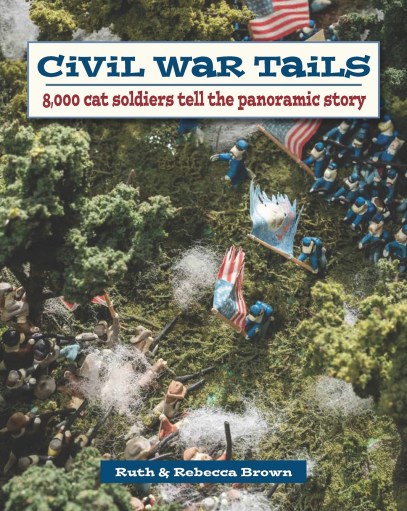
CoverFront_CWTails_tpc resizedCivil War Tails: 8,000 Cats Tell the Panoramic Story is more than a book about our museum. It’s a chance for us to tell many of the stories that don’t get told verbally.

Some stories are just a quick mention, such as that of Col. John Bowie Magruder during Pickett’s Charge. Rebecca always remembers him because two bullets struck him from different directions and crossed in his chest as he crossed the stone wall. We don’t know much else about him—but he is included on our diorama and now in our book. Even only a sentence or two helps us to remember that he was a real person with a life and a story, and much more than just a name.

Our book also allows us to share the context of our dioramas, giving better understanding of the importance of the events portrayed. For example, the even-handed duel between the ironclads, portrayed in our diorama, contrasted sharply with CSS Virginia’s bloody destruction of wooden ships the day before. Or, the events that led to the fighting on Little Round Top or Pickett’s Charge help us to realize that history-changing moments don’t just happen; there are always events and decisions that converge to cause them—and affect their outcome. This book allows us to share some of the “backstory” with our readers.

Civil War Tails is available for pre-order on Amazon and we will soon have copies available in our museum. We hope you enjoy our book, not only for the photos and stories of our dioramas, but also for the history of the real people behind them.

Civil War Tails is Expanding!

Civil War Tails is expanding this week!

In 1903, the former girls’ dormitory for the Soldiers’ National Homestead was moved up to Baltimore Street and widened into a duplex. This winter, we opened two doorways in the duplex wall to allow free passage between the two sides of the house once again. The larger doorway is six feet wide to allow the diorama “The Boys Are Still There” (Little Round Top) to pass through and become the focal point of its own room. Last week, the construction plastic came down and the cats of the 20th Maine’s left wing got a sneak peek at their new digs! It looks like they are excited and ready to go!20180407_214621

“Come On, You Wolverines!” (East Cavalry Field) is still due to make its debut this spring. However, as was the case with the actual Gettysburg campaign, Gen. Jeb Stuart’s Confederate cavalry is, shall we say, running a little late. Stay tuned for updates—the cavalrycats hope to arrive in May.

You might ask what’s new to see before the cavalry arrives. Well, there’s plenty! Come see details on the current dioramas that were not previously visible or have not been seen in a while. See John Chamberlain (brother of Colonel Joshua and Lieutenant Thomas Chamberlain) in the 20th Maine’s aid station behind the spur of Little Round Top. See Capt. Ellis Spear and the 20th Maine’s left wing starting their charge down the wooded slope. See Cpl. Henry O’Brien of the 1st Minnesota single-handedly starting the Union counterattack in the Copse of Trees during Pickett’s Charge. See the intricate detail of red piping and buttons on the uniforms of the 1-inch tall 72nd Pennsylvania cats—it took Ruth half an hour to make each cat!20180421_152838.jpg

We’ll be moving the dioramas early next week, and will be celebrating the expansion next weekend. Join us on Friday or Saturday (April 27 and 28) and mention “New Digs” to get a free Civil War Tails t-shirt!

Poor Kitty Popcorn

Poor Kitty Popcorn 1

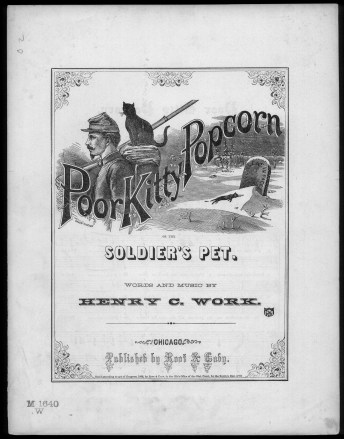
Today we’re highlighting a post-Civil War song which our friend Loyalty of Dogs brought to our attention. Who knew there was a song about a Civil War cat? I don’t know if “The Ballad of Poor Kitty Popcorn” is based on a real cat, but some soldiers had cats as mascots—of course, not nearly as many as had dogs.

Written in 1866, “The Ballad of Poor Kitty Popcorn” tells the tale of a cat who follows her flag and joins the army. She meets a soldier whom she bonds with, riding on his shoulder “when her feet were sore” and “Whisp’ring in his ear with wonder at the cannon’s roar, Me-yow!” They both survive the war, but alas, her soldier dies shortly thereafter, and she pines away on his grave, dying in a snowstorm.

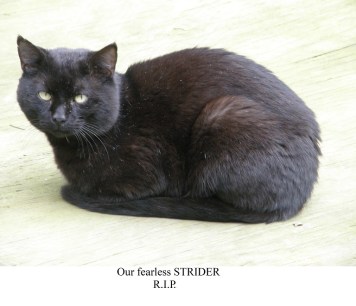
OLYMPUS DIGITAL CAMERAI’m not sure that our museum cat, Kitty, would follow us off to war, but at least she would miss us. However, our cat Strider might have tagged along. He followed me all the way down the street once, despite being a little apprehensive once we ventured outside of his familiar territory.
If you have a cat who would follow you on an adventure or who misses you when you’re away, give him or her a few extra cat treats today. If you’re musically inclined, you can find the sheet music on the Library of Congress website and sing the ballad to your cat. Maybe they will join in on each “Me-yow!” Alas, I think I had better not try it myself, or Kitty might disown me for disturbing her peaceful slumber!

The Irishman Who Saved the Union

Today, on St. Patrick’s Day, we’re taking a look at Patrick Henry O’Rorke, an Irishman-turned-American who was warm and endearing—and unflappable and courageous.

Born in 1836 in Ireland, “Paddy” O’Rorke was of medium size, with black hair and freckles. His family settled in Rochester, New York, and as a young man, Patrick apprenticed as a marble cutter. However, a local congressman offered him an appointment to the Military Academy at West Point, knowing of the young man’s academic prowess. There, he studied alongside Alonzo Cushing, Charlie Hazlett, George Custer, John Pelham, James Dearing, Tom Rosser, and Hugh Kilpatrick—all of whom would, like O’Rorke, find their place in history in the Civil War.

One story from his West Point days shows a glimpse of O’Rorke’s character and personality. During artillery drill one day, the gun fired prematurely while O’Rorke still held the rammer. He was thrown to the ground, but fortunately his arms were not torn off by the accident. His instructor rushed over, asking if he was all right.

O’Rorke stood up and said, “I’ve lost my glove, sir.”

“Bother your glove!” the panicked instructor retorted. “Your arm, man? Is your arm all right?”

“Oh, yes sir,” O’Rorke replied. “There’s nothing wrong with my arm.”

When war came, O’Rorke served as a staff officer and an engineer, but in the summer of 1862, while he was in New York on leave (and getting married!), he learned that a local regiment was forming—the 140th New York. He requested a commission, and in September he received the colonelcy of the regiment. Serving in the brigade of Gen. Gouverneur K. Warren, the 140th New York had their first taste of battle in the terrible Union disaster at Fredericksburg that December. A few months later in May, Col. O’Rorke was placed in temporary command of the brigade when Warren was made acting chief topographical engineer of the Army of the Potomac.

On the afternoon of July 2, 1863, the 140th New York sat resting about half a mile from Little Round Top. Orders came for the brigade, under the command of Gen. Stephen Weed, to move to the aid of Sickles’ III Corps. But, as they passed the little rocky hill, who should gallop up to O’Rorke but their old commander, Gen. Warren!

“Paddy,” he called, “give me a regiment!” When O’Rorke asked where to go, Warren replied, “Take your command and secure the hill before the enemy reaches it; that position must not be lost.”

Sometimes in battle, an “acoustic shadow” would occur, which is an atmospheric condition that dampens sound. Strangely enough, it is possible to be unaware of serious fighting nearby, even just on the other side of the hill! On July 2, such a shadow seems to have occurred at Little Round Top. Warren seems unaware of Col. Vincent’s brigade on the hill, and as O’Rorke and the 140th climbed the slope, they did not load their rifles, unaware that the fighting was so close. As they reached the crest however, they could see the Confederates a mere forty feet away! There was no time to form into a traditional line of battle.

IMG_0353 cropDismounting and drawing his sword, O’Rorke shouted, “Down this way, boys!” and dashed down the slope. Companies A and G followed him, loading their rifles and forming a ragged line among the boulders on the right of the beleaguered 16th Michigan of Vincent’s brigade.

O’Rorke called out, “Here they are, men, commence firing!” His men fired and the Confederates replied with a withering volley. Col. O’Rorke fell with a bullet in his neck. He bled to death within minutes.

O’Rorke fell just as his men were entering the fray, but his regiment held their ground, saving Vincent’s right flank just as the 20th Maine on the left flank began their bayonet charge. O’Rorke could have refused Warren’s pleas, or sought approval of the change in plans from Weed or Sykes, the corps commander. He could have taken a few minutes to form his regiment in a proper line, to avoid the confusion of tumbling into line first-come-first-served fashion. But he knew what was needed and when. If he had delayed even a minute, Little Round Top would have been lost. What good would the 20th Maine’s charge have been, if the Confederates had overlapped and flanked the 16th Michigan, opening an easy route to the crest of the hill?

This weekend, as you enjoy the green beer, corned beef, and shamrocks, take a moment to raise a glass to Col. “Paddy” O’Rorke, an Irishman who helped save Little Round Top, the Union Army of the Potomac…and the nation!


A Glimpse into Cavalrycat Rehab, Part 2: Making the Plans

Last fall, our Mewsings took a look at the cavalry rehab for our new diorama and saw what it takes to get the cats ready.  But while the cavalrycats polish their saddles and buttons, Rebecca has been busy planning out the diorama.

Early versions of our cavalry battle portrayed Brandy Station, the largest cavalry fight of the Civil War, which occurred only a month before Gettysburg.  About ten years ago, we changed our diorama to portray East Cavalry Field, the fighting that took place east of Gettysburg during Pickett’s Charge.

IMG_0261Now, we are giving the diorama a new, larger base and reevaluating what was portrayed.  Rebecca started by reading books on the fighting at East Cavalry Field to pinpoint the action we wanted to depict.  Then she visited the field itself (part of the Gettysburg National Military Park) to map out where that action occurred.

After locating the entire action on maps and fields, Rebecca determined the scope of the diorama.  The cats and horses are a larger scale (1:36) and the depicted action occurred in a farm’s open field, so this diorama does not need the usual trees or fences.  If we had used a smaller scale (1:72 or 1:96), we could have fit more of the field within the confines of our base, and may have needed to show natural features, fences, and topographical contours.  As it is, “Come On, You Wolverines!” will offer a close-up of the action, rather than the sprawling feel of a large diorama with a smaller scale, such as “The Fate of Gettysburg,” which shows the entire area of the Angle.

Even if overall features will be simple, Rebecca still had to pay attention to details and make a lot of calculations such as the frontage of a regiment charging in columns of squadrons, the distance between ranks, and the locations of Generals Custer and Hampton (i.e. who would be on our diorama and who would not).  After finishing those calculations, Rebecca came up with a total count for the cats and horses we will need on the diorama—over 300!  This means we will need to make over 200 new horses and cavalrycats, and when all is finished, about half of the horses recorded on our “census” will be on this diorama.

Stay tuned as the cats receive their marching orders, then finally mount up and move out!