Letting Go…Or Holding On?

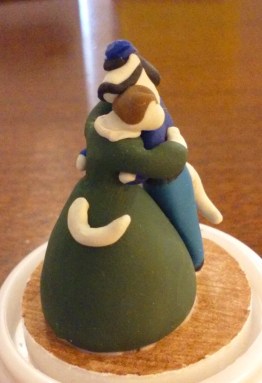
Reunion 162It’s been said that a good book (or any work of art) leaves you with questions, wanting to know more.  Today, I was working on assembling cats in small domes to sell in our gift shop.  They’re all cute, and sometimes it’s hard to part with them because they turned out so well, but this time there was a husband and wife set that Ruth made that struck me the first time I saw them, and has continued to make me pause every time I look at them.

Every detail about them is perfect in conveying just how much the little lady does not want to let her husband go.  Something about how her head is nestled against his shoulder makes me want to know more, every time I look at her.  Is he leaving for the first time?  Or was he home on leave, and the parting is so much harder than the first time, now that she knows the fears that will haunt her until his return?  Or is the war over at last, and her nightmares can end, now that he is home, safe and sound, and she knows, finally, that she will never have to let him go, ever again?

Our figures are cats, but like all art, they can draw out our emotions and leave us wanting to know more about each one’s story.  Sometimes that catches us by surprise—even when we are the ones who made them!

What is a Hero?

Last week, we considered the heroic actions of the men of the 54th Massachusetts Volunteer Infantry in 1863, including Sgt. William Carney, who received the Congressional Medal of Honor for his actions at Battery Wagner. Lately, we’ve been doing a lot of thinking about the question…what is a hero?

Just this past July 18th, Lt. Col. Charles Kettles was awarded the Medal of Honor for his actions in Vietnam.  On May 15, 1967, when he learned that 8 men had been missed and left behind in an ambush, he turned his battered UH-1 helicopter around and went back for them (you can read more about Lt. Col. Kettles here).  Because of him, their names are not on the black granite wall of the Vietnam Memorial.  Because of him, they survived.  But he did not consider his actions special that day.  He thought it was just what war is.  He had just done what he had to do. He wasn’t trying to be a hero.

P1220137

Lt. Col. Kettles’ story reminds me of another young soldier who just did what he had to and thought nothing of it.  During the heaviest fighting of the 20th Maine’s defense of Little Round Top on July 2, 1863, Sgt. Andrew Tozier stood at the apex of the regiment, practically alone, holding the flagstaff in the crook of his elbow and firing a rifle he had picked up from a wounded comrade.  Col. Chamberlain saw him and admired the way he was “defending his sacred trust.”  Capt. Spear also saw him and noted that he was calmly chewing on a piece of cartridge paper.  Like Maj. Kettles, Sgt. Tozier was just doing what he could to take care of business.  He wasn’t thinking about being a hero.  After their respective wars ended, both men returned to quiet lives.

That is why I find it so fascinating to study history, to see how people react in the crucible—Henry V’s ragged, outnumbered army at Agincourt in 1415; officers and men in the hell of Pickett’s Charge; Sgt. Tozier on Little Round Top; Ida Straus telling her husband, “where you go, I go,” before going down with the Titanic, together; Jack Phillips, the Titanic’s wireless operator who remained at his post, sending the distress signal until the power finally went out; salvage divers to the wrecks at Pearl Harbor; fighter pilots over the Philippines, facing Japanese Zeroes; Maj. Kettles in Vietnam.  So many opportunities to turn and run, to give up or give in—and instead so many stories of valor because it was what was needed and the right thing to do.

What I find most fascinating about the Medal of Honor heroes I’ve read about is that they all say the real heroes are their buddies, not them.  For me, this humility makes them even more special.   Lt. Col. Kettles says the men under his command that day are the true heroes, because they had no choice but to follow his orders and they did.  Audie Murphy, the most decorated soldier of WWII, said the true heroes were the ones who didn’t make it home.

A couple years ago, I had the honor of meeting Gary Wetzel, a Vietnam veteran who also earned the Medal of Honor.  I remember him telling me that he didn’t deserve the Medal.  A quick search on Wikipedia tells me that after his helicopter was shot down on January 8, 1968, he was severely wounded and yet was able to take out an enemy position with his machine gun and then help wounded comrades, even as he bled profusely from multiple wounds, including a nearly-severed left arm.  I’m pretty sure the soldiers he defended and helped would agree that he deserved the Medal.  Meeting him was an indescribable honor for me, and a memory I will always cherish. Not one of these men did what they did with a medal in mind.  Whenever I read the story of a soldier who has been awarded the Medal of Honor, and it tells of their reactions, not once have I read that the fellow thought he was going to get the medal, not one has said he deserved it.  Each one thinks someone else should have gotten it instead.

We need these stories to remind us that heroes are not big-chested guys who fly around saving people; they’re ordinary folk who are just doing their jobs.  The firefighters at the World Trade Center did not enter the buildings thinking about being heroes.  No, they went in because it was the right thing to do, to help the injured, to find the trapped, to get everyone out—to serve their fellow man.  If you were to study every story of tragedy that grips us, I am willing to bet that in each one of them, the hero is thinking of someone else and not themselves—a fallen son, the buddies around him, the good of the nation and the families at home, the stranger in trouble.  Search for these stories, hunt for them, and take them to heart.  Heroes don’t try to be heroes—they’re just ordinary folk who do the right thing when it’s asked of them.

Courage of Every Kind

P1240627Today is the 153rd anniversary of the first time the men of the 54th Massachusetts Volunteer Infantry saw combat. In two days, we will reach the 153rd anniversary of their second fight: the assault on Battery Wagner. It was there that the men of the 54th proved that they could fight . . . by losing nearly half of the men who went into battle.

The 54th Massachusetts was one of the first regiments of black soldiers raised during the Civil War. Theirs is a story of courage—of every kind.

It takes courage to do the right thing, even if people think less of you because of it. Robert Gould Shaw was in a good position as a captain when he was asked to command a regiment of “colored” soldiers. It was a post that would subject him to ridicule, maybe even ruin his future prospects. After initially refusing the position, Shaw reconsidered and accepted command of the 54th. He determined to prove that his men could fight as well as white men.

It takes courage to keep going, despite an uncertain future. When the 54th headed south, they did so knowing that the Confederate Congress had declared that every black soldier captured would be sold into slavery. Every white officer in command of black troops would be executed. Would their own government defend them, if they were captured? They had no idea. It was not until after the fight at Battery Wagner that the U.S. Government threatened retaliation on Confederate prisoners if the Confederacy went through with their word.

It takes courage to risk your life to save another person’s life. In their first taste of combat, the 54th skirmished on James Island, SC, contesting every inch and holding their position long enough to save the trapped 10th Connecticut. One Connecticut soldier wrote home after the battle: “But for the bravery of three companies of the Massachusetts 54th (colored), our whole regiment would have been captured…they fought like heroes.” Later, other white regiments greeted them with the cries: “Well done! We heard your guns!” and “Hurrah boys! You saved the 10th Connecticut!”

And then, there’s the courage exhibited on July 18, 1863.

A mere two days after James Island, the regiment faced a much greater test. Col. Shaw offered his regiment to lead the assault on Battery Wagner. It was a place of honor . . . but a costly one. Col. Shaw had his own reservations as to whether he would survive the fight. Yet as the regiment prepared to advance, one of his captains recalled of Col. Shaw, “His bearing was composed and graceful, his cheek had somewhat paled, and the slight twitching of the corners of his mouth plainly showed that the whole cost was counted.”

When Gen. Strong pointed to the flag bearer and asked who would carry the flag on if the man should fall, Col. Shaw set an example when he calmly replied, “I will.” He then told his men, “I want you to prove yourselves men. The eyes of thousands will look on what you do tonight.”

The regiment advanced through cannon and rifle fire, across a ditch filled with several feet of water, across buried land mines, across sharpened stakes and felled trees with sharpened branches, and up the sloping wall of Wagner. Col. Shaw reached the top of the wall and cried, “Forward, 54th!” and fell dead.

P1240626 Lt Emerson

Rather than lose their nerve at the death of their commander, the men of the 54th hung on. They fought hand-to-hand. Officers picked up rifles alongside their men. One man’s broken arm didn’t stop him from piling cartridges on his chest for Lt. Edward Emerson to use.
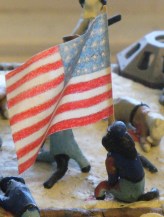
P1240606 Sgt CarneyThe regimental color-bearer, John Wall, fell, but Sgt. William H. Carney picked up the flag. He knelt on the wall with the colors until the regiment fell back. By the time he reached the hospital, Sgt. Carney had been wounded in the head, breast, arm, and both legs. He simply told the men in the hospital, “I but did my duty. The dear old flag never touched the ground.” For his courage, Sgt. Carney received the Congressional Medal of Honor in 1900. His was the earliest action for which the Medal of Honor was awarded to a black soldier.

The regiment advanced with about 600 men and lost nearly 300. Although more Union troops finally joined the fighting, the 54th was initially unsupported. Nevertheless, in this, the second time they had seen combat, the men of the 54th did not falter or give up on their mission. They not only proved themselves men, but they proved themselves to be men of the highest caliber.
Understanding war…through dioramas?

Last week I was asked, how can dioramas help us understand war in general?  It’s a question I’ve never considered, and the answer I found took me a little by surprise.  A diorama is such a simple thing, and yet its meaning and purpose is so much richer than I ever thought.  Here is my answer.

It depends on the focus of the diorama.  Typically, dioramas focus on the overall battle or story of the given subject.  I wonder if ours are unique in that we want to tell the stories of individuals.  All of our larger dioramas have information panels with stories of individuals or units, as well as the general overview of what you’re looking at.

As I write the stories to put on display, I am continually struck by how much we can relate to the people back then.  At the Angle, there was Capt. Michael Spessard, who had just seen his son fall mortally wounded on the way across the fields.  I think every parent can relate to his feelings as he reaches the Union position at the stone wall.  Is it any surprise to a father or mother reading his story, that he will refuse to surrender, and even after his would-be captors wrestle his sword away from him, that he will chase them away, pelting them with rocks?  Or the story of Sgt. Andrew Tozier—growing up with an abusive alcoholic father, but going on to earn the Medal of Honor on Little Round Top at Gettysburg.  How many kids nowadays need to hear his story and learn that their character–not their past–dictates their future and their potential?

We live in a culture that focuses on death and pain, ghosts and gore.  Studying war, you find yourself in a strange clash between destruction and glory, pain and valor, death and salvation.  For all the stories of pools of blood, you can find stories of rescue and relief.  Col. Oates losing his brother on Little Round Top, Spessard losing his son, Capt. Cocke losing sight of his brother at the Angle.  And then you have Pvt. Grine venturing between the firing lines to bring wounded enemy soldiers back to safety and the field hospitals, you have the story of John Chamberlain’s relief at finding his brothers Tom and Lawrence safe after their hard fighting leading the 20th Maine.

In the paintings of the great masters, the most striking ones are dark with a ray of light piercing through.  I think that is why we keep coming back to study war—to search for those stories of light, of man at his best.  It’s not the stories of destruction; it’s the stories of standing firm, of doing what is right, of helping others, of determination, desperation, and mercy.  And if you let those stories sink in, you can’t help but think, “Would I do that?  Could I do that?”  If our dioramas can interest people in those stories and inspire them to be the type of person who stands firm, who does the right thing, who thinks of the people around them and not of themselves when trouble comes, I think our cats will have done their work.

P1220562 Spessard crop and fix

Standing by Different Guns – Cat 8000

Last night, Rebecca placed Cat 8000 on our diorama of the Angle. Ever since Cat #2000 on our census, we have kept track of each thousand with a special cat-soldier.

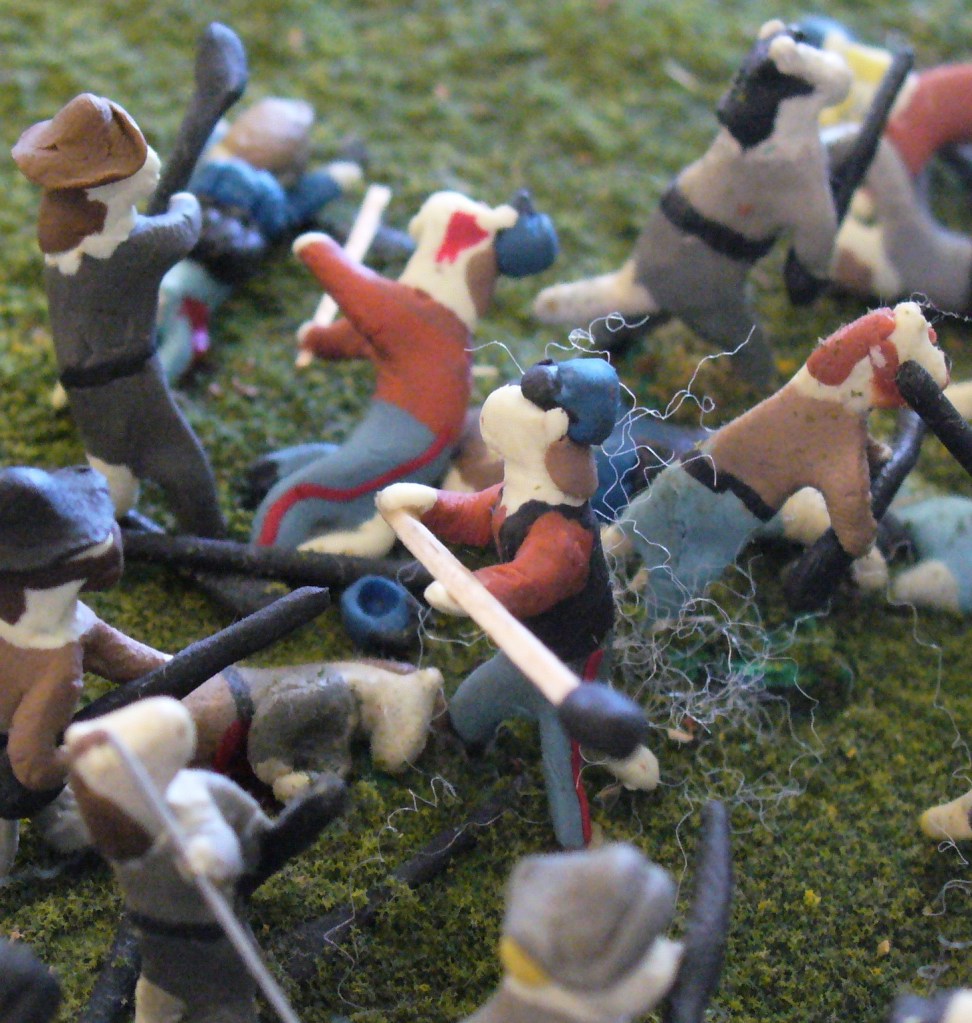
Cat 8000 is a gunner from Lieutenant Alonzo Cushing’s Battery A, 4th U.S. Artillery, but he is not standing anywhere near a cannon. Instead, he wields his rammer at a Confederate clubbing one of his fellow gunners at the wall in front of the Copse of Trees.

As the Confederates poured over the wall and Lt. Cushing’s demolished guns were abandoned, some of his gunners joined the 69th Pennsylvania instead of retreating. They wielded handspikes and sponge-staffs in desperate hand-to-hand fighting, likely joining their infantrymen comrades in, as members of the 69th put it, “looking and praying for help” and thinking they “were all gone.”


P1240525 crop

You can recognize Cat 8000 by the black vest that he is wearing over his red shirt.

Hidden Victory

On June 9, 1863, the largest cavalry battle of the Civil War was fought at Brandy Station, Virginia. Union troopers caught Gen. Jeb Stuart’s Confederate cavalry by surprise at dawn, beginning a day-long battle. Whereas cavalry usually fought dismounted, the battle at Brandy Station moved so quickly that the men remained mounted, attacking and counter-attacking in grand, mounted cavalry charges.

Although the Confederates held their ground and therefore won, the battle became more important for another reason. After two years of fighting, the Union cavalry finally proved they were the equals of the Southern horsemen. In less than a month, these cavalrymen would need their new-found confidence as they moved north to Gettysburg.

Futures Lost

This morning, I headed off to work with the usual “life’s problems” rattling through my mind. But as I pulled my car out of our garage, I caught sight of little American flags stuck into the ground on the other side of the iron fence that runs along the driveway. Our property backs up to Annex D of the Soldiers’ National Cemetery. Each Memorial Day, the graves are marked with thousands of American flags lovingly placed to honor our fallen soldiers. At that moment, it struck me.

Many of the soldiers buried in that cemetery died young – 22, 21, 18… They never had a chance to have the little annoyances of everyday 32-year-old life. They had dreams and plans just like I do, but they never had a chance to pursue them. Perhaps it is a strange way to think of their sacrifice, but it really helped me today. It was a gentle dose of perspective, and it actually made me thankful for the annoyances of life that I am blessed to experience.

To all our veterans and especially their comrades who fell and never experienced their futures, Thank You.

P1240451

Window to the Past

Photography was quite new during the Civil War. It was a time for experimentation with techniques and with subject matter, a time to learn that battles could not quite be captured yet. It was a time to record the images of great men, notable women, and the ravages of war that otherwise would not have reached the citizens in the further reaches of the country…or time.

Through this remarkable medium, we can gaze into the past. We can actually see the toughness of men like Gen. Sherman. We can see the tenderness of a mother and her baby. The style of the clothing is different, but some things never change.

We see the faces of the dead – nameless on the field awaiting burial…or as their families would remember them, gazing steadily into the camera in a blue or gray uniform, perhaps a sword or revolver in hand, ready to take on the enemy army and looking forward to returning home again. We see the ones they left behind: wives, children, sweethearts.

We see the devastation of war in the images of the destroyed Richmond. We can even see what Fort Sumter looked like soon after the opening shots of the war: the Columbiad fired from its recoiled position still lies fallen, halfway into the stair tower, next to the howitzer it dismounted. They’re the stories we read about, brought through time exactly as they were 150 years ago.

Take some time to study a photograph from the past. Really, really study it. What can you see?

The Power of Music

Recently, we’ve been listening to a stack of new Civil War-related CDs. Some are traditional Irish songs, some are traditional folk tunes. The great thing about music is its ability to draw us in. Whether the song has lyrics (the Civil War soldiers’ song “Tenting Tonight” or the modern song “The Day the Sun Stood Still” from the musical “The Civil War”) or is purely instrumental (“The Road Home” by Altan), music draws us in. Music evokes joy or heartbreak. It can make us cry for people we don’t know–even fictional characters!

Music can be a way for a nation to process events, just as we as individuals might journal to process a traumatic event. I recently heard that during World War II, one way to survive the chaos in the world was to write humorous songs, such as those poking fun at Adolf Hitler. In the wake of John Brown’s Raid in 1859, many songs were written about him.

A song can bring us together as a community–locally, nationally, or perhaps even across national boundaries. A song drew together the weary soldiers on the night of July 2, 1863 here at Gettysburg, uniting blue and gray in thoughts of home as they knelt in blood-soaked fields. There is certainly something special about music when it can draw such opposing forces together.

Perhaps the power of music is that through its beauty, grandeur, light-heartedness, and pathos, it draws us out of our selfish personal world and into a new experience where we begin to see and care about others.


Spring: a time of beauty and reflection

Spring has finally arrived here in Gettysburg! The buds and flowers have been trying to convince me of it, but when the temperatures are still rather cold, it’s hard to believe that it’s April. After all, we had snow flurries a week ago. But now, the weather is warm and the sun is shining, and it’s a great time to come out and avoid the summertime crowds while traipsing the battlefield and perusing museums and shops in town.

It’s kind of crazy to realize that Spring is also the time of year when the armies would be mobilizing again after their winter camps. While we enjoy the weather sipping tea on our front porch, it’s hard to remember that in the end of March and early April during the Civil War, men were already fighting and dying. Think Appomattox and the fighting that led up to it.

Take a moment to stand in the Spring sunshine and ponder the cost paid by those who came before us. What is the significance of it? Does it still matter? Do battlefields still matter? Why is it important that we study history? Why is it important that we preserve the bits and pieces that we still have from times and people long past?