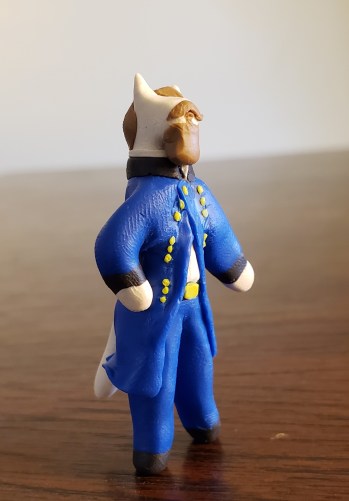
 It was shortly after 12:30 p.m., July 1, 1863, in Taneytown, MD. Gen. George Meade, in command of the Army of the Potomac for only a few days, knew that two of his seven corps, the I and XI, were engaged at Gettysburg, thirteen miles away. Now he learned that Gen. John Reynolds—one of the best generals in the army—had been either killed or badly wounded. Not knowing the full situation, he needed someone to replace Reynolds and take charge. He immediately rode over to the II Corps headquarters and Gen. Winfield Scott Hancock. Leave the corps behind, he told Hancock, and ride immediately for Gettysburg. If indeed Reynolds is incapacitated, take command of the field.
It was a bold decision. Hancock had been in command of a corps for only three weeks. Now, Meade sent him to take charge of two corps fully engaged with Confederates. The other odd thing about Meade’s order was that a senior officer was already on the field—Gen. O. O. Howard of the XI Corps. Sending the junior Hancock to supersede him was highly unusual. So, who was this Hancock, that Meade would entrust him with acting as Meade’s own representative? What about him gave Meade the confidence that this new corps commander could correctly assess the situation—whatever it might be—and then competently take the reins of two corps?
Winfield Scott Hancock was a career army officer. He had distinguished himself in the Mexican War, but more recently he had shown his character in the earlier fighting of the Civil War. In May of 1862, at Williamsburg, VA, Hancock demonstrated his unwillingness to back down when he was in the right. Faced with the opportunity to flank the Confederate position, he resisted the order to withdraw. Fortunately for him, the Confederates attacked before he had to either disobey orders or obey against his better judgment. The situation ended well—his men sent the Confederates reeling back and he earned the nickname “Hancock the Superb.”
Antietam, in September of 1862, gave a foretaste of the Hancock of Gettysburg. He was commanding a brigade in the IV Corps when he received orders to take a division of the II Corps. He had never commanded a division, and these men, being of another corps, were new to him. Nevertheless, he took charge, and by his confident bearing, the men knew at once he was their commander.
But July 1, 1863 was different than Antietam. Hancock was heading into a situation of which even Meade did not know the full details. He would take charge of all the Union forces on the field, a demi-army of men who had never experienced his personal command. How did Meade know that Hancock, personally, was the best choice?
From a military standpoint, Hancock’s observation skills would be extremely useful. He had an eye for terrain, probably thanks to his skills at drawing. Just as artists carefully observe their subject, so Hancock applied that observation to the ground around him. Even as he rode to Gettysburg, he noted features of the terrain that would be useful as defensive positions, should the I and XI Corps need to retreat to the “Pipe Creek Line” that Meade had already planned out before Confederate contact was made.
Hancock also put his observation skills to work after his arrival—placing troops on Culp’s Hill to protect his right flank, putting artillery on the little knoll between Culp’s and East Cemetery Hill to cover the steep eastern slope of Cemetery Hill, and even sending a division down to the area of Little Round Top. At two miles away, the hill was not part of the battlefield. But Hancock saw that it formed part of a strong defensive position that centered on his current location on Cemetery Hill. He was, in fact, first to see the “fishhook,” the line that ran along high ground and featured a tight, compact position with short interior lines to facilitate reinforcing any area that needed help.
From a personal standpoint, Hancock had the presence and charisma to take charge. Lt. Frank Haskell, a staff officer in the II Corps, wrote, “I think if he were in citizens clothes, and should give commands in the army to those who did not know him, he would be likely to be obeyed at once.” When fellow soldiers described him, common descriptors included “magnificent,” “splendid,” and of course “superb.” They even described him as Mars, the god of war.
But it was not just his stalwart, imperturbable, soldierly bearing. Warm and friendly off the field, in battle his blue eyes “became intensely cold and had immense power on those around him,” according to Gen. “Baldy” Smith, his superior at the beginning of the war. Gen. Carl Schurz of the XI Corps, writing about Hancock on July 1, recalled, “His mere presence was a reinforcement, and everyone on the field felt stronger for his being there.”
Lest you think the effect was felt only by the generals around Hancock, the average soldier felt the same way. Lt. Edward Whittier of the 5th Maine Battery had participated in the retreat of the I Corps through town on the afternoon of July 1. When he saw Hancock, he wrote later, “I shall never forget…the inspiration of his commanding, controlling presence, and the fresh courage he imparted.”
Lt. Sidney Cooke was part of the 147th New York, one of the first infantry regiments to reach the field. The day had been long and hard for them, and they formed part of the flood of Union soldiers retreating through town—disorganized, but not routed. Cooke’s recollections give a glimpse into the mind of an average soldier in the two shattered corps that evening: “Every man knew how hopeless resistance would be, but Hancock sat his horse, superb and calm as on review; imperturbable, self-reliant, as if the fate of the battle and of the nation were not his to decide. It almost led us to doubt whether there had been cause for retreat at all.”
Any officer whose mere arrival can cause battered, bloodied soldiers who are being chased through the crowded narrow streets of a strange town to think that they are all right now and there was no need for alarm or retreat after all—that man is the one for the job.
Gen. Meade could not have known that the two corps would be shattered by the time Hancock arrived on the field, but he knew that whatever situation the general might find, Winfield Scott Hancock was equal to the task.
Resource: Bretzger, Paul E. Observing Hancock at Gettysburg: The General’s Leadership through Eyewitness Accounts. Jefferson: McFarland & Co., 2016.


 This week in 1995, Rebecca was reading The Story of Robert E. Lee by Iris Vinton and The Story of Ulysses S. Grant by Jeannette C. Nolan. After finishing the biographies, she made two cats out of clay. One wore the beard and blue uniform of Gen. Grant, and the other the beard and gray uniform of Gen. Lee. They needed men to command, so she made ten Union cats and ten Confederate cats. Little did we know, she was starting us on a road to 8,747 cats and a museum in Gettysburg!


 After a quiet, 2.5 month, stay-at-home “vacation,” the cats at Civil War Tails are dusting themselves off and getting ready for the summer season! That’s right, we are opening on Friday, June 12!
 Schools are closing, workplaces are closing—and you’re ready. You have food and hand sanitizer. You have technology set up to work from home. You have milk, bread, and eggs. But have you thought about…free time? On a typical day off, do you (or your kids) get bored? What will the kids do if school is closed for weeks? Don’t panic. It’s not too late to prepare. We suggest assembling a “Cabin Fever Emergency Kit.” You guessed it—diorama supplies!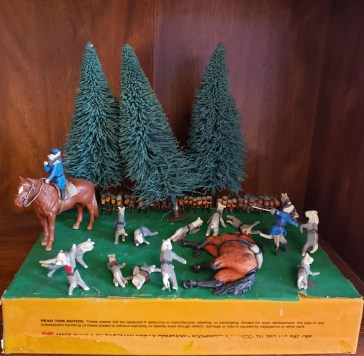


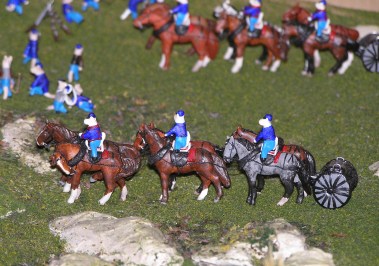 This kit is the same as the Kids kit with the exception of the green and blue paper. Come on, you didn’t really think you could get away with using green paper for grass, did you? If you have a higher level of skill or boredom, it’s time to bring out the turf! Basic turf comes in containers as loose specks of foam. See our


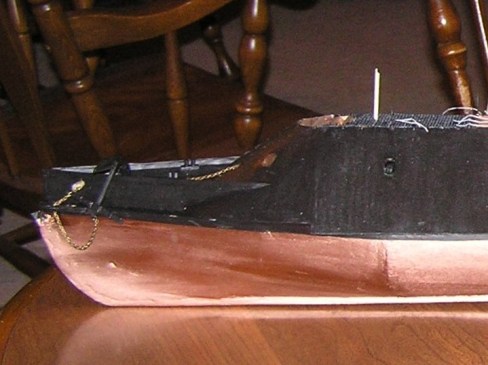








 In our reading, we came across an account from New York Times correspondent Samuel Wilkeson, written shortly after the battle of Gettysburg. While it was probably difficult for any correspondent to write newspaper articles about the battles they had witnessed, this time was particularly difficult for Wilkeson, as he mourned the death of his son in the first day’s fighting. Nevertheless, he persevered. In his account, he described the massive artillery bombardment that preceded Pickett’s Charge. As Wilkeson described what he saw in the yard and vicinity of the Leister House, where Gen. Meade had his headquarters, we read these words:
 Because Saddlebred would portray the ambulance horse, he (obviously) dictated that the scale be 2-inch-tall cats, rather than the 1-inch size that we were likely using at the time. Because the description of the ambulance horse is flanked by a description of the horses in the yard and an account of damage to the house, the ambulance was clearly galloping past the headquarters. So, we built the house and yard. Ruth likes making buildings and vehicles, so she made the Leister house and the ambulance, while Rebecca made the picket fence and garden. We based the features off of period photographs as well as current photos of the house, which still stands on Taneytown Road behind the Angle. Thanks to photos taken shortly after the battle, we were able to portray specific damage to the house, and we even found sticks that matched the shape of the trees in its yard!
 It is New Year’s week, so it’s time for the annual self-reflection and analysis that often leads to yet another New Year’s Resolution that may or may not…survive the month. Today, we consider a slightly different type of reflection and analysis.
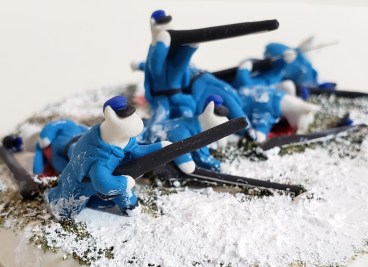 Burnside determined to break through the Confederate line, then turn and smash the two sections, destroying the Confederate army. Several of his generals disagreed, arguing that such an attack would fail because the Confederates had a strong position with open fields in front of them, leaving the Union attackers unprotected from enemy fire as they advanced. Burnside remained unmoved. After the meeting where he outlined his plan, he asked Col. Rush Hawkins, a brigade commander, what he thought. Hawkins replied, “If you make the attack as contemplated it will be the greatest slaughter of the war; there isn’t infantry enough in our whole army to carry those heights if they are well defended.”