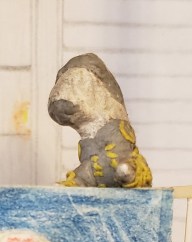
Gen. P. G. T. Beauregard
Today is the anniversary of the beginning of the battle of Shiloh, which raged over two days near Pittsburg Landing in Tennessee. Ordinarily, we think of battles being fought by two armies. Shiloh involved four. On the Confederate side, Gen. Albert Sidney Johnston and Gen. Pierre G.T. Beauregard had joined their armies in the hopes of defeating the Union forces together. On the Union side, Gen. Ulysses S. Grant’s army lay encamped at Pittsburg Landing on the Tennessee River, and Gen. Don Carlos Buell’s army was en route to join Grant.
On the night of April 5, 1862, the Confederates lay ready to launch a surprise attack on Grant’s army. That evening, a Union captain saw campfires and heard bugles and drums. He told the officer of the day, Lt. Col. Graves, who went to Gen. Benjamin Prentiss, the division commander. Prentiss said it was just an enemy patrol. Frustrated, Graves and the captain went to see Col. Everett Peabody, who commanded a brigade under Prentiss. Peabody believed them. Taking full responsibility, he sent a patrol to investigate.
The patrol marched out of camp at 3:00 a.m. on Sunday morning, April 6. At 4:55 a.m., firing erupted as the patrol ran into Confederates. The battle of Shiloh had begun. The patrol held their ground for about an hour and a half, then a battle line of Confederates appeared and the Union soldiers retreated.
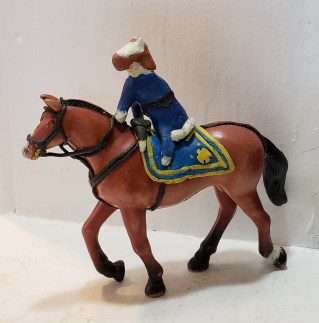
Gen. William Tecumseh Sherman
Around 7:00 a.m., other Confederates launched a furious attack on Gen. William Tecumseh Sherman’s men. After heavy fighting, Sherman ordered a retreat, and his men reformed in a road about 500 yards to the rear. Suddenly a battery came galloping up. The infantry were unable to get out of the artillery’s way because of the brush on either side of the road. To add to the confusion, more retreating troops came running up. Everyone was in a jumbled mess when the Confederates arrived and fired a volley. They charged, and all but one brigade ran.
Meanwhile, Col. Peabody heard heavy firing off in the woods and ordered a drummer to sound the “long roll,” to assemble the men for battle. Suddenly, Gen. Prentiss appeared. Furious, he asked if Peabody had started the fight. Before the colonel could explain, Prentiss shouted, “Colonel Peabody, I will hold you personally responsible for bringing on this engagement!”
Peabody responded that he was always personally responsible for his actions, and the general rode off in a huff. Peabody advanced with his brigade into the woods. They stopped the Confederate advance for a time, but then two brigades charged, screaming the Rebel Yell. They sent Peabody’s men reeling back.
Peabody, already wounded four times, galloped among his retreating men, begging them to rally and fight. Before the battle he had had a premonition he would be killed and had said goodbye to his officers. Now the 31-year-old colonel fell with a bullet through his head. By 8:45 a.m., Peabody’s camps were in the hands of the Confederates.
Gen. Prentiss’ other brigade had formed by then, and the Confederates concentrated on it. The Union soldiers retreated. One regiment of the brigade, the 15th Michigan, had just arrived at Pittsburg Landing and hurried into battle. When they formed into a battle line, facing several Confederate brigades, they realized they did not have ammunition. They hurriedly withdrew. By now, Prentiss’ division was a wreck. Only a few regiments remained organized; most of the artillery had been captured.

Gen. U. S. Grant
About this time, Gen. Grant arrived at Pittsburg Landing from Savannah, a town downriver. Realizing that a battle was being fought, he quickly sent word to Gen. Lew Wallace, whose division was farther down the river.
On the Union left, a lone brigade held the flank. The commander was nervous because he did not know from which direction the Confederates would come. As a result, his men marched here and there and everywhere. The Confederates saw the movement and were convinced they faced at least a division. As a result, Gen. Johnston sent reinforcements, weakening the rest of the Confederate line, most of which would soon be engaged at the “Hornet’s Nest.”
Gen. Prentiss’ men had reformed in a sunken road. To their left was Gen. Hurlbut’s division and to their right was Gen. W. H. L. Wallace’s division (not to be confused with Lew Wallace, whose division had been delayed by taking a longer route than expected). Around 11:00 a.m., the Confederates attacked. But the attack was made by only one brigade and failed miserably. Gen. Braxton Bragg ordered Col. Randall Lee Gibson’s brigade to charge next. They were met by a terrible fire from the Union line and forced to retreat. Bragg thought they retreated too soon and ordered them to charge again. Col. Gibson protested, but there was nothing he could do, so he led his men forward once more. When they were only twenty yards from the Union line, the Union soldiers rose and fired a volley. Again, Gibson retreated. His men said the bullets sounded like angry bees, and they dubbed the Union line the “Hornet’s Nest.” Bragg sent them forward a third time, and a fourth time. The decimated brigade was forced back a fourth and final time. Amazingly, Col. Gibson would be accused of cowardice, even though he had led his men in four hopeless charges.

Gen. A. S. Johnston
On the Union left, the lone brigade was doing a good job of holding off the enemy. Finally, the Confederates, led by Gen. Johnston himself, pushed the Union left back. They now had a clear way to Pittsburg Landing and complete victory.
Around that time, a bullet struck Johnston behind his right knee, severing a major artery. The blood flowed into his boot, hiding the presence of the wound until he slumped in the saddle. His staff pulled him down from his big bay, Fire-Eater, and searched for a wound. By the time they found it, it was too late and Johnston died. It was 2:30 p.m. and a lull descended on the battlefield.
If the Confederates had pushed around the Union left and reached Pittsburg Landing, they could have surrounded the Union army. Instead, the Confederate commanders led their men to the sounds of firing at the ‘Hornet’s Nest.’ The Confederates struck the left of Hurlbut’s line, forcing him to retreat. Then Confederate artillery opened fire. There were 62 cannons in line, the largest gathering of artillery in North America up to that time. After the artillery blasted the Union line, the infantry advanced and forced W.H.L. Wallace to retreat. Only Prentiss remained and before long, he surrendered.
The Union army tried to reform on some bluffs near Pittsburg Landing. Just as the Confederates were about to launch a final attack, Gen. Buell’s army arrived, adding fresh troops to the Union line. Darkness put an end to the fighting.
The night was miserable for everyone. It began raining around midnight and continued until after 3:00 a.m. As if the rain were not enough to keep the tired soldiers awake, around 9:00 p.m. the Union gunboat Tyler began firing its huge guns every ten minutes. At 1:00 in the morning, USS Lexington took over.
On the morning of April 7th, Buell’s army attacked the Confederates. By 3:30 in the afternoon, after furious fighting, Beauregard ordered a retreat. The battle of Shiloh was over. It was the bloodiest battle in America’s history up to that time.


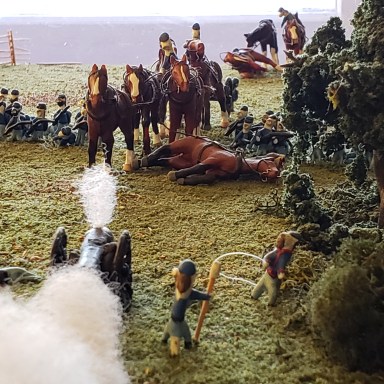
 Horses might seem to just plod through life, wherever we lead them, but in fact they are highly sensitive and observant animals. Henry Kyd Douglas, an aide to “Stonewall” Jackson, recalled his horse’s distress while passing through the Antietam battlefield during the night, after the fighting had ended.
 One thing which forcibly occurred to me was the perfect quiet with which the horses stood in their places. Even when a shell, striking in the midst of a team, would knock over one or two of them or hurl one struggling in his death agonies to the ground, the rest would make no effort to struggle or escape but would stand stoicly [sic] by as if saying to themselves, “It is fate, it is useless to try to avoid it.”
 Dick remained steady throughout the following fighting. Despite a serious wound to his right thigh and three bullets in his body, Dick carried Haskell back and forth at the gallop as the lieutenant urged men forward and summoned reinforcements to repulse Pickett’s men. Not until their duty was over did Dick lie down and finally succumb to his mortal wounds. “Good conduct in men under such circumstances,” Haskell wrote, “…might result from a sense of duty—his was the result of his bravery.” Haskell finished by expressing his wish that, if there be a Heaven for horses, “in those shadowy clover fields [Dick] may nibble blossoms forever.”
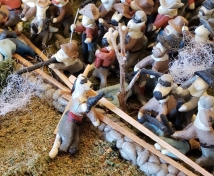
 Today we take a look at our first to-scale diorama, “I Want You to Prove Yourselves,” which shows the 54th Massachusetts Infantry charging Battery Wagner in Charleston, SC, on July 18, 1863.

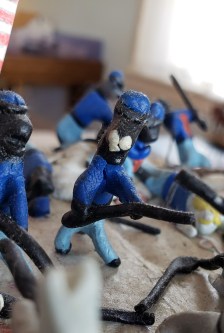 While some of the cats on the diorama represent identified historical officers and men, there is one cat whose importance is related to the history of Civil War Tails instead. At midnight on January 1, 2000, we installed Cat 3000. His number means that at the time he was made, we had 3,000 cats on our census. (Currently, we have 8,723.) To make him recognizable, we gave him a white feline (not human) “mustache” nose and a white tip on his tail.


 Now, Forrest rode to join Polk, but although he heard the firing, he could not catch up with the fight because Stanley’s cavalry pushed Wheeler’s men back so quickly. As the afternoon wore on, Wheeler decided Forrest was not coming and withdrew over Skull Camp Bridge. Just as the Confederates were about to burn the bridge, Maj. Rambaut of Forrest’s staff galloped up and said that Forrest was in sight of Shelbyville and would cross at the bridge.
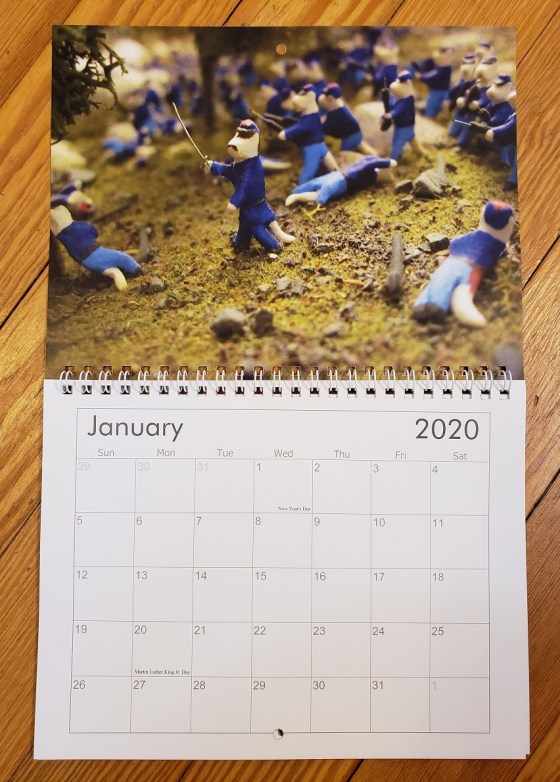
 Wheeler and his second-in-command Will T. Martin took 400 volunteers back across the bridge. They put up a short, hand-to-hand fight with sabers and carbines, and pistol butts as clubs, but the Union cavalry broke through Wheeler’s line and overran the two cannons he had brought with him. A caisson overturned on the bridge, blocking it. Union cavalry now stood between Wheeler’s men and the river.


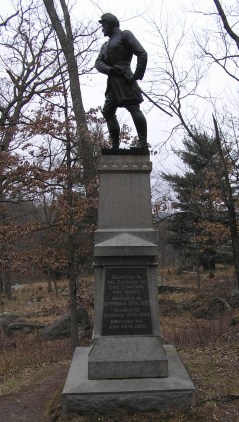
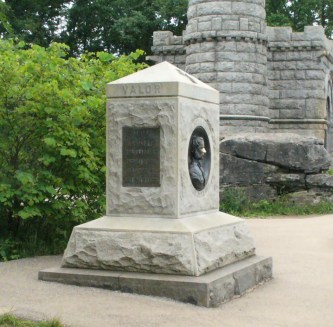

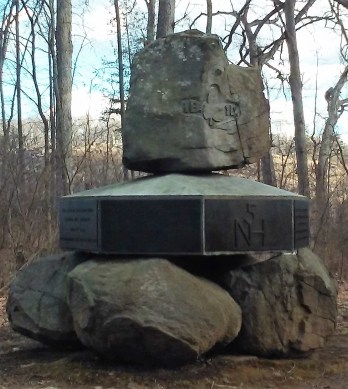 One particularly interesting monument is that of the 5th New Hampshire on Ayres Avenue along the edge of the Wheatfield. It is quite memorable, formed by three large boulders supporting a massive slab on which another boulder sits. But even more striking is the choice of the veterans as they designed and located their monument. Commanding their brigade during the battle was Col. Edward Cross. While he was a fine officer who took good care of his men, his manner—including a highly critical personality and a strict sense of discipline—did not endear him to others, even prompting the officers of one regiment to view him as a tyrant. During the fighting near the Wheatfield on July 2, he fell mortally wounded. His last words were, “I think the boys will miss me. Say goodbye to all.” Mixed as feelings may have been of him on July 2, 1863, in 1886 the veterans of the 5th New Hampshire chose to honor him with their regimental monument. Not only is Col. Cross’ name included on the slab’s plaque, but the monument stands where he fell.


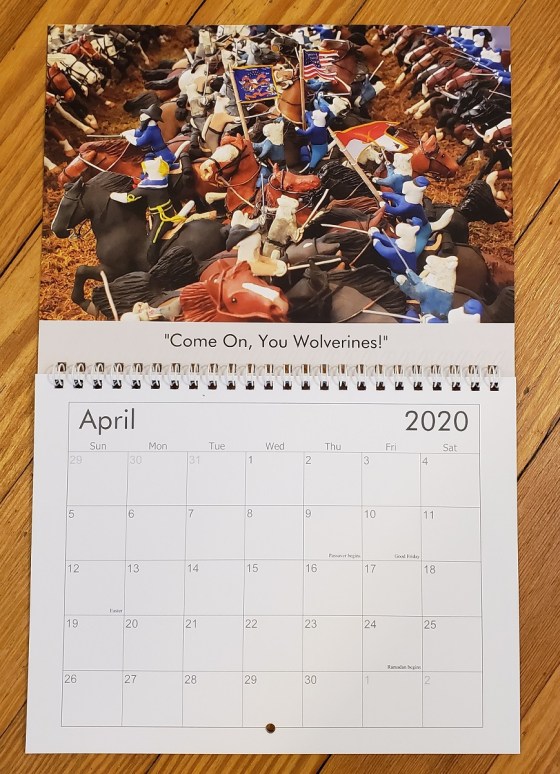
 The two Union batteries opened fire immediately. “Great gaps were torn in that mass of mounted men, but the rents were quickly closed. Then, they were ready.” As one, the massive column advanced. One Confederate recalled the anticipation: “It was the moment for which cavalry wait all their lives—the opportunity which seldom comes—that vanishes like shadows on glass. If the Federal cavalry were to be swept from their place on the right, the road to the rear of their center gained, now was the time.” The Confederates advanced in close columns of squadrons, first at a walk, moving “in superb style,” then at a trot. Finally, they leaped into a gallop, yelling “like demons.”
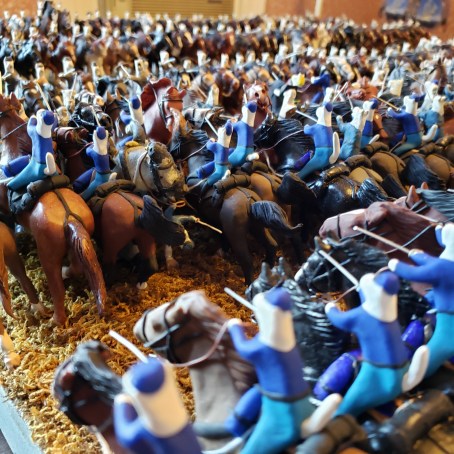 The Union line along Little’s Run fired into the Confederate right, and bits and pieces of regiments charged—here a squadron, there a couple dozen men. Even Col. McIntosh charged with his staff and headquarters escort!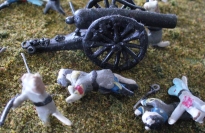
 Civil War Tails at the Homestead Diorama Museum - Gettysburg miniatures