This Memorial Day, we decided to “mews” on the monuments here at Gettysburg, specifically those that were designed, raised, and dedicated by the veterans in honor of their comrades who fell during the battle.
While not every monument was dedicated by a unit’s veterans, most of them were, and as such they bear various features with special meaning: the shape of the corps badge, the equipment the men carried, or symbols like laurel for victory. Often, there is even more to a monument. Many locations were chosen because they held special meaning, such the place where a beloved colonel fell or a specific boulder that sheltered the wounded. Sometimes a statue or bas relief carving shows an individual whose acts of courage remained engraved in the veterans’ memories. While we will look at a few of the monuments’ stories today, you can find more in Gettysburg: Stories of Men and Monuments as Told By Battlefield Guides by Frederick W. Hawthorne.
Just past the edge of town along Chambersburg Pike (Rt. 30 W), the monument for the 149th Pennsylvania sits near the McPherson Farm. During the fighting on July 1, their color guard took the flags fifty yards away from the regiment in order to draw away the heavy artillery fire. The granite soldier on the monument gazes toward the spot where the color guard risked (and, for several of them, sacrificed) their lives to protect their comrades.
The 38th Pennsylvania’s monument stands on Warren Avenue, at the base of Little Round Top. The solemn bas relief of a soldier standing “By a Comrade’s Grave” honors all of the men of the regiment who fell during the war. It is a simple but sobering reminder to all of us of the cost of protecting our great nation and the freedoms and rights that we enjoy.
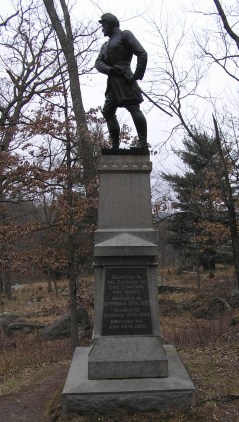
As Sykes Avenue begins to ascend Little Round Top, on the left stands the monument for the 83rd Pennsylvania. Forbidden by the Pennsylvania State Monuments Commission to include inscriptions regarding specific individuals, the 83rd topped their monument with “a Union officer.” However, the figure is clearly Col. Strong Vincent, their original commander and, at Gettysburg, their brigade commander. On the afternoon of July 2, Vincent was mortally wounded while trying to rally the 16th Michigan on the right of his brigade. More than twenty-five years later, the veterans of the 83rd could think of no one more deserving of a memorial than their beloved colonel whose blood stained the hill that day.
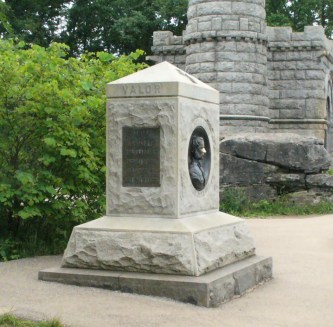
On the crest of Little Round Top, the veterans of the 140th New York raised their monument in honor of their fallen comrades. In particular, they unanimously chose to honor their commander, Col. Patrick O’Rorke, who was killed while leading the regiment into the fray on July 2. Not only does the monument bear a bas relief of his face, but it stands on the place where he fell.

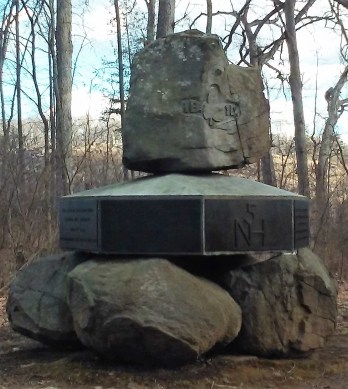 One particularly interesting monument is that of the 5th New Hampshire on Ayres Avenue along the edge of the Wheatfield. It is quite memorable, formed by three large boulders supporting a massive slab on which another boulder sits. But even more striking is the choice of the veterans as they designed and located their monument. Commanding their brigade during the battle was Col. Edward Cross. While he was a fine officer who took good care of his men, his manner—including a highly critical personality and a strict sense of discipline—did not endear him to others, even prompting the officers of one regiment to view him as a tyrant. During the fighting near the Wheatfield on July 2, he fell mortally wounded. His last words were, “I think the boys will miss me. Say goodbye to all.” Mixed as feelings may have been of him on July 2, 1863, in 1886 the veterans of the 5th New Hampshire chose to honor him with their regimental monument. Not only is Col. Cross’ name included on the slab’s plaque, but the monument stands where he fell.
It is easy for us, a century later, to gloss over the thousands of monuments on the battlefield. But each one has a story, spoken in written words and symbols and often telling of those who paid the ultimate price for their country. To the veterans, the monuments did not mark the places where nameless soldiers stood and fought; they marked where comrades were killed or where a friend’s bravery was noticed by all—even the enemy. This Memorial Day, take a moment to ponder what the monuments of Gettysburg represent—maybe even take a drive around the battlefield if you can. We might not recognize a lot of the symbolism, but this can be a chance to reflect on the men who gave their lives for our country, no matter the decade or century.


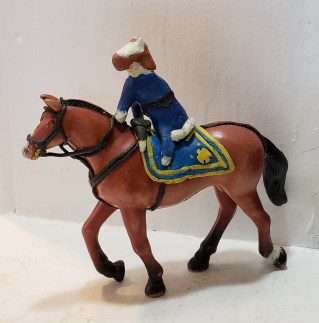
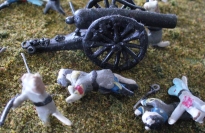
 The two Union batteries opened fire immediately. “Great gaps were torn in that mass of mounted men, but the rents were quickly closed. Then, they were ready.” As one, the massive column advanced. One Confederate recalled the anticipation: “It was the moment for which cavalry wait all their lives—the opportunity which seldom comes—that vanishes like shadows on glass. If the Federal cavalry were to be swept from their place on the right, the road to the rear of their center gained, now was the time.” The Confederates advanced in close columns of squadrons, first at a walk, moving “in superb style,” then at a trot. Finally, they leaped into a gallop, yelling “like demons.”
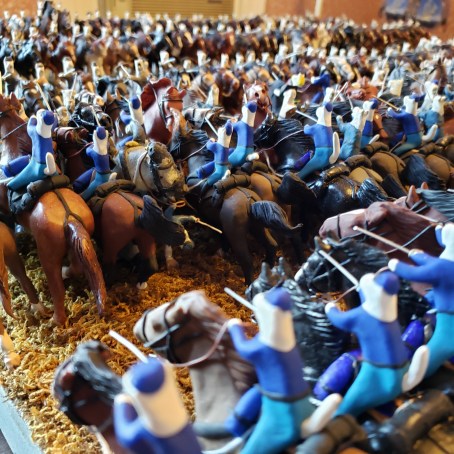 The Union line along Little’s Run fired into the Confederate right, and bits and pieces of regiments charged—here a squadron, there a couple dozen men. Even Col. McIntosh charged with his staff and headquarters escort!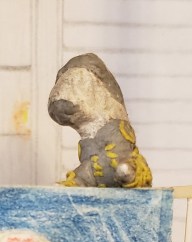


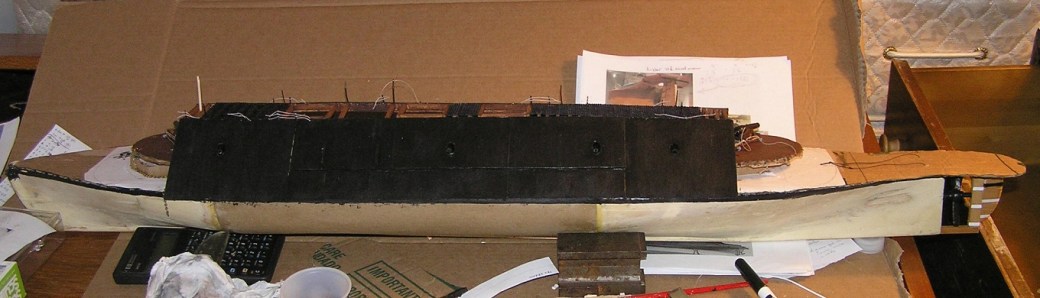
 CSS Virginia in dry-dock. Ordinarily, we would have built the ships entirely of cardboard, but since Rebecca had just “inherited” some light wood from a fellow model-builder, she decided to experiment with making the hulls out of wood. Virginia’s bow and stern are made of wood that was shaped to the bulkheads, while the middle section is cardboard. The casemate (the “barn-roof” part) is all cardboard. Note the missing section of the casemate—this is so that part is removable to allow you to see inside. Removing the entire side is impractical since the curve of the ends of the casemate require them to be securely anchored to the side panels.


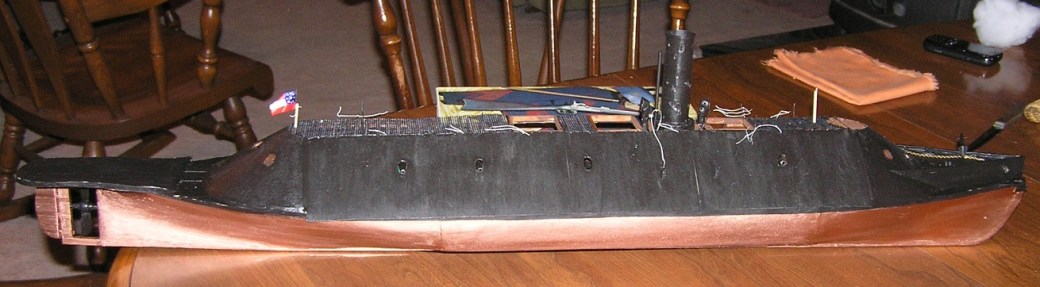

 Here, a few of the future crew are inspecting the work on the upside-down hull. (You can also see that Civil War cats drive Ford Mustangs!)


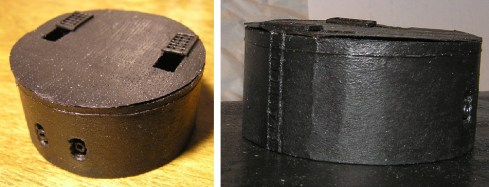


 Monitor finished! Note the gap between her black upper deck and her red hull. This is for the plexiglass “water,” since the ship is made in two parts. The hull glues to the underside of the plexiglass, and then the deck rests on top and remains removable. In designing the ship, we had to make sure to remember to factor in the thickness of the plexiglass and the gap, so Monitor did not end up an extra 1/8 inch thick.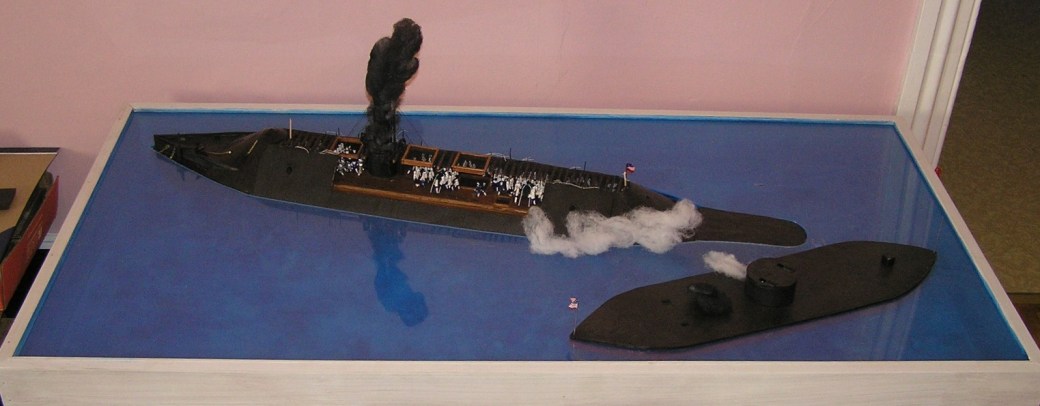

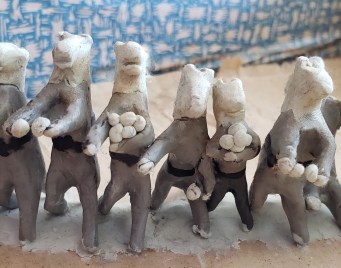 They decided to play a joke on their colonel and some of the other officers. They went to the colonel’s quarters armed with eight or ten snowballs each, and put a blanket over the chimney. Capt. Langston had been told about the joke ahead of time, so as soon as he realized the blanket was in place, he added more logs to the fire and went out to join the pranksters.


 Christmas trees were just becoming popular, thanks to Queen Victoria adopting the German tradition. They were not the large trees that we are used to; rather, a Christmas tree in the 1860’s would be smaller and stand on a table in the center of the room. Branches would be cut out until the remaining branches formed layers. Presents were placed on the branches, with larger presents on the table. Presents during the Civil War were often handmade, such as hand-carved toys, cotton or flannel animals, hickory nut and flannel dolls, candied fruits in paper cornucopias, gingerbread cakes, needle cases, or slippers. Of course, because of the war, presents were often scarce, particularly in the South. Mothers in the Confederacy would have to come up with excuses as to why Santa wouldn’t make it to their house for Christmas. Imagine if your mother told you that Santa couldn’t get through the Northern blockade or, even worse, had been shot!
 Just as it is today, children would hang stockings for Santa to fill. They might even know the story “’Twas the Night Before Christmas,” since it was written in the 1820’s. The family could also enjoy carols, such as “Deck the Halls,” “O Come, All Ye Faithful,” “Hark, the Herald Angels Sing,” “Silent Night,” “What Child is This,” “Away in the Manger,” “Joy to the World,” and “Oh Little Town of Bethlehem.” Some specifically American carols were “It Came Upon a Midnight Clear,” “We Three Kings,” and “Up on the Housetop.” However, for all of you who have not sent out Christmas cards yet, it’s okay—cards were popular in Europe but the fad would not take hold in the United States for another decade!
