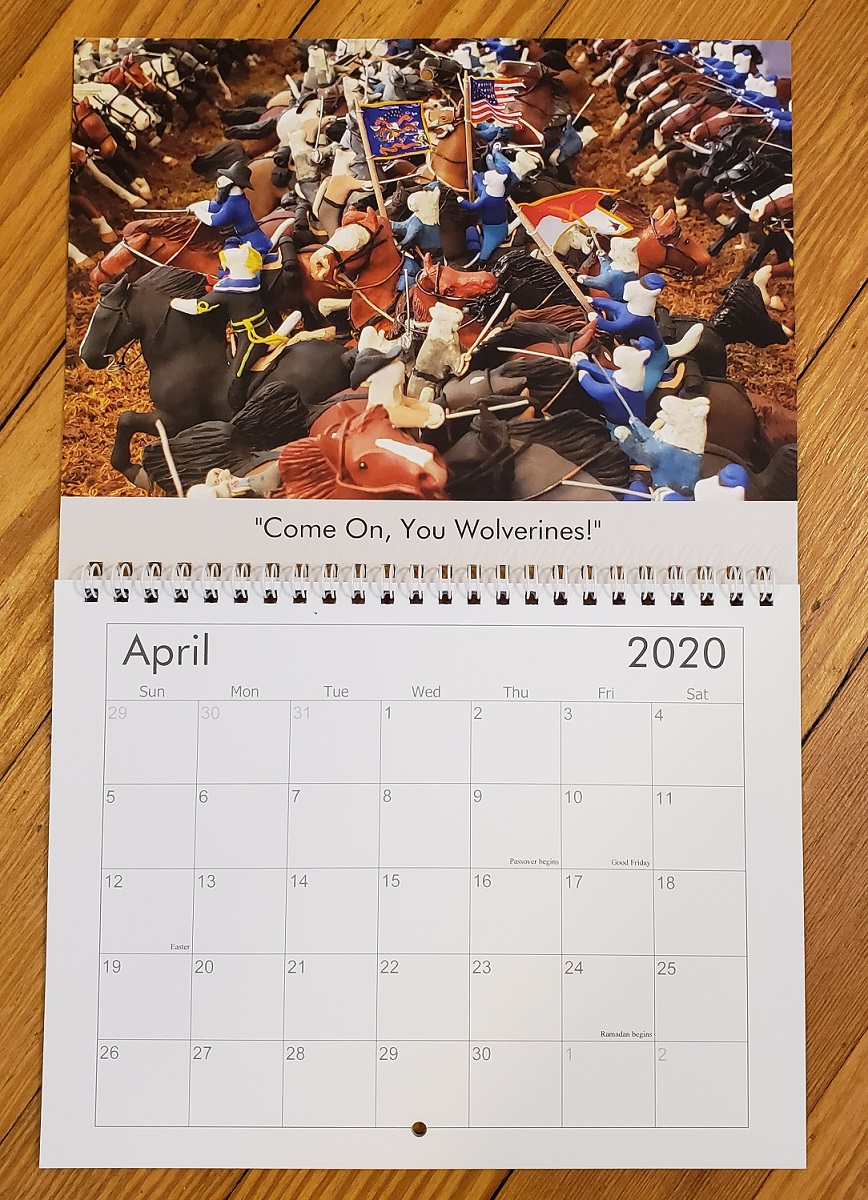
Today, on the anniversary of the Battle of Cedar Creek, we’re taking a look at Gen. George Custer’s thrilling involvement. We’ve Mewsed on his actions as a new brigade commander at Gettysburg, and today is a good opportunity to check in on him as a division commander a year and a half later.
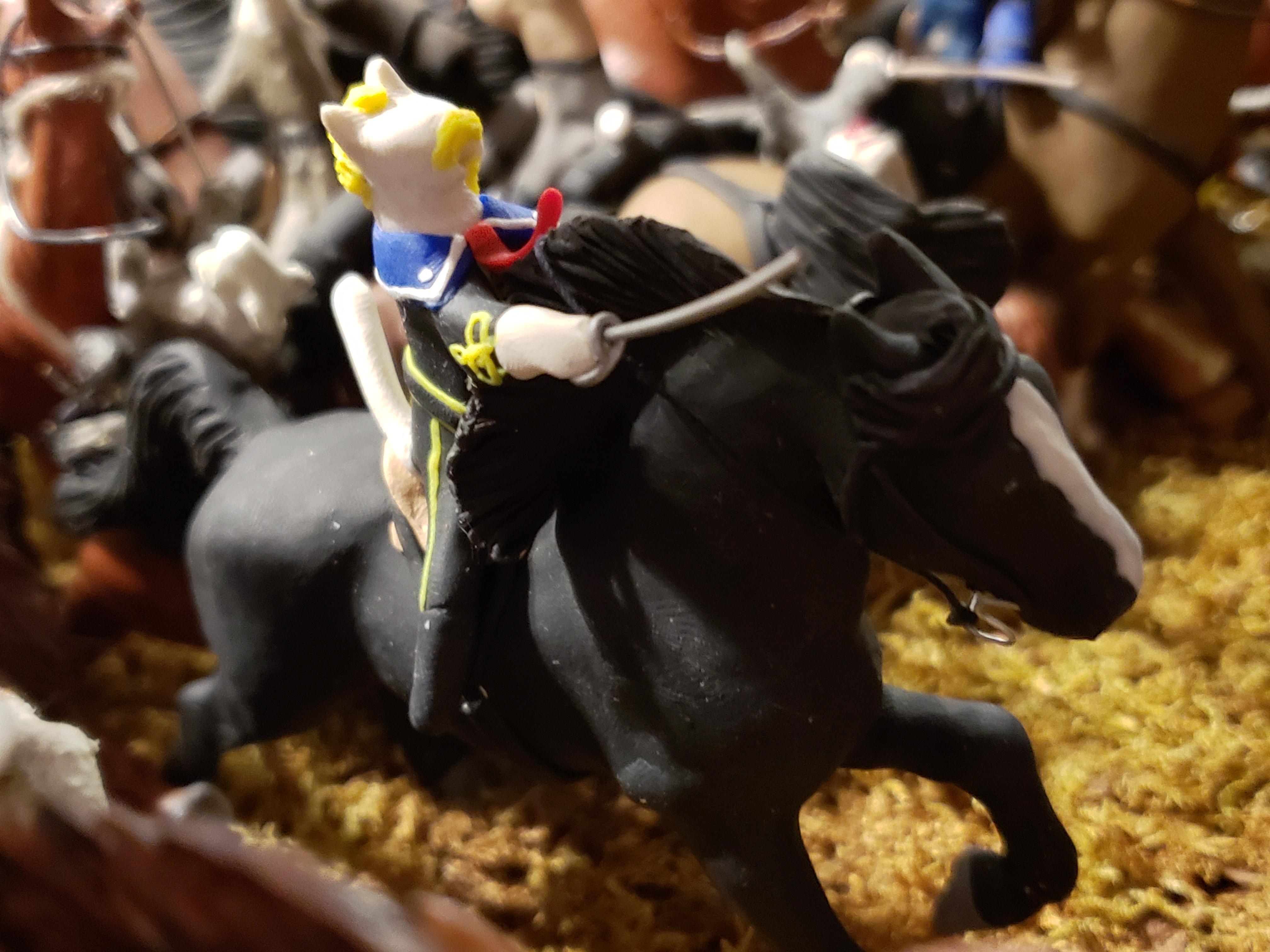 Custer had been in command of the 3rd Cavalry Division of Gen. Phil Sheridan’s Army of the Shenandoah for less than three weeks. Even so, his men had already adopted the red neckties that his old Wolverines had adopted after Gettysburg, and called themselves “The Red Tie Boys.”
On the morning of October 19, 1864, Sheridan’s army lay peacefully sleeping on the banks of Cedar Creek, south of Middletown, VA, in the Shenandoah Valley. Sheridan, returning from a meeting in Washington, was in Winchester, about twelve miles away. Around 4:00 or 4:30 a.m., firing erupted a couple miles to the west of the army as two brigades of Confederate cavalry under Gen. Tom Rosser sought to cross Cedar Creek and drive in the pickets of the 7th Michigan, some of Custer’s old Wolverines but now part of Gen. Wesley Merritt’s 1st Division. Hearing the firing, both Merritt and Custer roused their cavalrymen, but the Confederates halted and did not press the attack, content to hold the ford.
At 5:00 a.m., the Union infantry was rudely awakened as thousands of Confederates opened fire from the heavy fog that hung over the ground in the predawn darkness. Confederate major D. A. Grimsley noted that the attack “was not ushered in by a few preliminary shots, as was generally the case, but it was a prolonged roll, without cessation.” It was an ominous beginning to a disastrous morning. For the next five hours, the Union army fought, even as it ran for its life. Confederate captain Augustus Dickert recalled that “the country behind [the Union camp] was one living sea of men and horses—all fleeing for life and safety.” Union divisions fought to hold their positions but were overwhelmed, either by Confederates appearing out of the fog, or by the waves of retreating Union soldiers. It was a mix of unchecked rout and dogged delaying actions.
By 8:00 a.m., the only organized Union infantry on the field was Gen. George Getty’s division of the VI Corps. Together with their artillery and some cavalry on their left, they faced three—and soon a fourth—Confederate divisions riding the tide of wild success.
Meanwhile, the cavalry under Custer and Merritt sat motionless in their camps, mounted and ready to go but without orders. Finally, around 9:00 a.m., orders came for both divisions to head to the Union left to secure the Valley Pike. Leaving one brigade behind to keep Rosser at bay, Custer took his remaining brigade—under Col. Alexander Pennington, who had been his artillery commander at Gettysburg’s East Cavalry Field—away to the aid of Getty’s beleaguered division.
By 10:00 or so, Getty’s division formed the keystone of a semblance of a Union line. Remnants of the army’s three corps had formed on either end of his line, and the cavalry hovered on his left. Col. James Kidd, commanding the Michigan Brigade, recalled seeing his former commander Custer “chafing like a caged lion” at their inaction. The Army of the Shenandoah had been chewed to pieces, but the defeat had made them mad and determined. Now they stood awaiting the next attack.
But the Confederates did not come. Whether because of exhaustion, disorganization, or plundering the Union camps, the Confederate onslaught stalled. During that pause, the tide of battle took a sudden turn. A veteran of Getty’s division recalled, “There we stood, driven four miles already, quietly waiting for what might be further and immediate disaster, while far in the rear we heard the stragglers and hospital bummers, and the gunless artillerymen actually cheering as though a victory had been won. We could hardly believe our ears.”
Why the cheering? Sheridan had returned! His presence electrified the battered army. One of Getty’s staff officers recalled, “Hope and confidence returned at a bound. …Now we all burned to attack the enemy, to drive him back, to retrieve our honor and sleep in our old camps that night. And every man knew that Sheridan would do it.” Sheridan immediately began preparing a counterattack.
Sheridan sent Custer back to the right of the Union line. Custer found Rosser stirring, and charged the Confederate cavalry’s flank, catching the gray troopers by surprise. The line broke, but a sudden counterattack by a group of fifty halted the blue column. Rosser withdrew across Cedar Creek and, rather than pursue him and widen the gap between his cavalry and the Union line, Custer headed back to form his division alongside the XIX Corps.
It was now noon, and a lull descended for several hours. Shortly before 4:00 p.m., just as the Union army was about to begin its counterattack, Custer looked to his right and saw Rosser’s skirmishers advancing. After a day of mostly inaction, Rosser had picked a good time to be annoying. Taking some of Pennington’s brigade and a battery, Custer drove the skirmishers back. Seeing Rosser’s division beyond, he ordered Pennington to attack with his full brigade, then leave one regiment facing Rosser and rejoin Custer in the attack with the infantry. The resulting charge drove the Confederates to the creek.
Meanwhile the Union infantry began their advance, doggedly slugging away at the Confederate positions. The rightmost brigade managed to take some breastworks, only to have a Confederate brigade appear on their flank. Wheeling, the Union troops stopped them. Sheridan appeared then, telling the men, “You are doing splendidly, but don’t be in too much haste. Now lie down right where you are, and wait until you see General Custer come down over those hills, and then, by G–, I want you to push the rebels!”
Moments later, as the infantry resumed their advance, Private Herbert Hill recalled, “We caught sight for a moment of the dashing Custer, that prince of horsemen, on an opposite eminence toward the setting sun, as he started with his famous division on that fierce charge.” Custer’s cavalry came down on the Confederate skirmish line, only to find the main line already running. Between the Union infantry in front and the threat of cavalry flanking them, the weary Confederates had had enough. The line crumbled, regiments and brigades one after the other, like dominoes falling from left to right.
The Union infantry charged, driving the Confederates before them in confusion and chaos. Pvt. Hill of the 8th Vermont found his regiment “overlooking…a great, rushing, turbulent, retreating army, without line or apparent organization, hurrying and crowding on in mad retreat.” The sound of battle died away, now that the Confederate artillery was bent on escape and the infantry was too busy running to use their rifles—if they still carried them. 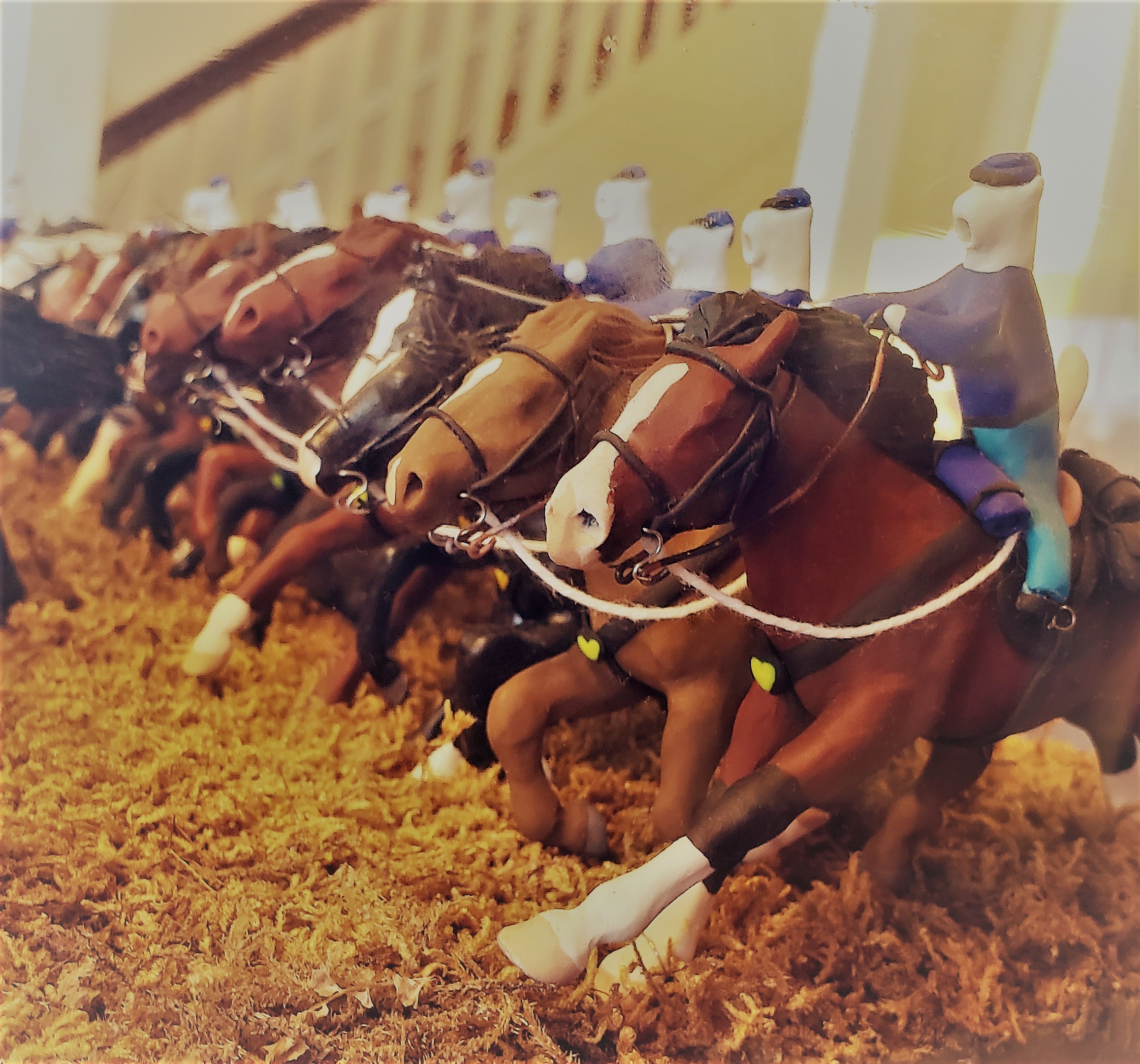 Gen. John Gordon, struggling to stem the tide, recalled, “As the tumult of battle died away, there came from the north side of the plain a dull, heavy, swelling sound like the roaring of a distant cyclone, the omen of additional disaster.” The Union cavalry, coming down on both flanks! At that point, “all effort at orderly retreat was abandoned.” In the 10th Vermont, the chaplain recalled, “We chased them to Cedar Creek…The infantry halted on the banks of the creek; then came the smoking steeds of Custar [sic].”
Custer’s goal was to get beyond the Confederates and take the bridge of the Valley Pike over Cedar Creek, thereby bagging the entire Army of the Valley. But the swarms of Confederates were retreating so quickly that he saw he would not make it. So, ordering the rest of his regiments to come as soon as they could, he took the 1st Vermont and the 5th New York, jumped into a ravine, and headed upstream to a ford about a quarter mile from the bridge. Crossing unseen, the two regiments formed and headed in the direction of the Pike.
Suddenly, Confederates opened fire on a squadron of the 1st Vermont from behind rough breastworks of stones and fence rails. The Union troopers could see about 5,000 Confederates trying to reform their line and knew they didn’t have much time. Col. J. W. Bennett of the 1st Vermont told Custer, “If I am to charge them it must be at once, for if they reform they will empty every saddle before I can reach them.”
“That is so,” Custer replied. “When you go, throw in every man you have, and I will take care of you.”
The Red Tie Boys charged, the 5th New York on the left and the 1st Vermont on the right. Leaping the breastworks, they slashed through the infantry and galloped on to the Pike. With Custer reaching the Pike (and Merritt’s cavalry coming down from the Union left), the pursuit of the army became, in Custer’s words, “an exciting chase after a panic-stricken, uncontrollable mob.” On the macadamized limestone pike, the pounding hooves of the galloping regiments sounded like ten thousand troopers, lending even more fear to the chaos. Only darkness ended the pursuit—although one Union artilleryman recalled hearing the shots of Custer’s cavalry until midnight.
It was around 9:00 p.m. when a jubilant Custer returned to Sheridan’s headquarters. Sheridan, known for his Irish temper and hard-headed determination, was equally ecstatic and pulled him from his horse, exclaiming, “You have done it for me this time, Custer!”
Custer grabbed his army commander around the waist, lifted him off the ground, and whirled him around and around. “By G–, Phil!” he shouted, “We’ve cleaned them out of their guns and got ours back!” His comment wasn’t far from the truth. The 1st Vermont alone had captured 161 prisoners (including a general, colonel, and lieutenant colonel), 3 flags, 23 guns, 14 caissons, 17 wagons, 6 ambulances, 83 artillery harnesses, 75 wagon harnesses, 98 horses, and 69 mules. The 5th New York captured another 22 guns.
After the spectacular victory, Sheridan recommended Getty, Merritt, and Custer for promotion.


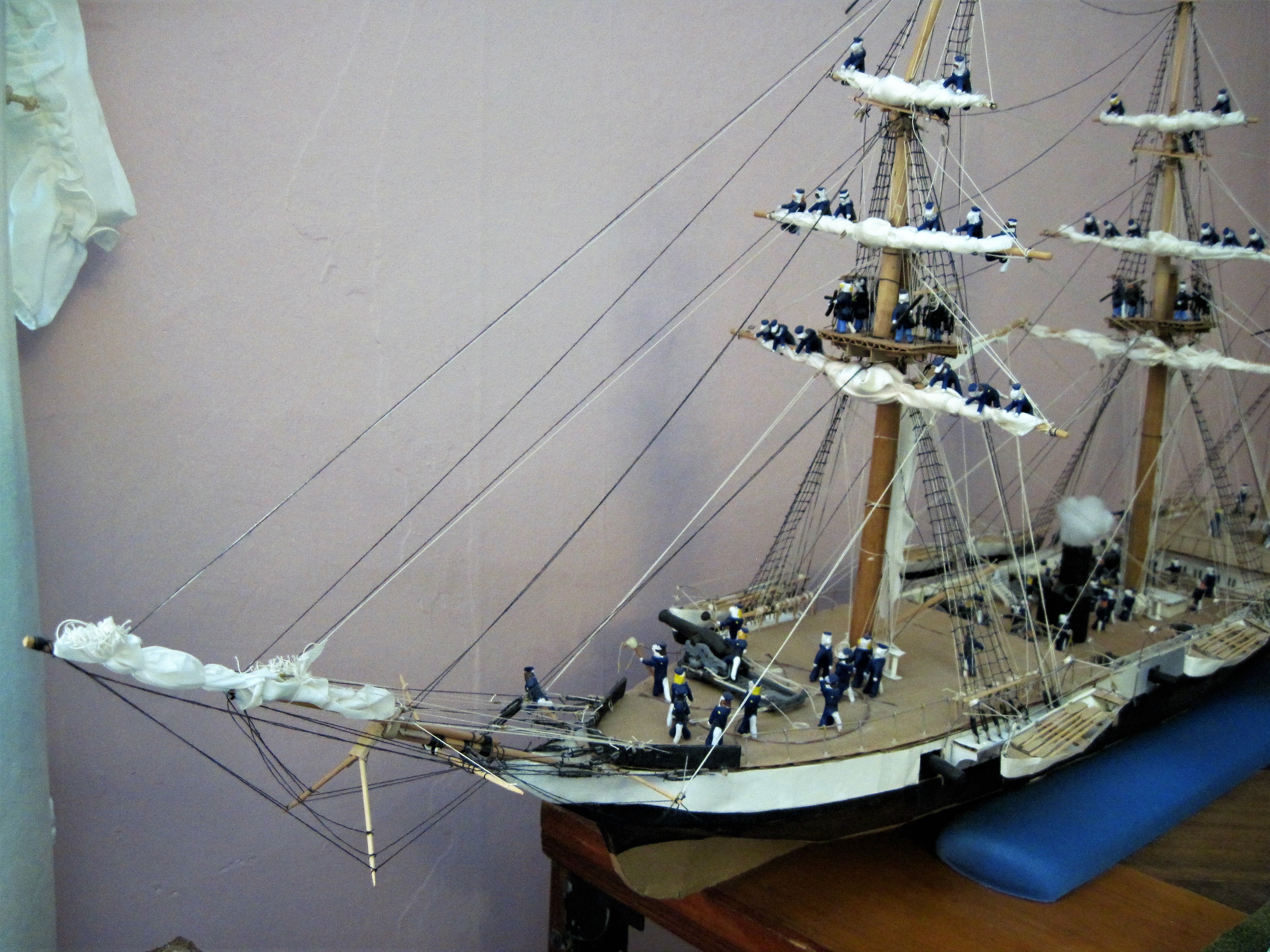


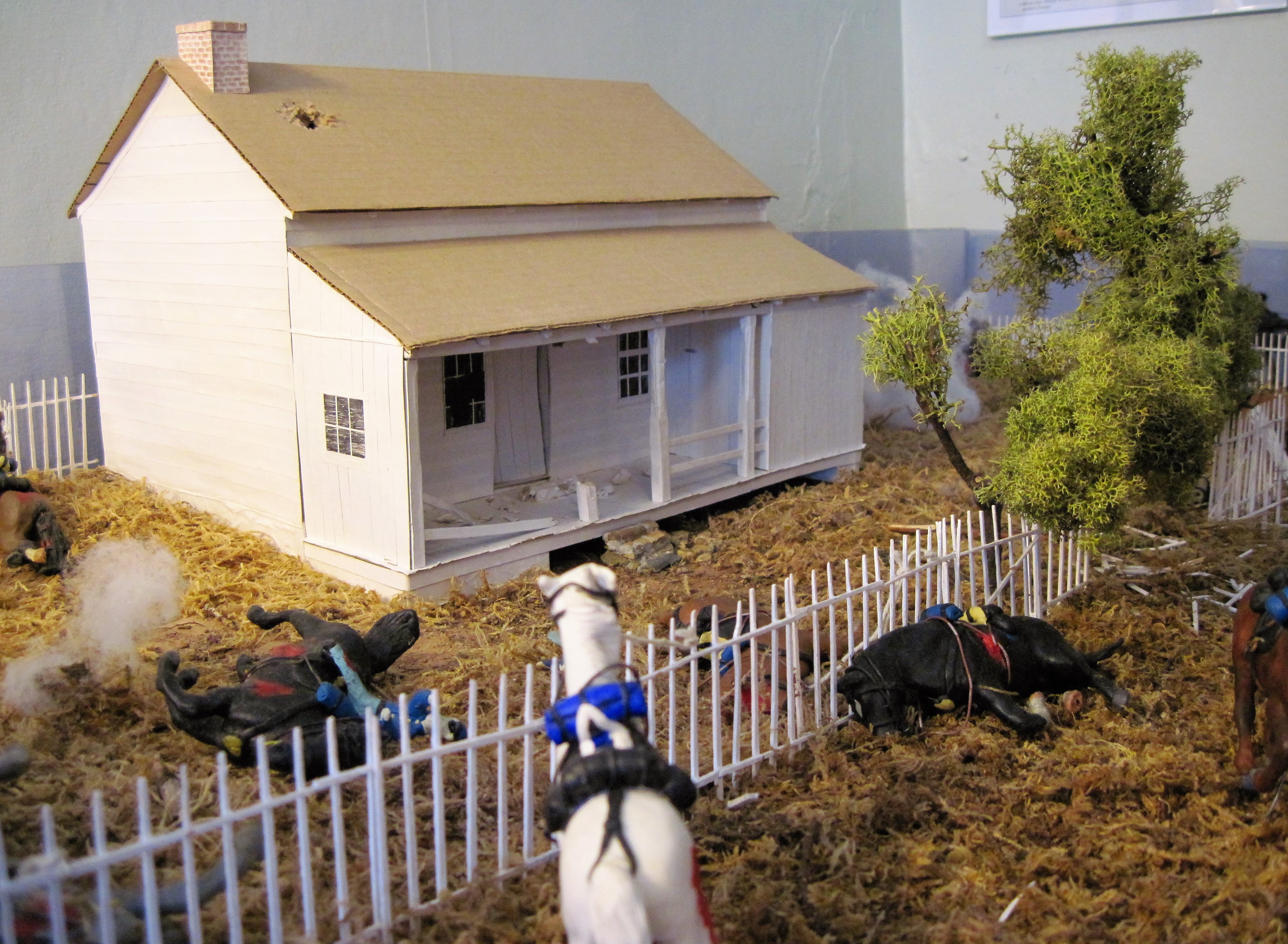






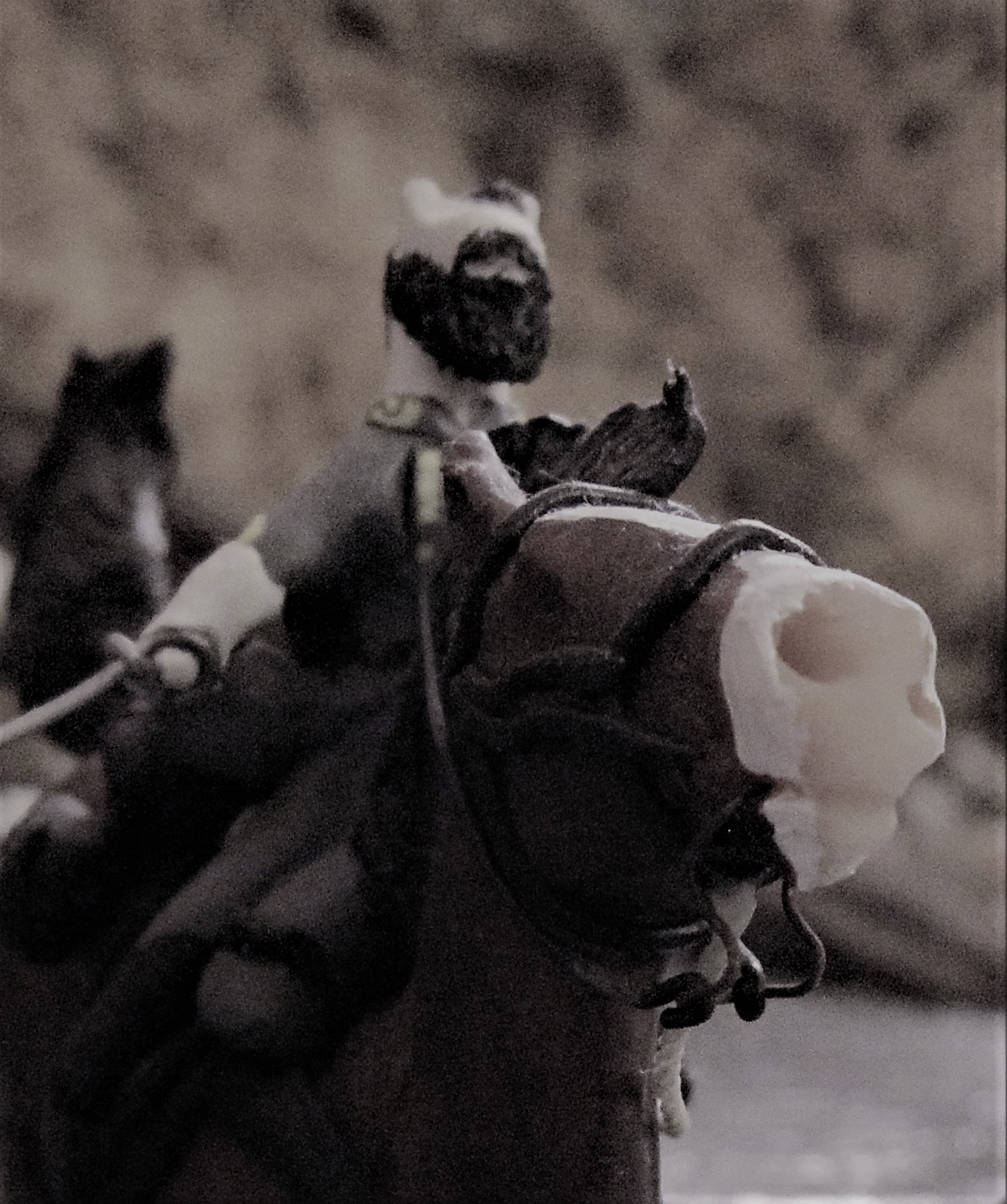
 Horses might seem to just plod through life, wherever we lead them, but in fact they are highly sensitive and observant animals. Henry Kyd Douglas, an aide to “Stonewall” Jackson, recalled his horse’s distress while passing through the Antietam battlefield during the night, after the fighting had ended.
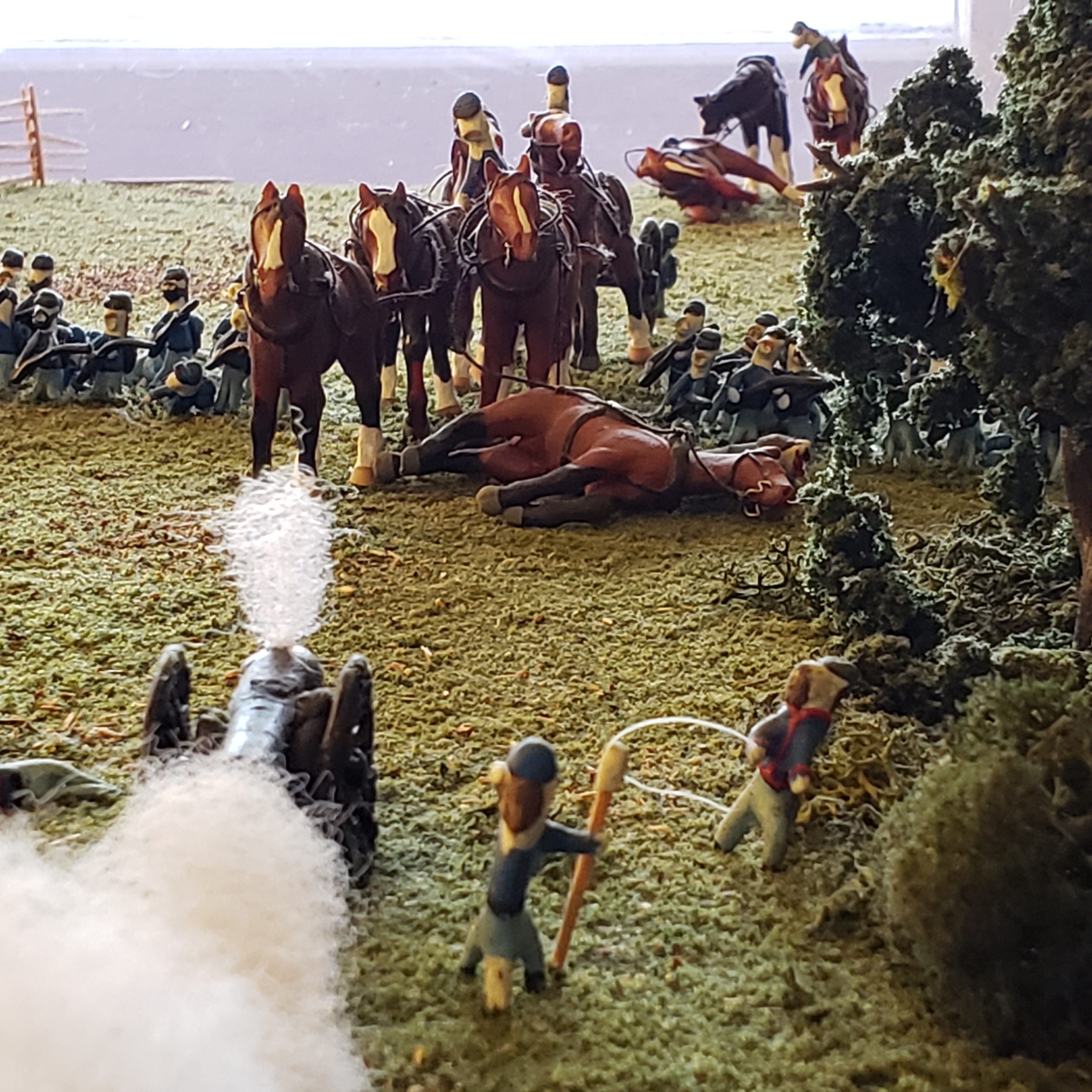
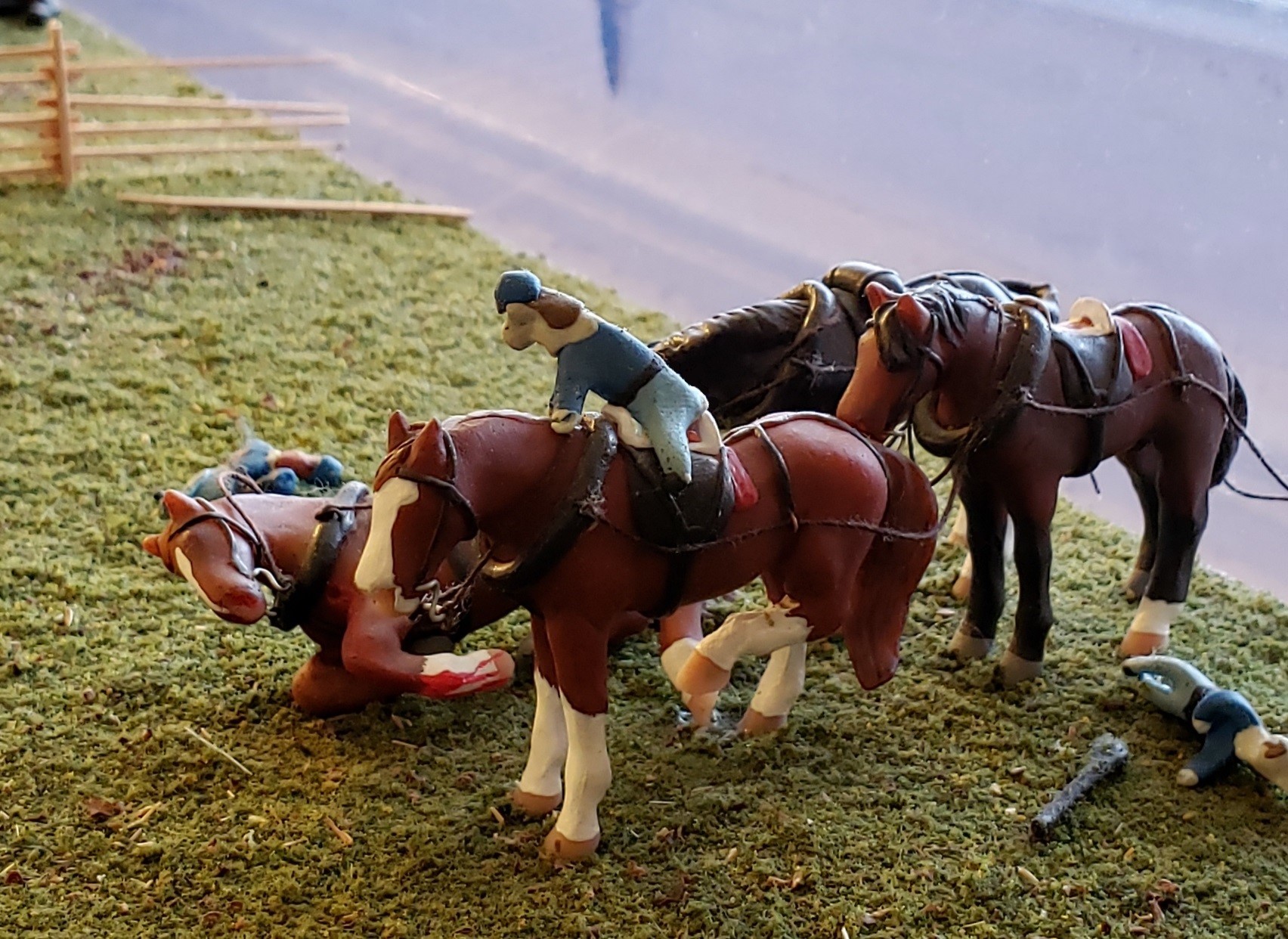 One thing which forcibly occurred to me was the perfect quiet with which the horses stood in their places. Even when a shell, striking in the midst of a team, would knock over one or two of them or hurl one struggling in his death agonies to the ground, the rest would make no effort to struggle or escape but would stand stoicly [sic] by as if saying to themselves, “It is fate, it is useless to try to avoid it.”
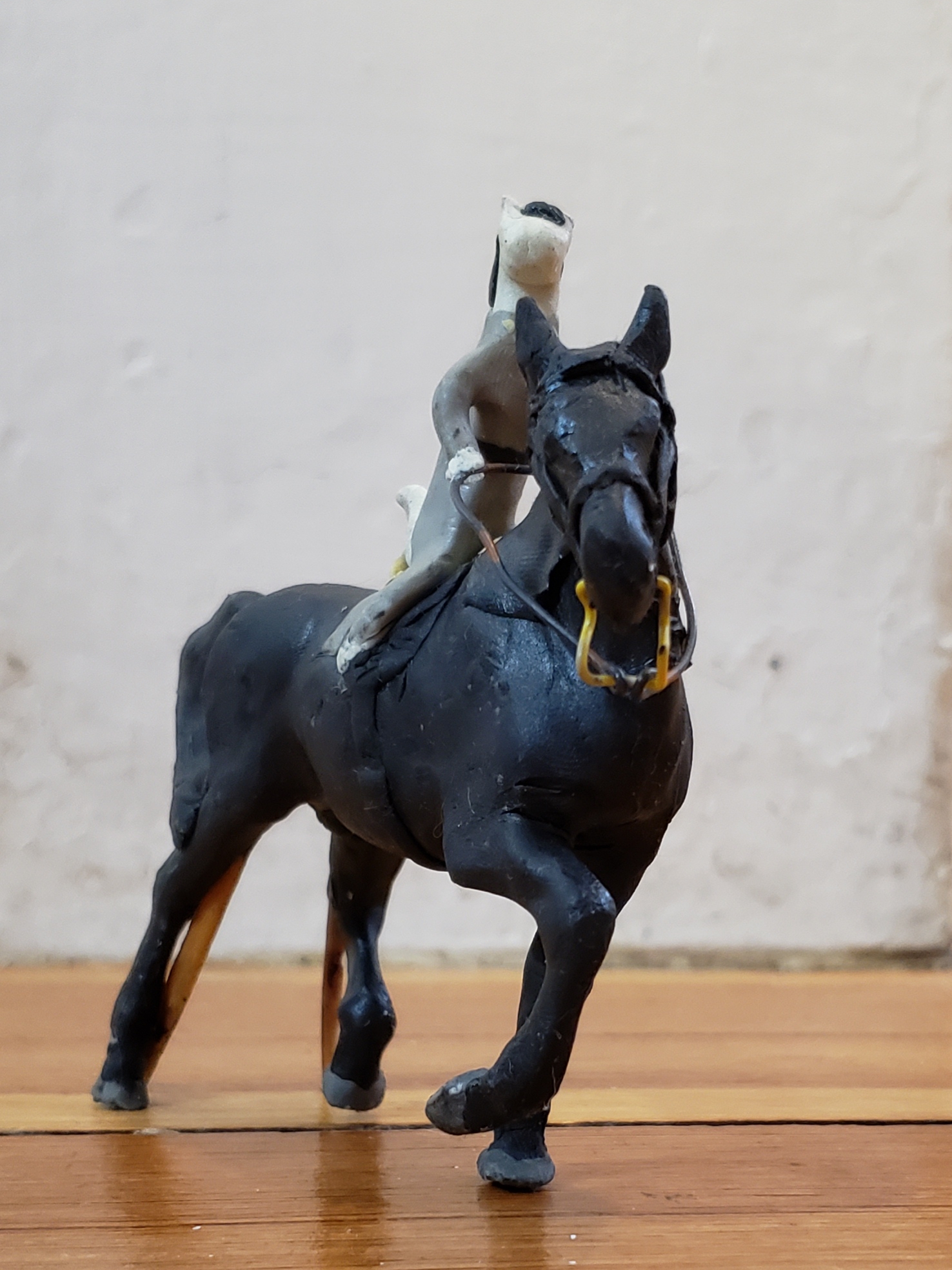
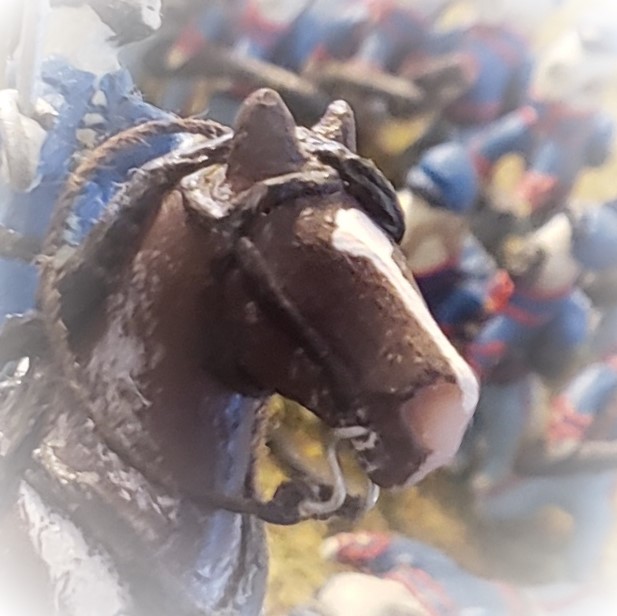 Dick remained steady throughout the following fighting. Despite a serious wound to his right thigh and three bullets in his body, Dick carried Haskell back and forth at the gallop as the lieutenant urged men forward and summoned reinforcements to repulse Pickett’s men. Not until their duty was over did Dick lie down and finally succumb to his mortal wounds. “Good conduct in men under such circumstances,” Haskell wrote, “…might result from a sense of duty—his was the result of his bravery.” Haskell finished by expressing his wish that, if there be a Heaven for horses, “in those shadowy clover fields [Dick] may nibble blossoms forever.”
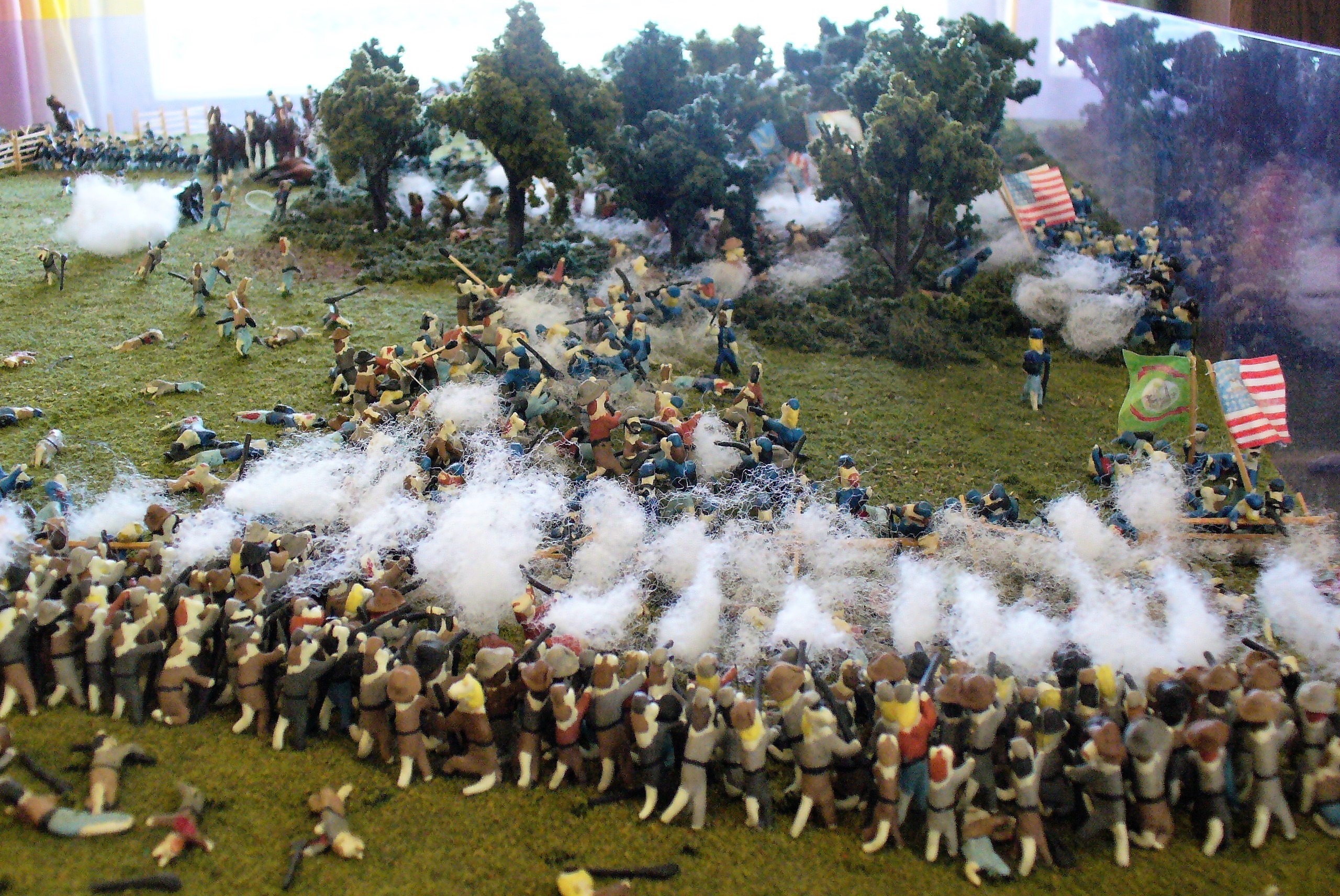
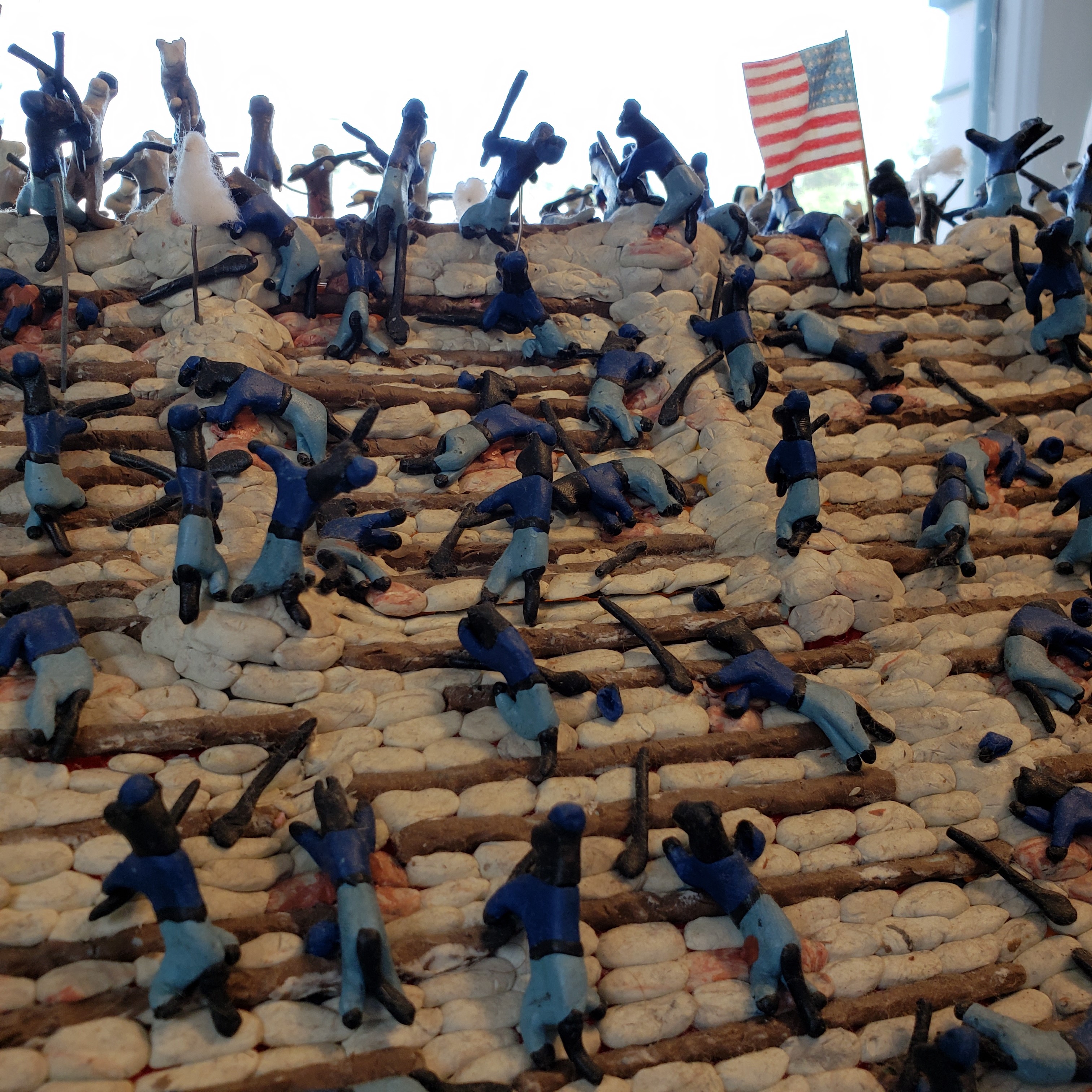 Today we take a look at our first to-scale diorama, “I Want You to Prove Yourselves,” which shows the 54th Massachusetts Infantry charging Battery Wagner in Charleston, SC, on July 18, 1863.

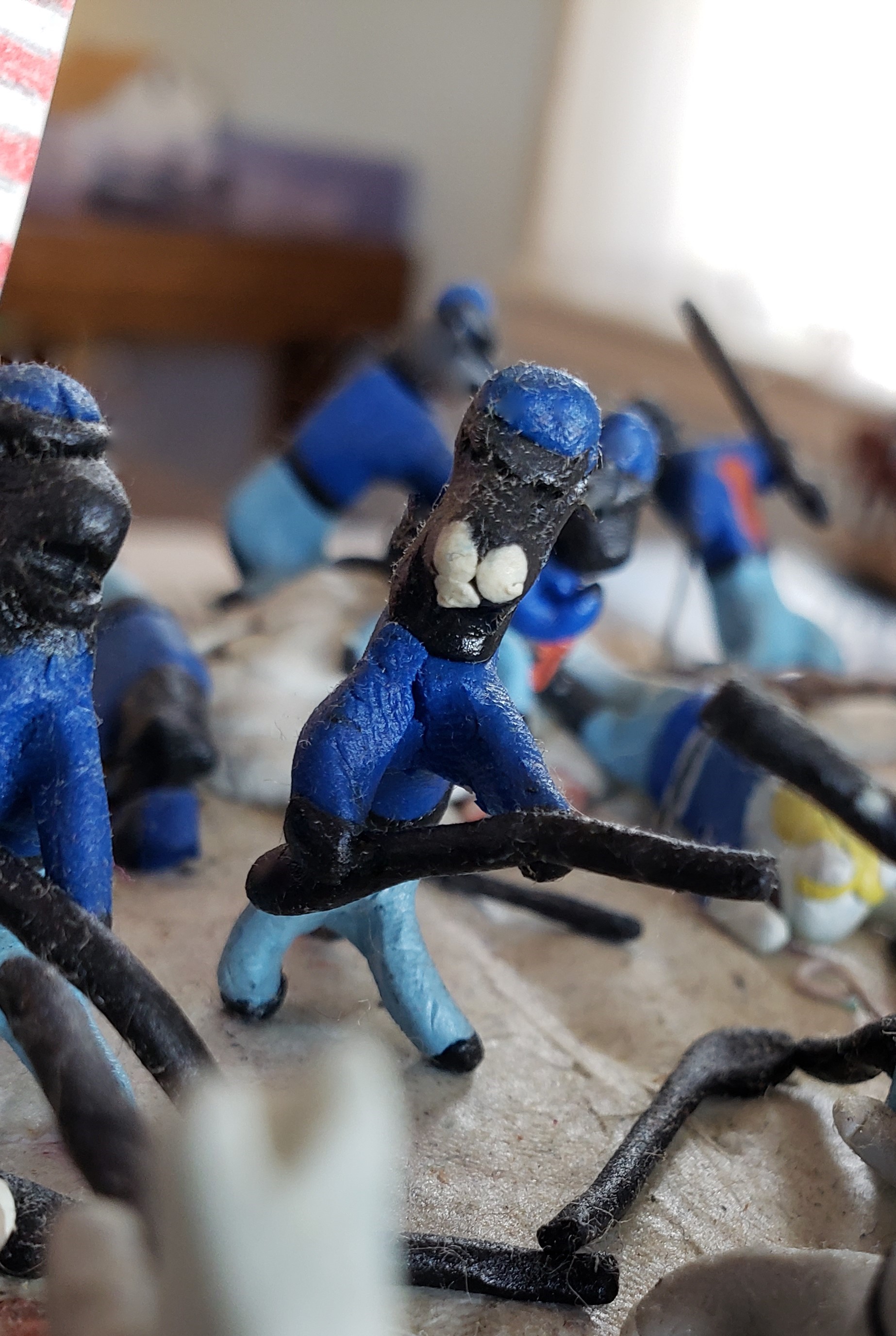 While some of the cats on the diorama represent identified historical officers and men, there is one cat whose importance is related to the history of Civil War Tails instead. At midnight on January 1, 2000, we installed Cat 3000. His number means that at the time he was made, we had 3,000 cats on our census. (Currently, we have 8,723.) To make him recognizable, we gave him a white feline (not human) “mustache” nose and a white tip on his tail.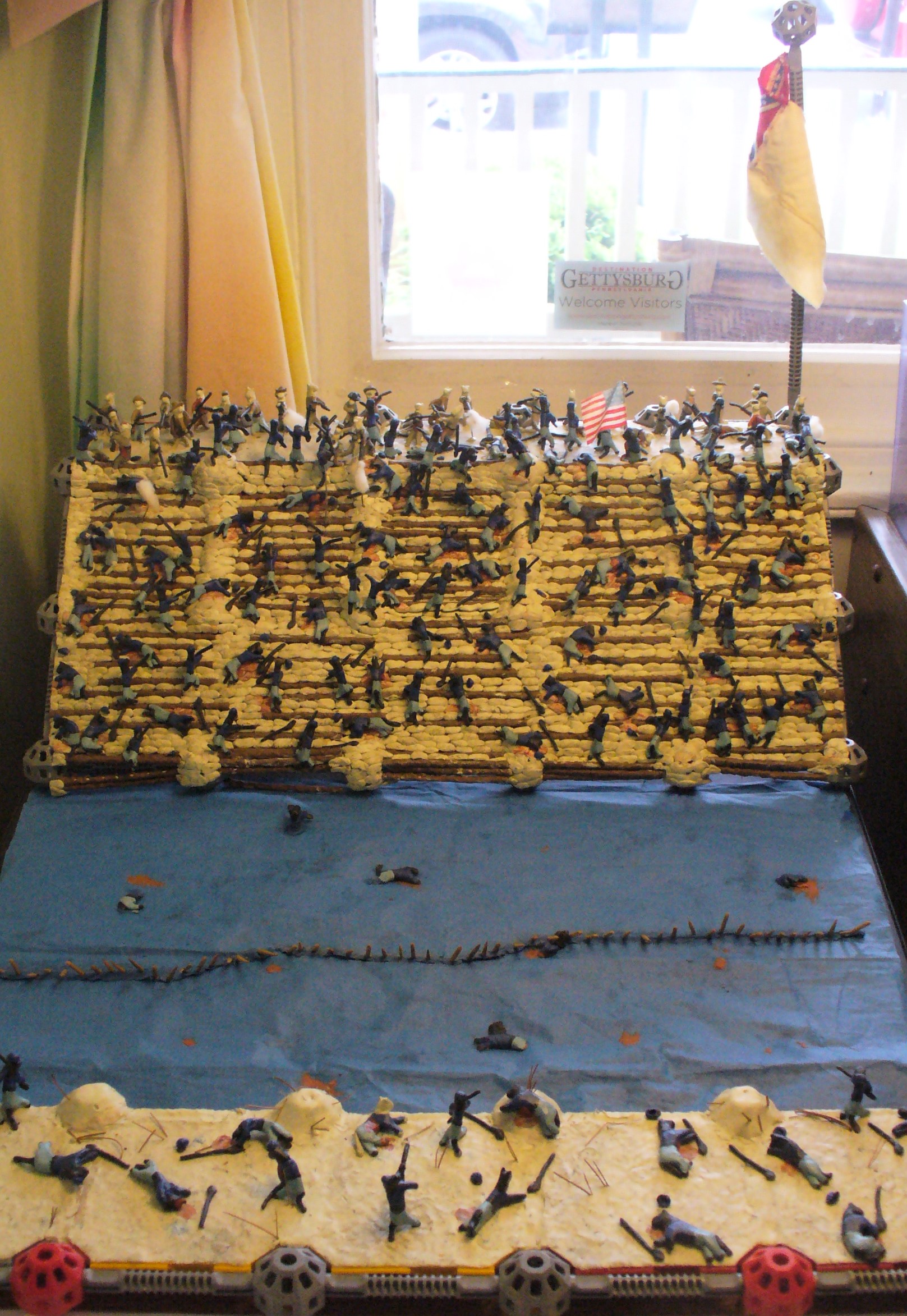


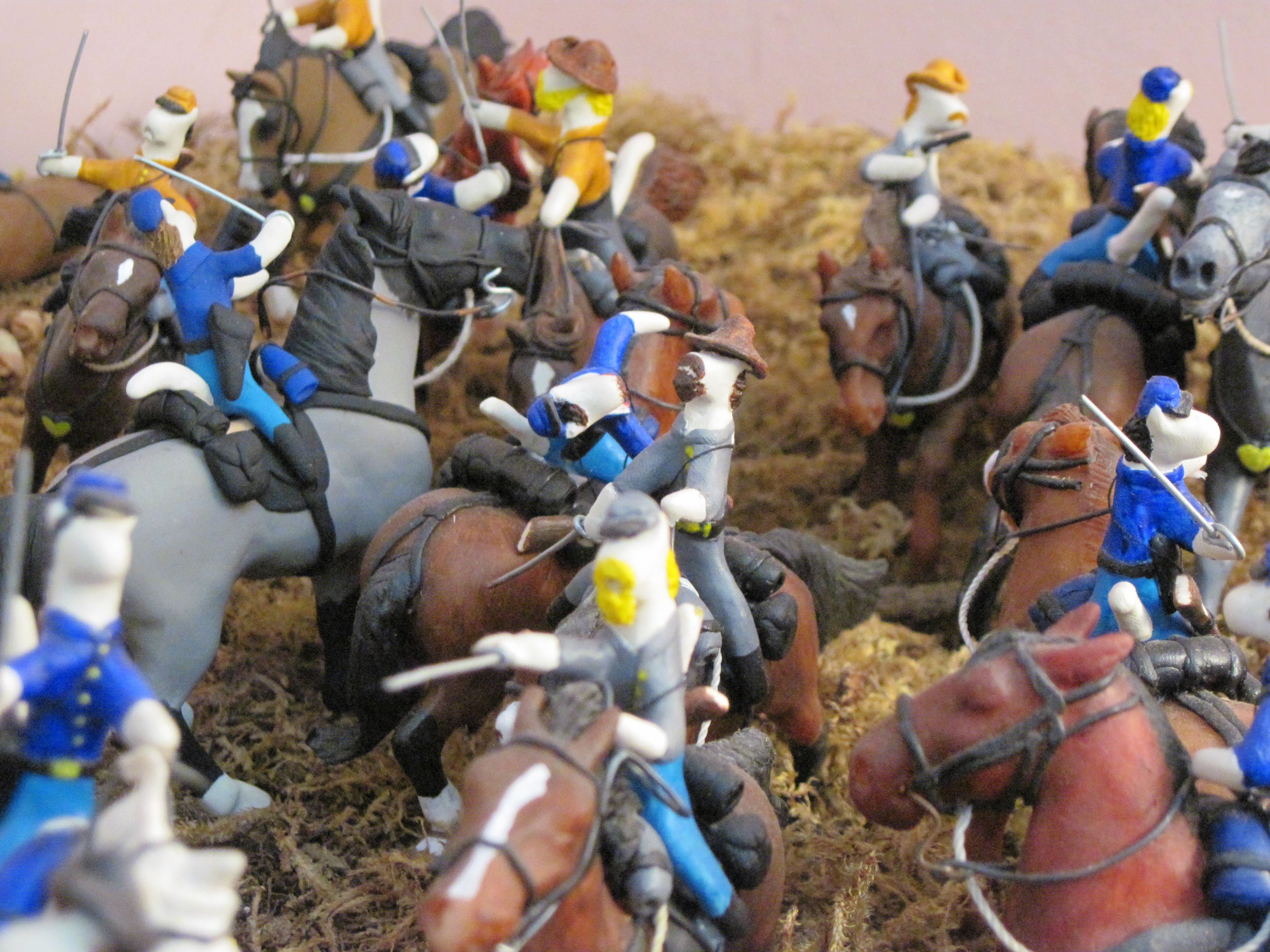 Now, Forrest rode to join Polk, but although he heard the firing, he could not catch up with the fight because Stanley’s cavalry pushed Wheeler’s men back so quickly. As the afternoon wore on, Wheeler decided Forrest was not coming and withdrew over Skull Camp Bridge. Just as the Confederates were about to burn the bridge, Maj. Rambaut of Forrest’s staff galloped up and said that Forrest was in sight of Shelbyville and would cross at the bridge.
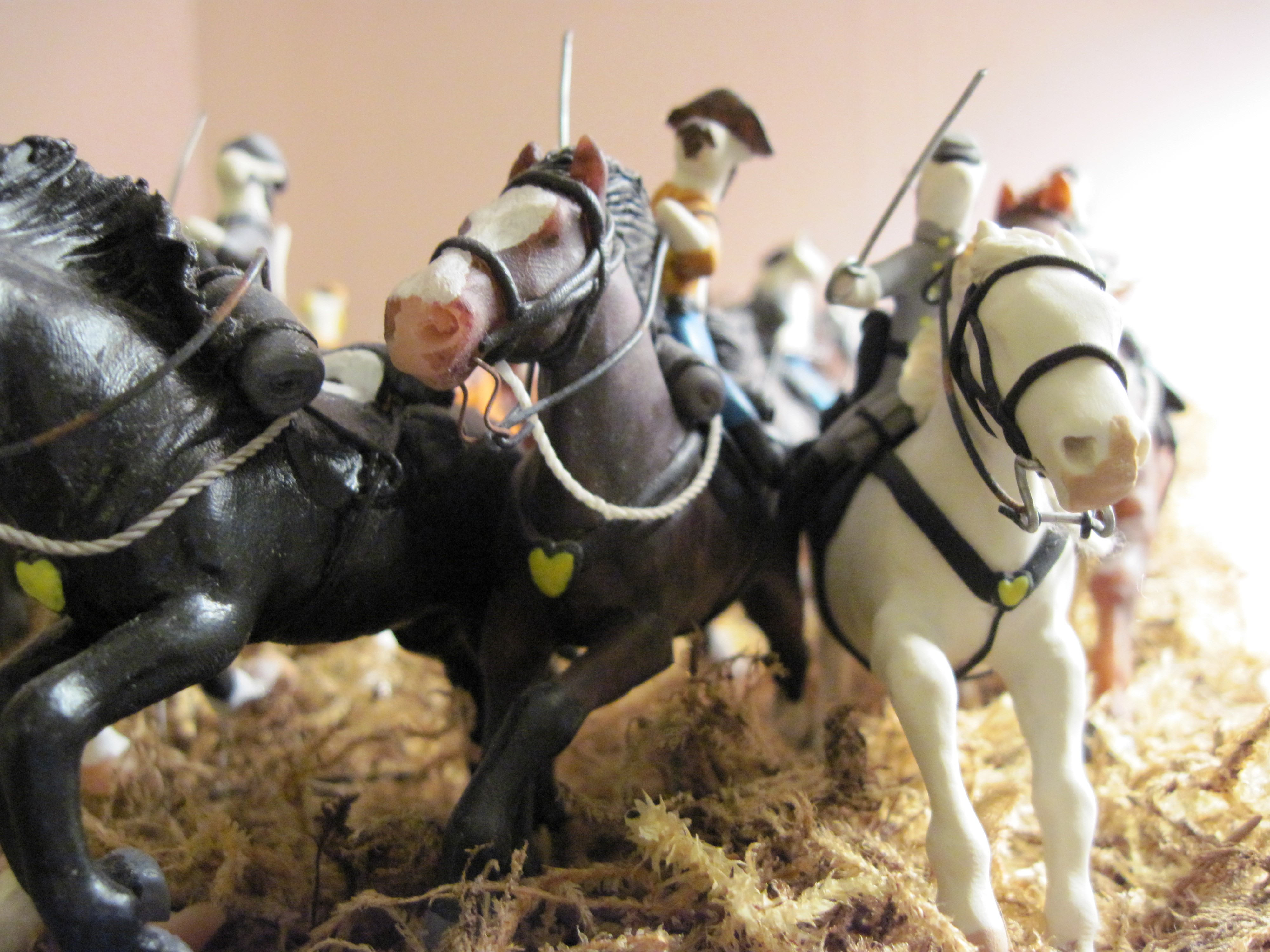 Wheeler and his second-in-command Will T. Martin took 400 volunteers back across the bridge. They put up a short, hand-to-hand fight with sabers and carbines, and pistol butts as clubs, but the Union cavalry broke through Wheeler’s line and overran the two cannons he had brought with him. A caisson overturned on the bridge, blocking it. Union cavalry now stood between Wheeler’s men and the river.


