Standing by Different Guns – Cat 8000

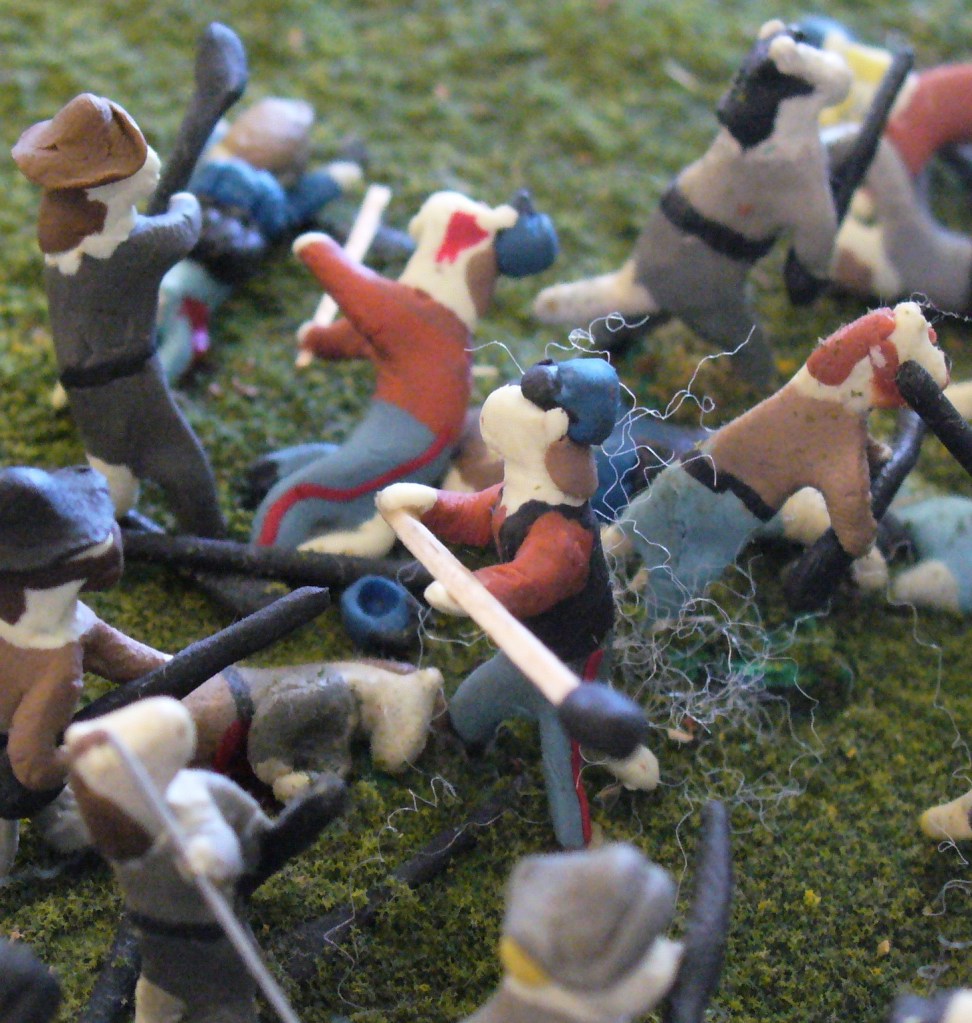
Last night, Rebecca placed Cat 8000 on our diorama of the Angle. Ever since Cat #2000 on our census, we have kept track of each thousand with a special cat-soldier.

Cat 8000 is a gunner from Lieutenant Alonzo Cushing’s Battery A, 4th U.S. Artillery, but he is not standing anywhere near a cannon. Instead, he wields his rammer at a Confederate clubbing one of his fellow gunners at the wall in front of the Copse of Trees.

As the Confederates poured over the wall and Lt. Cushing’s demolished guns were abandoned, some of his gunners joined the 69th Pennsylvania instead of retreating. They wielded handspikes and sponge-staffs in desperate hand-to-hand fighting, likely joining their infantrymen comrades in, as members of the 69th put it, “looking and praying for help” and thinking they “were all gone.”


P1240525 crop

You can recognize Cat 8000 by the black vest that he is wearing over his red shirt.

Hidden Victory

On June 9, 1863, the largest cavalry battle of the Civil War was fought at Brandy Station, Virginia. Union troopers caught Gen. Jeb Stuart’s Confederate cavalry by surprise at dawn, beginning a day-long battle. Whereas cavalry usually fought dismounted, the battle at Brandy Station moved so quickly that the men remained mounted, attacking and counter-attacking in grand, mounted cavalry charges.

Although the Confederates held their ground and therefore won, the battle became more important for another reason. After two years of fighting, the Union cavalry finally proved they were the equals of the Southern horsemen. In less than a month, these cavalrymen would need their new-found confidence as they moved north to Gettysburg.

Futures Lost

This morning, I headed off to work with the usual “life’s problems” rattling through my mind. But as I pulled my car out of our garage, I caught sight of little American flags stuck into the ground on the other side of the iron fence that runs along the driveway. Our property backs up to Annex D of the Soldiers’ National Cemetery. Each Memorial Day, the graves are marked with thousands of American flags lovingly placed to honor our fallen soldiers. At that moment, it struck me.

Many of the soldiers buried in that cemetery died young – 22, 21, 18… They never had a chance to have the little annoyances of everyday 32-year-old life. They had dreams and plans just like I do, but they never had a chance to pursue them. Perhaps it is a strange way to think of their sacrifice, but it really helped me today. It was a gentle dose of perspective, and it actually made me thankful for the annoyances of life that I am blessed to experience.

To all our veterans and especially their comrades who fell and never experienced their futures, Thank You.

P1240451

Window to the Past

Photography was quite new during the Civil War. It was a time for experimentation with techniques and with subject matter, a time to learn that battles could not quite be captured yet. It was a time to record the images of great men, notable women, and the ravages of war that otherwise would not have reached the citizens in the further reaches of the country…or time.

Through this remarkable medium, we can gaze into the past. We can actually see the toughness of men like Gen. Sherman. We can see the tenderness of a mother and her baby. The style of the clothing is different, but some things never change.

We see the faces of the dead – nameless on the field awaiting burial…or as their families would remember them, gazing steadily into the camera in a blue or gray uniform, perhaps a sword or revolver in hand, ready to take on the enemy army and looking forward to returning home again. We see the ones they left behind: wives, children, sweethearts.

We see the devastation of war in the images of the destroyed Richmond. We can even see what Fort Sumter looked like soon after the opening shots of the war: the Columbiad fired from its recoiled position still lies fallen, halfway into the stair tower, next to the howitzer it dismounted. They’re the stories we read about, brought through time exactly as they were 150 years ago.

Take some time to study a photograph from the past. Really, really study it. What can you see?

The Power of Music

Recently, we’ve been listening to a stack of new Civil War-related CDs. Some are traditional Irish songs, some are traditional folk tunes. The great thing about music is its ability to draw us in. Whether the song has lyrics (the Civil War soldiers’ song “Tenting Tonight” or the modern song “The Day the Sun Stood Still” from the musical “The Civil War”) or is purely instrumental (“The Road Home” by Altan), music draws us in. Music evokes joy or heartbreak. It can make us cry for people we don’t know–even fictional characters!

Music can be a way for a nation to process events, just as we as individuals might journal to process a traumatic event. I recently heard that during World War II, one way to survive the chaos in the world was to write humorous songs, such as those poking fun at Adolf Hitler. In the wake of John Brown’s Raid in 1859, many songs were written about him.

A song can bring us together as a community–locally, nationally, or perhaps even across national boundaries. A song drew together the weary soldiers on the night of July 2, 1863 here at Gettysburg, uniting blue and gray in thoughts of home as they knelt in blood-soaked fields. There is certainly something special about music when it can draw such opposing forces together.

Perhaps the power of music is that through its beauty, grandeur, light-heartedness, and pathos, it draws us out of our selfish personal world and into a new experience where we begin to see and care about others.


Spring: a time of beauty and reflection

Spring has finally arrived here in Gettysburg! The buds and flowers have been trying to convince me of it, but when the temperatures are still rather cold, it’s hard to believe that it’s April. After all, we had snow flurries a week ago. But now, the weather is warm and the sun is shining, and it’s a great time to come out and avoid the summertime crowds while traipsing the battlefield and perusing museums and shops in town.

It’s kind of crazy to realize that Spring is also the time of year when the armies would be mobilizing again after their winter camps. While we enjoy the weather sipping tea on our front porch, it’s hard to remember that in the end of March and early April during the Civil War, men were already fighting and dying. Think Appomattox and the fighting that led up to it.

Take a moment to stand in the Spring sunshine and ponder the cost paid by those who came before us. What is the significance of it? Does it still matter? Do battlefields still matter? Why is it important that we study history? Why is it important that we preserve the bits and pieces that we still have from times and people long past?

A First Step

Today is the anniversary of the surrender of General Robert E. Lee’s Army of Northern Virginia to General U.S. Grant at Appomattox Court House, Va. We had the privilege of traveling to Appomattox for the 150th anniversary last year. One thing I took away from the trip (besides red Virginia mud!) was a new appreciation for Gen. Grant and the way he handled the surrender. I touched on this briefly last week, but wanted to share some more thoughts on the topic.

Gen. Lee and his army were the enemy. But Gen. Grant recognized that they were now his countrymen again. He gave the Confederates generous terms, and every decision was designed to promote recovery (allowing them to take their horses or mules to work their farms) and peace (ordering his own men not to cheer and rub it in). He even had rations issued to feed the starving soldiers. Because Gen. Grant saw his enemy as human beings and not just defeated foes, healing began immediately after the end of the fiercely-fought war.

What do you think? As you think about your life and the people you disagree with, would you be able to set aside past disagreements and take that first step towards reconciliation and healing? Are we able to see the humanity in people we have fought with, whether a spouse or an enemy combatant, and show them kindness instead of rubbing it in? Gen. Grant could not change the heart of a nation, but he did what he could to start the healing. We can follow his example and take that first step forward in our own relationships, towards healing.

Purpose

As we near the anniversary of the surrender of Gen. Lee’s Confederate army at Appomattox, I’ve been doing some thinking about the man who brought it all about–Gen. Ulysses S. Grant.

Before the war, Grant seemed like a failure.  He tried his hand at all sorts of jobs, but none worked out.  The only thing he seemed good at was soldiering–but the United States was at peace.  When the Civil War broke out, Grant returned to the army and, it seemed, his element.  While Union generals kept losing to Lee in Virginia, Grant steadily won in the western theater.  On July 4, 1863, he accepted the surrender of Vicksburg, MS, effectively cutting the Confederacy in half.  Taking Vicksburg launched him into the nation’s view.  When Pres. Lincoln placed him in command of all the Union armies in 1864, Grant won the war in a year.

Gen. Grant was not a pretty fighter; he did what he had to, slugging it out at Petersburg, Cold Harbor, and the Wilderness.  He was not a dandy; his photos show a simple soldier who has seen too much war.  But a pretty dandy was not what the North needed.  Lincoln needed a soldier to reunite the country.  Gen. Grant showed that, as a soldier, he knew exactly how to end the war.  It has been said that he and Gen. Sherman gave the world its first taste of ‘total war.’  But he knew it was necessary, in order to bring peace.  And when all was said and done, he showed–through his kindness to the conquered Confederates of Lee’s army–that Southerners were not his enemies and his ‘total war’ tactics were not personal.  He did what was necessary to win, and then he did what was in his power to bring healing to the torn nation.

All his life, Grant seemed like a fish out of water–but when all hell broke loose, he was exactly what this nation needed.  Perhaps you are at a loss about your purpose in life.  Be patient.  It took U.S. Grant over 40 years to find his.


The Fighting 69th

P1160367 69th PA

One of my favorite Union regiments from July 3, 1863 at Gettysburg is the 69th Pennsylvania. They were Irish immigrants and some had only been in the United States for a matter of months before they joined the Union army. The regiment did not start out as the “69th,” but was re-designated to reflect the Irish Brigade’s famous 69th New York regiment.

Back in the 1800’s, immigrants were looked down on and feared. With all the Germans and Irish coming in, how was an honest “old family” American to get a job? Does this sound familiar? Some things never change. The men of the 69th, like their fellow immigrants, were trying to work hard for their families and now were fighting hard–for their new home country. If they could prove themselves on the field, maybe they would be accepted in society.

On July 3rd, the 69th found themselves bearing the brunt of Gen. George Pickett’s charging Confederates. As Confederates swarmed over the stone wall at the Angle, the 69th stood alone, refusing to budge from their section of wall. On their right, there was nothing but gray uniforms. On their left, there was only an artillery battery, firing as best it could–but kicking stones into the backs of the men of the 69th.

As the men of the 69th fired as fast as they could, their brigade commander, Gen. Alexander Webb, joined them. One of his regiments had retreated and another stood on the crest, firing but refusing to advance. So he joined the plucky Irishmen of the 69th. What I find ironic is that up until then, he had despised the Irishmen. I wonder if he changed his opinion of them after the battle!

Gen Webb

Gen. Webb joins the 69th PA

Even with their right flank bent back into an L-shape by the pressing Confederates, the 69th held their position. In time, reinforcements arrived and pushed the Confederates back over the wall. The battle of Gettysburg was a Union victory, thanks in part to the Irishmen of the 69th Pennsylvania, who stood firm beneath the flags of their past and their future–the green of Ireland with its sunburst and keep, and the Union Stars & Stripes.
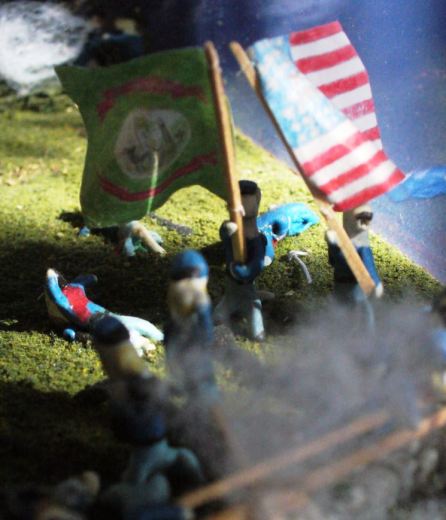
69th flags

The flags of the 69th PA

What Time Is It??

For most of us in the U.S., it’s time for Daylight Savings Time again, that time of year when we move our clocks forward an hour and “lose” an hour of sleep. They didn’t have to do this during the Civil War, which also means that if you want to experience the actual time of day of a Civil War event, you have to take DST into consideration.

Gettysburg is my favorite battle, and there’s something special about standing on the fields of Pickett’s Charge at 3 p.m. on July 3rd. But if I really thought about it, I should be standing there at 4 p.m.

Or, for example, on the 150th anniversary of the Battle of Cedar Creek (October 19, 1864), I stood on the battlefield in the dark, trying to figure out what “DST” time would be equivalent to 5:30 a.m. in 1864. For some of us, that takes some mental gymnastics. Still, perhaps it explains why armies tended to head out on a march at 4:30 a.m. Maybe it was because the sun was just beginning to rise, not because the generals had nothing better to do than drag their men out of bed in the middle of the night.

So if, this summer, you try to experience a Civil War site at the right time of day for the battle, remember to factor in DST!

OLYMPUS DIGITAL CAMERA